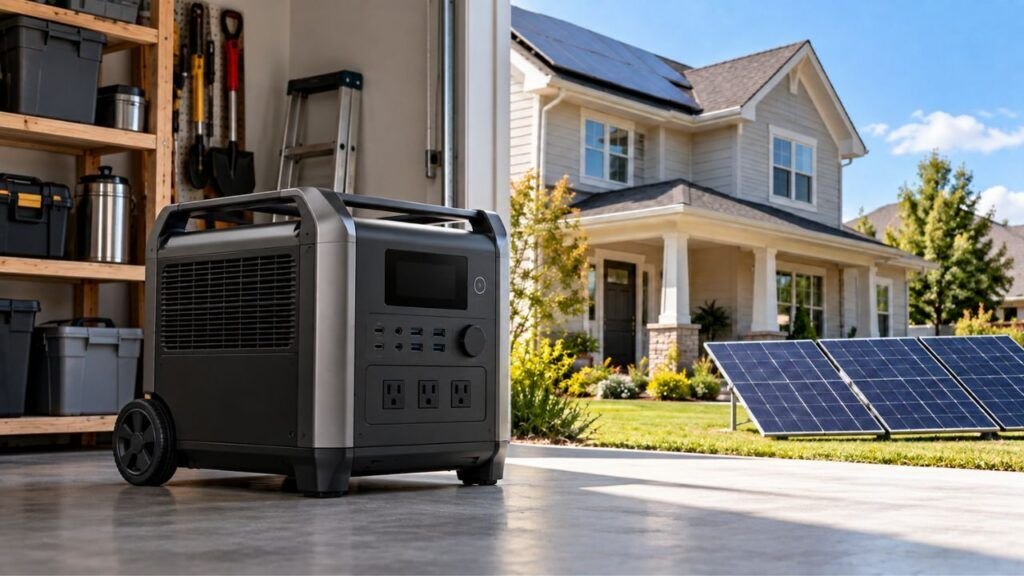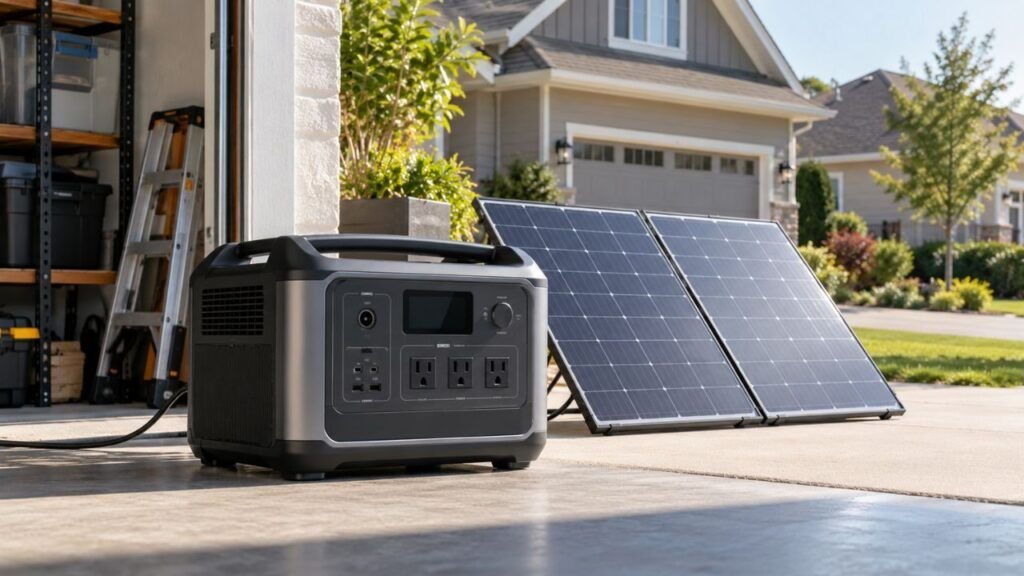
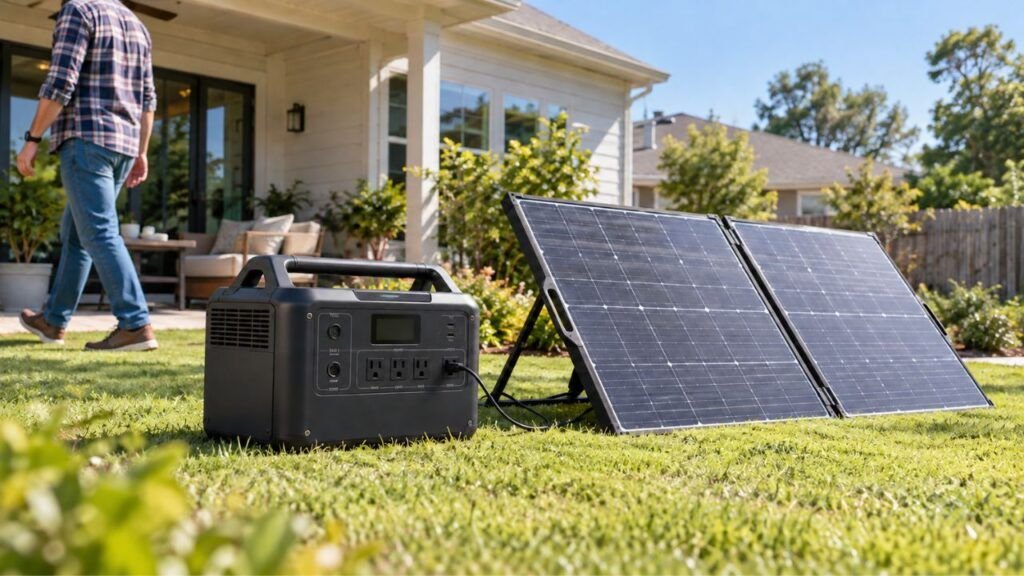
A solar generator works by collecting electricity from solar panels, storing that energy inside a battery, and converting it into usable AC power. During a blackout, the stored electricity can run refrigerators, lights, internet equipment, medical devices, and other essential household loads.
But home backup involves more than simply connecting solar panels. In this guide, I’ll explain the complete power flow, what happens during an outage, how long backup can last, and how to choose the right setup for your home.
Key Takeaways
- Solar panels produce DC electricity from available sunlight.
- A charge controller safely manages electricity entering the battery.
- The battery stores energy for use during an outage.
- An inverter converts stored DC energy into household AC electricity.
- Battery capacity determines runtime, while inverter wattage determines supported loads.
- Solar panels can recharge the battery during longer outages.
- Whole-home backup requires suitable equipment and proper electrical integration.
- Portable systems can power essential appliances without connecting to household wiring.
What Is a Solar Generator for Home Backup?
A solar generator is essentially a rechargeable battery power system that can receive electricity from solar panels. Most systems combine a battery, charge controller, inverter, battery management system, and several electrical outlets inside one portable unit.
The term “solar generator” can be slightly confusing. The power station itself does not create electricity from sunlight. The solar panels generate electricity, while the power station stores, manages, and delivers that electricity when needed.
Many solar generators can also recharge from a regular household outlet. Some support vehicle charging or other charging methods as well. This means you can fully charge the battery before a storm, then use solar panels to replenish it during an extended outage.
Portable solar generators are also different from permanently installed home battery systems. A portable unit may simply run appliances through its built-in outlets. Larger systems can sometimes connect to selected household circuits through approved electrical equipment.
How Does a Solar Generator Work?
The basic process is surprisingly simple once you follow the electricity from beginning to end. Four major components handle most of the work before electricity reaches your appliances.
1. Solar Panels Turn Sunlight Into DC Electricity
Everything begins with the solar panels.
Photovoltaic cells inside each panel absorb sunlight and produce direct current, commonly called DC electricity. The amount produced depends on several conditions.
Panel wattage matters, but sunlight conditions matter just as much. Shade, clouds, panel angle, dirt, temperature, and the season can all affect actual production.
A 400-watt solar panel, for example, will not necessarily produce exactly 400 watts throughout the day. Its output constantly changes with available sunlight.
The generated DC electricity then travels toward the power station for charging.
2. The Charge Controller Manages Incoming Solar Power
Electricity coming from solar panels cannot simply be sent into a battery without regulation.
That’s where the charge controller becomes important.
The controller manages the voltage and current entering the battery. It helps prevent electrical conditions that could damage the battery or shorten its lifespan.
Many modern solar generators use an MPPT charge controller. MPPT stands for Maximum Power Point Tracking.
This technology continually adjusts how the panels operate to collect available solar power efficiently under changing sunlight conditions.
However, every power station has solar input limits. You need to stay within its supported voltage, current, and wattage ranges when choosing panels.
3. The Battery Stores Electricity for Later
Once the incoming electricity is regulated, it enters the battery.
Think of the battery as the generator’s energy tank.
Instead of storing gasoline or propane, you are storing electrical energy. That energy remains available until appliances need it.
Battery capacity is normally measured in watt-hours, or Wh.
For example, a 2,000Wh battery stores roughly twice as much energy as a 1,000Wh battery. However, the entire advertised capacity may not become usable AC electricity because the system consumes some energy while operating.
Many modern home backup power stations use LiFePO4 batteries. They are popular because of their long cycle life, thermal stability, and suitability for repeated charging.
The battery management system also watches important operating conditions. These can include temperature, voltage, current, charging limits, and individual cell behavior.
4. The Inverter Converts DC Power Into Household AC Power
Your battery stores DC electricity, but most household appliances require alternating current, or AC electricity.
The inverter handles that conversion.
It takes electricity from the battery and converts it into AC power that can operate common household appliances.
Modern quality power stations generally use pure sine wave inverters. This provides smooth AC electricity suitable for sensitive electronics and household devices.
The inverter’s wattage rating is extremely important.
A 3,000Wh battery could store plenty of energy. However, a 1,500W inverter still cannot continuously operate 2,500 watts of appliances.
Battery capacity and inverter output therefore answer two different questions.
Battery capacity tells you how long your power may last.
Inverter wattage tells you what you can actually run.
5. Electricity Reaches Your Appliances or Home Circuits
Once the inverter creates AC electricity, that power becomes available to your appliances.
The simplest setup involves plugging devices directly into the power station.
You might connect a refrigerator, Wi-Fi router, television, laptop, lights, or other essentials directly to the generator’s outlets.
Larger compatible systems can work differently.
They may connect to selected household circuits through a transfer switch, backup panel, smart electrical panel, or another approved system.
That arrangement lets you continue using certain normal wall outlets during an outage without moving appliance cords to the power station.
The complete energy path looks like this:
Solar panels → charge controller → battery → inverter → household load
That simple path explains the basic operation of almost every solar generator.
What Happens When the Power Goes Out?
A blackout changes where your home gets electricity, but the exact experience depends on your backup setup. Portable systems and professionally integrated systems operate somewhat differently.
If the Solar Generator Is Already Charged
A charged solar generator already has electricity waiting inside its battery.
You do not need sunlight at that exact moment.
Even if the outage begins at midnight, the battery can still supply electricity collected or stored earlier.
You simply begin using the stored energy until the battery needs recharging.
That is one major reason I recommend keeping a home backup battery charged when severe weather is expected.
If Appliances Are Plugged Directly Into the Generator
This is the simplest home backup arrangement.
You place the power station in a suitable indoor location and connect important devices directly to its outlets.
For example, you might power:
- Refrigerator
- Freezer
- Wi-Fi router
- Phones
- LED lights
- Laptop
- Television
- CPAP machine
- Small kitchen appliances
No connection to your home’s electrical panel is necessary for this setup.
You simply need to make sure the combined load stays within the generator’s continuous and surge output limits.
If the Solar Generator Is Connected to Home Circuits
Larger systems may supply selected circuits rather than individual appliances.
This requires compatible electrical equipment.
Depending on the system, that equipment may include a transfer switch, backup panel, smart panel, or manufacturer-specific home integration equipment.
When properly configured, the backup source becomes isolated from the utility supply before powering household circuits.
This isolation is extremely important.
You should never attempt to power household wiring by connecting a generator to a regular wall outlet. That can create dangerous backfeeding conditions.
A qualified electrician should handle permanent or panel-level electrical integration.
What Happens to Rooftop Solar During an Outage?
This point surprises many homeowners.
Having solar panels installed on your roof does not automatically mean your home will stay powered during a blackout.
Many traditional grid-connected solar systems shut down when utility power disappears.
That shutdown protects utility workers and electrical equipment from electricity being pushed onto damaged power lines.
To continue using rooftop solar during an outage, the system generally needs compatible backup equipment. That may include battery storage, backup-capable inverters, isolation equipment, and appropriate controls.
A portable solar generator works differently because its panels charge an independent battery system instead of directly powering the utility-connected home wiring.
Can Solar Panels Recharge the Generator During a Blackout?
Yes. Solar recharging is one of the biggest advantages of battery-based backup power.
You can place compatible panels in sunlight and recharge the battery while the utility grid remains unavailable.
However, sunlight does not automatically give you unlimited electricity.
Your backup duration depends on the relationship between the electricity coming in and the electricity going out.
If your solar panels produce 500 watts while your appliances consume 250 watts, the battery may gradually recharge.
If your appliances consume 800 watts while the panels provide 300 watts, the battery will continue losing stored energy.
Several conditions affect solar production:
- Cloud cover
- Shade
- Panel orientation
- Time of day
- Season
- Snow
- Dirt or debris
- Panel temperature
- Available daylight
- Solar generator input limits
This is why conserving electricity matters during extended outages.
Running your refrigerator, communications equipment, and essential lights may allow solar charging to keep pace much longer than running heaters, cooking equipment, and air conditioners continuously.
Watts vs. Watt-Hours: The Two Numbers That Determine Backup Performance
Two specifications cause more confusion than almost anything else: watts and watt-hours. Understanding both makes choosing a home backup generator much easier.
Watts Tell You What the Generator Can Run
Watts measure power at a specific moment.
If your solar generator has a 2,000W inverter, the combined continuous load should remain within that rating.
Imagine these appliances running together:
- Refrigerator: 150W
- Television: 100W
- Router: 15W
- Lights: 40W
- Laptop: 60W
The combined running load would remain relatively small.
Add a 1,500W space heater, however, and total demand increases dramatically.
This is why high-wattage heating appliances can quickly push smaller power stations toward their limits.
Surge Watts Determine Whether Certain Appliances Can Start
Some appliances temporarily need much more electricity when they start.
Refrigerators, freezers, pumps, air conditioners, and other motor-driven equipment can produce these startup demands.
The surge usually lasts only briefly.
Your generator therefore needs enough surge capability to handle these temporary spikes without shutting down.
Always check both continuous output and surge output when motor-driven appliances are involved.
Watt-Hours Tell You How Long Power Can Last
Watt-hours measure stored energy.
A 2,000Wh battery theoretically contains enough energy to supply 200 watts for about ten hours.
Real operation is different because some energy is lost through the inverter and other electronics.
A simple runtime calculation is:
Estimated runtime = usable battery capacity ÷ average load
Suppose a 2,000Wh system provides roughly 1,700Wh of usable AC energy after operating losses.
If your appliances average 170 watts:
1,700Wh ÷ 170W = about 10 hours
That calculation is only an estimate because appliance consumption can constantly change.
A Simple Home Backup Example
Imagine your essential appliances average around 150 watts over several hours.
That average could include a cycling refrigerator, router, several lights, and occasional laptop charging.
A battery offering around 1,700Wh of usable electricity could provide approximately:
1,700Wh ÷ 150W = 11.3 hours
Now imagine reducing the average load to 100 watts.
The same battery could theoretically last around 17 hours.
That shows why load management can matter almost as much as battery size.
What Can a Solar Generator Power During a Home Outage?
The appliances you can operate depend on both inverter output and available battery energy. The following ranges are general estimates, so always check your appliance label or energy monitor for actual consumption.
| Appliance | Typical Running Power | Startup Surge Concern | Backup Priority |
| Refrigerator | 100–250W | Yes | High |
| Wi-Fi router | 5–20W | Usually no | High |
| LED light | 8–15W each | No | High |
| CPAP machine | 30–100W | Usually low | High |
| Freezer | 80–200W | Yes | High |
| Television | 50–200W | Usually low | Medium |
| Laptop | 30–100W | No | Medium |
| Microwave | 1,000–1,800W | Moderate | Medium |
| Sump pump | 800–1,500W | High | High |
| Window air conditioner | 500–1,500W | Yes | Situational |
| Central air conditioner | 2,000–5,000W+ | High | System-dependent |
Actual numbers vary widely between models.
The nameplate wattage, EnergyGuide information, or a plug-in energy meter can give you a much better estimate.
Can a Solar Generator Power an Entire House?
Yes, certain solar generator systems can support whole-home backup. However, most small portable power stations cannot run an entire home normally.
Whole-home backup requires much more than a large battery.
The system must provide enough continuous output, startup power, stored energy, and appropriate household voltage.
Many U.S. homes also use 240V appliances.
These can include central air conditioning, electric dryers, ranges, water heaters, well pumps, and certain heating systems.
A basic 120V portable generator cannot operate those loads directly.
A whole-home system may therefore require:
- 120/240V output
- High continuous inverter capacity
- Strong surge capability
- Expandable battery storage
- Large solar charging capacity
- Compatible home integration equipment
- Load management
- Professional installation
It is also important to define what “whole-home” actually means.
Keeping refrigerators, lights, outlets, internet, and selected appliances running is much easier than powering every device exactly as you would during normal grid service.
For most households, prioritizing essential circuits dramatically reduces the battery capacity required.
How Long Will a Solar Generator Run a Home?
There is no universal runtime because every home consumes electricity differently. A better approach is matching battery capacity with the loads you actually intend to use.
Essential-Load Backup
Essential backup normally provides the longest runtime.
You might operate only:
- Refrigerator
- Freezer
- Wi-Fi
- Several LED lights
- Phones
- Medical equipment
- Laptop
These loads can often stay within a few hundred watts on average.
A moderate battery system may therefore keep essential devices operating for many hours.
Solar charging during daylight can extend that runtime further.
Partial-Home Backup
Partial-home backup usually supplies several household circuits.
You may add televisions, kitchen appliances, a furnace blower, small air conditioning, or pumps.
Energy consumption increases quickly once larger appliances become involved.
Expandable batteries become particularly useful here because you can increase runtime without replacing the entire system.
Whole-Home Backup
Whole-home backup should usually be calculated using kilowatt-hours consumed each day.
Suppose your home uses 20kWh during an ordinary day.
A 5kWh battery obviously cannot maintain that consumption for 24 hours without substantial recharging.
But an outage does not require normal consumption.
If you reduce household usage to 6kWh daily, that same backup system becomes much more practical.
The question therefore becomes:
How much electricity do I actually need during an emergency?
That number is usually much lower than normal household consumption.
How Long Does Solar Recharging Take?
Solar charging time depends on the battery energy you need to replace and the actual power coming from your panels.
A simple calculation is:
Ideal recharge time = battery energy needed ÷ actual solar input
Suppose you need to replace 2,000Wh.
If your panels provide an average 500 watts of actual charging power:
2,000Wh ÷ 500W = approximately 4 hours
Real charging normally takes longer.
Solar production changes throughout the day, and charging efficiency is never perfect.
You should also understand three different solar numbers.
First, panels have a rated wattage.
Second, the generator has a maximum solar input rating.
Third, the system receives an actual amount of solar electricity in real conditions.
Those numbers are rarely identical.
For example, connecting 1,200 watts of panels does not guarantee 1,200 watts continuously enters the battery.
The generator may accept less, and the panels may produce less because of weather or positioning.
Three Ways to Use a Solar Generator for Home Backup
Home backup can range from powering one refrigerator to supporting most household circuits. Understanding these three setups helps you avoid buying far more or far less equipment than you need.
Direct Plug-In Backup
This is the easiest setup for most people.
You keep the solar generator indoors and plug important devices directly into it.
There is no permanent electrical installation.
This arrangement works particularly well for:
- Refrigerators
- Freezers
- Routers
- Electronics
- Lamps
- CPAP machines
- Phones
- Small appliances
It also keeps your backup system portable.
You can use the same power station for camping, RV travel, workshops, or other temporary power needs.
Selected-Circuit Backup
The next step is connecting backup power to selected home circuits.
Instead of running extension cords throughout the house, specific circuits receive electricity from your backup source.
These might include:
- Refrigerator circuit
- Kitchen outlets
- Internet equipment
- Lighting
- Furnace blower
- Sump pump
- Selected bedroom outlets
This setup generally requires approved transfer or backup equipment.
A licensed electrician should handle the household wiring.
Whole-Home Integrated Backup
Large modular systems can provide much greater backup capability.
These systems may combine several batteries, high-output inverters, large solar arrays, and automated home integration.
Some can support both 120V and 240V loads.
They may also switch to stored electricity automatically when utility service disappears.
The tradeoff is cost, installation complexity, and increased system size.
For many households, selected-circuit backup offers a practical middle ground.
What Are the Limitations of Solar Generators for Home Backup?
Solar generators offer several advantages, but they still have practical limitations. Knowing these limits before an outage helps you build a backup system that actually works.
- Stored battery electricity is finite.
- Cloudy weather can reduce solar charging substantially.
- Solar production may not keep pace with household consumption.
- Small power stations may provide only 120V output.
- High-wattage heating appliances can drain batteries quickly.
- Large motors may exceed the inverter’s startup capability.
- Every unit has solar voltage and current limits.
- Charging can slow or stop at extreme temperatures.
- Large battery systems can become heavy and expensive.
- Whole-home integration may require additional electrical equipment.
- Permanent electrical connections should be professionally installed.
The key is choosing a system for realistic emergency loads rather than expecting a portable battery to replace unlimited utility power.
Solar Generator Safety for U.S. Homeowners
Battery power avoids the carbon monoxide risk associated with combustion generators, but electrical and battery safety still matter. A few basic precautions can prevent serious problems.
Portable Power Station Safety
Keep the generator dry and protected from moisture.
Do not block cooling vents while the unit is operating or charging.
Avoid placing objects directly against areas that need airflow.
Use charging equipment approved by the manufacturer and inspect cables for damage before use.
Battery temperature also matters.
Extremely hot or cold conditions can affect charging, performance, and battery protection systems.
Follow the manufacturer’s operating and storage temperature recommendations.
Home Electrical Connection Safety
Never attempt to feed electricity into your home by plugging a generator into a normal wall outlet.
A proper transfer or isolation system prevents backup electricity from traveling where it should not.
This protects your home’s electrical equipment and people working on utility infrastructure.
Direct appliance connections are much simpler because the generator remains separate from household wiring.
For panel-connected backup, use appropriate equipment and professional installation.
Safety Certifications to Look For
Safety certification becomes particularly important when buying large battery equipment.
Portable power equipment and permanently installed residential storage systems may fall under different safety standards.
Look for recognized testing and certification appropriate for the product’s intended application.
Also review:
- Battery certification
- Inverter certification
- Electrical protection features
- Over-temperature protection
- Overcurrent protection
- Warranty terms
- Installation requirements
Certification does not replace proper installation, but it provides another important layer of confidence.
How to Choose a Solar Generator for Home Backup
Choosing the right solar generator starts with your actual outage needs. Focus on the appliances you need to keep running, then match battery capacity, inverter output, solar charging, and connection options to those requirements.
- Decide what must stay powered: List essentials such as your refrigerator, freezer, Wi-Fi router, lights, phones, medical equipment, and necessary heating or cooling devices.
- Calculate running and starting watts: Add the wattage of appliances that may operate together. Pay extra attention to refrigerators, pumps, freezers, and air conditioners because they can require higher startup power.
- Estimate daily watt-hours: Multiply each appliance’s wattage by its expected operating time. For example, a 100W device running for five hours uses about 500Wh.
- Check solar input and recharge capability: Make sure the generator accepts enough solar power to replace a useful amount of the electricity you consume during daylight.
- Choose between 120V and 120/240V: Most small electronics use 120V, while appliances such as central AC units, dryers, ranges, water heaters, and some well pumps may require 240V.
- Check battery chemistry and cycle life: LiFePO4 batteries are common in modern backup systems because of their long cycle life and stable performance. Compare cycle ratings, temperature limits, and warranty coverage.
- Consider expandable battery storage: Expansion batteries let you increase runtime later without replacing the main power station.
- Check home integration compatibility: If you want to power household circuits, verify support for transfer switches, backup panels, smart panels, or compatible home connection equipment.
- Review warranty and safety features: Look at battery protection, certifications, operating temperatures, manufacturer support, warranty length, and replacement options before buying.
Is a Solar Generator Worth It for Home Backup?
A solar generator can be a very practical home backup option, especially if you mainly need essential electricity during outages.
It works especially well for refrigerators, communications equipment, lighting, medical electronics, computers, and other moderate loads.
You also avoid storing gasoline around the house.
Battery operation is quiet and creates no combustion exhaust, which makes indoor use much more practical when manufacturer placement guidelines are followed.
Solar charging adds another advantage during extended outages.
However, the value depends on your power needs.
If you expect to run central air conditioning, electric heating, water heating, cooking equipment, and several large appliances simultaneously, a small portable power station will not be enough.
You may need an expandable whole-home battery system, a traditional standby generator, or a combination of backup technologies.
The goal should not be buying the largest solar generator available.
The better approach is matching your backup system to the appliances that truly matter during an outage.
Final Words
A solar generator works through a straightforward energy chain. Solar panels create DC electricity, a controller manages charging, the battery stores energy, and an inverter converts that electricity into household AC power.
For home backup, remember the difference between power and energy. Inverter watts determine what appliances you can operate, while battery watt-hours determine how long those appliances can keep running.
Start with your essential loads and build from there. A modest portable unit may handle basic emergency needs, while larger 120/240V systems can support selected circuits or extensive home backup when properly installed.
Related FAQs
Does a Solar Generator Automatically Turn On When the Power Goes Out?
Some integrated backup systems can automatically switch to battery power when grid electricity disappears. Most portable solar generators require appliances to be connected directly unless they are paired with compatible home backup equipment.
Can a Solar Generator Run a Refrigerator Overnight?
Yes, a properly sized solar generator can usually run a refrigerator overnight. Runtime depends on battery capacity, refrigerator efficiency, room temperature, compressor cycling, inverter losses, and other connected appliances.
Can You Use a Solar Generator While It Is Charging?
Many solar generators support simultaneous charging and power output, sometimes called pass-through operation. However, supported loads and charging behavior vary between models, so check the manufacturer’s instructions before relying on this feature.
Does a Solar Generator Work at Night?
Yes. A solar generator operates at night using electricity already stored inside its battery. Solar panels stop producing useful power after sunset, so nighttime runtime depends mainly on remaining battery capacity.
Will a Solar Generator Work on Cloudy Days?
Yes, solar panels can still generate electricity under cloudy conditions, but production usually decreases. The battery can continue powering appliances while reduced solar input replenishes part of the energy being consumed.
Can a Solar Generator Run Central Air Conditioning?
Some large solar generator systems can operate central air conditioning, but they need enough continuous wattage, startup surge capability, battery capacity, and usually 240V output. Smaller portable models generally cannot support typical central AC systems.
Do I Need a Transfer Switch for a Solar Generator?
You normally do not need a transfer switch when appliances plug directly into the generator. If you want backup electricity supplied through household wiring, approved isolation or transfer equipment is generally required.
Can Rooftop Solar Power My Home When the Grid Goes Down?
Not necessarily. Many grid-connected rooftop solar systems shut down during outages. Continuing to power the home usually requires compatible battery storage, backup-capable inverter equipment, and electrical isolation from the utility grid.
How Many Solar Panels Do I Need to Recharge a Solar Generator?
The number depends on battery capacity, desired charging time, panel wattage, available sunlight, and the generator’s maximum solar input. Larger batteries generally benefit from larger panel arrays when rapid daytime recovery matters.
Is a Solar Generator the Same as a Portable Power Station?
Not exactly. A portable power station stores and supplies electricity from its battery. When compatible solar panels are added as a charging source, the complete setup is commonly marketed as a solar generator.

Blake Cooper writes practical guides on generators, portable power stations, and home backup systems. He focuses on simplifying power topics and helping homeowners make informed buying decisions.