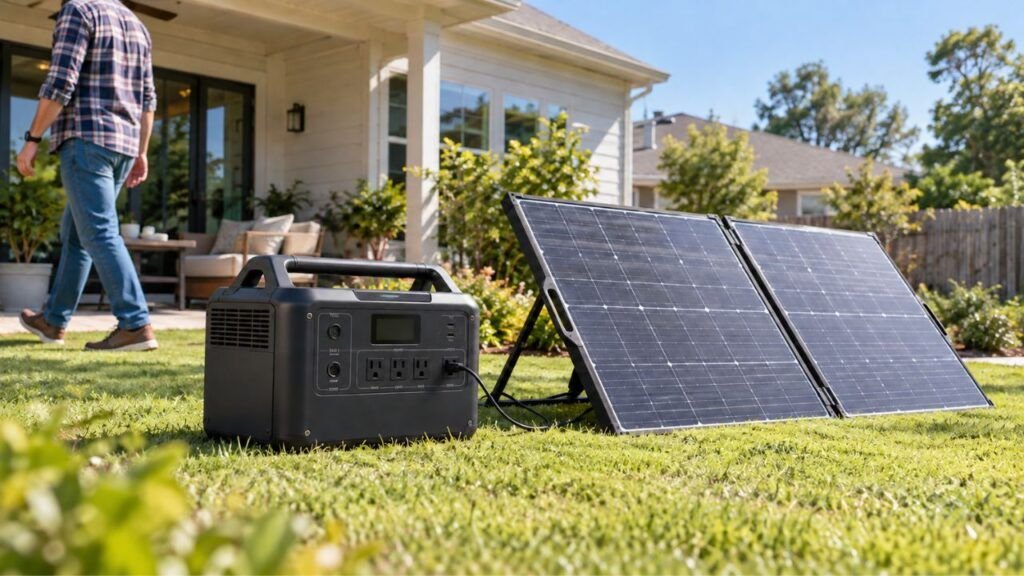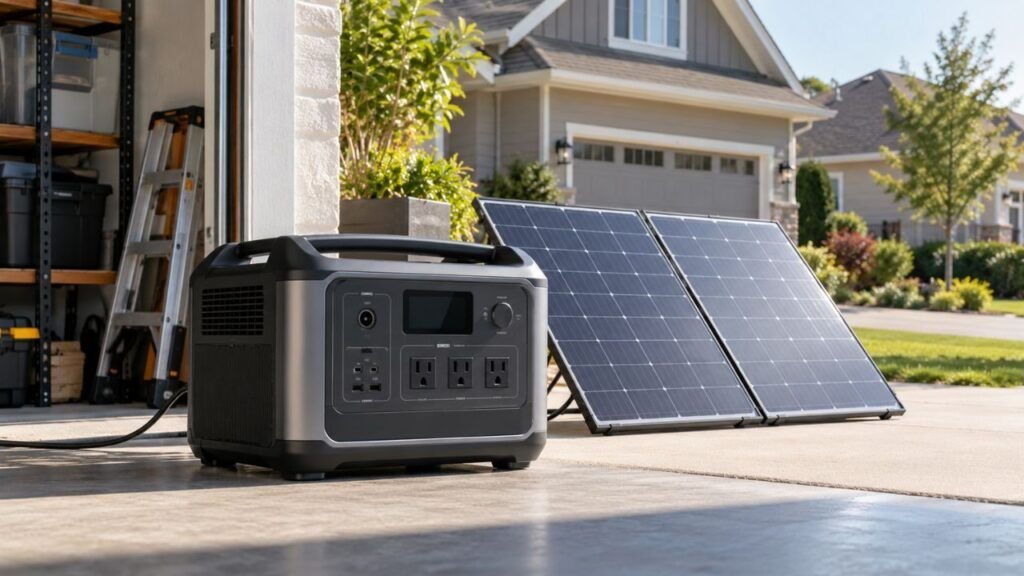
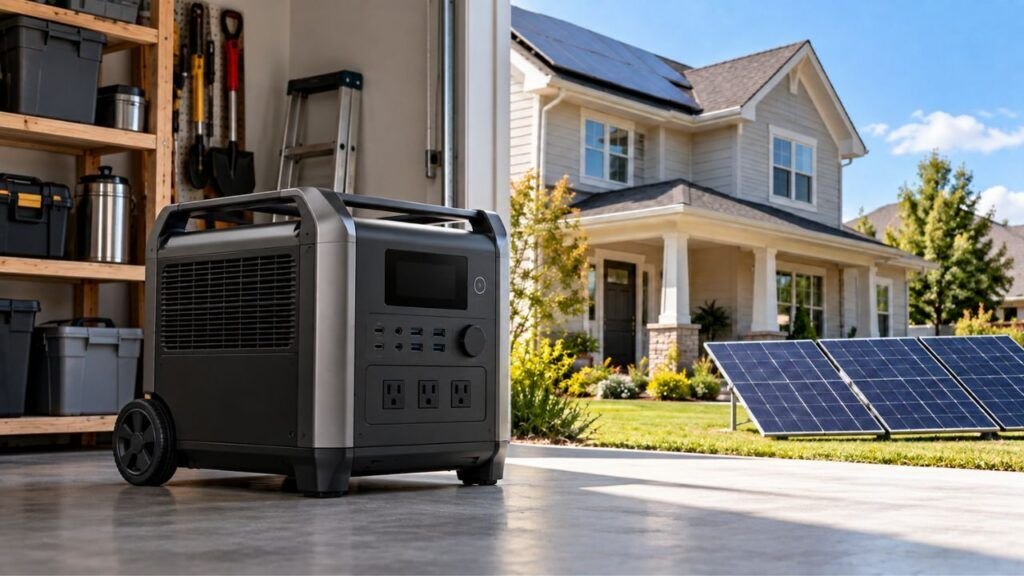
Yes, a solar generator can power a whole house, but the system must be large enough. You need sufficient battery storage, inverter output, surge capacity, solar input, and 120/240V support for larger household appliances.
In this guide, I’ll explain what whole-house power really means, how much capacity you may need, which appliances create challenges, and how to size a solar generator for reliable home backup.
Key Takeaways
- Small solar generators mainly work for essential household devices.
- Whole-house backup normally requires an expandable battery system.
- Battery capacity determines how long your home can stay powered.
- Inverter output determines how many appliances can run together.
- Large appliances may require 240V output and high startup power.
- Central air conditioning can dramatically increase battery requirements.
- Solar panels must replace enough energy during extended outages.
- A transfer switch or compatible home interface may be required.
- Critical-load backup is easier than running every household appliance.
- Proper load planning can significantly extend backup runtime.
Can a Solar Generator Power a Whole House?
A properly sized solar generator can power an entire house during an outage. However, that does not always mean running every appliance normally.
There is a major difference between powering household essentials and maintaining full grid-like operation.
Keeping your refrigerator, freezer, lights, Wi-Fi, television, and electronics running is relatively manageable.
Running central air conditioning, electric heating, water heating, cooking appliances, dryers, pumps, and an EV charger requires far more power.
That is why small portable solar generators usually cannot provide true whole-house backup.
Large expandable systems are different.
They can combine multiple battery modules, powerful inverters, high solar input, and home electrical integration.
Some systems can also provide both 120V and 240V output.
That makes them much more suitable for larger household circuits.
The key is matching the solar generator to your actual home.
What Does Powering a Whole House Actually Mean?
People often use “whole-house backup” to describe very different setups. Knowing which level you actually need can prevent serious overspending.
Essential-Load Backup
Essential backup focuses only on equipment you truly need.
That commonly includes:
- Refrigerator
- Freezer
- Wi-Fi router
- Phones
- Laptop
- LED lighting
- CPAP equipment
- Television
- Fans
- Small kitchen appliances
A moderate solar generator can often handle these loads effectively.
You may not live completely normally during the outage. However, your food, communication, lighting, and important electronics remain available.
Critical-Circuit Home Backup
Critical-circuit backup goes one step further.
Instead of plugging individual devices directly into the solar generator, selected household circuits may receive backup power.
These circuits might include refrigeration, lighting, internet equipment, selected outlets, furnace controls, and certain pumps.
This setup provides greater convenience without powering every circuit.
Managed Whole-Home Backup
Managed whole-home backup allows most household circuits to remain available.
However, you still control which heavy appliances operate simultaneously.
For example, you might run the air conditioner while avoiding the electric dryer.
Later, you could turn off the AC before using another large appliance.
This approach makes whole-house solar backup much more realistic.
Full Whole-House Operation
Full operation means using your home almost normally during an outage.
You may want to operate:
- Central HVAC
- Electric water heater
- Electric range
- Clothes dryer
- Well pump
- Refrigerator and freezer
- Multiple household circuits
- Electronics
- Lighting
- Possibly EV charging
This level requires considerably more battery storage and inverter capacity.
It also requires enough solar production to restore consumed energy.
How Much Electricity Does an Average U.S. House Use?
Before choosing a solar generator, you need an approximate daily energy target. Household electricity use varies widely across the United States.
The average U.S. household uses roughly 28 to 30 kWh daily.
However, that average should not become your automatic generator size.
A smaller household with gas heating could use much less electricity.
A large home with electric heating and central air could use substantially more.
Typical Home Energy Needs
| Backup Level | Approximate Daily Energy | Typical Loads |
| Minimal emergency backup | 1–3 kWh | Phones, router, laptop, lights, CPAP |
| Basic essentials | 3–6 kWh | Refrigerator, freezer, internet, lights |
| Expanded essentials | 6–12 kWh | Essentials, pumps, cooking, limited cooling |
| Managed home backup | 10–20+ kWh | Several circuits and selected larger appliances |
| Near-normal whole-home use | 20–40+ kWh | HVAC, cooking, water heating, laundry |
These numbers are only planning ranges.
Your electricity bill provides a much better starting point.
Check several months because household consumption changes by season.
Summer air conditioning can raise consumption significantly in warmer states.
Winter electric heating can have an even larger effect.
Battery Capacity vs. Inverter Output
A solar generator needs both enough stored energy and enough output power. These numbers describe completely different parts of system performance.
Battery Capacity Determines Runtime
Battery capacity is normally measured in watt-hours or kilowatt-hours.
One kilowatt-hour equals 1,000 watt-hours.
A 10 kWh battery stores approximately twice as much energy as a 5 kWh battery.
That generally means longer runtime under identical loads.
However, battery capacity does not tell you how much power the system can deliver at once.
Inverter Output Determines Simultaneous Loads
Inverter output is normally measured in watts or kilowatts.
Suppose your appliances are drawing 5,000 watts simultaneously.
Your inverter needs enough continuous output to handle that demand.
A huge battery paired with a weak inverter still cannot run everything.
Think about capacity as the size of your fuel tank.
Think about inverter output as how quickly power can leave it.
Surge Output Handles Appliance Startup
Some appliances briefly draw extra power when starting.
Motors and compressors are common examples.
These can include:
- Refrigerators
- Freezers
- Central air conditioners
- Well pumps
- Sump pumps
- Furnace blowers
- Power tools
Your solar generator therefore needs adequate surge output.
Otherwise, an appliance may fail to start even when enough battery remains.
120V and 240V Support Matters
Most standard household outlets in the United States provide 120V power.
However, many larger appliances operate on 240V circuits.
Examples may include:
- Central air conditioning
- Electric dryers
- Electric ranges
- Electric water heaters
- Some well pumps
- EV charging equipment
A large portable power station without 240V capability cannot directly power many of these loads.
Always check voltage compatibility before purchasing a whole-home system.
What Size Solar Generator Do You Need for a Whole House?
There is no single solar generator size that works for every house. Your required capacity depends on appliances, runtime, climate, and outage duration.
| Backup Goal | Battery Capacity | Typical Inverter Class | Suitable For |
| Small emergency backup | 1–3 kWh | 1–3 kW | Electronics and limited essentials |
| Essential home backup | 3–10 kWh | 2–5 kW | Refrigerator, freezer, lights, internet |
| Extended critical loads | 10–20 kWh | 4–8 kW | Multiple circuits, pumps, comfort loads |
| Managed whole-house backup | 15–30+ kWh | 7–12+ kW | Most circuits with load management |
| Heavy whole-home use | 30–60+ kWh | 10 kW+ | Larger homes and demanding electric loads |
These ranges should only be used as starting points.
For example, one home may use natural gas for heating, cooking, and water heating.
Another home may use electricity for all three.
Those two houses could require completely different backup systems.
Your goal should be matching the system to your actual loads.
How to Calculate the Solar Generator Size Your House Needs
You do not need complicated engineering calculations for an initial estimate. A simple load list can tell you surprisingly much.
Step 1: Check Your Electricity Bill
Start with your monthly electricity consumption.
Look for the total monthly usage measured in kWh.
Then calculate:
Monthly kWh ÷ number of billing days = average daily kWh
For example:
900 kWh ÷ 30 days = 30 kWh per day
However, you probably will not use your normal electricity amount during outages.
That brings us to the next step.
Step 2: List the Appliances You Actually Need
Create an outage priority list rather than copying normal household consumption.
Start with devices such as:
- Refrigerator
- Freezer
- Wi-Fi equipment
- Essential lighting
- Phones
- Medical equipment
- Furnace blower
- Well pump
- Sump pump
- Air conditioner
- Microwave
- Television
- Home office equipment
You can then separate essential loads from optional ones.
This usually reduces required battery capacity dramatically.
Step 3: Add Your Running Watts
Check the label or manufacturer specifications for each appliance.
Write down its normal running wattage.
Now determine which devices could operate simultaneously.
Add those wattages together.
That number provides a rough continuous inverter requirement.
Step 4: Account for Startup Surge
Next, identify appliances containing motors or compressors.
These may briefly require considerably more starting power.
Your inverter should handle both normal running demand and startup surges.
Central air conditioners and well pumps deserve particular attention here.
Step 5: Calculate Daily Energy Consumption
Runtime determines how much energy each appliance consumes.
Use this formula:
Watts × operating hours = watt-hours
For example:
A 200-watt device running for five hours consumes:
200 × 5 = 1,000Wh
That equals 1 kWh.
Repeat this calculation for your important appliances.
Then add the totals together.
Step 6: Decide How Long You Need Backup
Suppose your essential household loads consume 7 kWh daily.
You want approximately two days of stored backup.
Your basic calculation becomes:
7 kWh × 2 days = 14 kWh
That suggests approximately 14 kWh of usable stored energy.
Solar charging can reduce how much battery capacity you need.
Step 7: Leave Room for Real-World Losses
Do not assume every listed battery watt-hour reaches your appliances.
Energy is lost through inverter conversion and normal system operation.
Battery management systems may also reserve some capacity.
Cold temperatures can affect battery performance as well.
Leave reasonable headroom instead of sizing everything exactly.
Step 8: Size Your Solar Array
Finally, determine how much energy your panels must replace daily.
For multi-day outages, recharge capability becomes extremely important.
A massive battery eventually empties without enough incoming energy.
How Many Solar Panels Do You Need for Whole-House Backup?
Solar panel requirements depend on daily consumption and available sunlight. You also need a generator capable of accepting enough solar input.
A simple planning formula is:
Solar array wattage × peak sun hours = theoretical daily solar energy
Suppose you have a 2,000W solar array.
With five effective peak-sun-hours:
2,000W × 5 hours = 10,000Wh
That equals 10 kWh before accounting for real-world losses.
Actual production can vary considerably because of:
- Geographic location
- Weather
- Cloud cover
- Season
- Panel angle
- Shade
- Panel temperature
- Wiring losses
- Charge-controller efficiency
Your solar generator also has a maximum solar input rating.
Connecting more panels does not automatically increase charging speed.
Once the input limit is reached, additional panel capacity provides limited benefit.
Which Household Appliances Are Hardest to Run?
Large heating, cooling, and motor-driven appliances usually create the biggest challenges. Their energy consumption can affect both inverter and battery sizing.
| Appliance | Why It Matters | Common Voltage | Main Concern |
| Central AC | High continuous demand | 240V | Running power and startup surge |
| Heat pump | Long operating periods | 240V | Energy use and startup |
| Electric furnace | Very high power consumption | 240V | Battery drain |
| Water heater | High heating demand | 240V | Extended energy consumption |
| Electric range | High simultaneous load | 240V | Inverter capacity |
| Clothes dryer | Heating plus motor load | 240V | High running watts |
| Well pump | Motor startup demand | Often 240V | Surge capacity |
| Sump pump | Motor startup | 120V/240V | Surge output |
| Refrigerator | Repeated compressor cycling | Usually 120V | Startup surge |
| EV charger | Very high sustained demand | Often 240V | Battery depletion |
Actual wattage varies by appliance size and model.
Always use your appliance’s specifications when planning a system.
Can a Solar Generator Run Central Air Conditioning?
Yes, some high-capacity solar generators can run central air conditioning.
However, central AC is one of the hardest household loads to support.
The compressor can require substantial startup power.
The system may also run for many hours during hot weather.
That creates both an inverter problem and an energy-storage problem.
Your generator needs enough continuous output for normal AC operation.
It also needs enough surge capacity to start the compressor.
Most central air conditioners also require 240V power.
Some compatible systems can use a soft-start device to reduce startup demand.
However, compatibility should always be confirmed before installation.
A solar generator may easily start your AC but still drain quickly.
That is why battery capacity matters just as much as inverter wattage.
Can a Solar Generator Run a House Overnight?
Yes, provided the battery contains enough stored energy.
There is no solar production overnight, so everything comes from storage.
Suppose your home averages a 500W load overnight.
Over eight hours, that equals approximately:
500W × 8 hours = 4 kWh
That is before considering conversion losses.
Increasing the average load to 1,000W would roughly double consumption.
This is why reducing unnecessary overnight loads makes such a difference.
Keep refrigerators, important lighting, medical equipment, and internet running.
Delay heavy loads until daylight whenever possible.
How Long Can a Solar Generator Power a Whole House?
Runtime depends on battery capacity and average household demand. A bigger battery lasts longer only when household consumption remains controlled.
| Battery Energy | 500W Load | 1,000W Load | 2,000W Load | 5,000W Load |
| 5 kWh | About 10 hours | About 5 hours | About 2.5 hours | About 1 hour |
| 10 kWh | About 20 hours | About 10 hours | About 5 hours | About 2 hours |
| 20 kWh | About 40 hours | About 20 hours | About 10 hours | About 4 hours |
| 30 kWh | About 60 hours | About 30 hours | About 15 hours | About 6 hours |
These are simplified theoretical examples.
Real-world runtime will normally be somewhat shorter.
Solar charging can also extend runtime considerably during daylight hours.
The important number is your average load.
Even a huge battery disappears quickly under constant heavy demand.
Can Solar Panels Keep Your House Running During a Multi-Day Outage?
Yes, solar panels can extend backup operation for several days.
However, the panels must replace enough electricity each day.
Imagine your critical loads consume 8 kWh daily.
If your solar array produces roughly 8 kWh daily, your battery can potentially recover much of what you used.
If the array only produces 3 kWh, you create a 5 kWh daily deficit.
Eventually, the battery becomes depleted.
Cloudy weather makes this issue even more important.
Good whole-home backup therefore balances three things:
battery storage, household consumption, and solar production.
Also remember that ordinary grid-connected rooftop solar does not necessarily power your home during a blackout.
Many grid-tied systems shut down when utility power disappears.
This protects utility workers from electricity being sent back onto power lines.
Backup operation usually requires compatible battery storage, inverter equipment, and proper system configuration.
Portable Solar Generator vs. Whole-Home Backup System
Portable and whole-home systems serve different backup goals. One focuses on flexibility, while the other focuses on capacity and integration.
| Feature | Portable Solar Generator | Whole-Home Backup System |
| Battery capacity | Low to moderate | High and often expandable |
| Inverter output | Moderate | High |
| 240V support | Model dependent | Common on suitable systems |
| Home integration | Limited | Designed for panel integration |
| Automatic backup | Usually limited | Often available |
| Installation | Minimal | Often professional |
| Portability | High | Low |
| Expandability | Limited to moderate | Usually extensive |
| Best use | Essential devices | Critical or whole-house circuits |
A portable unit works well when your priority is flexibility.
A larger system makes more sense when you want integrated backup.
When Does a Solar Generator Make Sense for Whole-House Backup?
Solar backup works particularly well when your household can manage electricity carefully.
It may make sense when:
- You experience periodic utility outages.
- You want quiet backup power.
- You already have solar panels.
- You plan to install solar later.
- You can prioritize essential circuits.
- You want expandable battery storage.
- You want backup without storing gasoline.
- You need power indoors without combustion exhaust.
- Most major heating loads use another fuel source.
- You want automatic home backup with compatible equipment.
The ability to recharge from sunlight becomes especially valuable during extended outages.
When Might a Solar Generator Not Be Practical?
Solar generators are useful, but they are not ideal for every home.
Consider the limitations when:
- Your home uses very large amounts of electricity.
- You rely heavily on electric resistance heating.
- Several large 240V appliances operate together.
- Winter solar production is very limited.
- Your property experiences several cloudy days continuously.
- Your central HVAC system has unusually high power demand.
- You need frequent EV charging during outages.
- You have limited space for solar panels.
- Your backup requirement exceeds the system’s expansion limits.
In these situations, load management becomes particularly important.
You may also need another backup energy source.
How to Make a Solar Generator Last Longer During an Outage
Small changes in household behavior can add many hours of runtime. Focus on protecting important loads before using optional appliances.
Try these practical steps:
- Keep refrigerators and freezers closed whenever possible.
- Turn off lights in unused rooms.
- Disconnect unnecessary electronics.
- Avoid electric space heaters when possible.
- Stagger high-power appliances.
- Cook during strong daytime solar production.
- Charge phones and laptops during daylight.
- Avoid unnecessary dryer use.
- Delay EV charging until grid power returns.
- Reduce air-conditioning demand where practical.
- Keep solar panels clear of shade.
- Monitor incoming and outgoing power.
- Reserve enough battery for overnight use.
You do not need to turn your home into a survival camp.
You simply want to avoid wasting stored electricity.
Solar Generator vs. Standby Generator for Whole-House Backup
Both systems can provide home backup, but they operate differently. The better fit depends on outage length, household loads, and available energy sources.
| Factor | Solar Generator | Gas/Propane Standby Generator |
| Energy source | Battery and solar | Gas or propane |
| Operating noise | Very quiet | Engine noise |
| Exhaust | None during battery operation | Produces combustion exhaust |
| Refueling | Solar or grid charging | Requires fuel |
| Cloudy long outages | Storage may become limited | Runs while fuel remains |
| Maintenance | Generally lower | Engine maintenance required |
| Heavy loads | Depends on system size | Often well suited |
| Indoor equipment | Battery equipment may be indoors if approved | Generator engine remains outdoors |
| Daily energy cost | Sunlight can recharge batteries | Fuel must be purchased |
| Startup | Often automatic on integrated systems | Often automatic |
Neither technology is automatically right for every household.
A large solar system works well when quiet operation matters.
A fuel generator can remain useful during very long cloudy outages.
Some households even use both technologies together.
Common Mistakes When Sizing a Whole-House Solar Generator
Choosing a system by advertised battery capacity alone can cause problems. Avoid these common mistakes during your planning process.
- Looking only at battery watt-hours
- Ignoring continuous inverter output
- Forgetting startup surge requirements
- Ignoring 240V appliances
- Assuming every circuit must remain powered
- Sizing from average electricity use alone
- Treating advertised capacity as fully usable energy
- Assuming solar panels always produce rated wattage
- Ignoring winter solar production
- Underestimating air-conditioning runtime
- Forgetting expansion limits
- Assuming rooftop solar automatically works during outages
- Using unsafe backfeeding methods
- Installing panel-connected equipment without proper electrical protection
Spending a little more time on load calculations prevents these issues.
Final Words
So, can a solar generator power a whole house? Yes, but the answer depends heavily on what you mean by whole-house power.
A smaller portable solar generator can keep your refrigerator, internet, lights, electronics, and other essentials operating. That may be all you actually need during shorter outages.
For true whole-home backup, you will usually need substantially more equipment. Large battery storage, strong inverter output, adequate surge capacity, 120/240V compatibility, sufficient solar input, and safe electrical integration all matter.
The most practical approach for many homes is managed whole-home backup. You keep important circuits available while avoiding several heavy appliances at once.
Start by calculating your essential loads rather than buying the biggest system available.
Once you know your wattage, daily kWh requirement, and desired outage duration, choosing the right solar generator becomes much easier.
Related FAQs
Can a 2,000W Solar Generator Power a House?
A 2,000W solar generator can power several essential household devices, but it normally cannot run an entire home normally. It may handle refrigeration, lights, internet equipment, electronics, and selected small appliances within its output limits.
Can a 3,000W Solar Generator Power a House?
A 3,000W solar generator can support more household appliances simultaneously, but battery capacity still determines runtime. It can work well for essential-load backup, although large 240V appliances may require a more powerful system.
How Big of a Solar Generator Do I Need to Run a House?
Essential home backup may require roughly 3–10 kWh of storage, while broader whole-home backup can require 15–30 kWh or considerably more. Your inverter must also support the simultaneous running and startup loads.
Can a Solar Generator Run a Whole House All Day?
Yes, if battery capacity, inverter output, and solar production match your household demand. A home using 25–30 kWh daily needs significantly more storage than one operating only essential appliances.
Can a Solar Generator Run Central AC?
Large solar generators can run certain central air conditioners when they provide sufficient 240V output, continuous power, and startup surge capacity. Air conditioning can consume substantial battery energy during hot weather.
Can a Solar Generator Run a Well Pump?
Yes, compatible high-output solar generators can run many well pumps. However, well pumps often operate at 240V and can require substantial startup surge power, so check the pump specifications before sizing your system.
Can a Solar Generator Run a Refrigerator Overnight?
Yes. Refrigerators generally use relatively modest average energy because their compressors cycle on and off. A properly sized solar generator can usually keep a refrigerator running overnight while supporting several smaller essential loads.
How Much Battery Storage Do I Need for Whole-House Backup?
Battery requirements depend on daily electricity consumption and desired backup duration. Managed home backup may require roughly 10–20 kWh, while heavier whole-home use can require 30 kWh or considerably more.
How Many Solar Panels Do I Need to Power a House?
The number depends on household consumption, panel wattage, local sunlight, and system limits. Calculate your daily kWh requirement first, then size the solar array to replace as much of that energy as practical.
Can Solar Panels Power My House During a Blackout?
Solar panels can support a house during an outage when paired with compatible battery storage and an inverter designed for backup operation. Standard grid-tied solar systems may shut down when utility power fails.
Do I Need a Transfer Switch for a Solar Generator?
You usually need approved transfer or isolation equipment when connecting a solar generator to household circuits. Smaller portable systems powering individual appliances directly normally do not require a transfer switch.
Can a Solar Generator Replace a Standby Generator?
A sufficiently large solar battery system can replace a standby generator for many households. However, long outages, heavy electric heating, limited sunlight, or unusually large loads may require much more storage and solar capacity.

Blake Cooper writes practical guides on generators, portable power stations, and home backup systems. He focuses on simplifying power topics and helping homeowners make informed buying decisions.