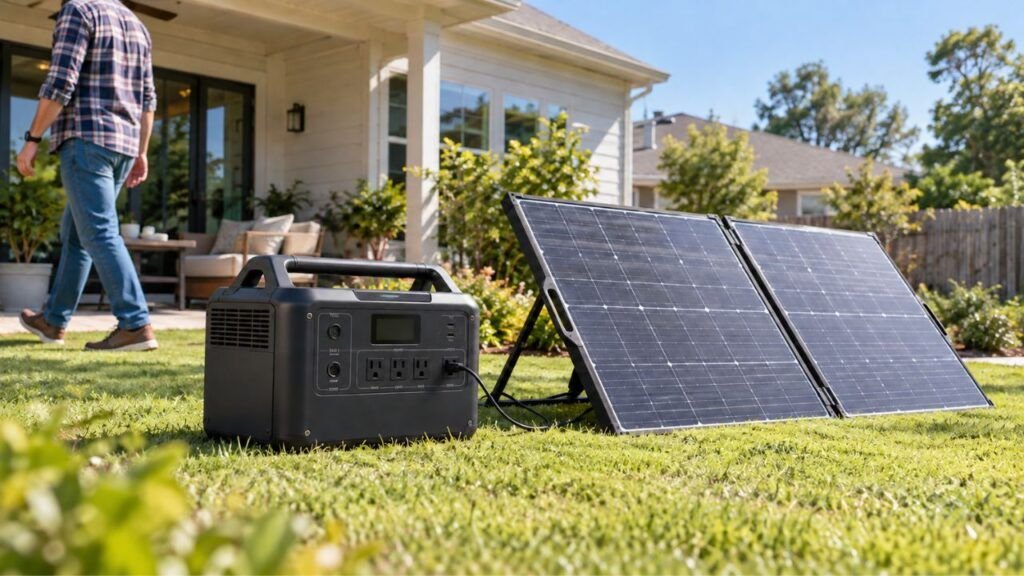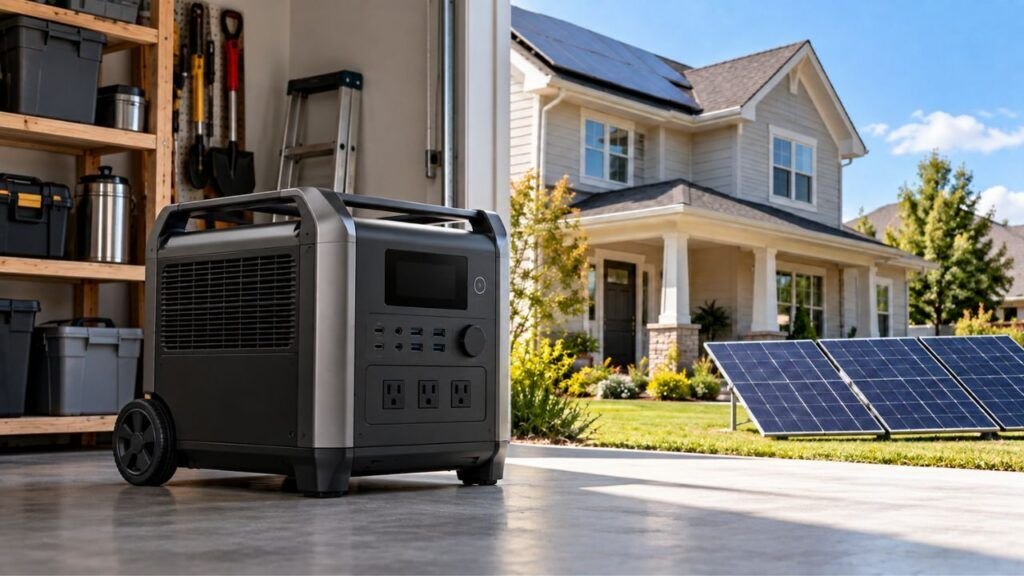
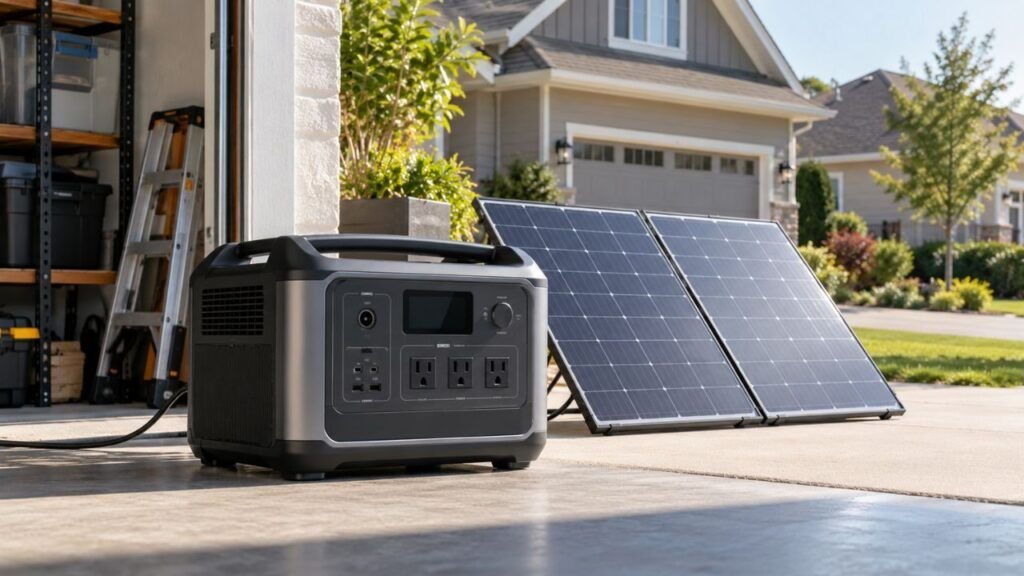
For basic home backup, a 1.5–3 kWh solar generator is often enough for a refrigerator, lights, Wi-Fi, and electronics. Extended essential backup may require 3–6 kWh, while partial or whole-home backup can require 10–30 kWh or more. You also need enough inverter output, surge capacity, and the correct 120V or 240V output.
In this guide, I’ll help you calculate the right size for your home. We’ll look at battery capacity, appliance loads, outage duration, solar panels, and real home backup examples.
Key Takeaways
- Battery capacity determines how long your backup power can last.
- Inverter watts determine how many appliances can run simultaneously.
- Starting surge matters for refrigerators, pumps, and air conditioners.
- Basic home backup usually needs around 1.5–3 kWh of capacity.
- Partial-home backup commonly starts around the 5–10 kWh range.
- Whole-home systems may require 10–30 kWh or considerably more.
- Large 240V appliances require a compatible split-phase power system.
- Solar input determines how quickly your battery can recharge during outages.
Quick Answer: What Size Solar Generator Do I Need for Home Backup?
The easiest way to narrow your choices is by backup level. Use these ranges as starting points, then calculate your actual appliance requirements.
| Backup Goal | Battery Capacity | Typical Inverter Output | Common Uses |
| Basic emergency backup | 500Wh–1,000Wh | 500W–1,500W | Phones, lights, Wi-Fi, laptop |
| Essential home backup | 1.5–3 kWh | 1,500W–3,000W | Refrigerator, lights, internet, electronics |
| Extended essential backup | 3–6 kWh | 3,000W–5,000W | Essentials, furnace blower, microwave, small AC |
| Partial-home backup | 5–10+ kWh | 4,000W–7,200W+ | Several circuits, pumps, larger appliances |
| Whole-home backup | 10–30+ kWh | 7,200W–12,000W+ | Major appliances, HVAC, pumps, multiple circuits |
These numbers aren’t universal. Your appliances, weather, outage duration, and heating or cooling needs can change the required size considerably.
Solar Generator Size Is More Than Battery Capacity
When someone asks what size solar generator they need, battery capacity gets most of the attention. But four different ratings actually determine whether your system works properly.
Battery Capacity Determines Runtime
Solar generator batteries are normally rated in watt-hours or kilowatt-hours.
The conversion is simple:
1,000Wh = 1kWh
A 2,000Wh battery stores twice as much energy as a 1,000Wh battery. That generally means longer runtime under the same load.
However, you normally cannot expect every rated watt-hour to reach your appliances. The inverter and internal electronics consume some energy during operation.
You may also want to keep some battery capacity in reserve.
That’s why I wouldn’t size your system with zero breathing room.
Continuous Output Determines What Can Run Together
Battery capacity tells you how long the system can operate. Continuous inverter output determines how much equipment can run simultaneously.
Suppose your outage setup includes:
- Refrigerator: 150W while running
- Wi-Fi equipment: 20W
- Lights: 60W
- Television: 100W
- Laptop: 70W
That gives you roughly 400W of simultaneous running load.
A 500W inverter might technically cover that load. However, it leaves very little room for appliance startup or additional equipment.
A larger inverter gives you more flexibility.
Surge Watts Handle Appliance Startup
Some appliances briefly require considerably more power when starting.
Common examples include:
- Refrigerators
- Freezers
- Well pumps
- Sump pumps
- Furnace blowers
- Window air conditioners
- Central air conditioners
A refrigerator might use relatively little power while its compressor runs. But the compressor may briefly demand several times that amount during startup.
Your solar generator must handle that short surge.
Otherwise, the inverter can shut down even when plenty of battery energy remains.
120V vs. 240V Determines Appliance Compatibility
This is one of the most overlooked parts of home backup sizing.
Small portable power stations usually focus on 120V household equipment.
That works well for items such as:
- Refrigerators
- Televisions
- Computers
- Routers
- Lights
- Many small appliances
But larger American homes often contain 240V equipment.
Examples can include:
- Central air conditioning
- Electric dryers
- Electric water heaters
- Well pumps
- Electric ranges
- Some workshop equipment
If you want to power these loads, you may need a system providing 120/240V split-phase output.
A larger battery alone doesn’t solve a voltage mismatch.
Solar Input Determines Recharge Speed
Battery capacity tells you how much energy you can store. Solar input tells you how quickly you can replace that energy.
This becomes especially important during multi-day outages.
A huge battery with very limited solar input could take several sunny days to recover completely.
A well-balanced home backup setup considers battery capacity and recharging together.
How to Calculate What Size Solar Generator You Need
You don’t need complicated engineering calculations for basic home backup planning. I recommend working through the following steps before shopping.
Step 1: List the Appliances You Actually Need
Start with your essential outage loads rather than everything in your house.
Your list might include:
- Refrigerator
- Freezer
- Wi-Fi router
- Lights
- Phones
- Laptop
- CPAP machine
- Furnace blower
- Sump pump
Then create a second list for optional items.
Those might include:
- Television
- Microwave
- Coffee maker
- Gaming console
- Additional lighting
Large loads such as central AC, electric ovens, dryers, and EV chargers deserve separate consideration.
You probably won’t use your home normally during an outage.
That makes an essentials-based calculation much more useful.
Step 2: Find the Running Wattage
Next, find how much power each appliance uses while operating.
You can often check:
- Appliance labels
- EnergyGuide labels
- Owner’s manuals
- Manufacturer specifications
- Plug-in power meters
Avoid assuming every refrigerator or air conditioner uses the same amount.
Size, age, efficiency, and operating conditions all affect consumption.
Step 3: Add Your Simultaneous Running Watts
Now determine which appliances might operate at the same time.
For example:
- Refrigerator: 150W
- Furnace blower: 500W
- Lights: 80W
- Wi-Fi: 20W
- Laptop: 70W
- Television: 100W
Total simultaneous running load:
150 + 500 + 80 + 20 + 70 + 100 = 920W
You would want continuous inverter output comfortably above 920W.
A larger margin gives you room for changing loads.
Step 4: Check Starting Surge Requirements
Now identify motor-driven appliances on your list.
Check their starting or peak wattage whenever possible.
Let’s say your system normally carries about 900W.
If a pump requires another 1,500W temporarily during startup, your inverter needs enough surge capability to handle that event.
This is why a solar generator shouldn’t be chosen using battery capacity alone.
Step 5: Calculate Daily Energy Use
Now calculate how much battery energy your appliances consume.
Use this formula:
Watts × Hours Used = Watt-Hours
For example:
A 100W television operating for four hours uses:
100W × 4 hours = 400Wh
Or:
400Wh ÷ 1,000 = 0.4kWh
Repeat this calculation for each appliance.
Then add everything together.
Step 6: Account for Cycling Appliances
Be careful with refrigerators, freezers, pumps, and HVAC equipment.
These devices usually don’t draw their full running wattage every minute.
A refrigerator compressor cycles on and off throughout the day.
Multiplying its running watts by 24 hours can therefore exaggerate consumption.
When available, use measured daily energy use or manufacturer energy data instead.
Step 7: Multiply by Your Required Backup Duration
Decide how long you want the system to operate before recharging.
Your target might be:
- 8 hours
- 12 hours
- 24 hours
- 48 hours
- 72 hours
Suppose your essential appliances consume 2.2kWh daily.
For one day:
2.2kWh × 1 = 2.2kWh
For two days:
2.2kWh × 2 = 4.4kWh
For three days:
2.2kWh × 3 = 6.6kWh
Solar charging can reduce the amount of battery storage required during longer outages.
Step 8: Add Some Real-World Headroom
I wouldn’t choose a battery that exactly matches your calculated requirement.
Real-world conditions are rarely perfect.
Extra capacity helps account for:
- Inverter losses
- Unexpected appliance use
- Cold temperatures
- Longer outages
- Battery reserve settings
- Battery aging
- Poor solar conditions
Adding roughly 20–30% is a practical starting point for many setups.
Critical backup situations may justify even more reserve.
Typical Home Appliance Power Requirements
Appliance wattages can vary considerably between models. Use this table for planning, then verify the actual ratings of your equipment.
| Appliance | Typical Running Load | Starting Surge | Sizing Concern |
| Refrigerator | Low to moderate | Yes | Compressor startup and cycling |
| Wi-Fi router | Low | No | Runs for long periods |
| LED lights | Low | No | Easy essential load |
| Laptop | Low | No | Extended daily operation |
| CPAP | Low to moderate | Usually low | Overnight runtime |
| Television | Low to moderate | Usually minimal | Several hours of use |
| Microwave | High | Usually limited | Large short-term inverter load |
| Furnace blower | Moderate | Yes | Motor startup |
| Sump pump | Moderate to high | Yes | Strong startup surge |
| Well pump | High | Yes | Surge and possible 240V requirement |
| Window AC | Moderate to high | Yes | Compressor and extended runtime |
| Central AC | High | High | 240V, surge, and heavy energy use |
Your exact numbers matter more than averages.
Always check your specific appliance when sizing important backup loads.
Worked Example: Sizing a Solar Generator for 24-Hour Home Backup
Let’s walk through a realistic essentials-only backup example. This makes the sizing process easier to understand than looking at battery ratings alone.
Assume you want to keep these devices operating during a one-day outage.
| Appliance | Estimated Daily Energy |
| Refrigerator | 1,200Wh |
| Wi-Fi equipment | 400Wh |
| LED lighting | 300Wh |
| Laptop | 350Wh |
| Phone charging | 100Wh |
| CPAP | 400Wh |
| Total | 2,750Wh |
Your estimated daily requirement is around 2.75kWh.
Now add approximately 25% headroom:
2.75kWh × 1.25 = about 3.44kWh
In this example, I would start looking around the 3.5–4kWh battery range.
But we’re not finished yet.
You also need to calculate simultaneous running watts.
Suppose the refrigerator, CPAP, lights, router, and laptop might operate together.
Their continuous load could remain well below 1,000W.
However, refrigerator compressor startup raises the peak requirement.
A solar generator with roughly 2,000W or more continuous output and sufficient surge capability could therefore make sense for this example.
Your actual numbers may be completely different.
The important part is following the calculation rather than copying the final size.
What Size Solar Generator Do You Need for Different Home Backup Levels?
Not every household needs whole-home backup. Choosing the right level can save you considerable money while still keeping important equipment operating.
Basic Emergency Backup: 500Wh–1,000Wh
This category works best when your backup needs are small.
Typical loads include:
- Phones
- LED lights
- Wi-Fi
- Laptop
- Small electronics
- Medical devices with modest power requirements
A unit this size isn’t designed to operate several major household appliances.
Think of it as communication and basic emergency power.
Essential Home Backup: 1.5–3 kWh
This is where home backup becomes more practical.
You may be able to operate:
- Refrigerator
- Router
- Lights
- Phones
- Laptop
- Television
- Selected small appliances
Careful load management matters.
Running a high-wattage microwave or coffee maker while other appliances operate could push a smaller inverter toward its limit.
Extended Essential Backup: 3–6 kWh
A larger 3–6kWh system gives you considerably more flexibility.
It can make sense if you need:
- Refrigerator and freezer
- Home-office equipment
- CPAP equipment
- Lighting
- Furnace blower
- Small window AC
- Occasional kitchen appliances
This size also gives you more runtime during overnight outages.
Expandable batteries become useful at this level.
Partial-Home Backup: 5–10+ kWh
Now you’re moving beyond individual appliance backup.
A system in this class may support selected household circuits and larger equipment.
Possible loads include:
- Refrigerator
- Freezer
- Lighting circuits
- Internet
- Electronics
- Furnace blower
- Sump pump
- Well pump
- Small HVAC loads
- Kitchen appliances
At this point, inverter output and voltage compatibility become just as important as capacity.
Whole-Home Backup: 10–30+ kWh
Whole-home backup requires much more careful planning.
A 10–30kWh system may cover a substantial portion of normal household demand.
But “whole home” doesn’t always mean everything runs normally.
High-energy equipment can drain battery storage quickly.
That includes:
- Central air conditioning
- Electric heating
- Electric dryers
- Electric ranges
- Electric water heaters
- Pool equipment
- EV charging
A home operating mostly on essential circuits may last much longer from the same battery.
That’s why I recommend defining what “whole home” means before buying.
Should You Size Your Solar Generator From Your Electric Bill?
Your electric bill can be useful, but I wouldn’t use it as the only sizing method.
Monthly electricity consumption shows how much energy your home normally uses.
You can divide monthly usage by 30 to estimate average daily consumption.
For example:
900kWh ÷ 30 = 30kWh daily
But that doesn’t mean you automatically need a 30kWh battery.
During an outage, you probably won’t operate every normal household load.
You may temporarily stop using:
- Electric dryer
- Dishwasher
- EV charger
- Pool equipment
- Secondary televisions
- Nonessential lighting
- Electric oven
- Certain HVAC loads
Instead, build an outage-specific energy budget.
Your electricity bill works better as a reference point than your final answer.
How Long Should Your Home Backup Last?
Your desired outage duration directly affects battery size. Think realistically about the outages you are preparing for.
- Short outages of 4–8 hours may need relatively little storage.
- Overnight backup generally requires more capacity and careful load planning.
- A 24-hour outage usually requires calculating total daily essential energy.
- A 48–72-hour outage makes solar recharging increasingly important.
- Multi-day outages favor expandable batteries and larger solar arrays.
Trying to store several days of normal household electricity becomes expensive quickly.
For longer outages, reducing loads and generating new energy during daylight usually makes more sense.
How Much Solar Panel Capacity Do You Need?
Solar panels can extend backup time dramatically during longer outages. But your panels need enough capacity to replace the energy you’re consuming.
Calculate How Much Energy You Need to Replace
Suppose your essentials consume about 3kWh each day.
Ideally, your solar array should recover a meaningful portion of that 3kWh during daylight.
A 400W solar array does not produce 400W continuously from sunrise until sunset.
Real output changes with:
- Time of day
- Cloud cover
- Panel angle
- Temperature
- Shade
- Season
- Location
That’s why daily solar energy matters more than panel wattage alone.
Check the Generator’s Maximum Solar Input
Every solar generator has limits.
Check:
- Maximum solar wattage
- Input voltage range
- Current limit
- Connector requirements
Suppose your power station accepts only 500W of solar input.
Connecting considerably more panel capacity won’t automatically make it charge several times faster.
The charging electronics still control how much energy enters the battery.
Account for Your Location and Weather
Solar production varies substantially across the United States.
Someone in Arizona may see very different production from someone in Washington or Maine.
Season also matters.
Short winter days, storms, tree shade, and cloudy conditions can reduce output.
For serious home backup planning, estimate solar production for your actual location instead of assuming perfect sunlight every day.
Do You Need 120V or 240V Home Backup?
Voltage becomes very important once you move beyond basic essentials. Before buying a large system, check whether your important appliances require 120V or 240V power.
When 120V Is Usually Enough
A standard 120V solar generator can handle many outage essentials.
These often include:
- Refrigerator
- Freezer
- Lights
- Wi-Fi
- Computers
- Television
- Phone chargers
- CPAP
- Small kitchen appliances
- Some portable or window air conditioners
This setup works well for many essentials-only backup plans.
When You May Need 120/240V Split-Phase Output
Larger household appliances often use 240V.
These can include:
- Well pump
- Central air conditioning
- Electric dryer
- Electric water heater
- Electric range
- Large workshop equipment
If one of these loads is essential, verify voltage before choosing your generator.
More Battery Capacity Cannot Fix the Wrong Voltage
This point is worth remembering.
A 20kWh battery with only 120V output doesn’t automatically power equipment requiring 240V.
The generator must provide compatible voltage and sufficient inverter output.
Check this before spending money on additional battery capacity.
Portable Solar Generator or Whole-Home Backup System?
Portable solar generators work best when you want targeted emergency backup.
You can plug important appliances directly into the unit without powering every circuit in your house.
Portable systems are useful because they offer:
- Simple setup
- Flexible placement
- No fuel storage
- Quiet operation
- Portable solar charging
- Lower starting cost
Whole-home systems operate differently.
They may integrate with selected circuits or your home’s electrical panel.
These systems often include:
- Larger batteries
- Expandable storage
- Higher inverter output
- 120/240V capability
- Automatic transfer equipment
- More powerful solar input
If you mainly want refrigeration, internet, lights, and electronics, a portable system may be enough.
If you want pumps, HVAC, and several household circuits, look toward a larger integrated setup.
Do You Need a Transfer Switch or Smart Electrical Panel?
You don’t normally need a transfer switch when appliances plug directly into your solar generator.
Things change when you want to power household circuits.
A properly designed transfer system isolates backup power from the utility grid.
This helps prevent unsafe backfeeding and allows selected circuits to receive backup electricity safely.
Depending on your system, you may use:
- Transfer switch
- Generator inlet equipment
- Backup load panel
- Smart electrical panel
- Manufacturer-specific home integration equipment
Whole-home electrical work should follow local electrical requirements.
I recommend using a qualified electrician for panel-connected installations.
Three Realistic Home Backup Sizing Scenarios
Generic capacity recommendations only get you so far. These examples show how different households can end up needing completely different systems.
Scenario 1: Apartment or Small Home Essentials
Suppose you only need:
- Refrigerator
- Wi-Fi
- Lights
- Laptop
- Phones
Your daily energy requirement could remain around 2–3kWh, depending on actual appliance use.
A solar generator around 3kWh could therefore provide a useful starting point.
You may only need a 1,500–2,000W inverter if your largest loads remain modest.
A few hundred watts of solar can help extend runtime.
Scenario 2: Suburban Home With Furnace and Sump Pump
Now add:
- Refrigerator
- Freezer
- Furnace blower
- Sump pump
- Router
- Lights
- Electronics
Battery capacity becomes important, but surge capacity becomes even more important.
Both the furnace blower and sump pump contain motors.
The inverter needs enough peak output to handle those startup events.
A 4–6kWh expandable system with stronger inverter output may make more sense.
Your actual requirements depend heavily on how often the furnace and pump operate.
Scenario 3: Larger Home With 240V Loads
Imagine a rural home requiring:
- Refrigerator
- Freezer
- Well pump
- Lights
- Internet
- Furnace
- Kitchen appliances
- Possibly central AC
This moves the problem into a completely different category.
You may need:
- 10kWh or more battery capacity
- High continuous inverter output
- Strong surge capability
- 120/240V split-phase power
- Larger solar input
- Electrical-panel integration
Central AC can increase both power and energy requirements considerably.
In this situation, professional load calculations become worthwhile.
Common Solar Generator Sizing Mistakes
A few simple mistakes can leave you with a backup system that looks powerful on paper but struggles during an actual outage.
- Choosing a generator based only on battery capacity
- Confusing watts with watt-hours
- Ignoring refrigerator or pump startup surge
- Forgetting about 240V appliances
- Assuming every appliance runs continuously
- Sizing directly from normal household electricity consumption
- Assuming solar panels always produce their rated output
- Ignoring the generator’s maximum solar input
- Buying exactly enough battery with no reserve
- Forgetting seasonal heating or cooling loads
- Underestimating multi-day outage requirements
- Buying a non-expandable system when future growth is likely
The safest approach is to calculate each part separately.
Capacity, output, surge, voltage, and recharge all need to work together.
What Else Should You Check Before Buying?
Battery size is important, but several other features affect how useful your solar generator will be during a real outage.
- Expandable battery support
- LiFePO4 battery chemistry
- Continuous inverter output
- Peak or surge output
- 120V or 120/240V compatibility
- Maximum solar input
- AC charging speed
- Generator charging compatibility
- UPS or EPS functionality
- Transfer-switch compatibility
- Low-temperature charging protection
- Battery management system
- Warranty coverage
- Manufacturer support
For long-term home backup, expandability is especially valuable.
Your needs can change after adding new appliances or experiencing longer outages.
Final Words
So, what size solar generator do you need for home backup? For many households, 1.5–3kWh works as a practical starting range for essential loads. Longer or heavier backup may require 3–6kWh, while partial-home and whole-home systems can quickly reach 10–30kWh or more.
But don’t choose by battery capacity alone.
Start with your essential appliances. Calculate simultaneous running watts, starting surge, daily watt-hours, outage duration, voltage requirements, and solar recharge potential.
Once you know those numbers, choosing the right solar generator becomes much easier.
Related FAQs
Is a 2,000W Solar Generator Enough for Home Backup?
A 2,000W solar generator can handle many essential household loads if their combined running wattage stays below its inverter limit. Battery capacity is separate, so check the Wh or kWh rating to determine how long those appliances can operate.
Is a 3,000W Solar Generator Enough for a House?
A 3,000W inverter can power many essential appliances together, including refrigeration, electronics, lighting, and selected kitchen equipment. However, whole-home backup involving central AC, pumps, or other heavy loads may require considerably more output.
What Size Solar Generator Will Run a Refrigerator?
Many refrigerators can operate from a 1,000–2,000Wh solar generator with adequate inverter output and surge capability. Runtime depends on refrigerator efficiency, compressor cycling, ambient temperature, and any additional loads connected to the generator.
How Many kWh Do I Need for 24 Hours of Home Backup?
Many essentials-only setups may use around 2–5kWh during 24 hours, although household needs vary considerably. Calculate the daily energy consumption of your actual essential appliances and add reasonable reserve capacity.
How Much Battery Capacity Do I Need for a 48-Hour Outage?
Multiply your essential daily energy requirement by two, then add reserve capacity. If your essential loads use 3kWh daily, a 6kWh minimum becomes roughly 7–8kWh after adding practical headroom.
Can a Solar Generator Run Central Air Conditioning?
Yes, but the generator needs enough continuous inverter output, startup surge capacity, battery storage, and compatible 240V output. Central AC can consume substantial energy, so smaller portable power stations usually aren’t suitable.
What Size Solar Generator Do I Need for a Well Pump?
Well-pump requirements depend on motor size, operating voltage, running watts, and starting surge. Many well pumps use 240V and have strong startup demands, so check the pump nameplate before choosing your solar generator.
Can a 5kWh Solar Generator Power a House?
A 5kWh battery can provide useful partial-home or extended essential backup, but it usually won’t support unrestricted whole-home electricity use for long. Runtime depends entirely on which appliances you operate.
How Many Solar Panels Do I Need for a Home Backup Generator?
The answer depends on your daily energy consumption, available sunlight, generator solar-input limit, and recharge target. Larger backup batteries generally need larger solar arrays if you expect daily recharging during extended outages.
Do I Need 240V for Whole-Home Solar Generator Backup?
You may need 240V if your backup plan includes equipment such as central AC, well pumps, electric dryers, electric ranges, or electric water heaters. Essentials-only systems often work with 120V output.
Do I Need a Transfer Switch for a Solar Generator?
Not when appliances plug directly into the generator. However, a properly designed transfer or home integration system is generally required when connecting backup power to household circuits or the main electrical system.
Should I Size a Solar Generator From My Electric Bill?
Your electric bill is useful for understanding normal household consumption, but it can overestimate emergency needs. For backup sizing, calculate the appliances and circuits you actually plan to use during an outage.

Blake Cooper writes practical guides on generators, portable power stations, and home backup systems. He focuses on simplifying power topics and helping homeowners make informed buying decisions.