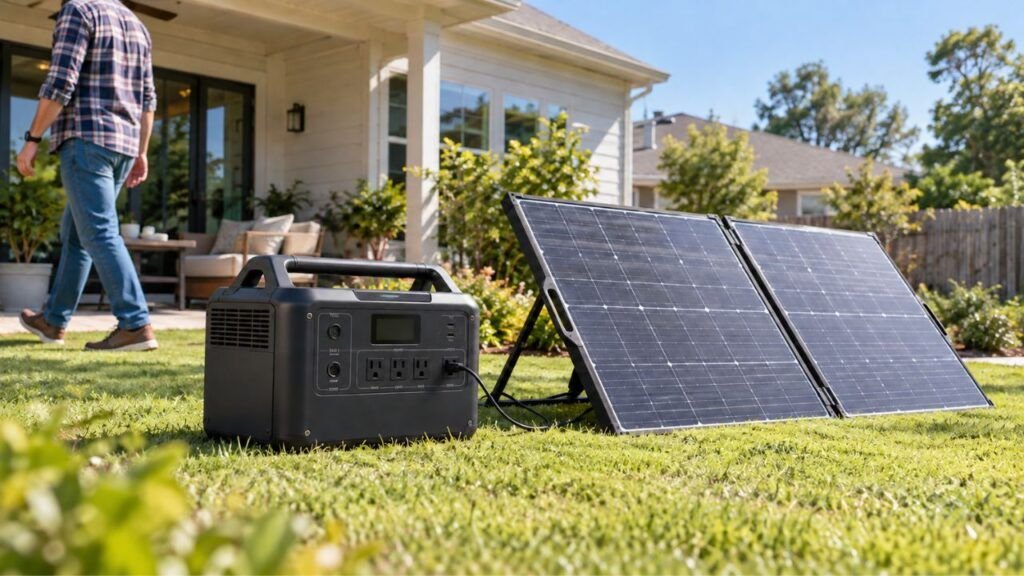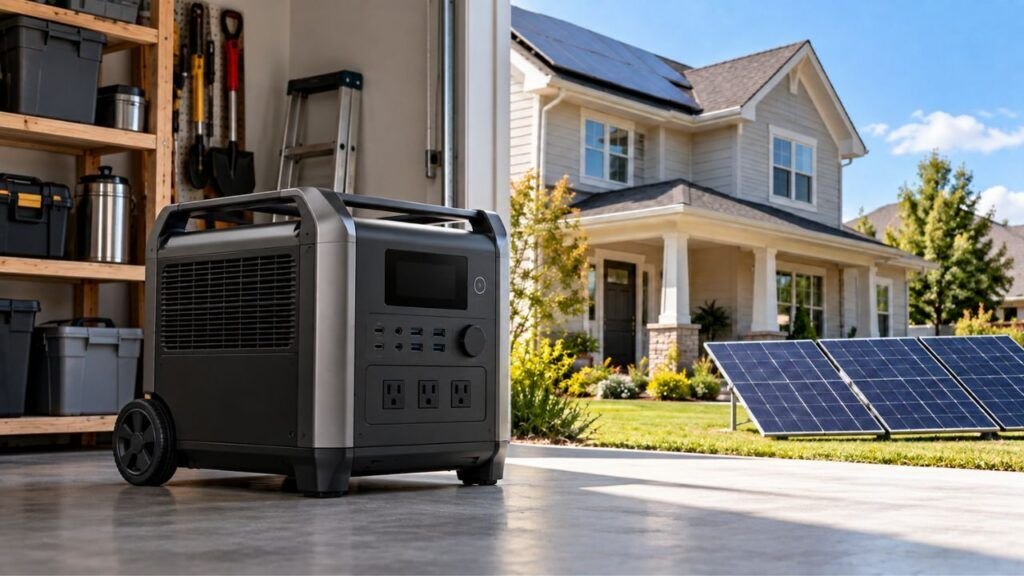
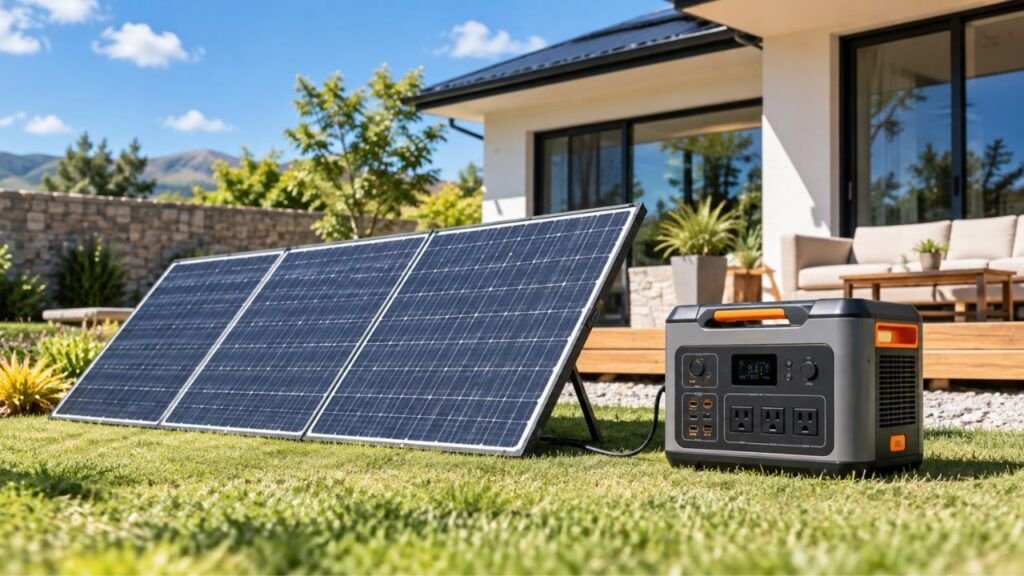
A solar generator can power a house for a few hours to several days. The actual runtime depends on battery capacity, household energy use, inverter efficiency, and whether solar panels recharge the system during the day.
The important question is not simply how large your house is. You need to know which appliances you want running and how much energy they consume. Below, I’ll help you calculate that runtime and plan realistic home backup.
Key Takeaways
- Small 1–2kWh systems are best for basic emergency essentials.
- Larger 3–5kWh systems can support more household devices overnight.
- Systems above 10kWh can provide extended essential-home backup.
- Battery capacity determines stored energy and possible runtime.
- Inverter wattage determines how much equipment can run simultaneously.
- High-wattage heating and cooling can drain batteries very quickly.
- Refrigerators should be calculated using daily energy consumption when possible.
- Solar charging can significantly extend backup during multi-day outages.
- Cloudy weather and shading can reduce available solar energy.
- Managing unnecessary loads is one of the easiest runtime improvements.
How Long Can a Solar Generator Power a House?
There is no single runtime that applies to every house. A small system may handle essential electronics for several hours, while a large expandable system can keep critical home circuits running much longer.
Here is a practical way to look at common battery sizes.
| Battery Capacity | Approx. Usable Energy* | Typical Backup Use | General Runtime |
| 500Wh–1kWh | 425–850Wh | Phones, router, lights, laptop | Several hours |
| 1–2kWh | 850Wh–1.7kWh | Basic emergency essentials | Several hours to overnight |
| 2–3kWh | 1.7–2.55kWh | Fridge, router, lights, electronics | Overnight or longer |
| 3–5kWh | 2.55–4.25kWh | Broader essential-home loads | Around one day with careful use |
| 5–10kWh | 4.25–8.5kWh | Multiple essential circuits | One to several days with light loads |
| 10–20kWh+ | 8.5–17kWh+ | Extended home backup | Multiple days depending on consumption |
*This table assumes roughly 85% usable AC energy for planning. Actual usable capacity varies between solar generators.
These are general planning ranges rather than guaranteed runtimes. Running an air conditioner or electric heater changes the numbers dramatically.
A home using only refrigeration, internet, lights, and charging may last much longer. Trying to maintain normal household electricity consumption requires significantly more stored energy.
What Does “Power a House” Actually Mean?
When someone says a solar generator can power a house, that can mean several different things. Understanding the difference helps you avoid buying too little battery capacity.
Essential-Only Backup
Essential backup focuses on keeping the most important devices operational.
That may include:
- Refrigerator or freezer
- Wi-Fi router
- Several LED lights
- Phones and tablets
- Laptop computer
- CPAP machine
- Home security equipment
- Small fan
- Essential medical equipment
This type of setup uses much less electricity than normal household operation.
A 2–5kWh solar generator can therefore provide useful backup during shorter outages when loads are carefully managed.
Partial-Home Backup
Partial-home backup covers more than basic emergency equipment.
You might run your refrigerator, freezer, internet, lights, television, furnace blower, sump pump, and occasional cooking appliance.
This requires more storage and stronger inverter output.
Systems around 5–10kWh become more practical when several household circuits need backup.
However, appliance scheduling still matters.
Running everything simultaneously can shorten runtime considerably.
Near Whole-Home Backup
Near whole-home operation is very different from essential backup.
A normal house may use electricity for heating, cooling, cooking, water heating, laundry, refrigeration, electronics, pumps, and many smaller loads.
Maintaining that lifestyle requires much more stored energy.
Large expandable systems may reach 10kWh, 20kWh, or considerably more. However, even a large battery can drain quickly when central air conditioning or electric heating runs continuously.
That is why I recommend thinking in terms of energy consumption rather than house size.
How to Calculate Solar Generator Runtime
You can estimate runtime with a simple calculation. The key is determining usable battery energy and your average electrical load.
The Simple Runtime Formula
Use this formula:
Runtime = Battery Capacity (Wh) × Efficiency ÷ Average Load (W)
For planning, we can use an 85% efficiency factor.
Imagine you have a 3,000Wh solar generator.
Usable energy:
3,000Wh × 0.85 = 2,550Wh
Now assume your average household backup load is 300W.
Estimated runtime:
2,550Wh ÷ 300W = 8.5 hours
That gives you roughly 8.5 hours without additional charging.
However, real appliances rarely consume exactly the same wattage continuously.
Watts and Watt-Hours Are Not the Same
This distinction is extremely important when comparing solar generators.
Watts measure how much power something needs at a particular moment.
Watt-hours measure how much energy is consumed over time.
For example, imagine a solar generator has:
- 3,600W inverter output
- 2,000Wh battery capacity
The 3,600W inverter tells you how much equipment it can support.
The 2,000Wh battery tells you approximately how long that equipment can run.
A bigger inverter does not automatically provide longer runtime.
Calculating Several Home Essentials Together
For realistic home backup, calculate daily energy consumption instead of looking at only one appliance.
Here is an example.
| Device | Approximate Use Pattern | Example Energy Use |
| Refrigerator | Cycles throughout day | 1,200Wh/day |
| Wi-Fi router | 15W for 24 hours | 360Wh/day |
| LED lights | 50W for 6 hours | 300Wh/day |
| Laptop | 60W for 5 hours | 300Wh/day |
| TV | 100W for 3 hours | 300Wh/day |
| Phones | Occasional charging | 100Wh/day |
The example totals about 2,560Wh per day.
That means a solar generator providing around 2.5kWh of usable energy could theoretically cover roughly one day of those loads.
Real results can still differ because appliances cycle and usage patterns change.
Why Refrigerator Runtime Is Often Estimated Incorrectly
Refrigerators cause plenty of confusion when people calculate backup power.
Suppose your refrigerator draws 150W while its compressor operates.
It would be easy to calculate:
150W × 24 hours = 3,600Wh.
But refrigerators normally do not run their compressors continuously.
They cycle on and off according to temperature, room conditions, door openings, food load, and thermostat settings.
That means actual daily electricity consumption can be much lower than multiplying running watts by 24 hours.
Check the refrigerator’s EnergyGuide label when possible.
You can also look at its annual kWh rating.
Divide annual energy consumption by 365 to estimate average daily usage.
A plug-in electricity meter can provide even better real-world information.
Knowing actual daily consumption gives you much more accurate runtime estimates.
Real-World Solar Generator Runtime Examples
Household backup becomes easier to understand when we look at combined loads. These examples show how battery capacity translates into practical outage use.
Short Evening Outage
Imagine the grid goes down during the evening.
You want to keep:
- Wi-Fi running
- Several lights operating
- Phones charging
- One laptop running
- Television on occasionally
Your average load might stay between 100W and 200W.
A 1,000Wh battery with about 850Wh usable could provide roughly 4–8 hours, depending on your actual load.
A 2,000Wh system gives you considerably more flexibility.
For short blackouts, this is often enough without restricting your routine heavily.
Overnight Essential Backup
Now imagine an outage lasting throughout the night.
You need:
- Refrigerator
- Wi-Fi
- Bedroom lighting
- Phone charging
- CPAP
- Small electronics
Instead of estimating only running wattage, calculate their total overnight energy consumption.
Suppose everything together consumes around 1.5kWh overnight.
A solar generator with roughly 2kWh of usable energy could cover that demand with some reserve capacity.
A larger 3kWh system would provide additional breathing room.
24-Hour Emergency Backup
A full-day outage requires more planning.
You might need:
- Refrigerator and freezer
- Router
- Lights
- Phones
- Laptop
- Television
- Microwave occasionally
- Small fan
Suppose these devices consume approximately 3kWh throughout the day.
A 3kWh battery would likely be too tight after efficiency losses.
Something closer to 4–5kWh provides a more comfortable margin.
Solar charging during daylight can stretch runtime much further.
Multi-Day Outage
Multi-day outages change the equation.
Battery capacity alone eventually runs out.
Imagine your emergency household consumes 4kWh every day.
A 10kWh system with around 8.5kWh usable could theoretically provide slightly more than two days without recharging.
Now add solar panels producing enough energy to replace several kWh daily.
Your effective backup duration could become much longer.
This is where solar generators provide a major advantage over battery-only systems.
How Solar Panels Change the Runtime
Solar panels can significantly extend generator runtime. However, they only help when incoming solar energy meaningfully offsets household consumption.
Solar Can Offset Daytime Energy Use
Imagine your home is currently consuming 300W.
Your panels are delivering 700W into the system.
Part of that incoming energy can support your current load.
The remaining available power can recharge the battery.
This reduces how quickly stored energy disappears.
Strong midday solar production can therefore preserve battery capacity for nighttime use.
Solar Must Also Cover Nighttime Consumption
Solar panels stop producing meaningful electricity after sunset.
Your battery must then support everything overnight.
That means you cannot size solar panels using daytime consumption alone.
You also need enough stored battery energy to cover:
- Evening loads
- Overnight refrigeration
- Medical equipment
- Internet equipment
- Early-morning usage
This becomes especially important during winter when daylight hours are shorter.
When Can Solar Power Continue for Days?
A solar generator can support loads for many days when daily energy production keeps pace with daily consumption.
The basic principle is simple:
Daily solar energy collected should approximately equal or exceed daily energy consumed.
Imagine your essential loads consume 3kWh daily.
If your panels regularly replace about 3kWh or more, battery levels can recover.
If panels produce only 1kWh daily, your stored energy continues declining.
Clouds, shading, weather, panel angle, temperature, and season all influence real solar output.
That is why I would never assume solar panels make runtime unlimited.
They can extend it dramatically, but only when the energy balance works.
What Factors Change Solar Generator Runtime?
Two identical solar generators can deliver very different runtimes in different homes. Several variables affect how quickly stored electricity disappears.
- Battery capacity: Larger batteries contain more stored energy and generally provide longer runtime.
- Battery charge level: A battery starting at 60% obviously provides less backup than one starting fully charged.
- Usable battery capacity: Conversion losses mean you normally cannot use every rated watt-hour through AC outlets.
- Total household consumption: More appliances running means faster battery depletion.
- Simultaneous load: Running several high-wattage appliances together increases immediate power demand.
- Appliance cycling: Refrigerators, freezers, pumps, and air conditioners regularly switch between running and resting.
- Startup surge: Motors can briefly require significantly more power while starting.
- Inverter efficiency: Some stored energy is lost while converting battery DC power into household AC power.
- Standby consumption: The solar generator itself uses a small amount of electricity while operating.
- Battery temperature: Extremely hot or cold conditions can affect performance.
- Battery age: Older batteries may hold less usable energy than when new.
- Solar panel capacity: Larger solar arrays can replace energy faster.
- Sunlight conditions: Clouds and storms reduce available solar production.
- Shading: Even partial shading can noticeably reduce solar charging.
- Season: Winter usually provides fewer daylight hours than summer.
Appliances That Can Drain a Solar Generator Quickly
Some household appliances consume much more energy than others. These loads can turn a multi-day backup system into a short-duration system.
| Appliance | Why It Reduces Runtime |
| Central air conditioner | High running power and compressor startup demand |
| Space heater | Often uses around 1,500W continuously |
| Electric water heater | Large heating-element load |
| Electric dryer | Very high power requirement |
| Electric oven | Heating elements consume substantial electricity |
| Electric range | High sustained cooking loads |
| Well pump | Motor startup can require strong surge output |
| Sump pump | Intermittent operation with motor surge |
| Microwave | High wattage despite short operating periods |
| Portable air conditioner | Sustained compressor load |
Heating appliances deserve particular attention.
A 1,500W space heater running for one hour consumes about 1.5kWh before accounting for additional losses.
That could use most of a smaller solar generator’s stored energy very quickly.
Short-duration appliances are easier to manage.
A 1,200W microwave running for five minutes consumes far less total energy than a heater running for several hours.
Battery Capacity vs Inverter Output: Which Controls Runtime?
Battery capacity primarily controls how long your solar generator can operate.
Inverter output determines what it can power at the same time.
Imagine two systems.
System A has:
- 4,000W inverter
- 2,000Wh battery
System B has:
- 2,400W inverter
- 4,000Wh battery
Moreover, System A can support a larger instantaneous load.
System B stores twice as much energy.
If both power the same 300W load, System B should run much longer.
This is why shopping by the largest watt number can be misleading.
Always check both inverter output and battery capacity.
For runtime calculations, focus mainly on the Wh or kWh rating.
Can a Solar Generator Power a House Overnight?
Yes, a solar generator can power essential household loads overnight when the battery contains enough stored energy.
The important step is calculating how many watt-hours your overnight equipment requires.
A refrigerator, router, lights, CPAP, security equipment, and phone charging can often be supported much more easily than heating or air conditioning.
Remember that solar panels contribute little or nothing overnight.
The battery must carry your entire nighttime load until sunlight returns.
For that reason, I recommend keeping some battery reserve before sunset during longer outages.
Can a Solar Generator Power a House for Several Days?
Yes, but multi-day backup usually requires more than one fully charged portable battery.
The strongest setups combine:
- Large battery capacity
- Expandable battery modules
- Reduced emergency electricity use
- Sufficient solar panel wattage
- Good daytime sunlight
- Efficient appliances
- Smart appliance scheduling
The goal is keeping daily consumption close to daily solar production.
Suppose you consume 4kWh daily but recover only 2kWh through solar.
You still lose about 2kWh of battery capacity every day.
Eventually, the system empties.
This is why several cloudy days can challenge even large solar-generator systems.
How to Make a Solar Generator Last Longer During an Outage
Runtime often improves significantly without buying another battery.
Try these strategies:
- Prioritize refrigeration, communications, lighting, and medical equipment.
- Turn off devices you are not actively using.
- Avoid space heaters when another safe heating method exists.
- Limit central air conditioning whenever conditions safely allow it.
- Use LED lighting instead of older incandescent bulbs.
- Keep refrigerator and freezer doors closed.
- Cook with high-wattage appliances for shorter periods.
- Charge phones and laptops during strong daylight.
- Run optional appliances when solar production is highest.
- Unplug unnecessary standby electronics.
- Monitor real-time input and output wattage.
- Use smaller fans instead of large cooling equipment when practical.
- Add solar panels when recharge speed is the main limitation.
- Add battery capacity when nighttime storage is the main limitation.
The solar generator’s display or mobile app can also help.
Watch your current load and estimated remaining runtime.
If your remaining time suddenly drops, start identifying unnecessary loads.
How Much Runtime Should You Plan for Home Backup?
Start with the outage duration you actually want to cover. Then calculate the energy needed for your essential devices during that period.
| Backup Goal | What You Should Plan Around |
| 4–8 hours | Basic short-outage essentials |
| Overnight | Refrigeration, internet, lighting, medical needs |
| 24 hours | Total daily energy use of critical loads |
| 2–3 days | Battery storage plus dependable solar recharge |
| Longer outages | Daily energy balance and weather reserve |
Do not size your system around the maximum wattage printed on appliances alone.
Calculate watt-hours instead.
If your essentials consume 3kWh daily, start there.
Then add efficiency losses and some reserve capacity.
A backup system with no reserve can become stressful quickly when bad weather reduces solar charging.
Solar Generator Runtime vs Battery Lifespan
Solar generator runtime and battery lifespan describe different things.
Runtime tells you how many hours one battery charge can support your equipment.
Battery lifespan describes how long the battery remains useful across years of charging and discharging.
Modern LiFePO4 batteries commonly provide far more charge cycles than older battery chemistries.
However, even a long-life battery can provide short runtime when connected to high-wattage equipment.
Battery chemistry affects longevity.
Battery capacity and household energy use determine daily runtime.
Final Words
So, how long can a solar generator power a house? It can range from several hours to several days, depending on battery capacity and how much electricity you actually use.
The biggest mistake is assuming every house needs the same backup system. Start by calculating the energy consumption of your essential appliances.
Then compare that demand with usable battery capacity and realistic solar recharging. Once those numbers match your outage goals, estimating runtime becomes much easier.
Related FAQs
How Long Will a 1,000Wh Solar Generator Power a House?
A 1,000Wh solar generator usually provides around 850Wh of usable AC energy using a conservative efficiency estimate. It can support small essential loads for several hours but is generally too small for normal whole-home operation.
How Long Will a 2,000Wh Solar Generator Last During an Outage?
A 2,000Wh system may provide roughly 1,700Wh of usable AC energy. A steady 200W load could therefore run for approximately 8.5 hours, while lighter loads may last considerably longer.
How Long Will a 3,000Wh Solar Generator Run a Refrigerator?
There is no accurate answer based on battery size alone because refrigerators cycle. If your refrigerator consumes around 1–2kWh daily, a 3,000Wh battery could potentially support it for roughly one to two days, depending on efficiency and actual consumption.
Can a Solar Generator Power a House for 24 Hours?
Yes, if its usable battery capacity meets your home’s essential 24-hour energy demand. A household consuming 3kWh of emergency power daily needs at least that amount of usable storage, preferably with additional reserve.
Can a Solar Generator Run a Refrigerator Overnight?
Yes. Most appropriately sized solar generators can run a refrigerator overnight. Check the refrigerator’s actual daily kWh consumption rather than assuming its compressor runs continuously at its rated wattage.
Can a Solar Generator Run an Air Conditioner Overnight?
Some large solar generators can run air conditioners overnight, but cooling can consume substantial battery energy. Runtime depends on AC size, cycling frequency, outdoor temperature, battery capacity, and inverter output.
Can Solar Panels Keep a Solar Generator Running Continuously?
They can under favorable conditions when daily solar production matches or exceeds daily consumption. Poor weather, nighttime loads, shading, and seasonal sunlight reductions can still cause the battery level to decline.
How Much Battery Capacity Do I Need for Two Days of Backup?
First calculate your essential daily energy use and multiply it by two. If you consume 4kWh daily, you would need at least 8kWh of usable energy, plus additional capacity for system losses and reserve.
Does Cloudy Weather Reduce Solar Generator Runtime?
Cloudy weather does not directly change stored battery capacity, but it reduces solar recharging. During multi-day outages, lower solar production can cause the battery to drain faster than it can recover.
Can I Use a Solar Generator While It Is Charging From Solar Panels?
Many modern solar generators support charging while powering connected equipment. This can significantly extend runtime because solar energy helps offset current loads while replenishing battery capacity.
What Is the Difference Between a 3,000W and 3,000Wh Solar Generator?
A 3,000W rating usually describes inverter output, meaning how much power the generator can deliver at once. A 3,000Wh rating describes battery energy capacity and is the more important number for estimating runtime.
How Long Does a Solar Generator Battery Last Before Replacement?
Battery lifespan depends on chemistry, operating temperature, charge cycles, storage habits, and usage. LiFePO4 batteries generally provide thousands of cycles and can remain useful for many years under normal conditions.

Blake Cooper writes practical guides on generators, portable power stations, and home backup systems. He focuses on simplifying power topics and helping homeowners make informed buying decisions.