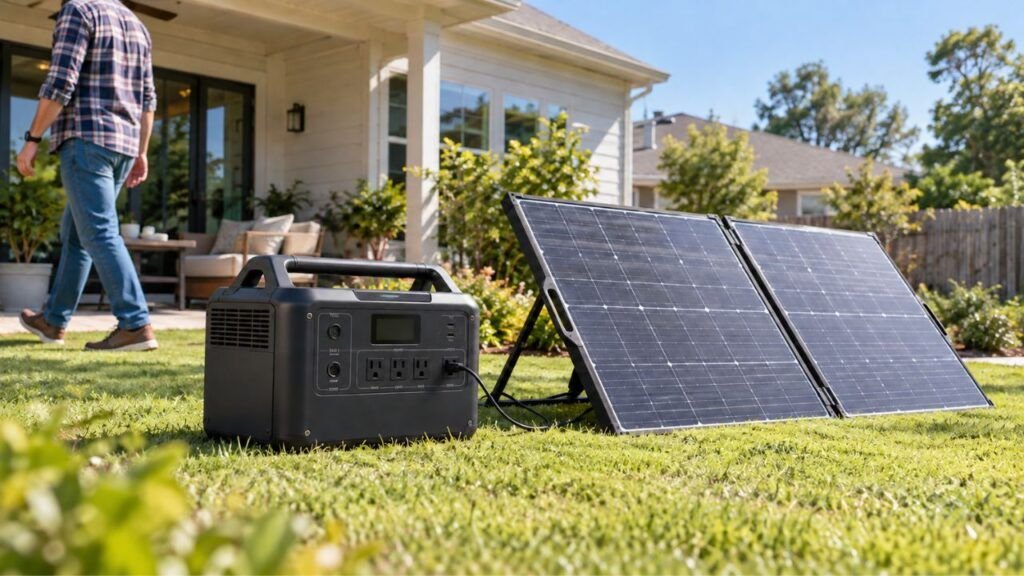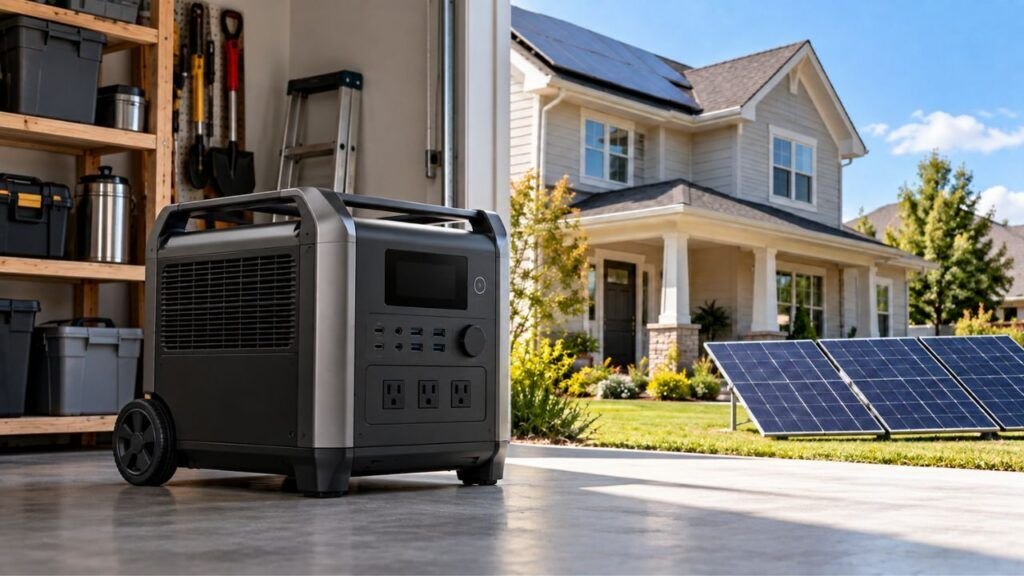
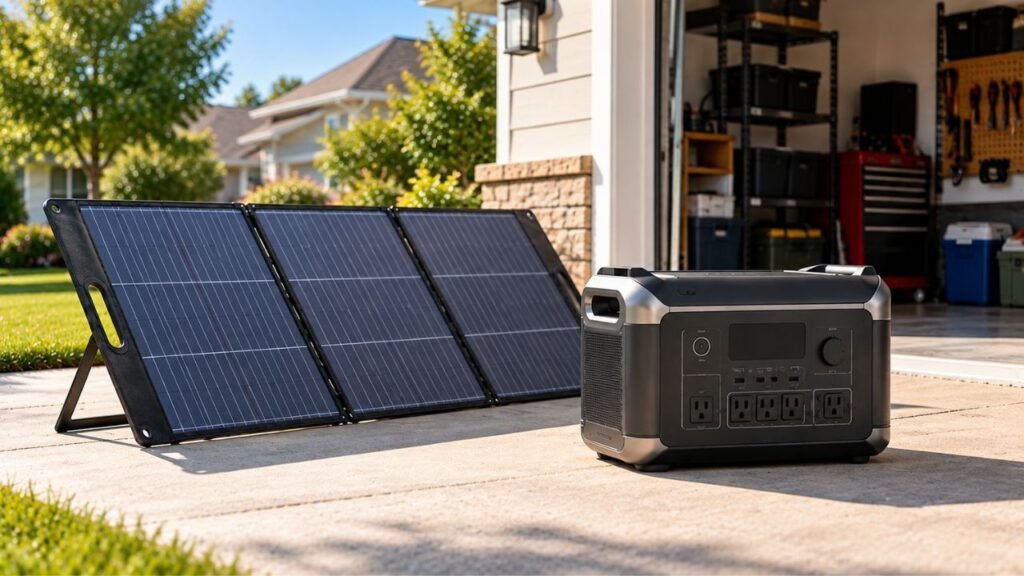
A 2000 watt solar generator can run refrigerators, TVs, Wi-Fi routers, laptops, lights, fans, CPAP machines, microwaves, coffee makers, and many smaller power tools. The main requirement is keeping the combined running load below 2,000 watts while staying within the generator’s surge limit.
However, knowing what it can start is only part of the answer. Battery capacity determines how long everything runs. Below, I’ll show you what works, what does not, realistic runtimes, and how to calculate your own setup.
Key Takeaways
- A 2,000W rating tells you how much power the inverter can supply.
- Battery capacity in Wh determines how long your appliances can run.
- Refrigerators, lights, electronics, fans, and small appliances usually work well.
- Microwaves, kettles, heaters, and coffee makers require careful load management.
- Refrigerators, pumps, and air conditioners may require extra startup power.
- Most large 240V appliances are beyond typical 2,000W portable systems.
- Solar panels extend runtime but do not normally increase inverter output.
- Always check your appliance label before relying on general wattage estimates.
What Can a 2,000-Watt Solar Generator Run?
A 2,000-watt solar generator handles many everyday household and outdoor loads. The table below gives you a practical idea of what usually works.
| Appliance | Typical Running Watts | Startup Surge | Can a 2,000W Solar Generator Run It? |
| Phone charger | 5–20W | No | Yes |
| LED light | 5–15W | No | Yes |
| Wi-Fi router | 10–30W | No | Yes |
| Laptop | 40–100W | No | Yes |
| Television | 50–200W | Usually no | Yes |
| CPAP machine | 30–100W | Usually no | Yes |
| Box fan | 40–100W | Small | Yes |
| Refrigerator | 100–800W | Yes | Usually |
| Chest freezer | 100–500W | Yes | Usually |
| Coffee maker | 800–1,500W | No | Usually |
| Microwave | 1,000–1,600W input | Small | Usually |
| Toaster | 800–1,500W | No | Usually |
| Electric kettle | 1,200–1,800W | No | Usually |
| Blender | 300–1,000W | Yes | Usually |
| Slow cooker | 150–400W | No | Yes |
| Space heater | 750–1,500W | No | Yes, but briefly |
| Window AC | 500–1,500W | Yes | Depends |
| RV air conditioner | 1,200–1,800W | High | Depends |
| Sump pump | 500–1,500W | High | Depends |
| Circular saw | 1,000–1,500W | Yes | Often |
| Electric water heater | 3,000W+ | — | Usually no |
| Electric dryer | 3,000W+ | — | Usually no |
| Central air conditioner | 3,000W+ | High | Usually no |
| Electric range | 2,000–5,000W+ | — | Usually no |
These figures are general estimates. Your actual appliance may use more or less power.
The safest approach is checking the manufacturer’s label or manual. That tells you the actual voltage, amperage, and power requirements.
What Does 2,000 Watts Actually Mean?
The 2,000W number is easy to misunderstand. You need to separate inverter output from stored battery energy before calculating anything.
2,000W Continuous Output
A solar generator rated for 2,000 watts can generally deliver around 2,000 watts continuously through its inverter.
For example, you might run a 200W refrigerator alongside a 70W fan, 60W laptop, 25W router, and several LED lights.
The combined load remains comfortably below 2,000 watts.
However, running a 1,500W heater and 1,200W microwave together would exceed the inverter limit.
2,000 Watts Is Not the Same as 2,000Wh
Watts and watt-hours measure two completely different things.
Watts tell you how much power you can use at once.
Watt-hours tell you how much electricity your battery stores.
For example, two solar generators could both have 2,000W inverters.
One might contain a 1,024Wh battery. Another could contain around 2,048Wh.
Both may run the same microwave.
The second unit can generally keep lower-wattage appliances running much longer.
That distinction becomes especially important during extended power outages.
Running Watts vs. Starting Watts
Some appliances require extra electricity for a few seconds when starting.
This is called startup, starting, or surge wattage.
Refrigerators, freezers, pumps, air conditioners, and power tools commonly have startup surges.
A refrigerator may consume relatively modest power while running. Its compressor can briefly demand much more when switching on.
Your generator therefore needs enough surge capacity for that moment.
Check both the continuous and surge ratings before connecting motor-driven appliances.
Voltage Matters Too
Wattage is not the only compatibility requirement.
Most portable solar generators sold in the United States provide standard 120V AC outlets.
Many large household appliances operate on 240V.
Examples include some:
- Electric dryers
- Well pumps
- Electric ranges
- Water heaters
- Central HVAC equipment
- Large workshop tools
A 240V appliance will not automatically work because its wattage appears low enough.
Check voltage, outlet type, inverter rating, and surge capacity together.
How Long Will a 2,000-Watt Solar Generator Run?
Runtime depends mainly on battery capacity and your average power consumption. A 2,000W inverter rating alone cannot tell you how many hours you’ll get.
A useful basic formula is:
Runtime = Usable battery capacity in Wh ÷ Average load in watts
Suppose your solar generator has a 2,048Wh battery.
If we assume roughly 85% becomes usable AC energy after losses, you have around 1,740Wh available.
| Average Load | Approximate Runtime |
| 50W | 34.8 hours |
| 100W | 17.4 hours |
| 200W | 8.7 hours |
| 500W | 3.5 hours |
| 1,000W | 1.7 hours |
| 1,500W | 1.2 hours |
| 2,000W | Less than 1 hour |
These numbers are estimates rather than guaranteed runtimes.
Temperature, inverter efficiency, battery condition, and appliance behavior all affect results.
Why Refrigerators Can Last Longer Than Simple Math Suggests
A refrigerator does not normally run its compressor continuously.
The compressor turns on until the refrigerator reaches its target temperature. It then shuts down and starts again later.
So, a refrigerator drawing 200 watts while its compressor runs does not necessarily consume 200 watts every hour continuously.
Room temperature, fridge efficiency, door openings, and thermostat settings also affect consumption.
This is why daily energy use matters more than one instantaneous wattage reading.
Why Heaters Drain Batteries So Quickly
Heating appliances behave differently.
A 1,500W space heater may draw close to its full rated power continuously while heating.
That means it can consume most of a 2kWh-class battery surprisingly quickly.
So yes, the generator may technically run the heater.
That does not necessarily make it a practical long-term backup load.
This is an important distinction when planning emergency power.
Can a 2,000-Watt Solar Generator Run a Refrigerator?
Yes, a 2,000-watt solar generator can usually run a standard refrigerator.
Modern refrigerators generally require much less than 2,000 watts while running. The bigger concern is compressor startup demand.
Your solar generator must support that brief surge.
Battery capacity then determines how long the refrigerator stays powered.
For an extended outage, prioritize refrigeration before high-wattage appliances such as heaters or kettles.
You can also improve runtime by opening refrigerator doors less frequently.
Most importantly, check your refrigerator’s actual specifications.
Online wattage averages should only be used as rough planning numbers.
Can It Run a Microwave, Coffee Maker, or Electric Kettle?
A 2,000W generator can handle many kitchen appliances individually. Trouble usually begins when several high-wattage appliances operate together.
Microwave
Most standard microwaves can work with a 2,000W solar generator.
However, pay attention to electrical input wattage.
A microwave advertised as a “1,000-watt microwave” may refer to cooking output rather than the electricity drawn from the outlet.
Its actual input requirement can be considerably higher.
Check the label on the back or inside the appliance.
I would also avoid running another heavy appliance simultaneously.
Coffee Maker and Electric Kettle
Coffee makers commonly fall within a 2,000W inverter’s capability.
Electric kettles often work as well.
The advantage is that both normally operate for relatively short periods.
However, their high power draw can still drain the battery quickly.
Use one high-draw kitchen appliance at a time whenever possible.
That leaves more inverter headroom for your refrigerator and essential electronics.
Can a 2,000-Watt Solar Generator Run an Air Conditioner?
Some air conditioners can run from a 2,000W solar generator. Others cannot, so AC compatibility depends heavily on size and startup demand.
Window and Portable Air Conditioners
A smaller window or portable air conditioner may operate within a 2,000W limit.
The issue is often startup power rather than running power.
An AC compressor can demand considerably more electricity when starting.
Your generator’s surge rating must accommodate that spike.
Battery capacity creates another limitation.
Even an AC drawing 700–1,000 watts can empty a smaller battery relatively quickly.
So an air conditioner may be compatible without offering all-night runtime.
RV Air Conditioners
RV air conditioners require more careful planning.
Some smaller RV AC units can work from high-quality 2,000W systems.
Others have startup surges that exceed the generator’s capability.
A compatible soft-start system can reduce startup demand on certain air conditioners.
However, it does not guarantee compatibility with every setup.
Check the AC specifications and generator surge rating first.
Central Air Conditioning
A typical central air conditioning system is usually beyond what a portable 2,000W solar generator is designed to handle.
These systems often require high startup power, substantial continuous wattage, and sometimes 240V service.
Whole-home cooling generally requires a larger backup power system.
Can a 2,000-Watt Solar Generator Run a Space Heater?
Yes, many space heaters use around 750–1,500 watts and can technically run from a 2,000W solar generator.
The problem is runtime.
A 1,500W heater consumes energy continuously and can drain a roughly 2kWh battery in around an hour or slightly longer, depending on usable capacity and losses.
For emergency backup, heating yourself rather than an entire room can be more energy-efficient.
For example, a lower-watt electric blanket may consume significantly less electricity.
Always follow the heater manufacturer’s safety requirements.
What Can a 2,000-Watt Solar Generator Run During a Power Outage?
A 2,000W unit works best during blackouts when you prioritize essentials. Rather than powering everything, build your backup around food, communication, lighting, and necessary electronics.
| Backup Scenario | Example Loads | Practicality |
| Basic essentials | Refrigerator + router + LED lights + phones | Excellent |
| Home office | Laptop + monitor + router + lights | Excellent |
| Food protection | Refrigerator + freezer + router | Usually good |
| Entertainment | TV + router + lights + phones | Excellent |
| Basic comfort | Refrigerator + fan + lights + router | Excellent |
| Short cooking | Refrigerator + microwave | Usually manageable |
| Cold-weather use | Refrigerator + 1,500W heater | Possible but short runtime |
| Heavy kitchen use | Microwave + kettle + coffee maker | Usually too much together |
The best outage strategy is usually load rotation.
Keep your refrigerator, router, and basic electronics running.
Then temporarily disconnect unnecessary loads before using a microwave or kettle.
Once cooking finishes, return to your lower-power essential setup.
That approach protects your battery and avoids inverter overloads.
How Many Appliances Can a 2,000-Watt Solar Generator Run at Once?
There is no fixed number of appliances.
You could run ten small devices without reaching 500 watts.
One large heating appliance could consume three times that amount.
Before connecting multiple loads, check:
- Combined running wattage
- Highest startup surge
- Individual outlet limits
- Generator surge capacity
- Battery capacity
- Desired runtime
For example, consider this basic setup:
- Refrigerator: 200W while running
- Wi-Fi router: 20W
- Laptop: 60W
- Fan: 60W
- Four LED lights: 40W
The combined running load is around 380 watts.
That leaves considerable inverter headroom.
Now add a 1,500W kettle.
Your load temporarily reaches around 1,880 watts.
That is much closer to the limit.
If your refrigerator compressor starts during that moment, the additional surge could overload the inverter.
This is why managing loads matters more than counting appliances.
What Can a 2,000-Watt Solar Generator Run in an RV or While Camping?
A 2,000W solar generator is particularly useful for RVing and camping. It provides enough power for daily comforts without requiring a fuel-powered generator.
Common RV and camping loads include:
- LED lights
- Water pump
- Roof vent fan
- Portable refrigerator
- Laptop
- Television
- Phones and tablets
- Cameras
- Wi-Fi equipment
- Coffee maker
- Small microwave
- Portable fans
- Battery chargers
- Inflatable mattress pump
A smaller RV refrigerator and electronics are relatively easy loads.
Air conditioning requires more careful planning.
Also remember that a 30-amp RV electrical connection can provide considerably more total power than a 2,000W portable solar generator.
Connecting your RV to a 2,000W unit does not give every appliance full shore-power capability.
You still need to manage the total load.
Solar panels become particularly useful while camping.
They can replace some of the electricity used during daylight hours and extend how long you remain off-grid.
What Power Tools Can a 2,000-Watt Solar Generator Run?
Many common DIY and job-site tools fit within a 2,000W inverter limit. Motor startup demand remains the main factor to watch.
Possible tools include:
- Corded drill
- Cordless tool charger
- Orbital sander
- Small shop vacuum
- Circular saw
- Angle grinder
- Jigsaw
- Small air compressor
Smaller tools and chargers are usually easy loads.
A large saw or compressor can demand substantial startup power.
Run heavier tools individually instead of operating several together.
For professional use, check the tool’s actual amperage and startup requirements before depending on the solar generator at a job site.
What Won’t a 2,000-Watt Solar Generator Normally Run?
A 2,000W solar generator is powerful for portable backup, but it has clear limits.
It normally is not suitable for:
- Central air conditioning
- Full-size electric ranges
- Large electric ovens
- Electric clothes dryers
- Electric water heaters
- Large 240V well pumps
- Large welders
- Heavy workshop equipment
- Multiple space heaters
- Several kitchen heating appliances simultaneously
- Full whole-house loads
Some specific appliances may fall outside these general rules.
Always check the actual electrical specifications instead of assuming compatibility from the appliance category alone.
How to Check Whether Your Appliance Will Work
You do not need to guess whether your appliance is compatible. A few simple checks can give you a much more reliable answer.
Step 1: Find the Appliance’s Actual Input Wattage
Look at the appliance label, manual, or manufacturer’s specifications.
You may find watts listed directly.
If so, use that figure rather than an online average.
A plug-in watt meter can provide even better real-world information for compatible 120V devices.
Step 2: Convert Amps to Watts if Needed
Some appliance labels show voltage and amperage instead of watts.
A basic calculation is:
Watts = Volts × Amps
For example, a 120V appliance drawing 5 amps uses roughly 600 watts.
Real electrical loads can be more complicated, but this calculation provides a useful sizing estimate.
Step 3: Check Startup or Surge Power
Look for startup demand when dealing with motors or compressors.
Pay particular attention to:
- Refrigerators
- Freezers
- Air conditioners
- Sump pumps
- Well pumps
- Power tools
- Air compressors
Your running load may fit comfortably under 2,000 watts while the startup surge exceeds your generator’s limit.
Step 4: Add Everything Running Together
Now add the running wattage of every appliance you want powered simultaneously.
Keep the total comfortably below the generator’s continuous rating.
Leaving some extra headroom is especially useful when refrigerators or pumps may start unexpectedly.
Step 5: Calculate the Battery Capacity You Need
Once the power load works, determine how long you need it.
Use:
Energy required in Wh = Watts × Hours
For example:
A 100W average load running for ten hours requires roughly 1,000Wh before accounting for losses.
A 500W average load running four hours requires roughly 2,000Wh.
This shows why battery capacity can matter more than inverter size for long outages.
Step 6: Test Your Setup Before an Emergency
Do not wait for a blackout to discover that your setup does not work.
Connect your essential appliances ahead of time.
Watch the generator’s display or app if available.
Check:
- Total watts
- Startup behavior
- Battery percentage
- Estimated runtime
- Heat
- Fan activity
- Warning messages
A simple test can reveal problems before you actually need backup power.
How Do Solar Panels Affect What You Can Run?
Solar panels can extend your available runtime by replacing some consumed energy. However, solar input should not be confused with inverter output.
Solar Panels Extend Runtime, Not Inverter Output
Suppose your generator has a 2,000W inverter and 400W of solar panels.
That does not normally create a 2,400W inverter.
The generator is still limited by its rated AC output.
Furthermore, solar panels simply feed energy back into the battery or power system.
Solar Can Reduce Battery Drain
Solar becomes useful when your incoming energy offsets part of your current load.
Imagine your appliances are averaging 500 watts.
If useful solar input contributes several hundred watts during sunny conditions, the battery may drain more slowly.
This can greatly extend off-grid runtime.
Actual performance depends on the generator’s charging design.
Why Solar Charging Time Varies
Solar recharge performance changes throughout the day.
Several factors affect it:
- Total panel wattage
- Maximum solar input of the generator
- Sun intensity
- Cloud cover
- Shade
- Panel angle
- Time of day
- Temperature
- Charging efficiency
A 400W panel array should not be expected to produce exactly 400 watts every hour.
Real-world conditions rarely remain perfect throughout the day.
Is a 2,000-Watt Solar Generator Enough for Home Backup?
A 2,000W solar generator can be excellent for essential home backup. However, it should not normally be viewed as a complete whole-house replacement.
It works particularly well for:
- Refrigerator
- Freezer
- Wi-Fi
- Phones
- LED lighting
- Laptop
- Home office equipment
- Television
- Fans
- CPAP machine
- Small kitchen appliances
Consider a larger system when you need:
- Central HVAC
- Large 240V appliances
- Electric water heating
- Electric cooking
- Large well pumps
- Multiple heating appliances
- Extended multi-day backup
- Whole-house power
Also consider whether your real limitation is power or energy.
You may only need 500 watts of continuous power but need it for 24 hours.
In that situation, increasing battery capacity can matter more than buying a much larger inverter.
Safety Tips When Using a 2,000-Watt Solar Generator
Solar generators are generally simple to use, but electrical safety still matters.
Keep these basic practices in mind:
- Stay within the generator’s rated continuous output.
- Check surge limits before starting motor-driven equipment.
- Keep ventilation openings clear.
- Follow the manufacturer’s operating temperature limits.
- Protect the unit from water unless specifically rated otherwise.
- Use properly rated extension cords.
- Avoid damaged plugs or loose connections.
- Do not improvise connections into household wiring.
- Use proper transfer equipment for home circuit integration.
- Follow appliance and generator instructions.
Never attempt to backfeed household wiring through a standard wall outlet.
If you want a generator integrated into home circuits, use suitable transfer equipment and qualified electrical installation.
When Should You Choose More Than 2,000 Watts?
A 2,000W system covers many portable and emergency needs. Larger systems make sense when your simultaneous power demand regularly approaches its limit.
Consider moving up when you need:
- Multiple kitchen appliances together
- Central air conditioning
- Large window or RV air conditioners
- 240V equipment
- Large pumps
- Heavy workshop tools
- Electric water heating
- Whole-home backup
- Higher continuous household loads
However, do not automatically buy more inverter power.
Ask yourself whether you need more watts or more watt-hours.
If your appliances only draw 300 watts but need to run all night, additional battery capacity may solve the problem better.
If your appliances demand 3,000 watts at once, then you need a larger inverter.
Understanding that difference can prevent you from buying the wrong system.
Final Words
A 2,000-watt solar generator is powerful enough for many everyday backup needs. Refrigerators, lights, laptops, routers, TVs, fans, CPAP machines, and numerous small appliances are comfortably within its range.
Higher-wattage devices such as microwaves, kettles, heaters, air conditioners, and power tools require more attention. Some work perfectly well individually but become problematic when combined with other loads.
Before connecting anything important, check its running watts, startup demand, voltage, and expected runtime. Once you understand those four numbers, deciding what your 2,000W solar generator can handle becomes much easier.
Related FAQs
Will a 2,000-Watt Solar Generator Run a Refrigerator?
Yes. Most refrigerators can run from a 2,000-watt solar generator as long as the inverter supports the compressor’s startup surge. Battery capacity determines how long the refrigerator remains powered.
How Long Will a 2,000-Watt Solar Generator Run a Refrigerator?
Runtime depends on the battery’s Wh capacity and the refrigerator’s actual energy use. Because refrigerators cycle their compressors on and off, actual runtime can be considerably longer than simply dividing capacity by compressor running watts.
Can a 2,000-Watt Solar Generator Run a Microwave?
Yes, most household microwaves can run from a 2,000W solar generator. Check the microwave’s electrical input wattage because it may be higher than the cooking wattage advertised on the front.
Can a 2,000-Watt Solar Generator Run a 1,500-Watt Heater?
Yes, a 1,500W heater normally falls within a 2,000W inverter limit. However, continuous heating consumes battery energy quickly and can empty a roughly 2kWh-class battery in a relatively short time.
Can a 2,000-Watt Solar Generator Run an Air Conditioner?
It depends on the air conditioner. Some small window and portable AC units can work, but compressor startup surge and battery runtime can be limiting factors.
Can a 2,000-Watt Solar Generator Run an RV Air Conditioner?
Some smaller RV air conditioners may work with a suitable 2,000W generator, especially when startup demand is controlled. Larger units may exceed the inverter’s surge or continuous output rating.
Can a 2,000-Watt Solar Generator Run a Sump Pump?
Possibly. Many sump pumps have manageable running wattage but significant startup demand. Check the pump’s amperage and the generator’s surge capacity before relying on it during an outage.
Can a 2,000-Watt Solar Generator Power a Whole House?
Not normally. A 2,000W solar generator is better suited to essential loads such as refrigeration, lights, internet, electronics, fans, and occasional small appliances rather than powering an entire house simultaneously.
How Many Appliances Can a 2,000-Watt Solar Generator Run at Once?
There is no fixed number. You can run multiple appliances as long as their combined running wattage remains within the inverter rating and any startup surges remain within the generator’s surge capacity.
Is 2,000 Watts the Same as 2,000Wh?
No. Watts measure how much power the generator can supply at one moment, while watt-hours measure how much energy the battery stores for use over time.
Can I Use a Solar Generator While It Is Charging From Solar Panels?
Many modern solar generators support powering devices while receiving solar input. However, charging behavior and pass-through capabilities vary by model, so check the manufacturer’s specifications.
Do I Need a 2,000Wh Battery With a 2,000W Inverter?
No. Inverter output and battery capacity do not have to match numerically. A 2,000W inverter can be paired with smaller or larger batteries depending on the system design and desired runtime.

Blake Cooper writes practical guides on generators, portable power stations, and home backup systems. He focuses on simplifying power topics and helping homeowners make informed buying decisions.