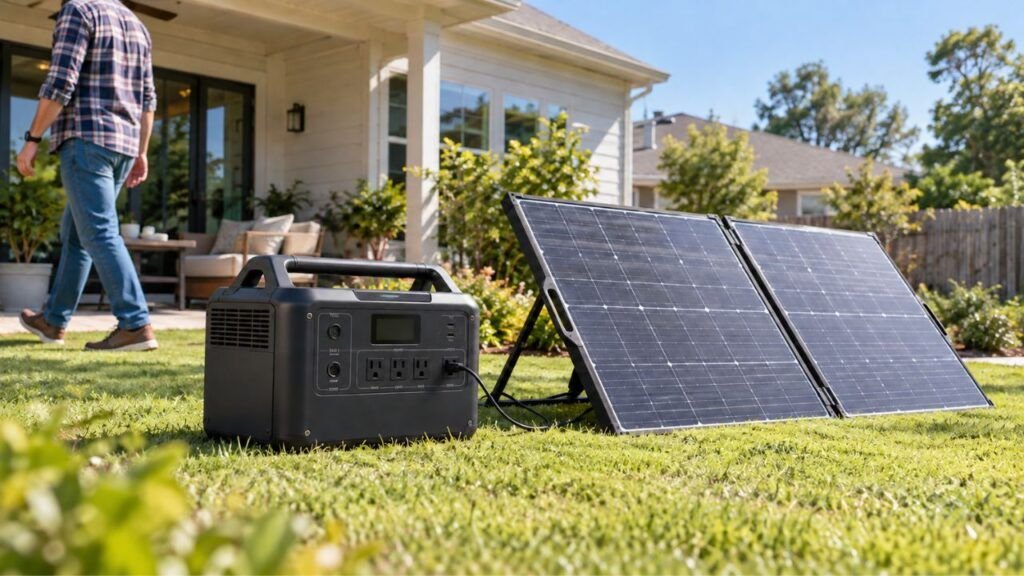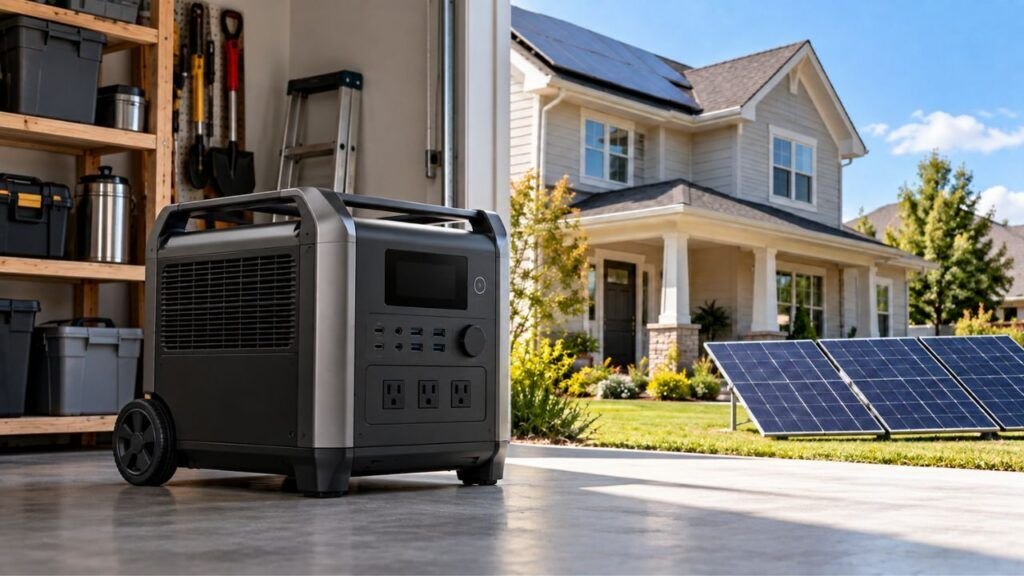
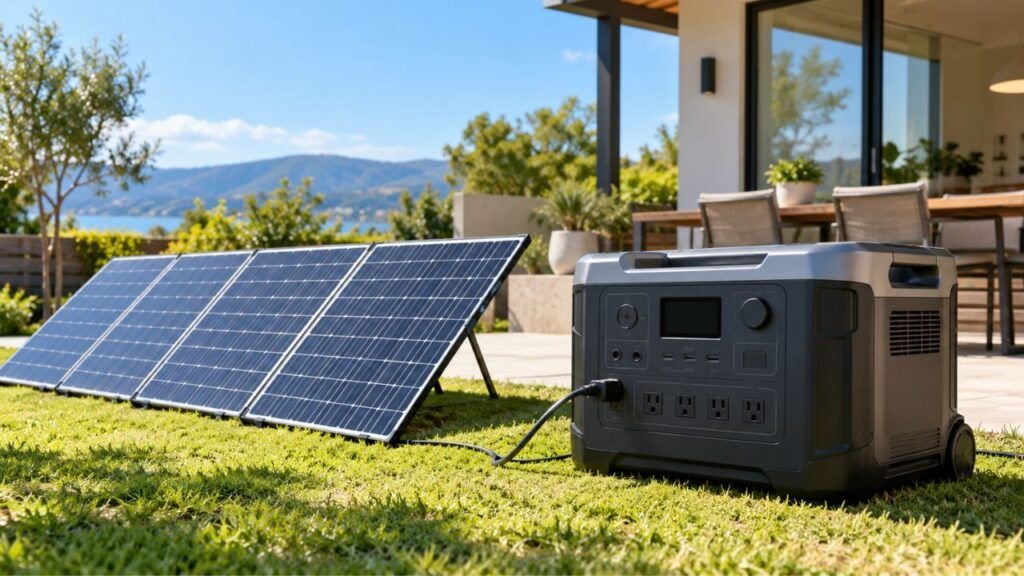
A 3,000-watt solar generator can run most essential household appliances, including a refrigerator, freezer, microwave, coffee maker, TV, Wi-Fi router, lights, computers, and many power tools. It can also handle some window and RV air conditioners when their startup requirements stay within the generator’s surge limit.
However, the 3,000-watt rating only tells you how much power the generator can supply at once. Battery capacity, startup watts, voltage, and appliance efficiency determine what you can actually run and for how long. Below, I’ll help you work through each of those limits.
Key Takeaways
- A 3,000W solar generator can handle most household essentials.
- Several low-wattage appliances can run at the same time.
- Microwaves, heaters, kettles, and AC units use much more power.
- Refrigerators, pumps, and AC units may require high startup watts.
- Battery capacity in watt-hours determines your actual runtime.
- A 3,000W rating does not automatically mean a 3,000Wh battery.
- Some 240V appliances will not work with 120V-only generators.
- Staggering large appliances helps prevent overloads.
What Can a 3,000-Watt Solar Generator Run?
A 3,000-watt solar generator gives you enough output for many everyday appliances. The important part is keeping their combined running load below the inverter’s continuous rating while allowing enough room for startup surges.
Here are typical household power requirements.
| Appliance | Typical Running Watts | Typical Startup Demand | Can 3,000W Run It? |
| Refrigerator | 100–800W | 600–1,500W+ | Yes |
| Chest freezer | 100–400W | 500–1,200W | Yes |
| Microwave | 900–1,500W | Minimal | Yes |
| Coffee maker | 800–1,500W | Minimal | Yes |
| Toaster | 800–1,500W | Minimal | Yes |
| Electric kettle | 1,200–1,500W | Minimal | Yes |
| LED TV | 50–200W | Minimal | Yes |
| Wi-Fi router | 10–30W | Minimal | Yes |
| Laptop | 30–100W | Minimal | Yes |
| Desktop computer | 100–600W+ | Varies | Yes |
| LED light | 5–15W each | Minimal | Yes |
| Ceiling or box fan | 30–100W | Small | Yes |
| CPAP machine | 30–100W+ | Minimal | Yes |
| Washing machine | 400–1,400W | 1,000–2,300W+ | Usually |
| Window AC | 500–1,500W+ | 1,500–3,000W+ | Often |
| RV air conditioner | 1,300–2,000W | 2,500–4,000W+ | Depends |
| Space heater | Around 1,500W | Minimal | Yes |
| Circular saw | 1,200–1,800W | Higher | Usually |
| Sump pump | 800–1,500W | 1,500–3,000W+ | Depends |
| Gas furnace blower | 300–800W+ | Higher | Often |
| Hair dryer | 1,200–1,800W | Minimal | Yes |
These figures are general ranges rather than exact specifications. Always check the rating label or manual for the appliance you plan to use.
A newer refrigerator might draw far less power than an older model. The same applies to air conditioners, pumps, computers, and other equipment.
What Can a 3,000-Watt Solar Generator Run at the Same Time?
Running several appliances together is where load planning becomes important. A 3,000W solar generator can often support many essentials simultaneously, but high-wattage appliances can quickly consume your available capacity.
Basic Home Backup Setup
A basic outage setup usually leaves plenty of power available.
| Appliance | Example Running Load |
| Refrigerator | 200W |
| Chest freezer | 150W |
| Wi-Fi router | 20W |
| TV | 100W |
| LED lights | 80W |
| Laptop | 60W |
| Total | 610W |
A combined load around 610 watts is comfortably below 3,000 watts.
You could keep these essentials running while still having room for another appliance. Just remember that the refrigerator and freezer may briefly draw more power when their compressors start.
Home Essentials Plus a Microwave
Suppose your normal backup load is around 600 watts.
You then turn on a 1,200-watt microwave.
Your combined running load becomes roughly:
600W + 1,200W = 1,800W
That still leaves about 1,200 watts of inverter capacity.
For most 3,000W systems, this is a practical setup.
Refrigerator, Microwave, and Coffee Maker
This combination gets closer to the limit.
For example:
- Refrigerator: 200W
- Microwave: 1,200W
- Coffee maker: 1,200W
- Lights and electronics: 300W
Your combined running load reaches about 2,900 watts.
Technically, that may fit within a 3,000W rating. I still would not recommend operating this close to the limit.
The refrigerator compressor could start while everything else is running. That extra surge may trigger overload protection.
A better approach is simple.
Finish using the microwave first. Then start the coffee maker.
Window AC With Household Essentials
A smaller window AC might draw around 700–1,200 watts while running.
You may still have enough capacity for:
- refrigerator
- freezer
- router
- television
- lights
- laptop
- phone chargers
The bigger concern is the AC compressor starting.
Your generator must have enough surge capacity for that brief spike while other appliances remain connected.
Running Watts vs. Starting Watts
Two different power ratings determine whether your appliances will work properly. Running watts describe normal operation, while starting watts describe short bursts required by certain motors and compressors.
Running Watts
The Running watts are the continuous power an appliance uses while operating normally.
A 1,000W appliance continuously consumes about 1,000 watts while switched on.
With a 3,000W generator, several appliances can operate together as long as their combined load remains within the generator’s continuous output.
Starting or Surge Watts
Some appliances briefly require much more electricity when starting.
Common examples include:
- refrigerators
- freezers
- window air conditioners
- RV air conditioners
- sump pumps
- well pumps
- furnace blowers
- circular saws
- compressors
A refrigerator might consume only a few hundred watts while running but temporarily require considerably more when its compressor starts.
This is why looking only at running wattage can cause problems.
How to Check Your Total Load
You can estimate your power requirements using a simple process.
- List every appliance you want running together.
- Find the running wattage of each appliance.
- Add those running wattages together.
- Identify appliances with motors or compressors.
- Check their startup or surge requirements.
- Compare the total demand with your generator specifications.
- Leave some headroom instead of operating continuously at 3,000W.
Your actual appliance labels should always take priority over generic wattage charts.
3,000 Watts vs. 3,000 Watt-Hours
Watts and watt-hours sound similar, but they describe completely different things. Knowing the difference helps you avoid one of the biggest mistakes people make when choosing a solar generator.
| Specification | 3,000 Watts | 3,000 Watt-Hours |
| Abbreviation | W | Wh |
| Measures | Power | Stored energy |
| Tells you | What can run | How long it can run |
| Related to | Inverter output | Battery capacity |
| Main question | Can it power this appliance? | How long can it power it? |
A solar generator rated for 3,000 watts might have a 2,000Wh battery.
Another 3,000W generator might have a 3,000Wh or larger battery.
Both could have similar inverter output while providing very different runtimes.
Think of watts as how quickly electricity can flow.
Think of watt-hours as how much electricity you have stored.
How Long Will a 3,000-Watt Solar Generator Run Appliances?
Runtime depends mainly on battery capacity and your average load. Two solar generators with the same 3,000W inverter can have completely different runtimes if their batteries are different sizes.
Solar Generator Runtime Formula
A simple estimate is:
Battery Capacity × Usable Efficiency ÷ Appliance Load = Runtime
Suppose your generator has a 3,000Wh battery.
If we assume roughly 85% of that capacity reaches your AC appliances after conversion losses:
3,000Wh × 0.85 = 2,550Wh usable
You can then divide 2,550Wh by your average load.
Example Runtime With a 3,000Wh Battery
| Average Load | Approximate Runtime |
| 100W | 25.5 hours |
| 300W | 8.5 hours |
| 500W | 5.1 hours |
| 1,000W | 2.6 hours |
| 1,500W | 1.7 hours |
| 2,000W | 1.3 hours |
| 3,000W | 0.85 hour |
These are simple estimates rather than guaranteed runtimes.
Real performance changes because of inverter losses, temperature, battery condition, appliance cycling, standby consumption, and other factors.
Solar charging during operation can also extend runtime.
Can a 3,000-Watt Solar Generator Run a Refrigerator?
Yes, a 3,000-watt solar generator can run most household refrigerators comfortably.
A refrigerator usually consumes far less than 3,000 watts during normal operation. The main concern is the short startup surge required by its compressor.
Fortunately, many 3,000W-class solar generators provide a higher temporary surge rating.
Refrigerators also cycle on and off throughout the day.
They do not normally draw their rated running wattage continuously for 24 hours. This means real battery consumption may be lower than a simple wattage-times-hours calculation suggests.
For longer outages, keeping the refrigerator door closed also reduces compressor activity.
Can a 3,000-Watt Solar Generator Run an Air Conditioner?
Many smaller air conditioners can run from a 3,000W solar generator. However, AC units are motor-driven loads, so both running wattage and compressor startup demand matter.
Window Air Conditioner
Many smaller window units can work well with a 3,000W solar generator.
A unit drawing around 500–1,200 running watts leaves room for several smaller household loads.
Larger window AC units may consume more power.
Before connecting one, check both its rated current and startup demand.
RV Air Conditioner
A 3,000W solar generator can run many RV air conditioners, particularly smaller and more efficient models.
The challenge is usually compressor startup.
An RV AC might remain below 2,000 watts while running but briefly demand considerably more when the compressor starts.
A compatible soft-start device can reduce startup demand on some RV AC systems.
You should still verify compatibility with your particular air conditioner.
Central Air Conditioner
A basic 3,000W portable solar generator usually is not ideal for traditional central air conditioning.
Central AC systems can have:
- high running wattage
- very high compressor startup demand
- 240V electrical requirements
Even when the running wattage appears close to 3,000 watts, startup demand can exceed what the generator can safely provide.
Larger home battery systems are generally better suited for central HVAC backup.
Can a 3,000-Watt Solar Generator Power a House?
A 3,000W solar generator can provide useful home backup, but it normally should not be treated as unrestricted whole-house power. It works best when you select essential circuits and manage larger appliances carefully.
What It Can Keep Running During an Outage
Depending on appliance wattage, you may be able to support:
- refrigerator
- freezer
- Wi-Fi router
- modem
- LED lights
- television
- computers
- phone chargers
- fans
- CPAP equipment
- furnace blower
- sump pump
- selected window AC
- occasional microwave use
- coffee maker
That can cover most basic needs during a temporary outage.
Why It Usually Cannot Run Everything
A typical American home has several appliances that individually consume thousands of watts.
Electric dryers, central AC systems, electric water heaters, large ovens, and electric heating systems can quickly exceed a 3,000W inverter.
Running several high-draw appliances together creates an even larger problem.
Battery capacity also matters.
Even if your generator can produce enough instantaneous power, running large electric heating appliances continuously can drain the battery very quickly.
Connecting It to Home Circuits
Use equipment specifically designed for home backup when connecting a solar generator to household circuits.
Never improvise a connection through a standard wall outlet.
A properly designed transfer system prevents dangerous backfeeding and isolates backup power correctly.
If your setup connects directly to household wiring, have a qualified electrician confirm that the transfer equipment, voltage, current rating, and installation meet applicable electrical requirements.
Appliances a 3,000-Watt Solar Generator Usually Cannot Run
Some appliances simply demand too much continuous power, too much startup power, the wrong voltage, or a combination of these factors.
| Appliance | Why It May Not Work |
| Large central AC | High running and startup demand |
| Electric clothes dryer | High wattage and usually 240V |
| Electric water heater | Large continuous resistive load |
| Large electric oven | High wattage |
| Electric range | Multiple high-wattage heating elements |
| Electric furnace | Very high heating demand |
| Large well pump | High startup load or 240V requirement |
| Level 2 EV charger | Usually high power and 240V |
| Large workshop equipment | May require high surge or 240V |
| Multiple space heaters | Combined load exceeds 3,000W |
There are exceptions because appliances and solar generators vary.
A specialized 3,000W unit with 240V support may handle equipment that a standard 120V portable model cannot.
Always check both sides of the connection before assuming compatibility.
Why Voltage Matters Even When the Wattage Fits
Wattage gets most of the attention, but voltage is equally important. An appliance can fall below 3,000 watts and still be incompatible with your solar generator.
| Generator Output | Typical Use |
| 120V | Standard household plug-in appliances |
| 120/240V | Standard appliances plus selected 240V equipment |
Many portable solar generators sold in the U.S. provide standard 120V AC outlets.
That works for appliances such as refrigerators, microwaves, TVs, computers, and coffee makers.
However, larger residential equipment often requires 240V.
Common examples include some:
- dryers
- electric ranges
- water heaters
- well pumps
- central air conditioners
- EV chargers
- workshop machines
Suppose an appliance needs 2,500 watts at 240 volts.
A 3,000W generator technically has enough wattage.
But if that generator produces only 120V, the appliance still cannot be powered correctly.
So always check three things:
power, voltage, and connector type.
How Solar Panels Change Runtime
Solar panels can significantly extend how long your generator operates during daylight. They recharge the battery while your appliances continue using energy.
Solar Input Does Not Increase the 3,000W Output Rating
Adding more solar panels does not normally turn a 3,000W inverter into a 4,000W or 5,000W inverter.
The inverter rating still determines your maximum AC output.
Solar panels mainly replenish energy stored in the battery.
Solar Can Reduce Battery Drain
Imagine your appliances are drawing 700 watts.
Your solar panels are currently sending 500 watts into the system.
In simple terms, the battery may only need to supply the remaining difference rather than the full 700 watts.
Actual energy flow depends on the design and efficiency of the solar generator.
Still, strong solar production can greatly increase daytime runtime.
Check Maximum Solar Input
More panels are not automatically better.
Every solar generator has limits for:
- maximum solar wattage
- maximum input voltage
- maximum current
- acceptable voltage range
- connector compatibility
A panel array must remain within those specifications.
Real solar production also changes with clouds, shading, temperature, panel angle, season, and location.
How to Know Exactly What Your 3,000-Watt Solar Generator Can Run
Instead of guessing, you can work out your own setup in a few minutes.
- Check whether 3,000W is the continuous output rating.
- Find the battery capacity listed in watt-hours.
- Write down the appliances you want to use.
- Find each appliance’s running wattage.
- Check startup watts for motors and compressors.
- Add appliances that will operate simultaneously.
- Confirm whether they require 120V or 240V.
- Check the generator’s outlet and current limits.
- Leave extra power available for startup surges.
- Estimate runtime using your expected average load.
For example, suppose you want to run:
- refrigerator: 200W
- freezer: 150W
- television: 100W
- router: 20W
- six LED lights: 60W
- laptop: 70W
Your running load would be roughly:
200 + 150 + 100 + 20 + 60 + 70 = 600W
That is an easy load for a 3,000W generator.
You could then temporarily add a microwave or coffee maker while remaining within the generator’s output limits.
This type of load planning is much more useful than simply asking whether one appliance can run.
Tips for Getting More Runtime From a 3,000-Watt Solar Generator
A few simple changes can make your stored energy last considerably longer.
- Run the microwave and coffee maker separately.
- Avoid running multiple heaters together.
- Use LED lighting instead of older bulbs.
- Keep refrigerators and freezers closed during outages.
- Switch off appliances you are not actively using.
- Run high-wattage appliances during strong sunlight.
- Recharge from solar whenever conditions allow.
- Use energy-efficient fans before running AC continuously.
- Turn off unnecessary standby loads.
- Prioritize essential equipment during longer outages.
- Keep enough battery reserve for nighttime use.
Electric heating deserves special attention.
A 1,500W space heater may easily run from the inverter, but it can consume a large battery surprisingly quickly.
Sometimes the appliance that is easiest to power is not the appliance you should run for hours.
Is a 3,000-Watt Solar Generator Enough for You?
A 3,000W solar generator sits in a useful middle ground. It offers much more capability than small camping power stations without becoming as large or expensive as full whole-home battery systems.
Good Fit for Home Emergency Essentials
For emergency backup, 3,000 watts can be a very practical size.
You can keep food cold, maintain internet access, charge electronics, use lights, watch television, and operate several smaller appliances.
You can also temporarily use larger kitchen appliances when you manage your loads carefully.
Battery capacity becomes more important if you expect outages lasting overnight or several days.
Good Fit for RV and Off-Grid Use
A 3,000W unit also works well for larger RV setups, cabins, job sites, and off-grid use.
It can support electronics, kitchen appliances, power tools, refrigerators, water pumps, and selected air conditioners.
Solar charging makes these applications even more useful because you can replenish the battery away from the electrical grid.
Consider a Larger System If…
A larger solar generator may make more sense if you regularly need:
- central air conditioning
- several large 240V appliances
- electric water heating
- electric cooking and AC together
- multiple space heaters
- heavy workshop machinery
- large well pumps
- Level 2 EV charging
- near-normal whole-house operation
- multi-day backup with heavy electrical use
In those situations, both inverter output and battery capacity need to increase.
Final Words
A 3,000-watt solar generator can run far more than just phones and lights. It can support refrigerators, freezers, microwaves, coffee makers, televisions, computers, power tools, fans, and many smaller air conditioners.
The real limit comes down to four things: continuous watts, startup watts, voltage, and battery capacity. If you check all four, figuring out what your generator can handle becomes much easier.
For home outages, I would focus on essential loads first. Keep your refrigerator, freezer, internet, lights, and electronics running, then use larger appliances one at a time. That simple approach helps a 3,000W system provide useful backup without unnecessary overloads.
Related FAQs
What Appliances Can a 3,000-Watt Solar Generator Run?
A 3,000-watt solar generator can run refrigerators, freezers, microwaves, coffee makers, TVs, routers, computers, lights, fans, many power tools, and selected window or RV air conditioners.
Can a 3,000-Watt Solar Generator Run a Refrigerator and Microwave at the Same Time?
Yes, most 3,000W generators can run a refrigerator and microwave together if their combined running and startup requirements stay within the generator’s continuous and surge ratings.
Can a 3,000-Watt Solar Generator Run a Window Air Conditioner?
Yes, many smaller and medium window air conditioners can run from a 3,000W generator. Check both running wattage and compressor startup demand before connecting the unit.
Can a 3,000-Watt Solar Generator Run an RV Air Conditioner?
Many RV air conditioners can run from a 3,000W solar generator, although startup surge is often the biggest challenge. A compatible soft-start device may help reduce startup demand.
Can a 3,000-Watt Solar Generator Run a Well Pump?
It depends on the pump. Smaller pumps may work, but larger well pumps can require high startup wattage or 240V power that some 3,000W solar generators cannot provide.
Will a 3,000-Watt Solar Generator Run a Space Heater?
Yes, a typical 1,500W space heater can run from a 3,000W generator. However, heaters consume battery power quickly, so they may not be practical for extended backup use.
Can a 3,000-Watt Solar Generator Power a House?
It can power essential household loads but usually cannot run an entire home normally. Refrigerators, lights, internet, electronics, and selected appliances are realistic backup loads.
How Long Will a 3,000-Watt Solar Generator Run a Refrigerator?
Runtime depends on battery capacity, refrigerator efficiency, compressor cycling, and other connected loads. A larger battery can keep an efficient refrigerator running much longer than inverter wattage alone suggests.
Is 3,000 Watts the Same as 3,000 Watt-Hours?
No. Watts measure how much power the generator can supply at one time, while watt-hours measure how much energy the battery stores and therefore affect runtime.
How Many Solar Panels Do I Need for a 3,000-Watt Solar Generator?
The number depends on panel wattage and the generator’s maximum solar input. You should size the panel array within the manufacturer’s voltage, current, and wattage limits.
What Happens If I Exceed 3,000 Watts?
Most modern solar generators activate overload protection and shut off their AC output when the load exceeds their allowable limits. Remove some appliances before restarting the system.
Can a 3,000-Watt Solar Generator Run 240V Appliances?
Only if the generator specifically supports 240V output. A 3,000W generator with only 120V outlets cannot directly operate standard 240V appliances even when their wattage is below 3,000W.

Blake Cooper writes practical guides on generators, portable power stations, and home backup systems. He focuses on simplifying power topics and helping homeowners make informed buying decisions.