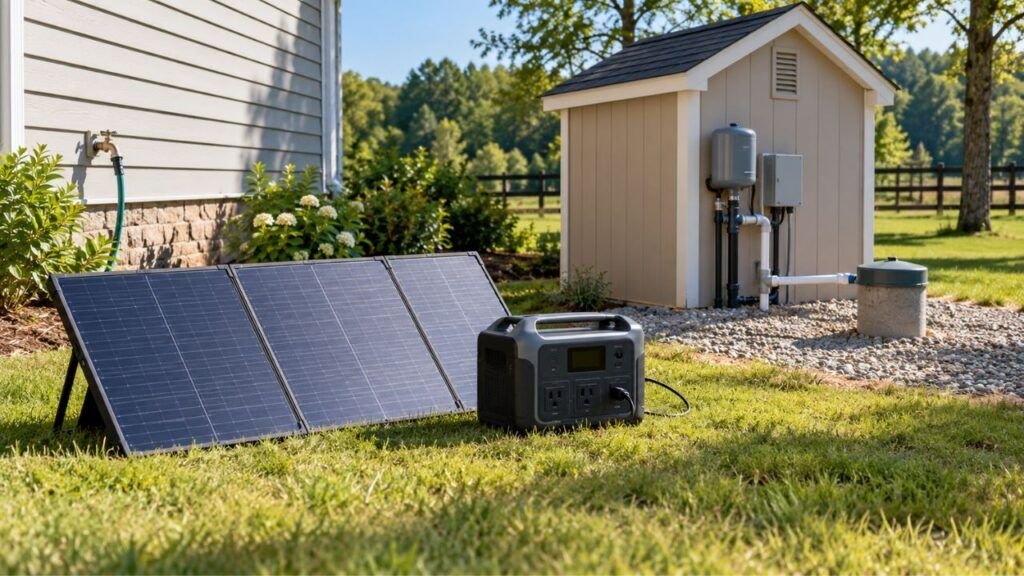
Yes, a solar generator can run a well pump. However, it must provide the correct voltage, enough running power, and sufficient startup surge capacity. Many residential well pumps use 240V power, so smaller 120V solar generators may not work.
In this guide, I’ll help you match your pump correctly. We’ll cover voltage, wattage, startup surge, battery capacity, runtime, solar charging, and safe connection options.
Key Takeaways
- A properly sized solar generator can run most residential well pumps.
- Check whether your well pump needs 120V or 240V first.
- Many deep-well submersible pumps operate on 230V or 240V.
- Well pump motors need significantly more power during startup.
- Inverter watts determine whether your pump can operate properly.
- Battery watt-hours determine how long the pump can keep running.
- Always use your pump’s actual specifications when sizing a system.
Can a Solar Generator Really Run a Well Pump?
Yes, but not every solar generator can handle every well pump.
Well pumps contain electric motors that require steady running power. They also demand a short burst of extra electricity during startup.
That startup demand is usually the biggest challenge.
You also need to consider the pump’s operating voltage. A powerful 120V power station still cannot directly run a 240V pump.
For a solar generator to work correctly, four things must match:
- Pump voltage
- Continuous running power
- Startup surge requirement
- Battery storage capacity
Get those four things right, and solar backup becomes practical.
What Determines Whether a Solar Generator Can Run Your Well Pump?
Before shopping by battery size alone, check these four specifications. Each one affects whether the system will actually work.
Pump Voltage: 120V vs. 240V
Voltage should be the first thing you check.
Some shallow-well and jet pumps operate at 120V. These are generally easier to power using portable solar generators.
Many residential submersible pumps operate at 230V or 240V.
A normal 120V solar generator cannot power these pumps directly. You need a system capable of producing the proper 240V output.
This matters even if the generator has plenty of wattage.
For example, a 3,600W power station may sound powerful. However, it cannot run a 240V pump if it only provides 120V output.
Check the pump documentation, control box, or electrical panel first.
Running Power
Running watts describe the electricity required while the pump operates normally.
Once the motor reaches full speed, power demand usually stabilizes.
Smaller pumps may consume several hundred watts during normal operation. Larger deep-well pumps can require considerably more.
Horsepower gives you a useful starting point, but it is not enough.
Motor efficiency, pump design, voltage, and operating conditions also affect electricity consumption.
Use your pump’s rated electrical specifications whenever possible.
Startup Surge
Starting a well pump motor requires extra power.
The motor briefly pulls much more current while accelerating. This is commonly called starting surge, inrush current, or starting watts.
Some pumps may need two or three times their normal running power. Others can briefly require even more.
That is why a solar generator can appear large enough but still shut down.
Suppose your pump consumes 1,000W while operating normally. A 1,500W inverter might seem sufficient.
However, if the pump needs 3,000W during startup, it may never start.
Your solar generator must handle both requirements.
Battery Capacity
Battery capacity determines how long the pump can operate.
Solar generator batteries are normally rated in watt-hours, or Wh.
This distinction is important:
- Watts tell you how much power the generator can deliver.
- Watt-hours tell you how much energy the battery stores.
A powerful inverter cannot compensate for a tiny battery.
Likewise, a huge battery cannot fix insufficient inverter output.
You need both specifications properly matched.
How Much Power Does a Well Pump Use?
Well pump consumption varies considerably between installations. The following ranges work best as general planning estimates rather than exact requirements.
| Well Pump Size | Common Voltage | Typical Running Demand | Possible Startup Demand | General Sizing Consideration |
| 1/3 HP | 120V or 240V | About 500–800W | About 1,500–2,500W | Mid-size system may work |
| 1/2 HP | 120V or 240V | About 700–1,000W | About 2,000–3,500W | Check surge carefully |
| 3/4 HP | Often 240V | About 900–1,300W | About 2,500–4,000W | 240V support may be needed |
| 1 HP | Often 240V | About 1,000–1,500W | About 3,000–4,500W+ | Heavy-duty system recommended |
| 1.5 HP | Usually 240V | About 1,500–2,200W | About 4,000–6,000W+ | Large backup system likely needed |
These numbers should not replace your pump’s actual electrical specifications.
Two 1 HP pumps can have different startup requirements. Motor design and control systems can make a major difference.
How to Find Your Well Pump’s Actual Power Requirements
Guessing from horsepower can lead to an undersized generator. Before buying anything, collect as much information as possible.
Look for:
- Pump horsepower
- Operating voltage
- Rated or full-load amps
- Starting or locked-rotor amps
- Pump model number
- Motor model number
- Two-wire or three-wire configuration
- Control box specifications
- Existing breaker size
- Well installation paperwork
Your pump itself may sit hundreds of feet underground.
That means reading the motor label may be impossible.
Instead, check the control box near your pressure equipment. You can also check previous service records or installation paperwork.
A well service company may identify the installed pump too.
Once you have the model number, sizing becomes much easier.
What Size Solar Generator Do I Need for a Well Pump?
The correct solar generator depends more on electrical requirements than horsepower alone. Start with voltage and surge capability before comparing battery sizes.
For a 120V Shallow-Well or Jet Pump
A 120V well pump is generally easier to power.
Suppose your pump uses around 800W while running. It might require around 2,000W or more briefly during startup.
In that situation, I would look for a solar generator offering:
- 120V AC output
- Continuous output comfortably above 800W
- Surge capability above the pump’s startup requirement
- Enough battery capacity for your expected water use
A larger inverter also gives you room for additional loads.
For a 240V Submersible Well Pump
A 240V pump needs a solar generator that provides proper 240V output.
This is where many buyers make mistakes.
Do not assume a high wattage rating automatically includes 240V power.
Some larger solar generators provide native 120V and 240V output. Others create 240V through paired units or dedicated home-backup configurations.
Check this specification carefully before purchasing anything.
You should also verify that the 240V output supports motor startup loads.
For a Soft-Start or Variable-Speed Well Pump
Some modern pumps reduce their electrical demand during startup.
Soft-start electronics gradually bring the motor up to speed. Variable-frequency systems can also manage motor acceleration more smoothly.
These designs may require less startup headroom than conventional pumps.
That can make solar-generator backup easier.
However, never assume your pump has this feature.
Check the pump or controller documentation before sizing around reduced surge.
Solar Generator Size by Pump Situation
| Pump Situation | Main Requirement | Suitable Solar Generator Type |
| Small 120V jet pump | 120V with adequate startup surge | Mid-to-large portable power station |
| 120V higher-power pump | Strong inverter and larger battery | High-output portable system |
| 240V submersible pump | True 240V and strong motor surge capability | Heavy-duty home backup system |
| Large conventional pump | High startup and continuous output | Large expandable system |
| Soft-start well pump | Correct voltage with reduced starting load | Depends on controller specifications |
Use this table as a starting point only.
Your actual pump specifications should make the final decision.
How to Calculate Solar Generator Size for a Well Pump
You do not need complicated electrical math for basic sizing. Follow these steps and verify the final numbers against your equipment.
Step 1: Confirm the Pump Voltage
Start by identifying whether the pump uses 120V or 240V.
If it requires 240V, eliminate 120V-only systems immediately.
This saves you from comparing generators that cannot work.
Step 2: Find Running and Starting Requirements
Next, determine normal running power and startup demand.
Manufacturer specifications are always better than generic online estimates.
Look for running amps, starting amps, or locked-rotor amps.
If only amperage is available, an electrician or pump professional can help determine the actual power requirements.
Step 3: Include Other Appliances
Your well pump might not be the only appliance connected.
During an outage, you may also want to power:
- Refrigerator
- Freezer
- Lights
- Internet equipment
- Furnace blower
- Sump pump
- Television
- Small kitchen appliances
Their combined load counts toward the inverter’s continuous capacity.
Motor-driven appliances may also start at the same time.
Avoid sizing your system exactly to the pump alone if you plan whole-home backup.
Step 4: Calculate Battery Capacity
Battery capacity affects runtime.
A simplified calculation looks like this:
Battery capacity in Wh ÷ pump running watts = theoretical runtime
For example, suppose you have:
- 3,000Wh battery
- 1,000W pump
Theoretical continuous runtime becomes:
3,000Wh ÷ 1,000W = 3 hours
Real runtime will be lower because of inverter losses, battery reserve, temperature, and other factors.
Fortunately, household well pumps usually cycle instead of running continuously.
Step 5: Leave Some Power Headroom
Avoid choosing an inverter that barely meets your requirements.
Additional capacity gives the system room for:
- Motor startup
- Voltage fluctuations
- Other appliances
- Aging equipment
- Unexpected loads
It also keeps the inverter from operating continuously at maximum capacity.
How Long Will a Solar Generator Run a Well Pump?
Runtime depends on battery size, pump wattage, and household water demand. Well pumps also operate differently from continuously running appliances.
Continuous Runtime vs. Actual Well-Pump Runtime
Most residential well pumps do not operate continuously.
Instead, your pressure tank stores pressurized water.
When household pressure drops, the pump switches on. It fills the pressure tank and then shuts off again.
Therefore, a battery providing two hours of continuous pump runtime could potentially provide water for much longer.
Your actual outage runtime depends heavily on water usage.
A household taking short showers and conserving water uses less energy. Heavy laundry, irrigation, and long showers increase pump cycling.
Example Well-Pump Runtime Calculation
Imagine your solar generator stores 4,000Wh of energy.
Your pump consumes approximately 1,000W while operating.
Assume roughly 85% of battery energy remains usable after losses.
4,000Wh × 0.85 = 3,400Wh usable energy.
Then:
3,400Wh ÷ 1,000W = approximately 3.4 hours
That means about 3.4 hours of accumulated pump operation.
It does not necessarily mean only 3.4 hours of household water.
If the pump operates ten minutes each hour, the battery could theoretically support many hours of elapsed time.
Real-world results will vary.
What Makes the Battery Drain Faster?
Several conditions can shorten backup runtime:
- Heavy household water consumption
- Long showers
- Frequent toilet use
- Running washing machines
- Outdoor irrigation
- Small pressure tank
- Frequent pump cycling
- Additional appliances
- Cold battery temperatures
- Inverter conversion losses
- Aging pump equipment
Water conservation makes a major difference during long outages.
Why Solar Panel Wattage Does Not Determine Whether the Pump Will Start
Solar panels do not usually supply a well pump’s startup surge directly.
The solar generator’s battery and inverter handle that sudden demand.
Solar panels primarily recharge the battery and replace consumed energy.
Imagine you connect 2,000W of solar panels.
That does not help if your inverter supports only 1,500W surge power.
The pump may still overload the inverter during startup.
Think about the system like this:
The inverter determines how much power can leave immediately.
The battery stores the energy available for later use.
The solar panels replenish that stored energy.
All three parts matter, but they perform different jobs.
Solar Generator vs. Direct Solar Well Pump
Solar generators and dedicated solar pumping systems solve different problems. One powers an existing electrical pump, while the other is designed around solar pumping.
| Feature | Solar Generator With Existing Pump | Dedicated Solar Well Pump |
| Uses existing AC well pump | Usually yes | Usually uses dedicated pump |
| Battery storage | Built-in or expandable | Optional |
| Can operate after sunset | Yes, with stored battery energy | Requires battery or alternate power |
| Powers other appliances | Yes | Usually no |
| Portable | Often | Usually permanently installed |
| Best use | Backup and multi-purpose power | Dedicated off-grid water pumping |
A solar generator makes sense when you already have a working pump.
It also gives you backup power for other household equipment.
A dedicated solar pump can make more sense for remote wells. It works well where grid electricity is unavailable entirely.
How to Connect a Solar Generator to a Well Pump Safely
Connection methods depend on the pump’s voltage and wiring. Plug-in equipment is simpler, while hardwired well pumps require more planning.
Plug-In 120V Pumps
Some shallow-well pumps connect through normal electrical receptacles.
If the plug, voltage, amperage, and generator output are compatible, operation can be relatively straightforward.
Still, confirm startup requirements before connecting the pump.
An overloaded power station may shut itself down immediately.
Hardwired 240V Well Pumps
Many residential submersible pumps are permanently hardwired.
Do not attempt to connect these through improvised adapters or extension cords.
A safe backup installation may require:
- Proper 240V output
- Correctly sized wiring
- Suitable inlet equipment
- Transfer equipment
- Overcurrent protection
- Proper grounding and bonding
A qualified electrician should handle permanent electrical connections.
This is especially important when backup power interfaces with household circuits.
Never connect a solar generator in a way that can backfeed utility lines.
Why a Solar Generator May Run the Pump but Fail to Start It
This situation is surprisingly common.
A pump may consume relatively little electricity after starting. However, the motor may demand far more power during those first moments.
Common causes include:
- Generator provides only 120V instead of required 240V
- Inverter surge output is too low
- Surge rating lasts too briefly
- Other appliances are already using inverter capacity
- Battery charge level is very low
- Pump has unusually high starting current
- Old motor draws more current
- Control equipment has problems
- Pump is mechanically struggling
- Generator overload protection activates
Do not immediately assume the solar generator is defective.
First compare its actual specifications with the pump’s electrical requirements.
Does Well Depth Affect Solar Generator Size?
Well depth can influence power requirements, but not quite how many people assume.
A deeper well generally requires more pumping head. The pump must move water farther and maintain the desired household pressure.
That often leads to a larger or differently designed pump.
However, the generator does not directly care how deep your well is.
It responds to the electrical demand of the installed pump.
For example, two homeowners may have wells at different depths. Their pumps could still have similar electrical requirements.
Always size the generator around the installed equipment.
Does a Pressure Tank Help During an Outage?
Yes, a properly functioning pressure tank can reduce unnecessary pump cycling.
The tank stores pressurized water for household use.
You can open a faucet and receive water without immediately starting the pump.
Once pressure drops to the pump’s cut-in setting, the pump starts.
It then restores pressure before switching off again.
Reducing unnecessary starts is useful because motor startup creates the largest electrical demand.
A properly sized pressure tank can therefore make backup operation smoother.
Is a Soft Starter Worth Considering for a Well Pump?
A soft-start system can reduce the electrical stress of motor startup.
Instead of applying full starting power instantly, it brings the motor up to operating speed more gradually.
This may reduce the inverter surge capacity needed.
However, compatibility matters.
Some modern well pumps already use integrated soft-start or variable-speed controls.
Others may not support aftermarket starting equipment.
I would not add a soft starter without checking manufacturer guidance.
A pump technician or electrician can confirm whether it makes sense.
Solar Generator vs. Gas Generator for a Well Pump
Both options can keep water running during an outage. The better fit depends on your pump, runtime needs, and backup setup.
| Factor | Solar Generator | Gas or Fuel Generator |
| Startup surge | Depends on inverter | Often strong on larger models |
| 240V availability | Available on selected systems | Common on larger generators |
| Energy source | Battery and solar | Gasoline, propane, or diesel |
| Operating noise | Very low | Noticeably louder |
| Exhaust | No combustion exhaust from battery unit | Produces dangerous exhaust |
| Indoor use | Battery power station can operate indoors | Engine generator must remain outdoors |
| Runtime | Depends on battery and charging | Depends on available fuel |
| Maintenance | Generally low | Requires engine maintenance |
| Solar recharging | Yes | No |
A fuel generator can provide strong motor-starting capability.
However, it needs fuel, ventilation, and regular engine maintenance.
A solar generator operates quietly and produces no combustion exhaust.
Its main limitations are battery capacity and inverter capability.
What to Check Before Buying a Solar Generator for a Well Pump
Before spending money, run through this checklist carefully.
- Confirm whether your pump uses 120V or 240V.
- Find the pump horsepower.
- Identify the pump model number.
- Check its running amperage.
- Check its startup or locked-rotor current.
- Determine whether the motor uses soft start.
- Check the solar generator’s continuous output.
- Check its surge output and surge duration.
- Confirm true 240V output when required.
- Calculate how much battery capacity you need.
- Include other appliances you plan to operate.
- Check available solar charging capacity.
- Determine how the pump will connect safely.
- Use professional installation for hardwired systems.
Taking ten minutes to gather these details can prevent an expensive mistake.
Final Words
Yes, a solar generator can run a well pump when properly sized. The important part is matching the system to your actual pump.
Start with voltage before comparing battery sizes. Then check running watts and motor startup requirements carefully.
Finally, choose enough battery storage for your expected water use. When those pieces match, solar backup can keep your water available during outages without relying on fuel.
Related FAQs
Can a 2,000-Watt Solar Generator Run a Well Pump?
A 2,000W solar generator may run a smaller 120V well pump if its surge rating is high enough. It will not directly run a 240V pump unless the system specifically provides 240V output.
Can a 3,000-Watt Solar Generator Run a Well Pump?
A 3,000W unit can run many smaller well pumps when voltage and startup requirements match. However, a conventional 240V submersible pump may require considerably more startup capability.
Can a Solar Generator Run a 240V Well Pump?
Yes, but the solar generator must provide true 240V output. It also needs enough continuous and surge capacity to start and operate the motor reliably.
What Size Solar Generator Do I Need for a 1/2 HP Well Pump?
Many 1/2 HP pumps need roughly 700–1,000 running watts and considerably more during startup. Choose the generator from your pump’s actual voltage and starting specifications rather than horsepower alone.
What Size Solar Generator Do I Need for a 1 HP Well Pump?
A 1 HP pump may require around 1,000–1,500 running watts and several thousand startup watts. Many also use 240V, making a high-output 240V-capable system the safer starting point.
How Many Starting Watts Does a Well Pump Need?
Startup requirements vary significantly by motor design. Some pumps may need roughly two to four times their normal running demand, while others can require more. Use manufacturer specifications whenever possible.
How Long Will a 2,000Wh Solar Generator Run a Well Pump?
A 2,000Wh battery running a 1,000W pump might provide around 1.5–1.8 hours of accumulated operation after normal losses. Since well pumps cycle, actual elapsed backup time may be much longer.
Can Solar Panels Run a Well Pump Without a Battery?
Yes, dedicated direct-solar pumping systems can operate without batteries during sufficient sunlight. However, a standard household AC well pump normally needs an inverter and properly designed power system.
Can I Run a Well Pump and Refrigerator at the Same Time?
Yes, if the solar generator has enough continuous output and startup capacity for both appliances. Account for the possibility that both motors could start close together.
Will a Soft Start Help a Solar Generator Run a Well Pump?
A compatible soft-start system can reduce motor startup demand, making the pump easier for an inverter to handle. Always verify compatibility with the pump manufacturer before adding one.
Do Deep Well Pumps Use More Power Than Shallow Well Pumps?
Deep wells often require pumps designed for greater pumping head, which can increase power requirements. However, generator sizing should be based on the installed pump’s electrical specifications rather than well depth alone.
Can a Portable Power Station Be Connected to a Well Pump?
Yes, when voltage, power output, surge capacity, and connection method are compatible. Hardwired 240V pumps usually require appropriate transfer equipment and professional electrical work.
Do I Need a Transfer Switch for a Well Pump?
A transfer method is commonly needed when a backup power source connects to permanently wired household circuits. It prevents unsafe backfeeding and should be installed according to applicable electrical requirements.
Can a Solar Generator Run a Well Pump Overnight?
Yes. The pump uses stored battery energy after sunset, so nighttime operation does not require active solar production. Your available runtime depends on battery capacity and household water consumption.

Blake Cooper writes practical guides on generators, portable power stations, and home backup systems. He focuses on simplifying power topics and helping homeowners make informed buying decisions.