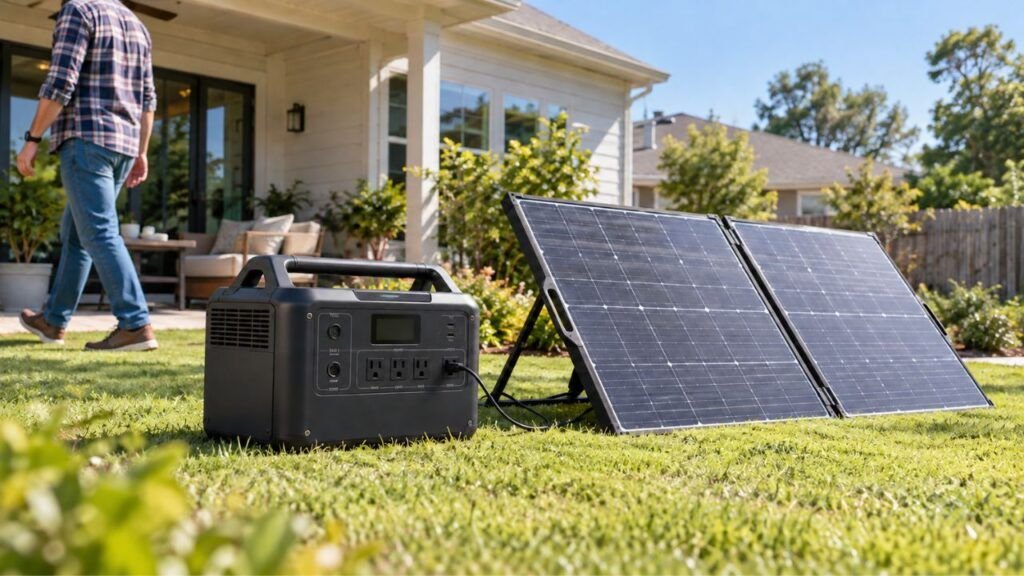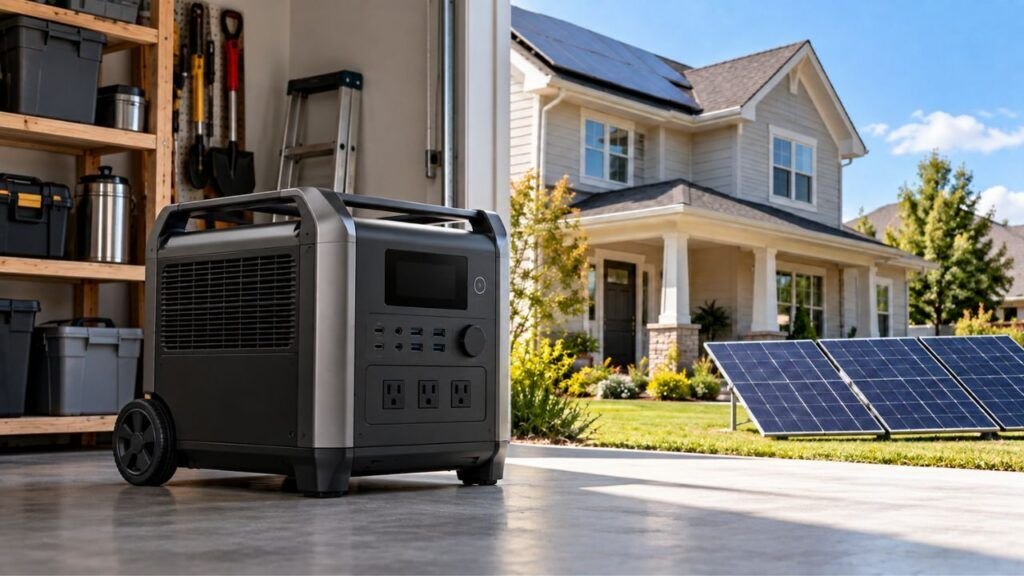
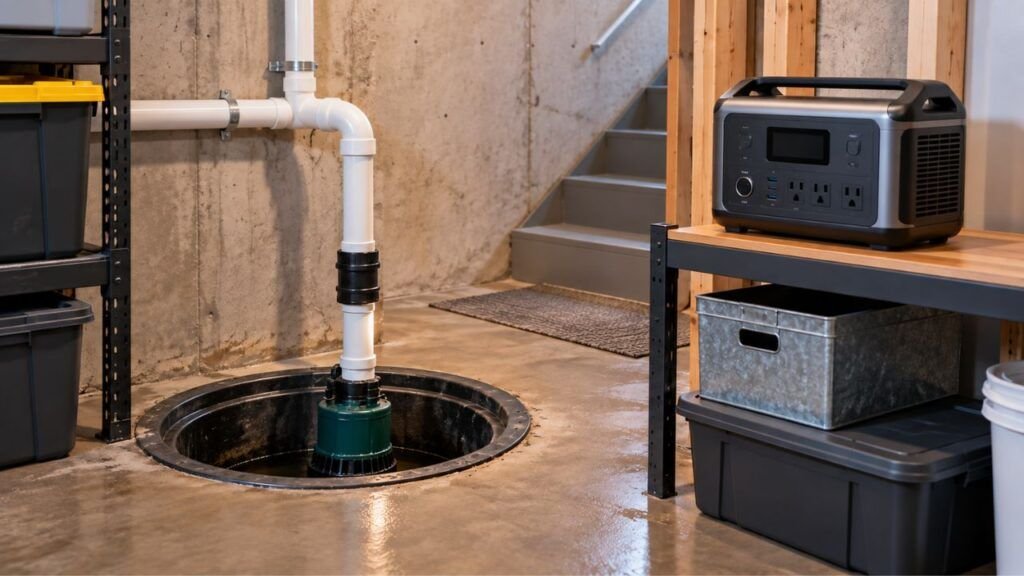
Yes, a properly sized solar generator can run a sump pump during an outage. The generator needs enough continuous output for normal operation and enough surge power to start the pump motor.
In this guide, I’ll help you size the system correctly. We’ll cover pump wattage, startup surge, battery capacity, runtime, solar charging, and storm backup setup.
Key Takeaways
- A solar generator can run most residential sump pumps.
- Startup surge is often the biggest sizing challenge.
- Check your actual pump specifications before choosing a generator.
- Battery watt-hours determine how long the pump can operate.
- Sump pump cycling can greatly extend actual backup runtime.
- Solar panels can extend runtime but depend on available sunlight.
- Test the complete setup before relying on it during storms.
- Keep the solar generator safely away from water and flooding.
How Much Power Does a Sump Pump Use?
Sump pump power use depends on the pump size and motor. Horsepower gives you a rough idea, but actual electrical requirements can vary considerably.
| Sump Pump Size | Approx. Running Watts | Possible Startup Surge | Typical Voltage |
| 1/4 HP | 400–600W | 900–1,500W | 120V |
| 1/3 HP | 600–800W | 1,300–2,500W | 120V |
| 1/2 HP | 800–1,100W | 2,000–4,000W | 120V |
| 3/4 HP | 1,000–1,500W | 2,500–4,500W+ | 120V or 240V |
| 1 HP | 1,500W+ | 3,000–5,000W+ | Varies |
These figures are general planning ranges. Your pump’s nameplate or manufacturer specifications should always take priority.
Running Watts vs. Starting Watts
Running watts are the power the pump uses after starting.
Starting watts are different. A sump pump motor can briefly demand much more power when it switches on.
This initial demand is often called startup surge.
Imagine your pump normally draws around 700 watts. It could briefly require 1,500 watts or considerably more during startup.
A 700-watt power station may therefore fail immediately.
The inverter needs enough extra capacity to handle that initial surge.
Why Horsepower Alone Is Not Enough
It is tempting to size everything using pump horsepower.
I would not rely on horsepower alone.
Two 1/3 HP sump pumps can have different motors. Their electrical consumption and startup requirements may also differ.
Motor efficiency, pump design, discharge pressure, and voltage affect power demand.
Use horsepower only when better information is unavailable.
Your actual pump specifications provide a much safer starting point.
How to Find Your Sump Pump’s Actual Power Requirements
Start by looking at the label attached to the pump.
You can also check its owner’s manual or manufacturer specifications.
Look for:
- Rated voltage
- Running amps
- Running watts
- Starting amps
- Maximum current
- Locked rotor amps, if listed
- Horsepower
- Frequency, usually 60Hz in the USA
If wattage is listed directly, use that figure.
If only voltage and amperage appear, multiplying volts by amps gives you a rough electrical sizing figure.
However, AC motors are more complicated than simple resistive appliances. That calculation should therefore be treated as an estimate.
What Size Solar Generator Do You Need for a Sump Pump?
Choosing the right solar generator requires more than checking battery capacity. I suggest checking voltage, continuous output, surge output, and battery storage separately.
Step 1: Match the Pump Voltage
Start with voltage.
Most common residential sump pumps in the USA operate around 115V or 120V.
That makes them compatible with many portable power stations.
However, some larger pumps can require 240V.
A normal 120V solar generator cannot power a 240V pump. This remains true even if the wattage rating appears large enough.
Always check voltage first.
Step 2: Check Continuous Output
Next, compare the pump’s running demand with the generator’s continuous AC output.
For example, suppose your pump uses 800 watts while running.
I would not choose an inverter rated for exactly 800 watts.
You want some extra capacity.
A generator with 1,200W, 1,500W, or greater continuous output provides much more breathing room.
The exact margin depends on your pump and other connected devices.
Step 3: Check the Startup Surge
This is often the most important step.
The sump pump motor may require several times its normal operating power for a brief moment.
Suppose your pump uses:
- 750W while running
- 2,000W during startup
Your solar generator must handle that 2,000W startup demand.
A unit with a 1,500W continuous inverter but only 1,800W surge capacity could still shut down.
I prefer leaving some headroom rather than sizing directly at the published number.
Step 4: Choose Enough Battery Capacity
Once the generator can start the pump, consider runtime.
This is where watt-hours matter.
A 2,000W inverter and a 2,000Wh battery describe completely different things.
Watts tell you how much power the system can provide.
Watt-hours tell you how much energy the battery stores.
For sump pump backup, you need enough of both.
Step 5: Leave a Safety Margin
Avoid buying a system that barely meets every requirement.
Extra headroom can help compensate for:
- Startup variations
- Older pump motors
- Other connected devices
- Battery losses
- Inverter losses
- Frequent pump cycling
- Changing pumping conditions
- Lower battery charge
A little extra capacity can make your setup much more reliable.
Solar Generator Size by Sump Pump Horsepower
You can use horsepower as a starting point when exact electrical specifications are unavailable. The following table provides reasonable planning categories rather than guaranteed requirements.
| Pump Size | Approx. Running Load | Possible Startup Demand | Suggested Continuous Output | Suggested Surge Capability |
| 1/4 HP | 400–600W | 900–1,500W | 1,000W+ | 1,500W+ |
| 1/3 HP | 600–800W | 1,300–2,500W | 1,500W+ | 2,500W+ |
| 1/2 HP | 800–1,100W | 2,000–4,000W | 2,000W+ | 4,000W+ |
| 3/4 HP | 1,000–1,500W | 2,500–4,500W+ | 2,500W+ | 4,500W+ |
These numbers should help with early planning.
However, your actual pump’s specifications should override any horsepower estimate.
How Long Will a Solar Generator Run a Sump Pump?
Runtime depends heavily on battery size and pump cycling. A sump pump usually runs only when water reaches a certain level, so actual backup time can be much longer than continuous-runtime estimates.
Calculate Continuous Runtime First
A basic runtime calculation looks like this:
Runtime = Usable Battery Capacity ÷ Pump Running Watts
Suppose you have a 2,000Wh battery.
Your pump uses 800 watts.
In perfect conditions:
2,000Wh ÷ 800W = 2.5 hours
But real systems have conversion losses.
The inverter consumes some power while converting battery energy into AC electricity.
You might therefore have around 80% to 90% usable AC energy, depending on the system and operating conditions.
Using an 85% estimate:
2,000Wh × 0.85 = 1,700Wh usable energy
Then:
1,700Wh ÷ 800W = about 2.1 hours
That represents roughly continuous operation.
Your sump pump probably will not run continuously.
Account for Sump Pump Duty Cycle
This is where runtime gets more interesting.
Suppose an 800W sump pump operates for ten minutes each hour.
Ten minutes equals one-sixth of an hour.
The pump therefore uses about:
800W × 1/6 = 133Wh per hour
With around 1,700Wh of usable battery energy:
1,700Wh ÷ 133Wh = about 12.8 hours
That is very different from the two-hour continuous estimate.
The important variable is how often your pump actually runs.
Worked Runtime Example
Let’s use another simple example.
Suppose you have:
- 1/3 HP sump pump
- 700W running demand
- 2,000Wh battery
- 85% estimated usable AC energy
- Pump running 15 minutes per hour
Usable battery energy would be:
2,000Wh × 0.85 = 1,700Wh
Fifteen minutes equals one-quarter of an hour.
Hourly consumption becomes:
700W × 0.25 = 175Wh
Estimated backup runtime:
1,700Wh ÷ 175Wh = about 9.7 hours
This remains an estimate.
A heavier storm might make the pump operate much more frequently.
Estimated Runtime at Different Duty Cycles
The following example assumes a 700W pump and about 85% usable battery energy.
| Battery Capacity | 10% Duty Cycle | 25% Duty Cycle | 50% Duty Cycle | Continuous |
| 1,000Wh | About 12 hours | About 4.9 hours | About 2.4 hours | About 1.2 hours |
| 2,000Wh | About 24 hours | About 9.7 hours | About 4.9 hours | About 2.4 hours |
| 3,000Wh | About 36 hours | About 14.6 hours | About 7.3 hours | About 3.6 hours |
These estimates should not be treated as guaranteed runtimes.
Your actual pump, battery, weather, and cycling pattern can change the result significantly.
Why Sump Pump Cycling Changes Runtime So Much
A sump pump normally waits until water reaches the float switch level.
The pump starts, removes the water, and switches off again.
During light rain, it might stay off most of the time.
During severe rainfall, groundwater can enter much faster.
The pump may then run every few minutes.
In extreme conditions, it could operate almost continuously.
That means the same solar generator might last overnight during one storm but only several hours during another.
This is why I recommend thinking in terms of pump duty cycle rather than advertised battery capacity alone.
Can Solar Panels Keep the Sump Pump Running During an Outage?
Solar panels can extend your backup time, but I would not assume they can keep the pump running indefinitely.
Your charging rate depends on several conditions.
These include:
- Available sunlight
- Cloud cover
- Panel wattage
- Panel angle
- Shading
- Solar input limit
- Battery charge level
- Pump energy consumption
There is another practical problem.
Sump pumps often work hardest during heavy storms.
Heavy storms usually bring clouds.
That means solar production can drop exactly when your pump needs the most backup energy.
Solar charging is still valuable.
I simply recommend treating it as a way to extend runtime rather than your only backup plan.
Can a Solar Generator Automatically Back Up a Sump Pump?
Some solar generators can provide automatic backup operation, while others require manual connection. If you want protection while sleeping or away from home, this distinction matters.
Manual Backup vs. UPS or EPS Backup
With a manual setup, your pump normally uses utility electricity.
When grid power fails, you manually connect the pump to your power station.
That can work if you are home.
It becomes less useful if an outage begins while nobody is there.
Some portable power stations support UPS or EPS-style operation.
In this arrangement, the pump can remain connected through the power station.
The station uses grid electricity normally.
When utility power disappears, it switches the connected load to battery power.
Transfer behavior varies between models.
Do not assume every solar generator supports automatic sump pump backup.
What to Verify Before Depending on Automatic Backup
Check the manufacturer’s specifications for:
- UPS or EPS support
- Transfer time
- Maximum backup load
- Bypass power rating
- Surge capability
- Pass-through charging support
- Automatic AC output behavior
- Battery reserve settings
- Overload recovery
- Long-term plugged-in use
I would also perform a real outage simulation before relying on the system.
How to Set Up a Solar Generator for Sump Pump Backup Safely
Setting up backup power is straightforward, but water and electricity require extra care.
- Check your pump’s voltage and power requirements.
- Confirm the generator’s continuous output.
- Verify that its surge rating covers motor startup.
- Fully charge the battery before severe weather.
- Place the power station somewhere dry and elevated.
- Never place electrical equipment inside a wet sump area.
- Keep plugs and connections away from possible floodwater.
- Follow the pump manufacturer’s electrical instructions.
- Follow the power station manufacturer’s connection requirements.
- Test several complete pumping cycles before an emergency.
- Test automatic switchover if using UPS or EPS mode.
- Check battery charge before major storms.
Do not place the solar generator on a basement floor that could flood.
Higher placement can protect the system if water enters unexpectedly.
Test Your Solar Generator Before a Storm
Do not discover a sizing problem during the storm itself. A practical test can show whether the inverter handles startup and whether your battery setup behaves correctly.
Before bad weather arrives:
- Fully charge the power station.
- Connect only the sump pump first.
- Let water trigger the float switch normally.
- Watch the generator during pump startup.
- Check for overload warnings.
- Let the pump complete several cycles.
- Record battery percentage before testing.
- Check battery percentage afterward.
- Simulate an outage if using automatic backup.
- Confirm that the pump restarts correctly.
Testing only once is better than nothing.
Several normal start-and-stop cycles give you more useful information.
Common Reasons a Solar Generator Won’t Run a Sump Pump
A generator can appear large enough on paper and still fail with a sump pump. These are the problems I would check first.
Startup Surge Is Too High
This is probably the most common issue.
The pump starts, the inverter detects excessive demand, and the power station shuts down.
You may need a generator with greater surge capability.
Continuous Output Is Too Low
The station might briefly start the pump but fail during normal operation.
Check the generator’s continuous AC rating.
Do not rely only on the advertised peak rating.
Other Appliances Are Using Available Power
Maybe the sump pump works perfectly by itself.
Then you add a refrigerator, freezer, lights, and internet equipment.
The combined load could exceed inverter capacity.
Motor appliances can also start at the same time.
That creates an even larger temporary surge.
The Battery Is Nearly Empty
A large inverter does not help if the battery has little energy remaining.
Keep backup batteries charged before storm season.
Check their state of charge whenever severe weather approaches.
The Pump Requires a Different Voltage
A high-output 120V power station still cannot directly operate a 240V pump.
Both wattage and voltage must match.
The Pump Has a Mechanical Problem
Sometimes the generator is not the real issue.
The pump may have:
- A blocked discharge pipe
- A stuck float switch
- A failing motor
- A blocked intake
- A faulty check valve
Backup electricity cannot solve a mechanical sump pump failure.
Solar Generator vs. Dedicated Sump Pump Battery Backup
Both systems can protect your basement during outages, but they solve the problem differently. A solar generator powers your existing equipment, while dedicated systems often use a separate backup pump.
| Feature | Solar Generator | Dedicated Battery Backup Pump |
| Powers existing AC pump | Yes | Usually uses separate pump |
| Automatic backup | Model dependent | Usually built for it |
| Powers other appliances | Yes | Usually no |
| Solar charging | Common | Varies |
| Portable | Yes | Usually fixed |
| Expandable capacity | Often | Varies |
| Installation | Usually simple | Often more involved |
| Best use | Flexible emergency power | Dedicated flood protection |
A solar generator is attractive when you want one backup battery for several household essentials.
A dedicated sump pump backup focuses entirely on flood protection.
Homes with serious flooding risk may benefit from having more than one backup method.
Redundancy matters when water damage could become expensive very quickly.
When a Solar Generator May Not Be Enough
Solar generators work well in many situations, but they are not perfect for every basement.
A solar generator may not be enough when:
- The pump’s startup surge exceeds inverter capacity.
- The pump requires unsupported 240V power.
- Water inflow keeps the pump running constantly.
- The outage lasts several days.
- Cloudy weather severely limits solar charging.
- Several large appliances share the system.
- Battery storage is too small.
- Floodwater could reach the power station.
- You need completely automatic redundant flood protection.
If your basement floods quickly after losing power, I would place reliability above portability.
A dedicated secondary pump or another backup system can provide another layer of protection.
Final Words
Yes, a solar generator can run a sump pump, and it can be a practical backup during power outages.
The key is sizing it correctly. Continuous output keeps the pump running, while surge output gets the motor started. Battery capacity then determines how long the system can keep supporting those pump cycles.
Check your actual pump specifications before buying anything. Then test the complete setup before storm season arrives. That gives you much more confidence than relying on generic horsepower estimates alone.
Related FAQs
Can a 1,000-Watt Solar Generator Run a Sump Pump?
It can run some smaller sump pumps, but startup surge is the deciding factor. A pump using 600W normally could require far more than 1,000W when its motor starts, so check both continuous and surge ratings.
What Size Solar Generator Do I Need for a 1/3 HP Sump Pump?
Many 1/3 HP pumps may need around 600–800W while running and considerably more during startup. A solar generator with roughly 1,500W continuous output and strong 2,000–2,500W or greater surge capability provides a better planning range, but verify your actual pump.
What Size Solar Generator Do I Need for a 1/2 HP Sump Pump?
A 1/2 HP sump pump often requires a larger inverter because its startup demand can reach several thousand watts. A system around the 2,000W continuous class with substantially higher surge capability may be appropriate, but always confirm the specific pump requirements.
How Many Watts Does a 1/3 HP Sump Pump Use?
A 1/3 HP residential sump pump may use roughly 600–800 watts while operating, though actual consumption varies by model. Startup demand can be much higher, so check the pump label or manufacturer’s specifications.
How Many Watts Does a 1/2 HP Sump Pump Use?
A 1/2 HP pump may use around 800–1,100 watts during normal operation. Motor startup can require several times that amount for a brief period, which makes inverter surge capacity especially important.
How Long Will a 2,000Wh Solar Generator Run a Sump Pump?
It depends on pump wattage and how often the pump runs. An 800W pump running continuously might get roughly two hours after normal conversion losses, while intermittent cycling could extend backup time to many hours.
Can I Leave My Sump Pump Plugged Into a Portable Power Station?
You can with some power stations designed for pass-through or UPS/EPS operation. Check the manufacturer’s instructions, maximum load, transfer behavior, and long-term charging recommendations before using it as a permanent backup.
Can Solar Panels Run a Sump Pump Directly?
Most standard AC sump pumps should not be connected directly to solar panels. They normally require a solar generator containing a battery and inverter that provides stable 120V AC power and enough startup surge.
Can a Solar Generator Run a Sump Pump and Refrigerator Together?
Yes, if the inverter has enough continuous and surge capacity for both appliances. Remember that both use motors, so overlapping startup surges can place a much larger temporary load on the generator.
Can a Solar Generator Run a 240V Sump Pump?
Only when the solar power system provides compatible 240V AC output and enough continuous and startup power. A standard 120V portable power station cannot directly operate a 240V pump.
Is a Solar Generator Better Than a Sump Pump Battery Backup?
Neither option is automatically better for every home. A solar generator provides flexible power for several devices, while a dedicated battery backup system focuses specifically on keeping the sump system operating automatically.
Should I Test My Solar Generator With the Sump Pump Before a Storm?
Yes. Let the sump pump complete several normal start-and-stop cycles while connected to the generator. This helps confirm that startup surge, continuous output, battery performance, and automatic transfer features work as expected.

Blake Cooper writes practical guides on generators, portable power stations, and home backup systems. He focuses on simplifying power topics and helping homeowners make informed buying decisions.