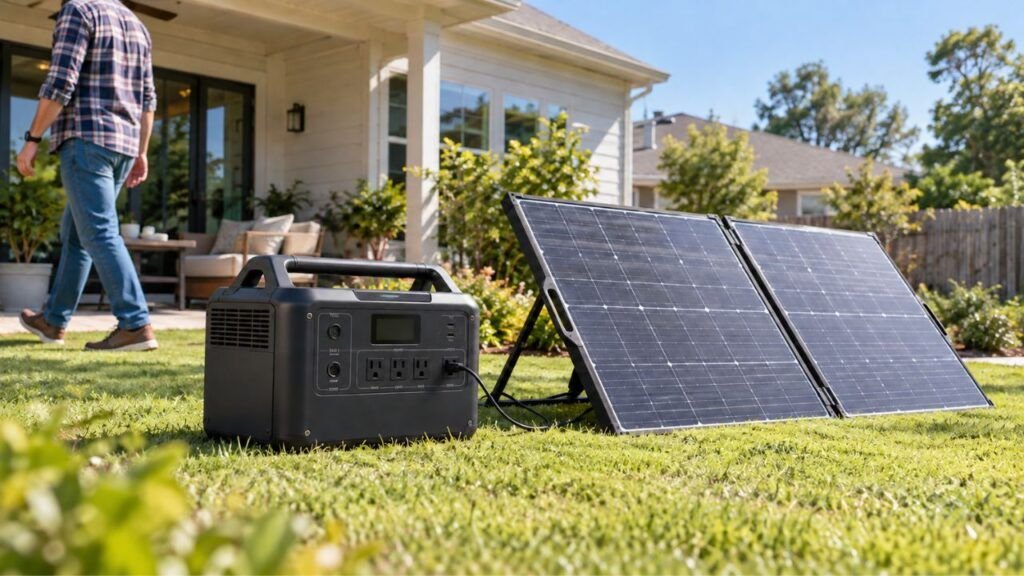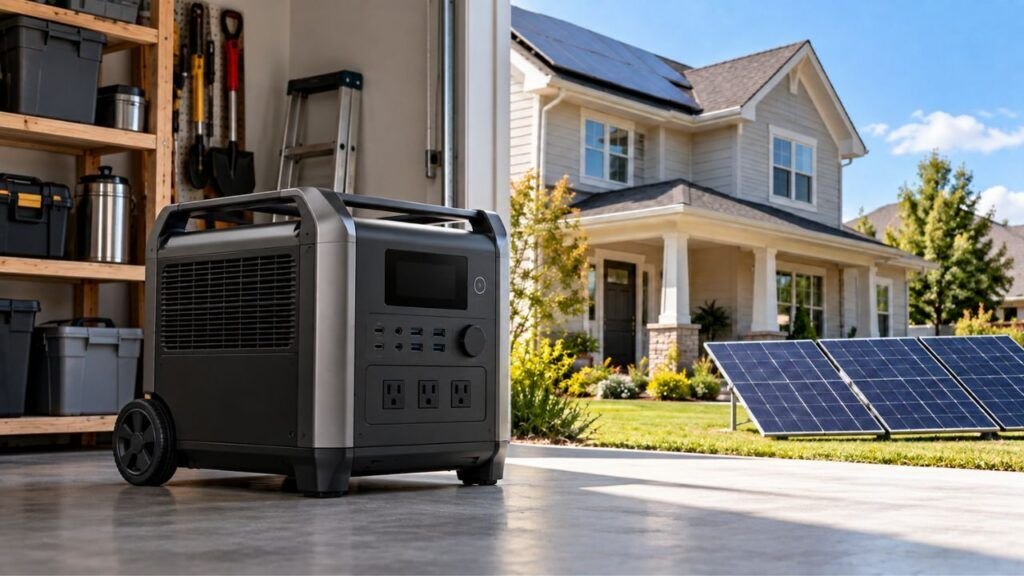
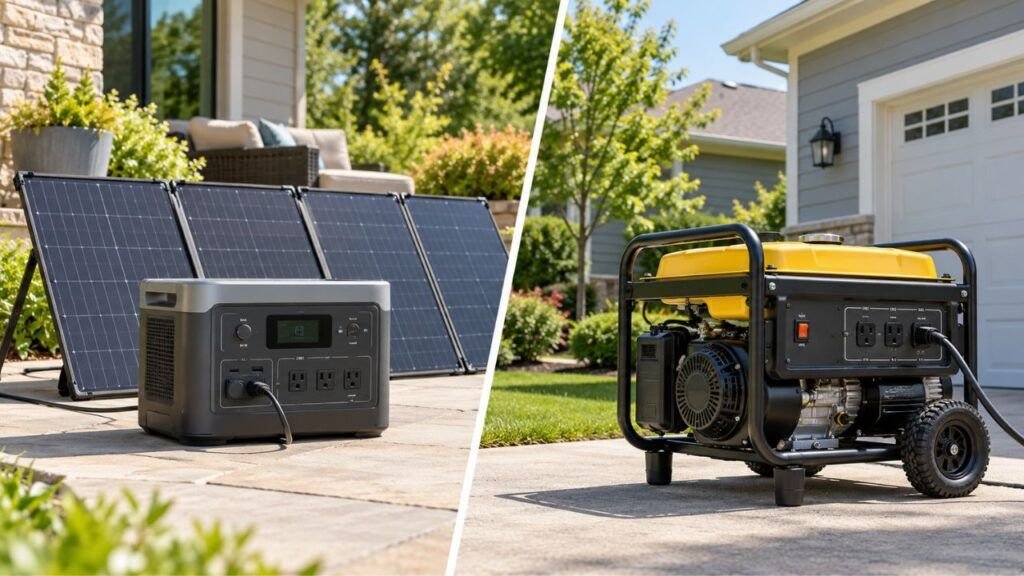
A solar generator is usually better for quiet, low-maintenance home backup. A gas generator can provide longer runtime when fuel remains available. Your best option depends on power needs, outage length, voltage, and recharging plans.
In this guide, I’ll compare power, runtime, safety, costs, appliances, and long-outage performance. You’ll also see when combining both systems can make more sense.
Key Takeaways
- Solar generators store electricity in batteries for later use.
- Gas generators produce electricity by burning fuel while operating.
- Solar generators are quiet and require relatively little maintenance.
- Gas generators can keep running when you continue supplying fuel.
- Battery watt-hours determine how long a solar generator can run.
- Starting watts matter for refrigerators, pumps, and air conditioners.
- Some large household appliances require 240V backup power.
- Gas generators must always operate safely outside the home.
- A hybrid solar and gas setup can improve outage flexibility.
Solar Generator vs Gas Generator: Quick Comparison
The biggest differences involve stored energy, fuel, noise, runtime, and maintenance. This table gives you a quick overview before we examine each factor.
| Feature | Solar Generator | Gas Generator |
| Energy source | Stored battery electricity | Gasoline, propane, or supported fuel |
| Recharging/refueling | Solar, AC, vehicle, or other supported source | Add fuel |
| Power output | Depends on inverter size | Depends on generator size |
| Runtime | Limited by battery capacity | Limited by available fuel |
| Noise | Usually very quiet | Engine noise during operation |
| Indoor operation | Battery unit may operate indoors | Never operate indoors |
| Maintenance | Relatively low | Regular engine maintenance |
| Fuel cost | None when charging from sunlight | Ongoing fuel expense |
| 120V support | Common | Common |
| 240V support | Available on selected models | Available on many larger models |
| Multi-day outages | Requires effective recharging | Requires enough stored or available fuel |
| Best use | Quiet essential backup | Sustained or demanding backup |
Neither system automatically works better for every household. Your appliances and outage conditions should guide the decision.
What Is the Difference Between a Solar and Gas Generator?
Both systems provide electricity during an outage, but they create that power differently. That difference affects runtime, noise, maintenance, safety, and everyday convenience.
How a Solar Generator Works
A solar generator is essentially a battery-based portable power station. It stores electricity and sends that power through an inverter.
The inverter converts stored DC electricity into household AC electricity. You can then plug compatible appliances into the available outlets.
Despite the name, solar panels are not always required. You can often recharge these units through:
- Solar panels
- A household wall outlet
- A vehicle charging connection
- Alternator chargers on compatible systems
- A compatible fuel generator
That also means a solar generator works at night. It simply uses electricity already stored inside its battery.
Solar becomes important when you need to replace consumed energy.
How a Gas Generator Works
A gas generator produces electricity while its engine is running. The engine burns gasoline or another compatible fuel.
That engine drives an alternator, which creates usable electrical power.
The main advantage is simple. You do not depend on stored battery capacity.
As long as you have enough fuel, you can continue producing electricity. However, you also have engine noise, exhaust, refueling, and maintenance.
Portable Generators vs Permanent Backup Systems
It helps to keep this comparison focused.
Here, I am mainly comparing portable or expandable solar generators with portable gas generators.
A permanently installed standby generator is a different type of system. Whole-home battery systems also belong in another category.
Those solutions often involve professional installation, automatic transfer equipment, and much larger budgets.
Which Provides More Power for Home Backup?
Power ratings can become confusing because manufacturers use several different numbers. I would focus on running watts, surge watts, battery capacity, and voltage.
Running Watts vs Starting Watts
Running watts tell you how much continuous power a generator supplies.
Starting watts describe short bursts of additional power available for certain appliances.
Motor-driven appliances often require extra power when starting. Common examples include:
- Refrigerators
- Freezers
- Sump pumps
- Well pumps
- Window air conditioners
- Some central air conditioners
Suppose a refrigerator needs 200 watts while running. It might briefly require much more when its compressor starts.
Your generator must handle both requirements.
That applies whether you choose solar or gas.
Battery Capacity Is Not the Same as Power Output
This is one of the easiest specifications to misunderstand.
Watts measure power.
Watt-hours measure stored energy.
For example, a solar generator might provide 3,600 watts of continuous AC output. Its battery might store 3,000 watt-hours of energy.
Those numbers answer different questions.
The 3,600W rating helps determine what appliances it can operate together.
The 3,000Wh rating helps determine how long those appliances can operate.
A large inverter does not automatically mean long battery runtime.
120V vs 240V Home Appliances
Many everyday household appliances operate on 120V power.
That includes lights, televisions, refrigerators, routers, and small appliances.
However, larger household equipment may require 240V.
Examples can include:
- Central air conditioners
- Electric water heaters
- Well pumps
- Electric ranges
- Clothes dryers
- Large heat pumps
If you need to power 240V equipment, check this before buying anything.
Many smaller solar generators only provide 120V output. Larger solar systems may support 120V and 240V operation.
Larger gas generators commonly offer 240V capability as well.
Always check the appliance nameplate and generator specifications.
What Appliances Can Each Generator Run?
Both generator types can power common household essentials when properly sized. The important question is whether output, startup capacity, voltage, and available energy match your appliances.
| Appliance | Main Requirement | Solar Generator | Gas Generator |
| Refrigerator | Running and startup watts | Usually practical | Usually practical |
| Wi-Fi router | Low continuous power | Easy load | Easy load |
| Lights | Total connected wattage | Easy load | Easy load |
| Television | Moderate continuous load | Usually practical | Usually practical |
| Gas furnace blower | Startup watts | Depends on system | Depends on system |
| Sump pump | Motor startup surge | Check inverter rating | Check surge rating |
| Well pump | Surge and possible 240V | Large system may be needed | Large system may be needed |
| Window AC | Startup and running watts | Larger units work better | Proper sizing required |
| Central AC | High surge and possible 240V | Large compatible systems | Large compatible generator |
| Space heater | High continuous consumption | Uses battery quickly | Uses significant fuel |
| Electric dryer | Usually 240V, high demand | Large system required | Large generator required |
Avoid buying based only on total generator wattage.
Make a list of the appliances you actually need.
Then check their running watts, startup requirements, and voltage.
Solar Generator vs Gas Generator Runtime
Runtime works very differently between these systems. Solar runtime depends on stored watt-hours, while gas runtime depends mainly on fuel consumption.
How Long Does a Solar Generator Last?
You can estimate battery runtime with a simple formula:
Usable battery watt-hours ÷ average load watts = approximate runtime
Suppose you have a 2,000Wh battery.
Not every rated watt-hour normally reaches your appliances. The inverter and internal electronics consume some energy.
For a simple example, assume 85% usable energy.
That gives you:
2,000Wh × 0.85 = 1,700Wh usable energy
Now suppose your appliances average 200 watts.
1,700Wh ÷ 200W = 8.5 hours
That gives you roughly 8.5 hours under those assumptions.
Real runtime may change because of:
- Appliance cycling
- Temperature
- Battery condition
- Inverter efficiency
- Standby consumption
- Actual appliance power use
Use calculations for planning rather than guaranteed runtime.
How Long Does a Gas Generator Run?
Gas generator runtime depends on fuel consumption and electrical load.
A generator running lightly normally consumes less fuel than one running near maximum output.
That is why advertised runtime needs context.
If a manufacturer says a generator runs eight hours at 25% load, do not assume it runs eight hours at full power.
You should check:
- Tank size
- Rated load during testing
- Fuel type
- Eco mode availability
- Fuel consumption
- Expected household load
For longer outages, available fuel becomes the real energy-storage system.
Why the Second Day Matters
A six-hour outage and a three-day outage create very different problems.
With a solar generator, the second-day question becomes:
Can I recharge enough energy to replace what I consumed?
With a gas generator, the question becomes:
Do I have enough fuel to keep operating tomorrow?
This is why I would never compare the systems using runtime alone.
You also need a realistic replenishment plan.
What Happens During a 6-Hour, 24-Hour, or Multi-Day Outage?
Outage duration can completely change which system feels more convenient. Short outages favor simplicity, while longer outages make energy replenishment increasingly important.
| Outage Length | Solar Generator | Gas Generator | Main Concern |
| 2–6 hours | Very convenient when already charged | Reliable but requires outdoor setup | Convenience |
| Overnight | Quiet operation is helpful | Noise and fuel monitoring continue | Noise and fuel |
| Around 24 hours | Battery capacity and recharging matter | Fuel consumption becomes important | Energy supply |
| 2–3 days | Solar input and extra storage become important | Fuel availability becomes critical | Replenishment |
| Extended outage | Multiple charging sources help | Large fuel supply may be required | Long-term resilience |
For short outages, a charged battery system can be extremely convenient.
You can bring power online quickly without starting an engine.
Once the outage continues into another day, energy replacement becomes more important.
That is where both systems require planning.
Recharging Solar vs Refueling Gas During a Long Outage
Long outages are less about the generator itself and more about restoring consumed energy. Solar needs effective charging conditions, while gas systems require continued fuel access.
Solar Recharging
The solar panels can extend runtime during longer outages.
However, panel wattage alone does not tell you how much energy you will collect.
Real solar charging depends on:
- Panel wattage
- Generator solar input limit
- Sun angle
- Panel orientation
- Shade
- Cloud cover
- Season
- Temperature
- Charging efficiency
Imagine an 800W solar array receiving four strong peak-sun hours.
Under perfect conditions, that suggests 3,200Wh of theoretical solar energy.
Real-world losses reduce how much reaches the battery.
If your home uses more energy each day than your panels replace, the battery eventually empties.
That remains true even with a large battery.
Extra batteries increase stored energy. They do not increase daily solar production.
Other Ways to Recharge a Solar Generator
Solar is not your only charging option.
Many modern systems support several charging methods.
Depending on the product, you may use:
- Household AC power
- Solar panels
- Vehicle charging
- Alternator charging
- A compatible fuel generator
This flexibility matters during extended outages.
For example, you might use solar whenever weather allows. You could then use another compatible charging source when solar production falls short.
Always follow the manufacturer’s charging requirements.
Gas Generator Refueling
A gas generator solves the charging problem differently.
You add more fuel.
That can make continuous operation easier during poor weather. However, your backup plan depends on fuel remaining available.
Think about:
- Safe fuel storage
- Fuel container capacity
- Fuel shelf life
- Generator consumption
- Local fuel availability
- Refueling frequency
- Maintenance intervals
Never refuel a hot or running generator.
Let the unit cool and follow its operating instructions.
Which Is Safer for Home Backup?
Safety should influence your choice just as much as wattage. Fuel generators create combustion exhaust, while battery systems bring different electrical and battery-related precautions.
Carbon Monoxide Safety With Gas Generators
Portable fuel generators produce carbon monoxide.
Carbon monoxide is invisible and can become deadly before you notice it.
Never operate a portable gas generator inside:
- Your home
- A garage
- A basement
- A shed
- An enclosed porch
- Any partially enclosed living area
Opening a garage door does not make indoor generator use safe.
For home use, place the generator outdoors and well away from doors, windows, vents, and other openings.
A common U.S. safety guideline is at least 20 feet from the home, with exhaust directed away from buildings.
Your property needs enough outdoor space to operate the unit safely.
If it does not, a portable fuel generator may not be practical there.
Indoor Use of Solar Generators
Battery power stations do not create combustion exhaust while operating.
That makes them much easier to use around living spaces.
However, indoor use still requires common sense.
Follow the manufacturer instructions regarding:
- Ventilation
- Charging
- Operating temperature
- Moisture
- Storage
- Clearance around cooling vents
Never use damaged batteries or equipment.
A solar generator may be quieter and cleaner during operation, but it still contains high-energy electrical components.
CO Alarms, Weather, and Refueling Safety
If you use a gas generator, prepare your safety setup before an outage.
Important precautions include:
- Keep working carbon monoxide alarms inside the home.
- Keep exhaust directed away from buildings.
- Protect the generator from unsafe weather exposure.
- Use properly rated extension cords.
- Keep fuel away from living areas.
- Let the generator cool before refueling.
- Follow manufacturer maintenance requirements.
A carbon monoxide shutdown feature adds protection. It does not replace proper outdoor placement.
How Do You Connect Either Generator to Your House?
Running one refrigerator is different from powering household circuits. How you connect the generator determines what equipment and professional installation you may need.
Plugging Appliances Directly Into the Generator
The simplest approach is connecting appliances directly to generator outlets.
This works well when you only need a few essentials.
For example:
- Refrigerator
- Freezer
- Lamps
- Router
- Phone chargers
- Television
Use properly rated cables and follow the generator manufacturer’s instructions.
Also avoid overloading a single outlet or extension cord.
Using a Transfer Switch or Generator Inlet
If you want to power circuits inside your electrical panel, the setup changes.
A properly installed transfer system allows backup power to feed selected household circuits while isolating them from utility power.
Depending on the equipment, this could involve:
- A manual transfer switch
- A generator inlet
- An interlock system where permitted
- A smart home panel
- Manufacturer-specific backup equipment
Have a qualified electrician determine the proper setup for your home.
This is especially important with 240V systems or larger loads.
Never Backfeed Through a Wall Outlet
Never connect generator output to a normal household outlet to energize your home.
This is sometimes called backfeeding.
It can energize wiring unexpectedly and create serious electrocution risks.
It can also endanger utility workers repairing electrical lines.
Use proper transfer equipment whenever backup power connects to household wiring.
Which Costs Less: Solar or Gas Generator?
Purchase price tells only part of the story. I would compare complete systems that perform the same backup job rather than comparing two product boxes.
Upfront Cost
Gas generators often provide substantial power at a relatively affordable purchase price.
Large solar generators generally cost more, especially after adding:
- Solar panels
- Expansion batteries
- 240V equipment
- Home integration hardware
However, remember to compare complete systems.
A gas generator may also require:
- Heavy-duty extension cords
- Fuel containers
- Transfer equipment
- Maintenance supplies
- Installation work
Look at everything required to make each option usable.
Ongoing Cost
A solar generator has relatively low operating expenses when charged from sunlight.
Grid charging still consumes electricity.
Battery cells also age gradually over years of use.
Gas generators have recurring expenses such as:
- Gasoline or propane
- Engine oil
- Filters
- Spark plugs
- Maintenance
- Repairs
The actual lifetime cost depends heavily on outage frequency.
Someone running backup equipment twice yearly has different economics from someone using it every month.
Hidden Ownership Costs
Here is a more useful way to compare expenses.
| Expense | Solar Generator | Gas Generator |
| Main equipment | Often higher for large capacity | Often lower per watt |
| Solar panels | Optional additional cost | Not required |
| Expansion capacity | Extra batteries | Extra stored fuel |
| Fuel cost | None with solar charging | Recurring |
| Grid charging | Electricity cost | Not applicable |
| Engine maintenance | None | Required |
| Battery aging | Yes | Not applicable |
| Home connection | Possible cost | Possible cost |
| Accessories | Panels, cables, batteries | Cords, fuel containers, maintenance supplies |
There is no universal break-even year.
Your usage pattern determines whether one system saves meaningful money.
Noise, Maintenance, Storage, and Everyday Convenience
Specifications matter, but living with the equipment matters too. Think about what you actually want to manage at midnight during an outage.
A solar generator generally offers:
- Quiet operation except for cooling fans.
- No engine starting procedure.
- No routine oil changes.
- Easy indoor battery access where permitted.
- Simple battery-level monitoring.
- Less mechanical maintenance.
- Solar panels that require storage space.
A gas generator usually involves:
- Moving it to a safe outdoor location.
- Checking fuel before operation.
- Starting and stopping the engine.
- Monitoring fuel levels.
- Engine noise during use.
- Oil and filter maintenance.
- Fuel storage and rotation.
- Outdoor weather considerations.
Keep both systems ready between outages.
A dead battery is not useful during an emergency.
Neither is a gas generator that has not been maintained.
Which Works Better in Different Home Backup Situations?
There is no single answer for every home. I would match the backup system to the outage pattern and appliances you actually expect to use.
Short, Occasional Power Outages
Solar generators are especially convenient for shorter outages.
If the battery is already charged, power is immediately available.
You avoid starting an engine, managing exhaust, or handling fuel.
This makes battery backup practical for refrigerators, lights, routers, electronics, and other essentials.
Multi-Day Storm Outages
This is where your energy replacement strategy matters most.
A solar setup needs enough panel production to replenish daily consumption.
Clouds, snow, shade, and limited daylight can reduce charging.
A gas generator can continue producing power if fuel remains available.
However, long regional outages can also affect gas stations and fuel availability.
Prepare for both possibilities.
Homes With Well Pumps or Other 240V Loads
Well pumps can create challenging backup loads.
Many require strong startup power, and some operate at 240V.
Do not assume any solar or gas generator can handle them.
Check:
- Pump voltage
- Running watts
- Starting watts
- Generator voltage output
- Surge capability
Large solar systems can run certain 240V pumps.
Properly sized gas generators can also handle these loads.
The specifications decide, not the generator category.
Homes That Need Air Conditioning
Air conditioning can dramatically increase backup requirements.
A small window AC is very different from a large central system.
Central air conditioners may require:
- 240V output
- High continuous wattage
- Large startup surge
- Significant daily energy
Large battery systems can support certain central AC setups.
However, air conditioning can consume stored battery energy quickly.
Gas generators also need sufficient output and fuel capacity.
Apartments and Homes With Limited Outdoor Space
This is one situation where physical placement matters enormously.
A portable fuel generator requires safe outdoor operating space.
Apartments, balconies, narrow townhomes, and dense neighborhoods can make this difficult or impossible.
Battery systems avoid combustion exhaust during normal operation.
That makes them more practical in many space-constrained situations.
Still, follow all building rules and manufacturer requirements.
Rural Homes With Frequent Long Outages
Rural homes often face a different challenge.
Outages may last longer, and homes may depend on:
- Well pumps
- Septic equipment
- Heating systems
- Freezers
- Large refrigerators
Here, backup redundancy becomes valuable.
A larger solar battery system may provide quiet everyday backup.
A fuel generator may provide another energy source during extended outages.
Combining both can also reduce dependence on one charging method.
Should You Use a Solar Generator and Gas Generator Together?
You do not necessarily have to choose only one system. A hybrid approach can combine quiet battery operation with fuel-powered charging during longer outages.
One practical strategy is using the battery overnight and for everyday essentials. Then you run the gas generator only when heavier loads or battery recharging require it.
A combined setup can provide:
- Quiet nighttime backup
- Fewer generator operating hours
- Solar charging when sunlight is available
- Fuel-based charging during poor weather
- More flexibility during multi-day outages
- Another backup option if one energy source becomes limited
However, confirm compatibility before connecting equipment.
The power station must accept the generator’s voltage, frequency, and charging output.
Follow both manufacturers’ instructions.
The fuel generator must still operate outside in a safe location.
How to Choose Between a Solar and Gas Generator
The easiest way to choose is by working backward from your household. Do not start by asking which technology sounds better.
- List the appliances you consider essential.
- Find their running wattage.
- Identify appliances with large startup requirements.
- Check whether anything requires 240V.
- Estimate how many watt-hours you use daily.
- Decide how long you want backup power available.
- Check whether you have safe outdoor generator space.
- Evaluate your realistic solar panel placement.
- Consider local fuel storage and availability.
- Compare the complete cost of both setups.
- Decide how you will recharge or refuel after day one.
- Consider a hybrid system if you need more redundancy.
Once you answer those questions, the better option usually becomes much clearer.
Common Mistakes When Comparing Solar and Gas Generators
Many buying mistakes come from comparing the wrong specifications. Avoid these common problems before choosing your home backup system.
- Comparing watts directly with watt-hours.
- Ignoring refrigerator or pump startup surge.
- Assuming every solar generator supports 240V.
- Assuming every gas generator can power an entire house.
- Using advertised runtime without checking test load.
- Assuming solar panels always recharge batteries fully each day.
- Ignoring cloudy weather, shade, or winter sunlight.
- Forgetting fuel storage and availability.
- Ignoring safe generator placement requirements.
- Backfeeding electricity through a household outlet.
- Comparing bare equipment prices instead of complete systems.
- Buying too little battery capacity for overnight use.
- Buying excessive wattage without calculating actual loads.
- Assuming a portable generator will be easy to carry.
Final Verdict
For many homeowners, a solar generator is the easier choice for quiet, convenient backup of essential appliances. It works especially well when you want low maintenance, indoor battery operation, and simple power during shorter outages.
A gas generator becomes attractive when you need sustained energy during longer outages. It can also support demanding loads when properly sized. However, you need safe outdoor placement, fuel storage, regular maintenance, and a dependable refueling plan.
If you regularly prepare for both short and multi-day outages, combining both technologies can offer greater flexibility. Use the battery for quiet everyday backup, then keep fuel generation available when you need another way to restore energy.
Related FAQs
Here are a few common questions homeowners ask when comparing solar generators and gas generators for backup power.
Is a Solar Generator Better Than a Gas Generator for Home Backup?
A solar generator is often better for quiet, low-maintenance essential backup, while a gas generator can be more practical for long outages requiring sustained power. Your appliances, outage duration, voltage needs, and available outdoor space should guide the choice.
Can a Solar Generator Power an Entire House?
Some large solar generator systems can support many household circuits or even substantial whole-home loads. However, you must consider inverter output, battery capacity, 120V or 240V requirements, startup loads, and your home’s electrical connection.
Can a Solar Generator Run a Refrigerator Overnight?
Yes, many properly sized solar generators can run a refrigerator overnight. Actual runtime depends on battery capacity, refrigerator energy consumption, compressor cycling, startup surge, inverter losses, and other connected appliances.
Can a Solar Generator Run Central Air Conditioning?
Large solar generators can run some central air conditioners when they provide enough continuous power, surge capacity, and required voltage. Central AC uses significant energy, so battery capacity and runtime become just as important as inverter wattage.
How Long Will a Solar Generator Run During an Outage?
Runtime depends on usable battery capacity and your average electrical load. Divide usable watt-hours by average watts to create an estimate, then allow for inverter losses and changing appliance consumption.
How Long Can a Gas Generator Run Continuously?
Runtime depends on generator design, fuel tank size, electrical load, fuel consumption, and manufacturer operating requirements. You should follow maintenance intervals and never assume a published runtime at light load applies at maximum output.
Is a Solar Generator Cheaper to Operate Than a Gas Generator?
Solar generators can have lower ongoing operating costs because sunlight does not require purchased fuel. However, the initial system may cost more, grid charging uses electricity, and batteries eventually age and require replacement.
Can You Use a Gas Generator to Charge a Solar Generator?
Many solar generators can charge from a compatible gas generator through their AC charging input. Check voltage, frequency, charging wattage, grounding requirements, and manufacturer compatibility before connecting the two systems.
How Far Should a Gas Generator Be From the House?
A portable fuel generator should generally operate outdoors at least 20 feet from the home, with exhaust directed away from windows, doors, vents, and nearby buildings. Always follow the generator manufacturer’s safety instructions.
Do I Need a Transfer Switch for a Solar or Gas Generator?
You usually need appropriate transfer equipment when connecting backup power to household electrical circuits. You may not need one when plugging individual appliances directly into the generator using properly rated connections.
Do I Need a 240V Generator for Home Backup?
You need 240V capability if you plan to run appliances requiring 240V power. Common examples include certain well pumps, central air conditioners, electric dryers, ranges, water heaters, and larger HVAC equipment.
Can Solar Panels Recharge a Generator During Cloudy Weather?
Yes, solar panels can still produce electricity during cloudy conditions, but output may fall significantly. Battery size, panel capacity, weather, season, shade, and daily energy use determine whether solar can replace the energy you consume.

Blake Cooper writes practical guides on generators, portable power stations, and home backup systems. He focuses on simplifying power topics and helping homeowners make informed buying decisions.