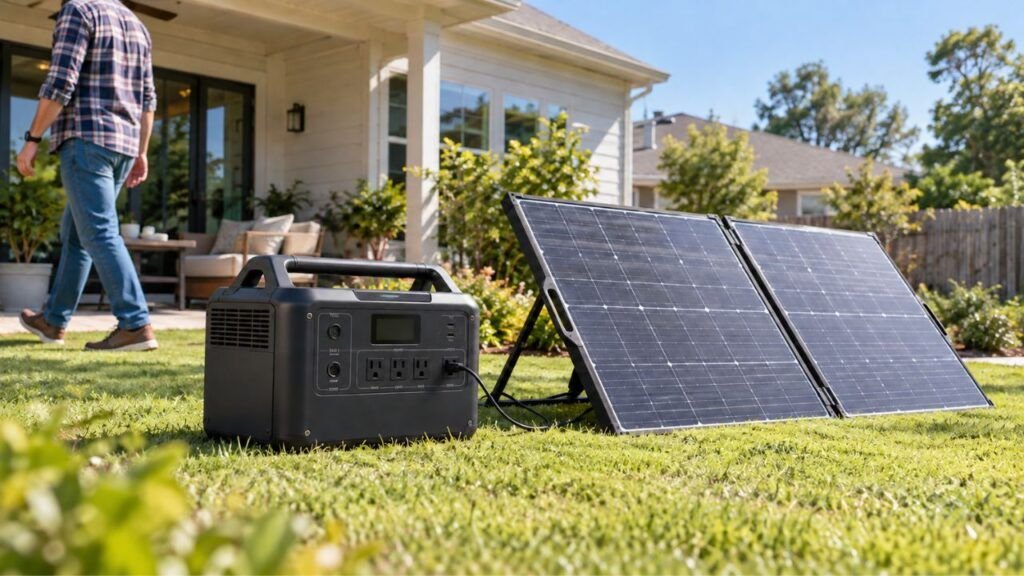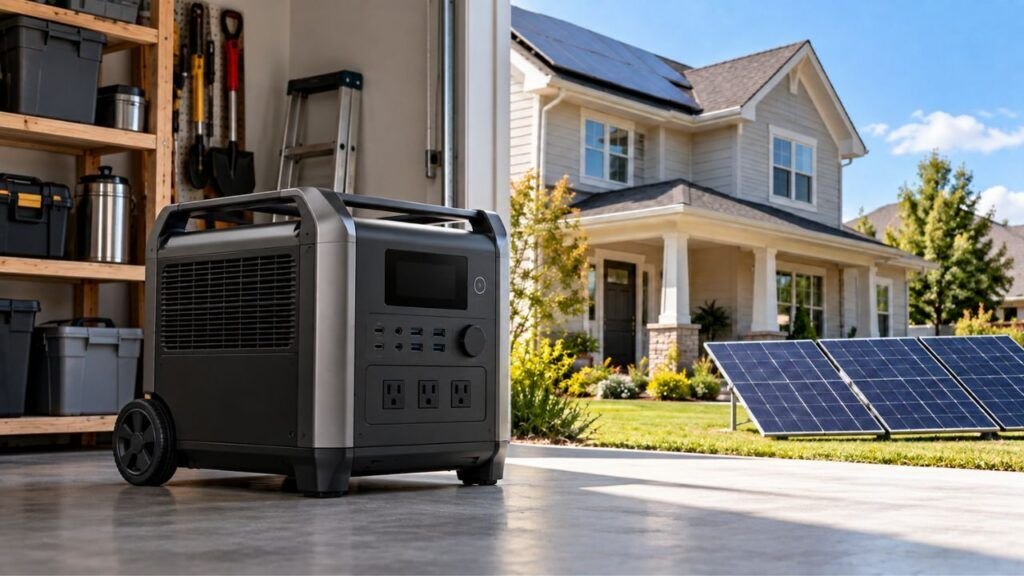
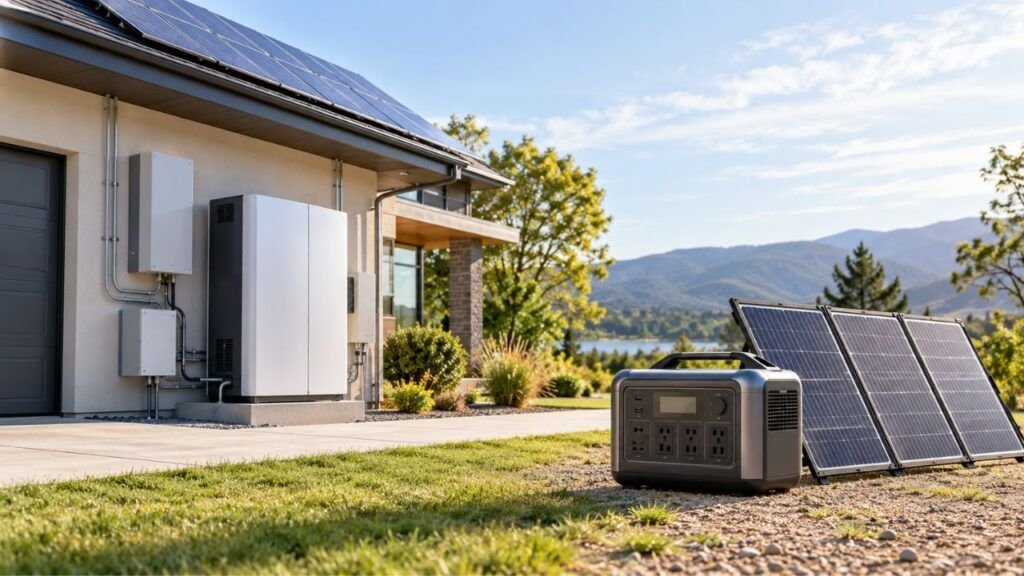
A portable solar generator is best for essential appliances, flexible backup, and lower-cost emergency power. A whole-house solar generator is better for automatic home backup, multiple circuits, larger battery capacity, and demanding 240V appliances.
The right choice depends on your actual power needs. Below, I’ll compare capacity, runtime, voltage, solar charging, installation, costs, and real home backup situations.
Key Takeaways
- Portable solar generators work well for essential household appliances.
- Whole-house systems offer larger capacity and easier home integration.
- Battery capacity determines how long your backup power lasts.
- Inverter output determines how many appliances can run together.
- Many large household appliances require 240V power.
- Some expandable portable systems can support home electrical panels.
- Solar charging capacity matters greatly during extended power outages.
- Whole-house backup does not mean every appliance runs continuously.
Portable vs Whole-House Solar Generator: Quick Comparison
Portable and whole-house systems serve different backup needs. However, today’s expandable systems can sometimes blur the line between them.
| Feature | Portable Solar Generator | Whole-House Solar Generator |
| Main purpose | Essential appliance backup | Multiple circuits or whole-home backup |
| Installation | Usually plug-and-play | Usually permanently installed |
| Portability | High to moderate | Very limited |
| Battery capacity | Small to large | Usually larger and expandable |
| AC output | Varies by model | Usually higher |
| 120V support | Common | Common |
| 240V support | Model-dependent | Common on suitable systems |
| Panel connection | Possible with compatible equipment | Common |
| Automatic backup | Limited or model-dependent | Often available |
| Solar charging | Portable or fixed panels | Usually larger fixed arrays |
| Heavy appliances | Limited by output | Better suited when properly sized |
| Outage setup | Often manual | Usually more automatic |
| Best for | Essential loads and flexible use | Integrated home backup |
The biggest difference is not simply physical size. The real difference involves capacity, voltage, integration, and automation.
What Do Portable and Whole-House Solar Generator Actually Mean?
The terms can become confusing because modern systems overlap. Understanding the equipment helps you compare them more accurately.
What Is a Portable Solar Generator?
A portable solar generator combines a rechargeable battery, inverter, charge controller, and several power outlets.
Solar panels collect sunlight and send electricity into the battery. The inverter then converts stored DC electricity into usable AC electricity.
Most portable systems can also recharge from a wall outlet. Many support vehicle charging and additional expansion batteries.
You can normally plug appliances directly into the power station. That makes portable models convenient during short outages.
Some larger models can also work with transfer equipment. This allows them to supply selected household circuits safely.
What Is a Whole-House Solar Generator?
A whole-house solar generator usually refers to a larger battery backup system connected to your home’s electrical system.
The setup may include:
- One or more battery modules
- A high-output inverter
- Solar panels
- Transfer equipment
- Backup controls
- Energy management hardware
The system can automatically supply household circuits when utility power disappears.
Depending on its size, it might support essential circuits or most household loads.
Many installers call these systems whole-home battery backup or solar-plus-storage systems rather than solar generators.
Why the Difference Is Becoming Less Clear
Portable solar generators have become much more capable.
Some larger systems now support expansion batteries, 240V output, transfer switches, smart panels, and automatic backup.
Once several batteries and permanent electrical equipment are added, a portable system may function much like a traditional whole-home battery.
At that point, the real comparison becomes system architecture rather than portability.
How Portable and Whole-House Solar Generators Work During an Outage
Both systems store electricity inside batteries. However, they deliver that electricity to your home differently.
How a Portable Solar Generator Supplies Power
The simplest method involves plugging appliances directly into the generator.
You might connect your refrigerator, router, lights, television, laptop, or phone chargers.
This works well when only several important devices need backup power.
Larger compatible systems can supply household circuits through approved transfer equipment. This eliminates running separate cords throughout the house.
How a Whole-House System Supplies Power
A whole-house system normally connects directly to your electrical panel or dedicated backup panel.
When utility power fails, the system isolates your home from the utility grid.
The battery inverter then supplies electricity to approved household circuits.
If solar panels are available and correctly configured, they can recharge the batteries during daylight.
This arrangement provides a much more seamless outage experience.
What Happens When Utility Power Returns?
Portable systems usually require little action when appliances are connected directly.
You can simply recharge the battery when utility power returns.
Integrated whole-house systems may automatically reconnect the home to utility electricity.
The batteries can then recharge from solar, grid power, or both.
Exact behavior depends on the equipment and system settings.
Power Output: What Can Each System Actually Run?
Battery size alone does not determine what your generator can power. Inverter output, voltage, and startup demand matter just as much.
Continuous Watts vs Starting Watts
Continuous wattage tells you how much power the inverter can provide steadily.
Starting wattage measures how much temporary surge power it can handle.
Motor-driven appliances often need extra power when starting.
Common examples include refrigerators, air conditioners, sump pumps, and well pumps.
A refrigerator might use relatively little electricity while running. However, its compressor may briefly demand much more during startup.
Always compare both appliance requirements with the generator’s ratings.
120V vs 240V Makes a Major Difference
Most smaller portable solar generators provide standard 120V AC power.
That works for many everyday devices, including:
- Refrigerators
- Freezers
- Televisions
- Wi-Fi equipment
- Lights
- Microwaves
- Computers
- Small kitchen appliances
However, many larger household appliances use 240V.
These may include central air conditioners, electric dryers, electric water heaters, electric ranges, larger well pumps, and EV chargers.
A large battery does not automatically solve this problem.
If your inverter only produces 120V, it cannot directly operate a 240V appliance.
That is why voltage should be checked before battery capacity.
Typical Household Loads to Consider
Actual power consumption varies significantly between appliances. Always check the appliance label or manufacturer specifications.
| Household Load | Typical Voltage | General Power Demand | Portable System | Whole-House System |
| Wi-Fi router | 120V | Very low | Easy | Easy |
| LED lights | 120V | Very low | Easy | Easy |
| Refrigerator | 120V | Low to moderate | Usually possible | Easy |
| Freezer | 120V | Low to moderate | Usually possible | Easy |
| Microwave | 120V | Moderate to high | Model-dependent | Usually possible |
| Sump pump | 120V | Moderate with startup surge | Model-dependent | Usually possible |
| Gas furnace blower | 120V | Moderate | Often possible | Usually possible |
| Well pump | 120V or 240V | Moderate to high | Model-dependent | Usually possible |
| Central AC | Often 240V | High | Limited to capable systems | Better suited |
| Electric dryer | 240V | High | Usually impractical | Requires proper sizing |
| Electric water heater | 240V | High | Usually impractical | Requires proper sizing |
| EV charger | Usually 240V | Very high | Usually impractical | Requires substantial capacity |
This is why I recommend listing your essential appliances before buying anything.
Battery Capacity and Runtime: Watts vs kWh
Understanding watts and kilowatt-hours makes solar generator sizing much easier. These numbers describe two completely different things.
Watts Tell You Power
Watts describe how much electricity equipment requires at a particular moment.
For example, imagine your appliances together require 2,000 watts.
Your inverter must provide at least that continuous power.
You also need enough surge capacity for appliances with motors.
Watt-Hours Tell You Runtime
Watt-hours describe how much energy your battery can store.
One kilowatt-hour equals 1,000 watt-hours.
For example, a 5 kWh battery theoretically stores 5,000 Wh of energy.
If your average load were 500 watts, simple math suggests about ten hours.
Real-world runtime will normally be somewhat shorter.
The inverter consumes energy, appliances cycle, and some battery capacity may remain reserved.
How to Estimate Solar Generator Runtime
You can use this simple formula:
Estimated runtime = usable battery capacity ÷ average power consumption
Suppose your usable battery capacity is 4,000 Wh.
Your appliances average 400 watts together.
4,000 ÷ 400 = approximately 10 hours.
That is only an estimate.
Refrigerators, pumps, HVAC systems, and other appliances cycle throughout the day.
Why Whole-Day Backup Requires More Battery
A normal U.S. household can consume many kilowatt-hours every day.
Trying to reproduce normal grid use during an outage therefore requires substantial battery capacity.
Fortunately, emergency electricity demand can be much lower.
You might temporarily stop using electric dryers, ovens, EV chargers, and other demanding appliances.
That can dramatically extend battery runtime.
Whole-House Backup Does Not Mean Running Everything
The phrase “whole-house backup” can create unrealistic expectations. A system connected to your whole panel still has finite battery capacity.
Some systems allow electricity throughout most of the house while actively controlling larger loads.
During an extended outage, you may want to limit:
- Central air conditioning
- Electric water heating
- Clothes drying
- Electric cooking
- EV charging
- Pool equipment
- Electric space heating
Load management can make a major difference.
Instead of purchasing enough batteries for every possible load, you prioritize what matters during an emergency.
For many families, that includes refrigeration, lighting, communications, pumps, and limited HVAC.
Solar Charging: Which Setup Recovers Faster During an Outage?
Battery capacity tells you how long stored energy lasts. Solar input determines how quickly that energy can be replaced.
Portable Solar Panel Charging
Portable generators often work with folding solar panels.
This makes them easy to deploy around your yard, driveway, campsite, or RV.
The limitation is usually total solar input.
A large battery connected to a relatively small solar array may take many hours to recharge.
Clouds, shade, panel angle, temperature, and daylight hours also affect production.
This becomes especially important during multi-day outages.
Rooftop Solar With Whole-House Batteries
Whole-house systems can use much larger rooftop or ground-mounted solar arrays.
That gives them more potential daytime generation.
Solar can recharge batteries while also supporting daytime household loads.
However, even a large system is not unlimited.
Poor weather can significantly reduce daily production.
Will Existing Rooftop Solar Work During a Blackout?
Not necessarily.
Standard grid-connected rooftop solar systems normally shut down when grid power disappears.
This protects utility workers and prevents unwanted electricity from entering utility lines.
To use solar during an outage, your system needs equipment designed for backup operation.
That usually includes appropriate inverter controls, battery storage, and isolation equipment.
Do not assume adding a battery automatically makes every existing solar installation outage-ready.
What Happens During Several Cloudy Days?
During a long outage, your energy balance becomes critical.
The solar array must eventually replace the electricity you consume.
If your home uses 8 kWh daily but your panels produce only 4 kWh, the battery loses roughly 4 kWh daily.
Eventually, it will become depleted.
Reducing household loads can help dramatically during poor solar conditions.
Some homeowners also use hybrid backup strategies for extended emergencies.
Home Electrical Panel Connection: Portable vs Whole-House
There are several ways to power a home during an outage. The safest method depends on how much of your electrical system you want powered.
Direct Plug-In Backup
This is the easiest option.
You plug appliances directly into the portable power station.
No electrical panel connection is required.
It works particularly well for refrigerators, routers, lights, computers, and small appliances.
The downside is managing multiple cords throughout the house.
Manual Transfer Switch or Generator Inlet
Some larger solar generators can power household circuits through compatible transfer equipment.
This creates a cleaner setup than running extension cords.
You can select important circuits such as refrigeration, lighting, internet equipment, and furnace controls.
Compatibility must be checked carefully.
The power station must also provide the correct voltage and output.
Smart Panel or Automatic Transfer Equipment
Whole-house systems may include automatic switching and smart energy management.
A smart setup can detect an outage and transfer selected circuits to battery power.
Some systems also let you prioritize household circuits.
For example, refrigeration and lighting could receive priority over an EV charger.
Load shedding can also prevent the inverter from becoming overloaded.
Never Backfeed Your Home Through an Outlet
Never connect a backup power source to household wiring through an ordinary wall outlet.
That can energize wiring unexpectedly and create serious electrical hazards.
A panel-connected backup system needs proper isolation and transfer equipment.
Permanent electrical connections should follow local requirements and manufacturer instructions.
A qualified electrician should handle home electrical integration.
Portable vs Whole-House Solar Generator Installation
Installation complexity varies dramatically between these two approaches. Portable systems usually require less work than integrated home systems.
Portable Installation
For simple emergency use, setup can be straightforward.
Charge the unit before an outage.
Then connect compatible appliances directly to its outlets.
Solar panels can be positioned outside where sunlight is strongest.
A portable system connected to household circuits becomes more complicated.
Transfer equipment and electrical work may then be necessary.
Whole-House Installation
Whole-house systems require more planning.
An installer may need to evaluate your home’s electrical loads, battery location, panel configuration, solar array, and backup goals.
Installation can involve batteries, inverters, gateways, transfer equipment, and electrical panel modifications.
Permits and inspections may also apply.
Local rules vary across the United States.
Can You Install Either System Yourself?
Basic portable systems generally require little installation.
You can normally charge them and connect ordinary appliances yourself.
Permanent electrical integration is different.
Anything connected to your breaker panel should follow electrical codes and equipment requirements.
Professional installation is generally the safer approach.
Portable vs Whole-House Solar Generator Cost
Price differences can be substantial. However, comparing only the battery price gives you an incomplete picture.
Portable system expenses may include:
- Power station
- Portable solar panels
- Expansion batteries
- Charging cables
- Transfer equipment
- Generator inlet
- Electrician labor
Whole-house system expenses may include:
- Battery modules
- High-output inverter
- Backup gateway
- Solar array
- Smart electrical panel
- Transfer equipment
- Installation labor
- Permitting
- Electrical panel upgrades
A basic portable setup may cost much less initially.
Large expandable portable systems can become surprisingly expensive once batteries and home integration equipment are added.
Whole-home battery systems usually require a larger initial investment.
However, they provide a much more integrated backup experience.
Always compare the complete installed system rather than just battery prices.
Advantages and Disadvantages of Portable Solar Generators
Portable systems are attractive because they provide flexible backup power without requiring a permanent installation.
Advantages
- Lower starting cost
- Simple basic setup
- Useful for renters
- Easy appliance-level backup
- Quiet battery operation
- No combustion exhaust during battery use
- Useful for camping and RV trips
- Expansion available on many larger models
- No permanent installation for basic use
Disadvantages
- Smaller practical capacity
- More manual outage management
- Limited solar input on smaller models
- 240V unavailable on many units
- Large models can become extremely heavy
- Panel integration needs additional equipment
- Heavy appliances can quickly drain batteries
- Automatic backup may not be available
Portable units work especially well when your goal is maintaining essentials rather than reproducing normal household electricity use.
Advantages and Disadvantages of Whole-House Solar Generators
Whole-house systems focus more on convenience, integration, and higher electrical capacity.
Advantages
- Automatic outage response
- Direct household circuit integration
- Larger battery capacity
- Higher available inverter output
- Better support for 240V loads
- Larger solar arrays
- Expandable battery storage
- Smart load management
- Cleaner permanent installation
- Easier everyday energy management
Disadvantages
- Higher initial cost
- Professional installation required
- Permanently attached to the property
- Batteries still have limited capacity
- Large loads shorten runtime quickly
- Adding battery modules can become expensive
- Poor weather reduces solar production
The additional convenience can be valuable if outages happen regularly.
Which Solar Generator Is Better for Different Homes?
Your house and lifestyle matter more than the label printed on the generator. Here are several common situations.
For Renters or Apartment Residents
A portable solar generator usually makes more practical sense.
You can use it without changing the building’s electrical system.
You can also take the equipment when you move.
A smaller unit can support phones, laptops, internet equipment, lights, and some refrigeration.
For Short, Occasional Power Outages
A portable system can be an excellent solution.
You may not need an expensive permanent battery system for several occasional outage hours.
Focus on your refrigerator, lights, communication devices, and other essentials.
For Refrigerators, Internet, Lights, and Medical Devices
These essential loads can often be handled by a properly sized portable system.
Runtime remains important.
Calculate how much energy each device uses throughout the outage.
Medical equipment should always be sized conservatively with adequate backup options.
For Homes With Gas Heat and Municipal Water
These homes may have relatively manageable electrical backup requirements.
A gas furnace may still need electricity for its blower and controls.
However, it generally requires much less electricity than electric resistance heating.
Municipal water also eliminates the electrical demand of a private well pump.
A large portable system may therefore cover many essential loads.
For Homes With Central AC or a Well Pump
Look closely at voltage and startup requirements.
Many central air conditioners and well pumps require 240V electricity.
They can also have substantial startup surges.
You need a system specifically designed to support those loads.
Battery capacity alone is not enough.
For Fully Electric Homes
Whole-home backup becomes more demanding in an all-electric house.
Heating, water heating, cooking, laundry, and cooling may all rely on electricity.
Running everything normally would require substantial battery storage.
Load management becomes especially valuable in these homes.
For Frequent Multi-Day Outages
I would focus heavily on recharge capability.
Having a massive battery helps during the first day.
But eventually, that energy must be replaced.
Compare daily essential energy use with realistic daily solar production.
For Camping or RV Use
Portable systems clearly offer more flexibility.
You can use the same unit for home outages, camping trips, tailgating, or RV travel.
A permanently installed home battery cannot provide that convenience.
Can a Portable Solar Generator Become a Whole-House Backup System?
Modern expandable systems can sometimes bridge the gap. However, the equipment must support the right electrical features.
When It Can Get Close
Larger portable systems may support features such as:
- Multiple expansion batteries
- 120V and 240V output
- Large inverter capacity
- Transfer switch compatibility
- Smart electrical panels
- Fixed solar arrays
- Automatic outage switching
With enough supporting equipment, these systems can supply several household circuits.
Some can handle demanding home backup loads when correctly configured.
When Portable Stops Being Truly Portable
Imagine adding several heavy battery modules, fixed solar panels, and permanent transfer equipment.
Technically, the main power station might still have wheels.
Practically, you now have a semi-permanent home energy system.
That is why I would not focus too much on the word “portable.”
Focus instead on voltage, capacity, output, expandability, and home integration.
How to Size the Right Solar Generator for Your Home
Sizing becomes easier when you work from your actual appliances. Do not begin by guessing how many batteries you need.
1. List Your Essential Appliances
Write down everything you want powered during an outage.
Start with necessities rather than your entire house.
2. Separate 120V and 240V Loads
Check which appliances require 240V.
This can immediately determine what type of inverter you need.
3. Calculate Running Wattage
Add the expected running wattage of appliances operating simultaneously.
Your inverter should comfortably support that total.
4. Check Starting Wattage
Find the largest startup requirement.
Pay particular attention to compressors, pumps, and HVAC equipment.
5. Estimate Daily Energy Consumption
Calculate how many watt-hours or kilowatt-hours your essential appliances consume daily.
This helps determine battery capacity.
6. Decide Your Required Backup Duration
Think about typical outages where you live.
Preparing for six hours is very different from preparing for three days.
7. Allow for Energy Losses
Do not assume every advertised watt-hour reaches your appliances.
Inverters, internal electronics, temperature, and battery reserves reduce usable energy.
Leave some margin.
8. Calculate Solar Recharging Needs
Determine how much electricity your solar panels can realistically replace daily.
This becomes crucial during long outages.
9. Choose Your Connection Method
Decide whether you want direct appliance connections or household circuit backup.
Panel integration requires compatible equipment.
10. Leave Room for Future Expansion
Your backup needs may increase later.
Expandable battery systems provide more flexibility than fixed-capacity products.
Portable vs Whole-House Solar Generator: Example Backup Scenarios
Different homes need dramatically different backup systems. These examples can help you identify where your needs fit.
| Backup Goal | Example Loads | Likely Approach |
| Basic emergency power | Phones, router, lights | Small portable system |
| Essential appliance backup | Refrigerator, lights, Wi-Fi, TV | Medium portable system |
| Essential circuit backup | Refrigerator, lights, furnace, sump pump | Larger system with transfer equipment |
| Selected 240V loads | Well pump or compatible HVAC | 120/240V expandable system |
| Broad home backup | Several household circuits | Whole-home battery system |
| High-demand electric home | HVAC, appliances, water heating | Large integrated system with load management |
These are general examples rather than fixed sizing rules.
Always calculate your actual appliance requirements before choosing equipment.
Questions to Ask Before Buying Either System
A good backup system should match your home instead of forcing your home to match the equipment.
Ask yourself:
- Which appliances absolutely need power?
- Do any essential appliances require 240V?
- What is my combined running wattage?
- What is my largest startup surge?
- How many kWh will I use each day?
- How long do local outages normally last?
- How much solar can I realistically install?
- Do I want automatic backup?
- Do I need electrical panel integration?
- Will I use the generator outside my home?
- Can I expand the battery capacity later?
- What is the complete installed cost?
Answering these questions usually makes the decision much clearer.
Portable vs Whole-House Solar Generator: Which Should You Choose?
Neither option is automatically better for every homeowner. Your outage needs, home wiring, budget, and appliances should guide the decision.
Choose a Portable Solar Generator If You
A portable solar generator makes more sense when you:
- Need backup mainly for essential appliances
- Experience shorter or occasional outages
- Want a lower starting cost
- Rent your home
- Want equipment for camping or RV trips
- Do not need large 240V appliances
- Prefer minimal installation
- Want the option to move the system
Large expandable models can also work well for homeowners wanting more capacity later.
Choose a Whole-House Solar Generator If You
A whole-house system makes more sense when you:
- Want automatic outage backup
- Need several household circuits
- Have important 240V appliances
- Experience frequent outages
- Want larger battery expansion
- Already have rooftop solar
- Want smart circuit management
- Prefer permanent electrical integration
Most importantly, do not choose based solely on marketing labels.
Compare continuous watts, surge watts, voltage, usable kWh, solar input, panel compatibility, and battery expansion.
Those specifications tell you what the system can actually do.
Final Words
Portable solar generators have become much more capable than older battery backup systems. For many homes, a properly sized portable setup can keep essential appliances running without requiring an expensive permanent installation.
Whole-house systems provide a different experience. They offer greater battery capacity, automatic switching, electrical panel integration, and better support for demanding household loads.
Before buying either option, calculate what you truly need during an outage. Backing up essential loads is usually much easier and more affordable than trying to reproduce unrestricted grid power.
Related FAQs
Can a Portable Solar Generator Power an Entire House?
A large portable solar generator can power several household appliances and sometimes selected circuits. Running an entire home normally requires sufficient inverter output, battery capacity, correct voltage, and safe panel integration.
How Big of a Solar Generator Do I Need for Home Backup?
Start by adding your essential appliances’ running watts, startup requirements, and daily energy consumption. Your system should provide enough inverter output for simultaneous loads and enough battery capacity for your desired runtime.
How Many kWh Does a Whole-House Solar Generator Need?
There is no single capacity that works for every home. Essential-load backup might require only several kWh, while broader whole-home backup can require considerably more depending on HVAC, water heating, cooking, and outage duration.
Do I Need a 240V Solar Generator for Home Backup?
You need 240V capability if essential appliances require it. Central air conditioners, electric dryers, electric water heaters, larger pumps, electric ranges, and EV chargers commonly use 240V power.
Can I Connect a Portable Solar Generator to My Breaker Panel?
Some portable solar generators can supply selected household circuits through compatible transfer equipment. The generator must support the required voltage and output, and the installation should follow applicable electrical requirements.
Do I Need a Transfer Switch for a Solar Generator?
You generally need appropriate transfer or isolation equipment when connecting backup power to household electrical circuits. Directly plugging appliances into a portable power station normally does not require a transfer switch.
Can a Whole-House Solar Generator Run Central Air Conditioning?
A properly sized whole-house system can run compatible central air conditioning. You must account for voltage, normal running power, compressor startup surge, battery capacity, and the energy consumed over several hours.
Can Rooftop Solar Charge Batteries During a Blackout?
Yes, but only when the solar and battery system is configured for outage operation. Ordinary grid-tied solar installations normally shut down during outages unless appropriate backup and isolation equipment is installed.
How Long Will a Whole-House Battery Power a Home?
Runtime depends on usable battery capacity and household consumption. A large battery may last much longer when powering essential circuits than when running central HVAC, electric heating, cooking appliances, and other demanding loads.
Can I Add More Batteries to a Portable Solar Generator Later?
Many modern portable solar generators support expansion batteries, but not every model does. Check the manufacturer’s maximum supported capacity and expansion options before purchasing the main unit.
Is a Whole-House Solar Generator the Same as a Home Battery?
The terms often overlap, but they are not always identical. A whole-home battery usually describes permanently installed energy storage, while “solar generator” is commonly used for battery systems charged partly through solar panels.
Is a Portable Solar Generator Enough for a Refrigerator and Freezer?
Many properly sized portable solar generators can run a refrigerator and freezer. Make sure the inverter handles their combined startup surge and that battery capacity provides enough runtime between charging periods.
Can a Solar Generator Power a Well Pump?
It can if the generator supports the pump’s voltage, running wattage, and starting surge. Many well pumps use 240V, so smaller 120V portable systems may not work.
What Happens When the Solar Generator Battery Runs Out During an Outage?
The system stops supplying backup electricity once its usable battery capacity is depleted. Solar panels can recharge it during daylight, but recharge speed depends on panel size, weather, sunlight, and solar input limits.
Is Whole-House Solar Backup Worth It for Short Outages?
It depends on your priorities. A whole-house system offers greater convenience and automatic operation, but homeowners experiencing only occasional short outages may find a portable essential-load system more economical.

Blake Cooper writes practical guides on generators, portable power stations, and home backup systems. He focuses on simplifying power topics and helping homeowners make informed buying decisions.