Yes, an expandable solar generator is worth it if you expect your backup power needs to grow. It lets you add battery capacity later for longer runtime without replacing the entire power station. However, it may not make financial sense if your energy needs are small, predictable, and unlikely to change.
In this guide, I’ll help you decide whether expandability is worth paying for. We’ll look at costs, runtime, charging, inverter limits, home backup, and important buying considerations.
Key Takeaways
- Expansion batteries mainly increase storage capacity and runtime.
- Adding batteries usually does not increase inverter output.
- Expandable systems work well for growing backup power needs.
- Larger battery banks require more energy and time to recharge.
- Expansion batteries are not always the cheapest option per kWh.
- Proprietary batteries can lock you into one manufacturer’s ecosystem.
- Solar input matters greatly when planning multi-day backup power.
- A fixed-capacity model may be better for predictable power needs.
What Is an Expandable Solar Generator?
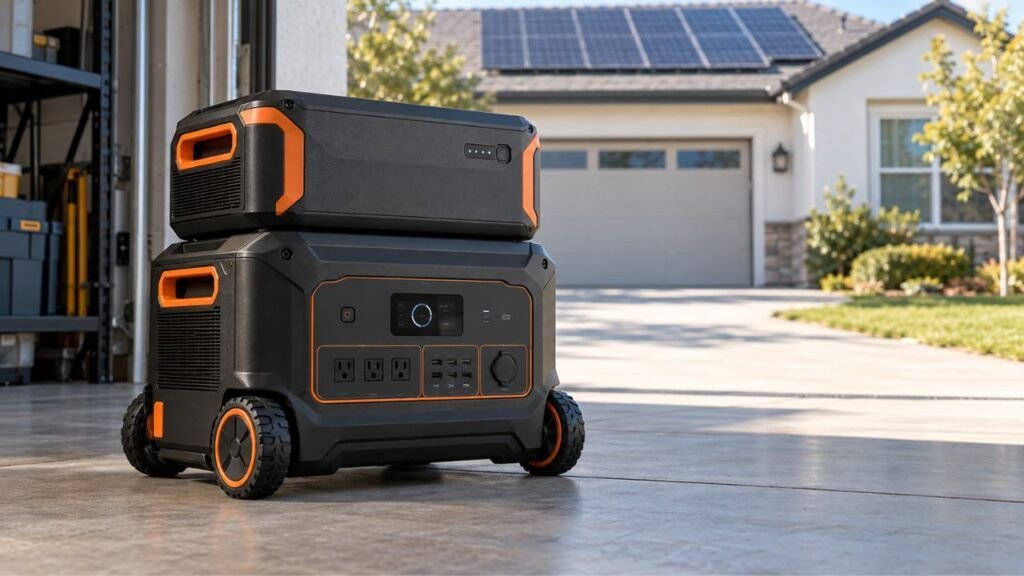
An expandable solar generator is a portable power station designed to accept additional battery packs. You can start with the built-in battery and increase storage later.
The main power station contains the inverter, charging system, outlets, controls, and battery management system. Expansion batteries connect through dedicated ports and add more stored energy.
Think of the main unit as your system’s control center. The expansion batteries simply give that system a larger energy reserve.
There is one important distinction to remember.
More battery capacity does not automatically mean more power output. A 2,000W inverter normally remains a 2,000W inverter after adding batteries.
The additional storage simply helps it provide that power longer.
What Changes When You Add an Expansion Battery?
Adding an expansion battery can dramatically increase runtime. However, several other specifications normally remain unchanged.
| Specification | What It Controls | Does Expansion Usually Increase It? |
| Battery capacity | Available stored energy | Yes |
| Runtime | How long loads can operate | Yes |
| Continuous inverter output | Maximum running load | Usually no |
| Surge output | Ability to start demanding appliances | Usually no |
| Maximum solar input | Solar charging limit | Usually no |
| AC charging input | Maximum wall charging rate | Usually no |
| Total weight | Portability | Yes |
| Storage space required | Physical footprint | Yes |
The easiest comparison is a vehicle’s fuel tank.
Adding batteries is like installing a larger fuel tank. You can travel farther, but your engine does not become more powerful.
That distinction matters when choosing a system for refrigerators, pumps, air conditioners, and other demanding appliances.
Why Can an Expandable Solar Generator Be Worth It?
Expandable systems offer several practical advantages. Their biggest benefit is giving you more control over how much battery storage you buy.
You Can Start Smaller and Expand Later
You might not need 10kWh of battery storage today.
Maybe you currently need enough backup power for your refrigerator, Wi-Fi, lights, and phones. A smaller base unit could handle those loads.
Your needs could change later.
You might start working from home, purchase another freezer, upgrade your RV, or want longer outage protection.
Instead of replacing your original power station, you can add compatible batteries.
That lets you spread the investment across several years.
You Can Extend Runtime During Longer Outages
Battery capacity determines how much energy your system can store.
More capacity usually means longer runtime.
Suppose your essential household loads consume around 2kWh overnight. A 2kWh power station may barely cover that requirement after normal conversion losses.
Increasing the system to 4kWh gives you considerably more breathing room.
That extra reserve can be valuable during hurricanes, winter storms, wildfire-related shutoffs, or other extended outages.
Your Backup System Can Grow With Your Needs
Household power needs rarely remain exactly the same forever.
You may eventually add:
- Another refrigerator or freezer
- A CPAP machine
- A sump pump
- A home office
- More lighting
- Additional electronics
- RV appliances
- Emergency communications equipment
A modular system gives you room to adjust without starting again.
This can be especially useful if you are uncertain about your future backup requirements.
You May Avoid Replacing the Main Power Station
Imagine your inverter already provides enough power for your appliances.
Your only problem is runtime.
Replacing the entire generator would mean purchasing another inverter, outlets, charging electronics, and battery management system.
An expansion battery addresses the actual problem instead.
You keep using the existing power station while increasing its energy storage.
However, always compare pricing first. An expansion battery is not guaranteed to be cheaper than every alternative.
You Can Store More Solar Energy
Extra battery storage can also help you capture more daytime solar energy.
Suppose your solar panels produce more electricity than your appliances currently use. A larger battery bank gives that excess energy somewhere to go.
You can then use the stored power overnight.
This becomes especially valuable for extended outages and off-grid setups.
However, your solar generator still needs sufficient solar input capacity. A huge battery bank paired with limited solar charging can take a long time to recover.
What Are the Downsides of Expandable Solar Generators?
Expandability sounds ideal, but it comes with compromises. I recommend looking at these limitations before paying extra for a modular system.
Expansion Batteries Can Be Expensive
A battery pack might look cheaper than another complete power station.
However, compare actual cost per kWh.
Use this simple calculation:
Cost per added kWh = expansion battery price ÷ added usable capacity
For example, suppose an expansion battery costs $1,200 and adds 2kWh.
Your approximate cost becomes:
$1,200 ÷ 2 = $600 per kWh
Now compare that against larger power stations and competing systems.
You may discover that buying your final required capacity upfront costs less overall.
Expansion offers flexibility, but flexibility sometimes carries a premium.
You Become Locked Into One Battery Ecosystem
Most expansion batteries are proprietary.
You generally cannot purchase any 48V or lithium battery and connect it directly.
The power station and battery need compatible connectors, communication protocols, charging limits, and battery management systems.
This means choosing an expandable generator often means choosing an ecosystem.
Before buying, look at the entire battery lineup, not just the base unit.
Compatible Batteries May Not Be Available Forever
This issue is easy to overlook.
You might buy an expandable generator today and plan to add batteries three years later.
But technology changes quickly.
Manufacturers may introduce:
- New battery generations
- Different connectors
- Updated power stations
- New communication systems
- Discontinued accessories
I would check how established the product family is before relying heavily on future expansion.
A useful expansion port today is less valuable if compatible batteries become difficult to find later.
More Batteries Mean More Weight and Space
Battery storage is heavy.
Adding several battery modules can quickly turn a portable setup into something far less portable.
This matters particularly for:
- RV travelers
- Apartment residents
- People using stairs
- Small garages
- Limited closets
- Vehicle payload limits
A base power station might be easy to move.
The same system with three expansion batteries may become a semi-permanent installation.
Bigger Battery Banks Take Longer to Recharge
This is another important limitation.
Suppose your system has a 1,000W maximum solar input.
Increasing storage from 2kWh to 8kWh does not automatically increase that solar input.
You now have four times as much energy storage requiring recharging.
More batteries therefore solve the runtime problem but can create a recovery problem.
You need to consider storage and charging together.
Extra Battery Capacity vs. More Power: What Do You Actually Need?
Many buyers confuse battery capacity with inverter power. Knowing the difference can prevent an expensive mistake.
| Your Problem | What You Need | Will Expansion Help? |
| Battery dies overnight | More battery capacity | Yes |
| Refrigerator runs but stops too soon | More battery capacity | Yes |
| Generator shuts down when AC starts | More inverter or surge power | Usually no |
| You need two days instead of eight hours | More battery capacity | Yes |
| Solar charging takes too long | More solar charging capability | Not by itself |
| You want more appliances running together | Higher inverter output | Usually no |
| You need 240V equipment | 240V-capable system | Not necessarily |
| You want independent backup units | Another power station | Possibly better |
Here is the easiest way to decide.
If your current generator can run the appliance but cannot run it long enough, you need more capacity.
If your generator cannot start or support the appliance, you need more output.
An expansion battery normally solves the first problem.
It usually does not solve the second.
Is an Expandable Solar Generator Cheaper in the Long Run?
Expandable systems can save money in certain situations. However, you should compare the complete ownership cost rather than the starting price.
Compare the Initial Price
Start by comparing similar base power stations.
Look at models offering roughly the same:
- Battery capacity
- Inverter output
- Surge output
- Solar input
- Battery chemistry
- Warranty
Expandable models may cost slightly more because the system includes additional connection hardware and battery communication features.
Ask yourself whether you will realistically use them.
Calculate the Cost of Each Added kWh
Next, calculate what expansion actually costs.
Use:
Expansion cost per kWh = battery cost + required accessories ÷ added kWh
Include any required cables, connection hubs, mounting equipment, or other accessories.
You want to know how much each additional unit of storage really costs.
Compare the Fully Expanded Price
This is where many buyers stop too early.
Do not compare only the base unit against competitors.
Calculate what your system would cost after reaching your desired capacity.
Compare:
- Base station plus expansion batteries
- One larger fixed-capacity system
- Two separate power stations
- A residential battery system
You may find different options become attractive at different capacities.
Consider the Value of Buying Capacity Later
Cost is not only about obtaining the lowest price.
Timing matters too.
Suppose you eventually want 8kWh but only need 2kWh today.
Buying the full 8kWh system immediately ties up more money.
An expandable system allows you to purchase additional capacity when you actually need it.
Even if the final cost becomes slightly higher, that flexibility may still have value.
How Much Expandable Battery Capacity Do You Need?
You do not need to guess how much storage to buy. A simple load calculation can give you a useful starting point.
Step 1: List the Appliances You Need
Start with essentials rather than everything inside your house.
Your list might include:
- Refrigerator
- Freezer
- Wi-Fi router
- LED lights
- Phones
- Laptop
- CPAP machine
- Fans
- Sump pump
Write down the wattage for each device.
Appliance labels and manuals can usually provide this information.
Step 2: Estimate Daily Energy Consumption
Battery capacity is measured in watt-hours or kilowatt-hours.
You can estimate energy consumption using:
Watts × hours used = watt-hours
For example:
150 watts × 10 hours = 1,500Wh
That means the appliance uses approximately 1.5kWh during those ten hours.
Repeat this calculation for your essential loads.
Then add everything together.
Step 3: Decide How Long You Need Backup
Think realistically about outages in your area.
Do you want coverage for:
- Six hours?
- Overnight?
- 24 hours?
- 48 hours?
- Three days?
Longer backup requirements naturally require more battery capacity.
However, solar recharging can reduce how much stored energy you need upfront.
Step 4: Account for Solar Recharging
Your battery does not necessarily need enough stored energy for the entire outage.
Solar panels can replenish part of your daily consumption.
Suppose your essential loads consume 4kWh daily.
If your solar array reliably replaces 3kWh during daylight, your battery only needs to cover the remaining energy gap plus an appropriate reserve.
Weather can change quickly, though.
I would avoid sizing a backup system around perfect sunny conditions.
Can Your Solar Panels Recharge the Expanded Battery Fast Enough?
Battery capacity tells you how much energy you can store. Solar input tells you how quickly you can replace that energy.
Check the Generator’s Maximum Solar Input
Every solar generator has a maximum solar charging limit.
For example, a system might accept up to 800W or 2,000W from solar panels.
Connecting additional panels does not necessarily increase charging speed beyond that limit.
The generator’s charge controller determines how much solar power it can accept.
Always check this specification before planning a large expansion.
Compare Battery Capacity With Daily Solar Recovery
Imagine you have an 8kWh battery system.
If your solar setup replaces only 2kWh during a good day, recovering a deeply discharged battery could take several days while also supporting ongoing loads.
That can become a major problem during an extended outage.
A well-designed backup system balances:
- Battery capacity
- Daily consumption
- Solar input
- Available sunlight
Simply buying more batteries is not always the answer.
Plan Around Real Solar Conditions
Solar panels rarely produce their advertised wattage continuously throughout the day.
Real-world output changes because of:
- Cloud cover
- Panel angle
- Shade
- Temperature
- Season
- Latitude
- Charging losses
- Cable losses
For emergency backup, build some margin into your calculations.
A system that works only under perfect summer sunshine is not a reliable year-round backup plan.
Expandable vs. Non-Expandable Solar Generator
Both designs can work well. The better choice depends on how certain you are about your future power requirements.
| Feature | Expandable Solar Generator | Non-Expandable Solar Generator |
| Initial cost | Often higher | Often lower |
| Battery capacity | Can grow | Fixed |
| Runtime flexibility | High | Limited |
| Setup complexity | Higher | Lower |
| Future upgrades | Easier | Usually require replacement |
| Portability | Decreases with added batteries | More predictable |
| Ecosystem dependence | Higher | Lower |
| Long outage preparation | Better potential | Limited by internal battery |
| Best for | Changing power needs | Stable power needs |
Choose expandable storage when flexibility matters.
Choose fixed capacity when you already understand your requirements and expect them to remain stable.
There is no reason to pay for expandability you will never use.
Expansion Battery vs. Buying a Second Power Station
Adding another battery is not your only option. Sometimes buying a second complete power station makes more sense.
An Expansion Battery Gives You More Runtime
An expansion battery usually depends on your main power station.
The base station still handles:
- AC output
- USB output
- Inverter functions
- Charging control
- Displays
- System management
The extra battery simply increases energy storage.
This approach works well when your main power station already handles everything you need.
A Second Power Station Gives You Redundancy
A second power station provides another complete electrical system.
You gain:
- Another inverter
- Additional outlets
- Separate charging
- Another battery
- Independent operation
That redundancy can be useful during emergencies.
If one system develops a problem, the other may continue working.
You can also place them in different rooms or vehicles.
Which Approach Costs Less?
There is no universal winner.
Expansion batteries often cost less because you are not purchasing another inverter and control system.
However, power stations frequently go on sale.
A discounted second power station can sometimes cost close to an expansion battery while offering much more functionality.
Compare dollars per kWh, output, solar input, and redundancy before deciding.
When Is an Expandable Solar Generator Worth It?
Expandability makes the most sense when you expect your requirements to change. Consider paying extra for it when several of these situations apply:
- You expect your energy needs to increase.
- You experience frequent overnight outages.
- Multi-day storms occur in your area.
- Your existing inverter already handles your appliances.
- You want to spread purchases across several years.
- You use backup power at home and while traveling.
- You need substantial nighttime energy storage.
- Your solar array can support future expansion.
- Compatible batteries are widely available.
- You plan to keep the system for many years.
In these situations, modular capacity gives you valuable flexibility.
You are less likely to outgrow the system simply because you need longer runtime.
When Is an Expandable Solar Generator Not Worth It?
Not everyone needs expandable storage.
A simpler fixed-capacity power station may be smarter when:
- Your electricity needs are small.
- Your loads rarely change.
- Outages normally last only several hours.
- Portability matters more than maximum runtime.
- You need higher inverter output instead of capacity.
- Expansion batteries are unusually expensive.
- Your available solar input is limited.
- You have nowhere to store additional batteries.
- You do not expect to expand later.
- You already know your exact required capacity.
Paying extra for unused expansion capability provides little benefit.
Buy for a realistic future scenario rather than an imaginary one.
Is an Expandable Solar Generator Good for Home Backup?
Expandable systems can work especially well for home backup. However, their usefulness depends on what part of your home you expect to power.
Essential Home Backup
This is where expandable solar generators often make the most sense.
You can prioritize:
- Refrigerator
- Freezer
- Internet
- Lights
- Phones
- Medical devices
- Fans
- Small cooking appliances
A modest base system may cover short outages.
Additional batteries can then extend those essentials overnight or through longer disruptions.
Multi-Day Outages
Extended outages are where extra capacity becomes much more useful.
You need enough stored energy for nighttime and poor weather.
During sunny periods, your solar panels can recharge the batteries while powering daytime loads.
The goal is not simply having the largest battery possible.
You want your daily solar production to replace most of your daily consumption.
That balance can make a modular system sustainable for much longer periods.
Whole-House Backup
Whole-house backup is more complicated.
A giant battery bank alone does not create a whole-house system.
You also need enough:
- Continuous inverter output
- Surge capacity
- Solar input
- Correct voltage
- Battery storage
- Home electrical integration
Large household loads can quickly change the equation.
Central air conditioning, electric heating, water heaters, ranges, and dryers consume significantly more power than basic emergency loads.
For these applications, look at the complete system architecture rather than battery capacity alone.
What About 120V, 240V, and Heavy Home Appliances?
Most ordinary household electronics run on 120V power.
Some larger U.S. appliances require 240V.
These can include central air conditioners, dryers, electric ranges, larger well pumps, and certain heat pumps.
Adding batteries does not automatically give a 120V power station 240V capability.
The power station itself must support the required voltage.
Some modular systems can create 240V through paired units or dedicated system configurations. Others remain strictly 120V regardless of battery capacity.
Heavy appliances can also require substantial startup power.
Before building a large battery bank, make sure the inverter can actually support the appliances you intend to use.
Otherwise, you could own plenty of stored energy that your system cannot deliver effectively.
Safety and Home Integration Matter as the System Grows
A small portable setup is relatively simple. Larger systems require more careful planning, especially when connecting them to home circuits.
Use Manufacturer-Approved Expansion Batteries
Stick with batteries officially designed for your power station.
Expansion batteries usually communicate continuously with the main unit.
The system monitors information such as:
- Battery voltage
- Temperature
- Charging status
- State of charge
- Protection conditions
Using incompatible equipment can interfere with these safeguards.
Always follow the manufacturer’s approved battery and cable requirements.
Check the Correct Safety Certification
Safety certifications matter more as battery capacity increases.
For portable power stations, look for recognized testing and certification appropriate to portable power equipment.
Large permanently installed energy storage systems follow different requirements from portable generators.
Do not assume every portable power station is automatically suitable for permanent residential installation.
Check the manufacturer’s documentation for its intended use.
Use Proper Home-Panel Integration
Never improvise a connection between your solar generator and household wiring.
Systems designed to power home circuits may use:
- Transfer switches
- Smart electrical panels
- Dedicated backup interfaces
- Manufacturer-approved connection equipment
Professional installation may be required.
This becomes particularly important with higher-power 120/240V systems.
What Should You Check Before Buying an Expandable Solar Generator?
There are many numbers on a specification sheet. These are the ones I would pay closest attention to:
- Base battery capacity
- Maximum expandable capacity
- Continuous AC output
- Surge output
- 120V or 120/240V support
- Maximum solar input
- Maximum AC charging rate
- Number of supported expansion batteries
- Price of each expansion battery
- Cost per additional kWh
- Required expansion cables
- Required battery hubs
- Battery chemistry
- Battery cycle rating
- Base-unit warranty
- Expansion-battery warranty
- Battery weight
- Battery dimensions
- Fully expanded footprint
- Transfer switch compatibility
- Smart-panel compatibility
- Safety certifications
- Expected battery availability
Do not judge the system using one impressive specification.
Battery capacity, inverter power, and recharge capability should work together.
A Quick Way to Decide if Expandability Is Worth Paying For
Use this table when you are still unsure.
| Situation | Is Expandability Useful? | Why |
| Occasional short outages | Usually not necessary | Smaller fixed storage may be enough |
| Frequent overnight outages | Often useful | Added storage extends essential loads |
| Two-day storm outages | Very useful | More reserve becomes valuable |
| Three-day emergency backup | Often useful | Modular storage provides flexibility |
| Weekend RV trips | Depends | Extra weight may outweigh benefits |
| Full-time RV use | Often useful | Energy needs can change |
| Refrigerator dies too soon | Yes | You need more stored energy |
| Central AC will not start | Usually no | You need more inverter power |
| Solar charging is already slow | Use caution | More storage worsens recovery time |
| Future requirements are uncertain | Often useful | Capacity can grow later |
The key question is simple.
Are you buying expandability because you expect to use it?
If the answer is yes, the feature can provide genuine long-term value.
If you are paying extra simply because it sounds better, a fixed system may be the smarter purchase.
Final Verdict
So, is an expandable solar generator worth it? For many homeowners, RV owners, and backup-power users, it can be. It makes the most sense when your inverter already provides enough power and you want the option to increase runtime later.
It becomes less valuable when your electricity needs are fixed, portability is critical, or you actually need a stronger inverter instead of more battery capacity. You should also compare the fully expanded system cost before making your decision.
The easiest rule is this: choose inverter output for what you need to run, battery capacity for how long you need to run it, and solar input for how quickly you need that energy back.
Related FAQs
Does Adding a Battery Increase a Solar Generator’s Wattage?
Usually, no. Expansion batteries increase stored energy and runtime, while the main power station’s inverter determines continuous and surge wattage. Check your specific model because a few modular systems use different configurations that can change overall output.
Can I Add an Expansion Battery Later?
Yes, that is the main advantage of an expandable solar generator. You can start with the base capacity and purchase compatible batteries later, provided your model still supports those batteries and they remain available.
Can I Use Any Battery With an Expandable Solar Generator?
Usually not. Most expandable power stations require compatible batteries with specific connectors and communication systems. Using an unsupported battery may prevent proper charging, battery monitoring, or protection features from working correctly.
Are Expansion Batteries Cheaper Than Buying Another Power Station?
They often are, but not always. Compare the expansion battery’s price per kWh against complete power stations currently available. Discounts can sometimes make a second power station surprisingly competitive while also providing another inverter and outlets.
How Many Expansion Batteries Do I Need for Home Backup?
It depends on your daily energy consumption and desired backup duration. Calculate the watt-hours your essential appliances consume, determine how many hours or days you need, and subtract the energy you realistically expect solar panels to replace.
Does Adding Extra Batteries Make Solar Charging Slower?
Your solar charging wattage may remain the same, but the larger battery capacity takes longer to refill. If you substantially increase storage without increasing available solar production, recovering from a deep discharge can take much longer.
Can an Expandable Solar Generator Power a Whole House?
Some large expandable systems can support substantial household loads when properly configured. However, battery capacity alone is not enough. You also need adequate inverter output, surge capability, voltage support, solar charging, and safe home-panel integration.
Is an Expandable Solar Generator Better for an RV?
It can be excellent for an RV if you regularly camp off-grid and expect changing energy needs. However, every additional battery increases weight and storage requirements, so check your RV’s available space and payload limits first.
Can I Mix Old and New Expansion Batteries?
Some systems allow batteries of different ages to operate together, but compatibility depends on the manufacturer. Check the manual before mixing batteries because firmware, battery condition, model generation, and charging behavior can affect performance.
What Happens if My Expansion Battery Is Discontinued?
You may have difficulty expanding the system later. That is why I recommend considering the manufacturer’s product history, warranty support, battery ecosystem, and availability before buying a power station mainly for its future expansion capability.

Blake Cooper writes practical guides on generators, portable power stations, and home backup systems. He focuses on simplifying power topics and helping homeowners make informed buying decisions.