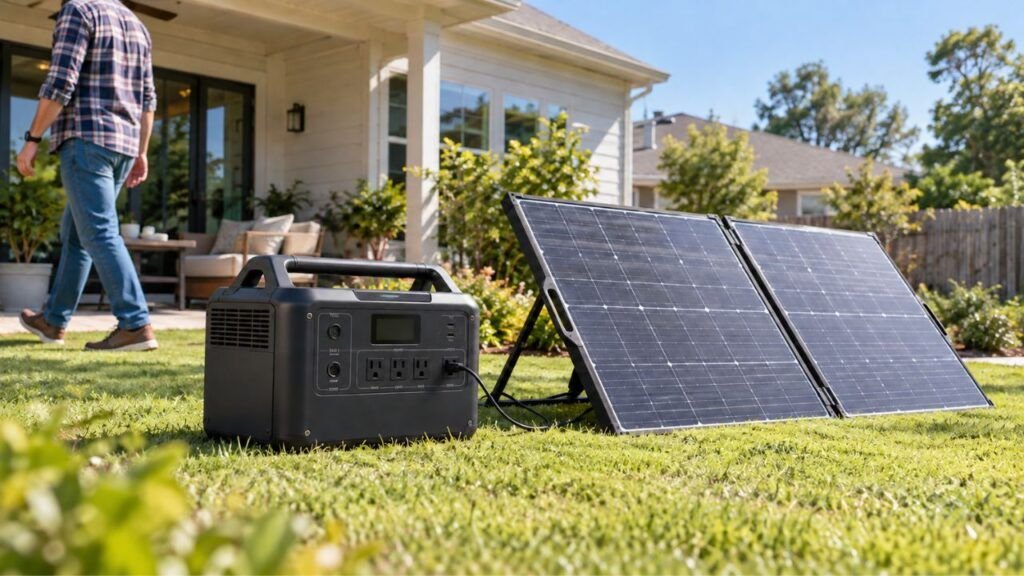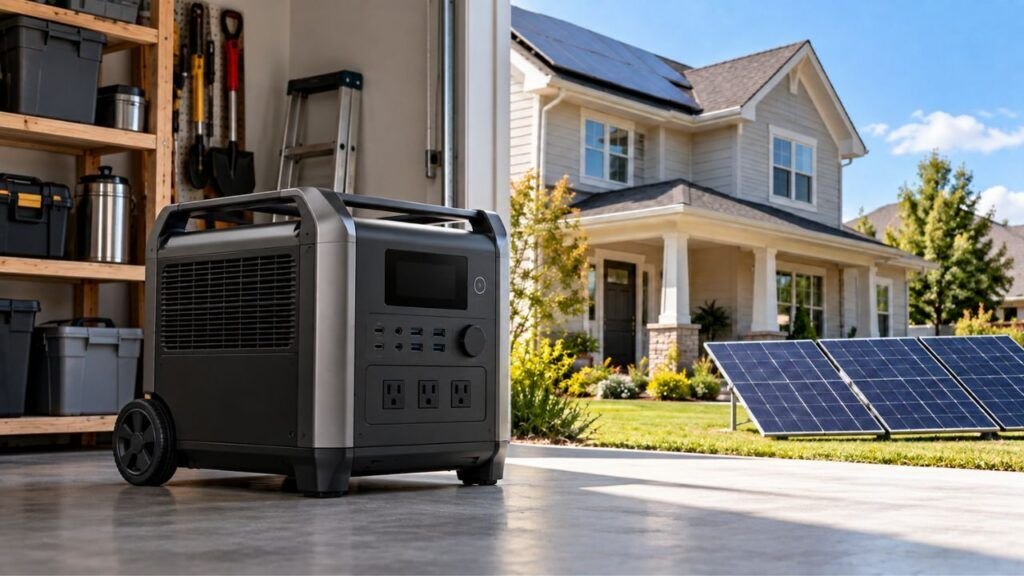
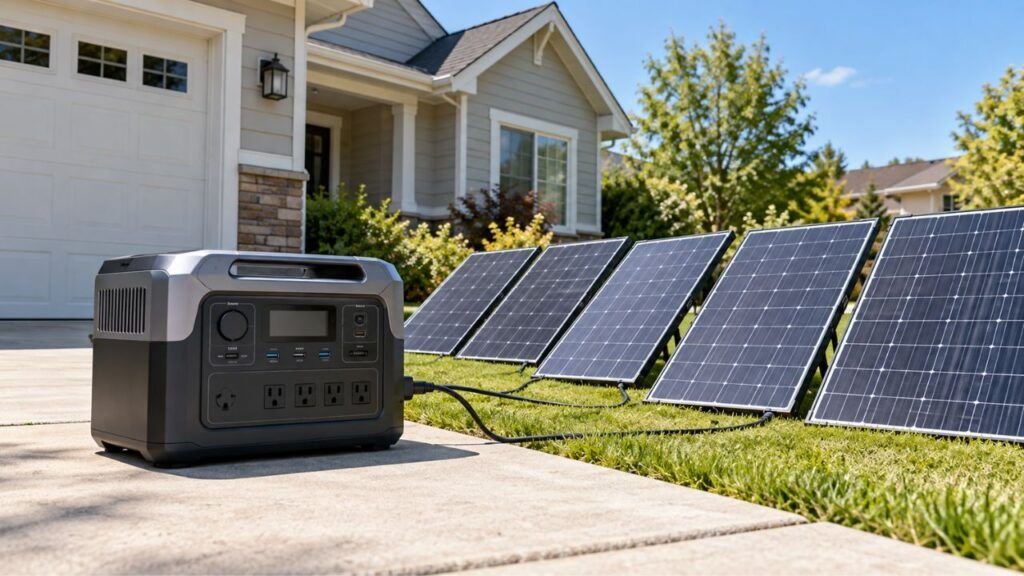
A home solar generator may need anywhere from 1 to 20+ solar panels, depending on battery size, daily energy use, sunlight, and panel wattage. Smaller backup systems may work well with two to four panels, while larger home backup systems can require ten or more.
The important part is finding the right number for your setup. Below, I’ll show you how to calculate panel count, account for real-world losses, and avoid exceeding your generator’s solar input limits.
Key Takeaways
- Small home backup generators may need only 1–4 solar panels.
- Larger systems can require 5–20+ panels for daily charging.
- Battery capacity alone does not determine your panel count.
- Your daily appliance use is equally important during long outages.
- Higher-wattage panels reduce the total number of panels required.
- Peak sun hours greatly affect daily solar production.
- Always check the generator’s maximum solar input before connecting panels.
- Voltage and current limits matter just as much as total wattage.
How Many Solar Panels Does a Home Generator Need?
Most homeowners can estimate their needs by looking at battery capacity, daily energy use, and panel wattage. The table below gives you a practical starting point using common 400W solar panels.
| Home Generator Size | Suggested Solar Array | Approx. 400W Panels | Typical Use |
| Around 1kWh | 400–800W | 1–2 | Refrigerator, lights, phones |
| Around 2kWh | 800–1,200W | 2–3 | Essential appliances |
| Around 3–4kWh | 1,200–2,400W | 3–6 | Longer outage backup |
| Around 5–10kWh | 2,000–4,000W+ | 5–10+ | Larger home backup |
| Around 10–20kWh | 4,000–8,000W+ | 10–20+ | Extended home backup |
| 20kWh or more | System-specific | 15–30+ possible | Large home or off-grid use |
These numbers are planning estimates rather than fixed requirements.
Your generator may not accept the entire solar array shown above. Always compare the planned array with its maximum PV input specifications.
A large battery does not automatically mean you can connect more panels.
Two Ways to Calculate How Many Solar Panels You Need
There are really two different questions hiding inside this topic. You may want enough solar to recharge the battery, or enough solar to replace the electricity your home consumes each day.
Panels Needed to Recharge the Generator Battery
This approach works when your main goal is restoring battery capacity.
Use this basic formula:
Required solar wattage = Energy to replace ÷ (Peak sun hours × efficiency)
Then calculate:
Number of panels = Required solar wattage ÷ panel wattage
Let’s say your generator needs 3,000Wh replaced.
Assume you receive five peak sun hours daily. We’ll also use an 80% efficiency factor for real-world losses.
The calculation becomes:
3,000Wh ÷ (5 × 0.80) = 750W
Using 400W panels:
750W ÷ 400W = 1.875 panels
You cannot buy 1.875 panels, so round upward.
You would need about two 400W panels under those assumptions.
However, both panels must still fit your generator’s input specifications.
Panels Needed to Support Daily Home Loads
This calculation becomes more important during multi-day power outages.
Instead of asking how large the battery is, ask this:
How much electricity am I actually using each day?
Imagine your essential appliances consume:
- Refrigerator: 1,200Wh
- Freezer: 800Wh
- Wi-Fi equipment: 300Wh
- Lights: 400Wh
- Television and electronics: 500Wh
- Phones and laptops: 300Wh
- Other essential loads: 500Wh
That gives you roughly 4,000Wh, or 4kWh, per day.
Your solar panels should ideally replace close to that amount daily.
This keeps your generator usable through a longer outage.
Why These Calculations Give Different Answers
Battery capacity tells you how much electricity your generator can store.
Daily energy consumption tells you how much electricity you must replace.
Those numbers are not always the same.
For example, you might own a 10kWh home generator. During an outage, however, you may only consume 4kWh daily.
In that situation, you do not necessarily need to produce 10kWh daily.
You mainly need enough solar production to replace what you used.
The opposite can also happen.
A smaller generator may power appliances while solar panels are charging it. Those appliances consume part of the incoming solar energy.
That means the panels may need additional capacity to maintain the battery.
How to Calculate Solar Panels for Your Generator Step by Step
The calculation becomes much easier when you handle one number at a time. You do not need advanced electrical knowledge to make a useful planning estimate.
Step 1: Find the Energy You Need to Replace
Start with either your battery usage or your daily appliance consumption.
Battery energy is normally listed in watt-hours or kilowatt-hours.
Remember:
1,000Wh = 1kWh
If your 5kWh generator drops from full charge to 40%, you used roughly 3kWh.
That means approximately 3,000Wh must be replaced.
For longer outages, calculating daily appliance consumption usually works better.
Step 2: Find Your Peak Sun Hours
Do not confuse peak sun hours with normal daylight hours.
Your panels may receive daylight for ten or twelve hours. They will not produce their full rated power throughout that entire period.
Peak sun hours represent the equivalent number of hours receiving strong solar energy.
Your actual number varies by:
- State
- Season
- Weather
- Panel direction
- Panel angle
- Nearby shade
A system that performs well during summer can recharge much slower during winter.
Use local solar data when planning a permanent home setup.
Step 3: Account for Real-World Solar Losses
A 400W solar panel does not continuously produce 400W outside.
Several conditions reduce real-world output:
- High panel temperatures
- Clouds and haze
- Wiring losses
- Battery charging losses
- Dust and debris
- Partial shading
- Poor panel angle
- Conversion losses inside the charge controller
Using around 75% to 85% as a planning efficiency range can provide a more realistic estimate.
For simple calculations, 80% works well as a starting assumption.
Step 4: Calculate Your Required Solar Array
Suppose you need to replace 5,000Wh daily.
You get five peak sun hours.
Using 80% efficiency:
5,000Wh ÷ (5 × 0.80) = 1,250W
You would therefore want around 1,250W of solar capacity.
Step 5: Convert Solar Wattage Into Panel Count
Now divide the required array wattage by your panel wattage.
With 400W panels:
1,250W ÷ 400W = 3.125 panels
Always round upward when estimating panel count.
That gives you about four 400W panels.
Four panels provide 1,600W of rated solar capacity.
Step 6: Check Your Generator’s Solar Input Limit
This is where many people make an expensive mistake.
Your calculations might suggest a 2,000W solar array. However, your generator might accept only 1,200W of solar input.
You cannot assume connecting more panels will automatically charge faster.
Check the manufacturer’s specifications for:
- Maximum solar input wattage
- PV voltage range
- Maximum input current
- Maximum open-circuit voltage
- Number of solar inputs
- Supported panel configurations
Treat these limits as part of the calculation, not an afterthought.
Battery Capacity vs. Daily Energy Use
Choosing the right sizing method depends on how you plan to use your generator. The table below shows which number should guide your calculation.
| Situation | What You Should Size Around |
| Recharging an empty generator | Battery energy needing replacement |
| Daily outage backup | Daily appliance consumption |
| Running appliances while charging | Daily loads plus battery recharge |
| Multi-day outage | Daily consumption plus weather margin |
| Off-grid living | Daily and seasonal electricity consumption |
| Emergency-only backup | Essential appliance consumption |
For most homeowners preparing for outages, daily essential energy use provides the most useful number.
Battery capacity still matters, but it does not tell the entire story.
A huge battery paired with a tiny solar array may take days to recover.
A smaller battery with enough solar input can recharge much faster.
How Many 400W Solar Panels Does a Home Generator Need?
400W panels are a useful benchmark because their higher output keeps panel counts manageable. The examples below assume 4.5 peak sun hours and approximately 80% usable solar production.
| Energy to Replace Daily | Approx. Solar Array Needed | Approx. 400W Panels |
| 1kWh | 280W | 1 |
| 2kWh | 560W | 2 |
| 3kWh | 835W | 3 |
| 5kWh | 1,390W | 4 |
| 10kWh | 2,780W | 7 |
| 15kWh | 4,170W | 11 |
| 20kWh | 5,560W | 14 |
| 30kWh | 8,335W | 21 |
These numbers show how much solar production may be required.
They do not confirm that your generator can accept the entire array.
For example, the calculation may suggest seven 400W panels. That equals 2,800W of rated solar capacity.
If your generator only accepts 1,600W, you cannot simply connect all seven panels directly.
This is why checking PV limits remains essential.
How Many 200W Solar Panels Does a Home Generator Need?
Using 200W panels usually means you need roughly twice as many panels compared with a similar 400W setup.
For example, an 800W solar array needs four 200W panels.
A 1,600W array needs eight 200W panels.
A 2,400W array needs twelve 200W panels.
Portable 200W panels can still make sense for emergency backup. They are easier to move and position around your property.
However, large home systems quickly become bulky when many portable panels are involved.
If you regularly need several thousand watts of solar input, larger fixed panels may be more practical.
Why Your Generator’s Maximum Solar Input Matters
The battery size gets plenty of attention, but solar input specifications are just as important. They determine how much solar power your generator can actually accept.
Maximum Solar Wattage
Every solar generator has a maximum amount of solar charging power it can process.
Suppose your unit accepts up to 1,500W.
Connecting a properly designed array around that capacity can maximize charging performance.
Installing a much larger array does not automatically mean the generator accepts all that power.
The charge controller sets the practical limit.
Solar Input Voltage Range
Solar generators normally accept power within a specific DC voltage range.
Your connected panels must stay inside that range.
Panel voltage changes depending on how the panels are wired.
Series connections increase voltage quickly.
That means adding another panel can sometimes push the system beyond its allowed range.
Maximum Input Current
Current also has a limit.
Parallel wiring increases available current while voltage remains similar.
Connecting too many panels in parallel can therefore create an incompatible configuration.
Do not look at total wattage alone.
Open-Circuit Voltage
Solar panels have an open-circuit voltage, often shown as Voc.
Voc can be higher than the normal operating voltage.
Cold weather can raise panel voltage further.
This matters because exceeding a generator’s maximum allowable input voltage can damage equipment.
If you are building a large custom array, follow the manufacturer’s approved configuration carefully.
For a permanent installation, getting professional guidance is worthwhile.
Series vs. Parallel Solar Panels for a Home Generator
Multiple solar panels can be wired in different ways. The correct arrangement depends on your generator’s voltage and current limits.
What Happens When Panels Are Connected in Series?
Connecting panels in series increases their voltage.
The current generally stays similar to one panel’s current.
For example, connecting three similar 40V panels in series may create approximately 120V.
The exact numbers depend on the panels you use.
Series wiring can work well with high-voltage MPPT inputs.
However, you must stay below the generator’s maximum voltage.
What Happens When Panels Are Connected in Parallel?
Parallel connections increase current instead of voltage.
Three identical panels may maintain similar voltage while combining available current.
That can be useful for certain generator inputs.
However, excessive current can also exceed the generator’s specifications.
Which Setup Should You Use?
There is no universal answer.
Use whichever configuration keeps voltage and current inside the generator’s approved ranges.
Do not assume series is always better.
Do not assume parallel is always safer.
The correct setup depends on both your panels and generator.
How Peak Sun Hours Change the Number of Panels You Need
Sunlight availability can dramatically change your required solar array. The example below assumes you want to replace 10kWh daily using 400W panels and roughly 80% overall efficiency.
| Peak Sun Hours | Approx. Array Needed | Approx. 400W Panels |
| 3 hours | 4.17kW | 11 |
| 4 hours | 3.13kW | 8 |
| 5 hours | 2.50kW | 7 |
| 6 hours | 2.08kW | 6 |
You can see why there is no single panel count for every U.S. homeowner.
Someone getting six useful solar hours needs less panel capacity.
Another homeowner may need more panels during a cloudy winter period.
The difference becomes especially important during extended outages.
Should You Size Solar Panels for Average Sun or Winter?
If you mainly keep your generator for occasional emergencies, average local solar conditions may provide a reasonable starting point.
Winter deserves more attention if you depend heavily on solar charging.
Shorter days, lower sun angles, snow, and extended cloud cover can reduce production.
A solar setup that easily restores your battery during July may struggle during January.
For serious outage preparedness, consider how your system performs during the least favorable season.
You do not have to design for the absolute worst day imaginable.
However, relying only on perfect summer conditions can leave you underpowered.
Can Solar Panels Charge the Generator While It Powers Your House?
Many modern solar generators can charge while simultaneously powering appliances.
However, incoming solar energy must cover those active loads first.
Imagine your panels are producing 1,000W.
Your refrigerator, freezer, electronics, and other devices are consuming 700W.
Only the remaining energy is available to increase battery charge.
If your appliances consume more than the panels produce, the battery continues dropping.
This is why looking only at maximum solar input can be misleading.
Your daily energy balance matters more during a long outage.
Example: Sizing Solar Panels for Essential Home Backup
Let’s work through a realistic example. Assume you want to keep important household equipment running rather than powering everything normally.
Calculate the Daily Loads
Your daily essential use might look something like this:
- Refrigerator: 1,200Wh
- Freezer: 900Wh
- Wi-Fi and modem: 300Wh
- LED lights: 400Wh
- Television: 400Wh
- Phones and laptops: 300Wh
- Miscellaneous essentials: 1,500Wh
Total daily energy use comes to approximately 5,000Wh.
That equals 5kWh per day.
Calculate the Required Solar Array
Assume five peak sun hours daily.
We’ll again use an 80% efficiency factor.
5,000Wh ÷ (5 × 0.80) = 1,250W
You need around 1,250W of useful rated solar capacity.
Convert That Into Panels
With 400W panels:
1,250W ÷ 400W = 3.125
Round upward to four panels.
Four 400W panels give you 1,600W of rated capacity.
That gives you some extra production margin.
Your generator still needs to support that panel configuration.
Add a Weather Margin
Real weather rarely follows a perfect calculation.
Clouds can dramatically reduce solar production.
You may therefore want extra solar capacity for long outages.
You can also conserve battery energy by reducing unnecessary appliance use.
That combination is often more practical than simply adding batteries.
Example: Sizing Panels for a Larger Home Backup System
Larger home backup systems require a slightly different approach. Here, daily consumption usually matters more than total battery capacity.
Estimate Your Reduced Outage Consumption
Suppose your normal household uses much more electricity each day.
During an outage, however, you reduce consumption to 12kWh daily.
You avoid heavy loads whenever possible.
Your backup system mainly powers:
- Refrigeration
- Lighting
- Electronics
- Internet
- Selected kitchen appliances
- Limited HVAC equipment
- Pumps or other essential loads
Using reduced outage consumption prevents unnecessary oversizing.
Calculate Solar Array Size
Assume five peak sun hours and 80% efficiency.
12,000Wh ÷ (5 × 0.80) = 3,000W
You need around a 3kW solar array.
Using 400W panels:
3,000W ÷ 400W = 7.5 panels
Round upward to eight panels.
That gives you 3,200W of rated panel capacity.
Check Whether One Generator Can Accept the Array
Now comes the critical question.
Can your generator actually accept 3,200W of solar input?
If its maximum PV input is only 1,800W, the answer is no.
Simply adding more panels directly will not solve the problem.
You may need a different system design, another compatible unit, additional charging sources, or a dedicated home battery setup.
For larger systems, this compatibility check becomes increasingly important.
What Changes the Number of Solar Panels You Need?
Several factors can push your required panel count higher or lower. Think about these before buying equipment.
- Daily electricity consumption
- Generator battery capacity
- Maximum PV input
- Solar panel wattage
- Peak sun hours
- Seasonal sunlight
- Cloud cover
- Panel shading
- Panel orientation
- Panel temperature
- Wiring losses
- Charging losses
- Appliances operating during charging
- Desired charging speed
- Additional expansion batteries
You rarely need the exact same setup as another homeowner.
Two houses with identical generators can still need different solar arrays.
Do Expansion Batteries Mean You Need More Solar Panels?
Adding expansion batteries gives your system more stored energy.
That does not automatically mean you must add more panels.
The real question is how much additional energy you expect to use.
Suppose you expand from 5kWh to 10kWh of battery storage.
If your daily consumption remains 4kWh, your solar requirement may remain similar.
You simply have more stored energy available between charging periods.
However, if you regularly use the additional battery capacity, you may need more solar production to restore it.
There is another limitation.
Adding batteries does not always increase the generator’s maximum solar input.
Your storage capacity may double while solar charging stays unchanged.
That can make full recharging take considerably longer.
Is More Solar Always Better for a Home Generator?
More solar capacity can be helpful, but there is a practical limit.
Once your generator reaches its maximum solar input, adding panels does not automatically increase charging speed.
Electrical compatibility also matters.
You must remain within allowable voltage and current limits.
That means the biggest possible solar array is not always the best setup.
A better goal is enough solar capacity to replace your expected daily energy use within available sunlight.
Anything beyond that should serve a specific purpose.
Common Solar Panel Sizing Mistakes
Solar calculations are simple enough once you know what matters. Most sizing mistakes happen because one important factor gets ignored.
- Using daylight hours instead of peak sun hours
- Assuming panels always produce rated wattage
- Sizing only from total battery capacity
- Ignoring appliances running during charging
- Exceeding maximum solar input wattage
- Ignoring PV voltage limits
- Ignoring maximum input current
- Forgetting open-circuit voltage
- Planning only around summer sunlight
- Assuming house size determines panel count
- Matching panels to inverter wattage
- Forgetting to round fractional panel counts upward
- Buying panels before checking connector compatibility
Avoid these mistakes and your estimate becomes much more reliable.
Home Solar Generator vs. Rooftop Solar
A rooftop solar system and a solar generator solve related problems, but their calculations are different.
Whole-home rooftop systems are commonly sized around annual household electricity consumption.
The goal may be offsetting utility usage throughout the year.
A solar generator normally focuses more on backup energy.
You may size it around:
- Essential outage loads
- Battery recharge requirements
- Available peak sun hours
- Generator solar input limits
- Expected outage duration
For example, your home may normally consume 25kWh daily.
During an outage, you might reduce that to 7kWh.
Your solar generator setup should usually focus on the 7kWh backup requirement.
This prevents the system from becoming unnecessarily large and expensive.
What to Check Before Buying Solar Panels for Your Generator
Before ordering panels, compare them with your generator’s charging specifications. This short check can prevent compatibility problems later.
- Maximum PV input wattage
- Allowed solar voltage range
- Maximum input current
- Maximum open-circuit voltage
- Solar panel Voc
- Solar panel operating voltage
- Solar panel wattage
- Connector type
- Required adapters
- Series and parallel limits
- Number of MPPT inputs
- Local peak sun hours
- Daily electricity requirement
- Available roof or yard space
- Manufacturer warranty requirements
If those numbers are compatible, you are much closer to building a reliable setup.
Final Words
There is no universal number of solar panels every home generator needs. A small backup system may work with two or three panels, while a large home system may need ten, twenty, or even more.
Start by calculating how much energy you need to replace each day. Then divide that requirement by your available peak sun hours and expected system efficiency.
Finally, compare your planned solar array with the generator’s maximum wattage, voltage, and current limits. That final check is what turns a rough calculation into a safe and practical setup.
Related FAQs
How Many Solar Panels Do I Need for a 2,000Wh Solar Generator?
A 2,000Wh solar generator may need around two 400W panels for practical daily charging under good sunlight. The exact number depends on peak sun hours, charging losses, remaining battery charge, and the generator’s maximum solar input.
How Many 400W Solar Panels Do I Need for a Home Generator?
Divide your required solar array wattage by 400W, then round upward. For example, a 1,600W solar requirement needs four 400W panels, assuming the generator supports that configuration.
Can One 400W Solar Panel Charge a Solar Generator?
Yes, one 400W panel can charge many solar generators if its voltage and current are compatible. Charging time depends on battery capacity, sunlight conditions, charging losses, and whether appliances are running simultaneously.
How Many Solar Panels Do I Need for a 5kWh Battery?
A 5kWh battery might need around three to four 400W panels for daily recharging under roughly five peak sun hours. Actual requirements depend on how deeply you discharge the battery and real-world solar conditions.
How Many Solar Panels Do I Need for a 10kWh Battery?
A full 10kWh daily recharge may require roughly seven 400W panels with five peak sun hours and reasonable system losses. You may need fewer panels if you only use part of the battery each day.
Can Four 400W Solar Panels Run a House?
Four 400W panels provide 1,600W of rated solar capacity. They can support many essential household loads, but they usually cannot duplicate unrestricted whole-home electricity use throughout the day.
Can You Have Too Many Solar Panels for a Solar Generator?
Yes. Connecting panels with excessive voltage, current, or incompatible electrical characteristics can exceed the generator’s input limits. Always follow the manufacturer’s approved PV specifications before adding more panels.
How Long Does It Take Solar Panels to Recharge a Home Generator?
Charging time depends on battery capacity and actual solar input. A 4,000Wh battery receiving an average 800W of usable solar energy would theoretically need around five hours, although real charging conditions may increase that time.
Do I Need More Solar Panels in Winter?
You may need more panel capacity to produce the same daily energy during winter. Shorter days, lower sun angles, clouds, and snow can reduce available solar production.
Should Solar Panel Wattage Match Generator Wattage?
No. Generator AC output wattage and maximum solar charging wattage are separate specifications. A 3,000W generator, for example, may accept much less than 3,000W through its solar charging input.
Can Solar Panels Charge a Home Generator on Cloudy Days?
Yes, solar panels can still generate electricity under cloudy conditions, but output can drop significantly. Extra panel capacity and careful energy management become more important during extended cloudy weather.
Is Battery Capacity More Important Than Solar Panel Wattage?
Both matter for different reasons. Battery capacity determines stored energy, while solar panel wattage affects how quickly that energy can be replaced. A well-balanced system needs enough storage and enough charging capacity.
How Many Solar Panels Do I Need for a Multi-Day Power Outage?
Size the array around your daily essential energy consumption rather than total battery capacity alone. Your panels should ideally replace most of the energy you use each day while accounting for weather and charging losses.
Can I Add More Solar Panels Later?
Often, yes, provided the additional panels remain within your generator’s wattage, voltage, and current limits. Check the manufacturer’s specifications before expanding the array.

Blake Cooper writes practical guides on generators, portable power stations, and home backup systems. He focuses on simplifying power topics and helping homeowners make informed buying decisions.