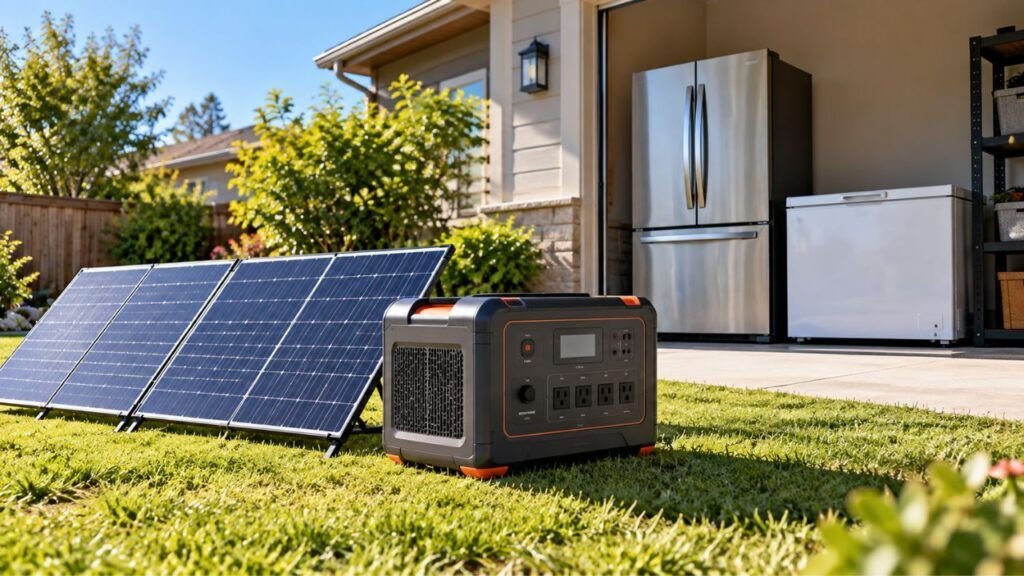
Yes, a properly sized solar generator can run a refrigerator and freezer at the same time. The system needs enough inverter output to handle compressor startup and enough battery capacity to cover their combined energy use.
The right size depends on your appliances, outage length, and solar setup. Below, I’ll show you how to calculate the power you need, estimate runtime, size your solar panels, and keep your food safely cold during an outage.
Key Takeaways
- A solar generator can run a refrigerator and freezer together.
- Inverter wattage determines whether both appliances can start safely.
- Battery watt-hours determine how long they can keep running.
- Refrigerators and freezers cycle on and off instead of running constantly.
- Compressor startup can require much more power than normal operation.
- A 2,000Wh to 4,000Wh battery is practical for many refrigerator-freezer setups.
- Multi-day operation usually requires enough solar input to replace daily consumption.
- Measure your actual appliance consumption whenever possible before choosing a system.
Can a Solar Generator Run a Refrigerator and Freezer at the Same Time?
A solar generator can run both appliances simultaneously as long as its output and battery capacity are sufficient.
The first thing I want you to check is what kind of setup you actually have.
A refrigerator with a built-in freezer is one appliance. A full-size refrigerator plus a separate chest or upright freezer creates a larger power demand.
Both situations are manageable with solar power, but the second setup usually requires more battery capacity.
You also need to think about startup power.
The refrigerator compressor may already be running when the freezer compressor starts. Your inverter needs enough headroom to handle that temporary increase without shutting down.
This is why choosing a solar generator based only on battery capacity can cause problems.
You need to consider both watts and watt-hours.
How Much Power Does a Refrigerator and Freezer Use?
Refrigerator and freezer energy use varies considerably between homes. Appliance size, age, efficiency, temperature, and usage habits all influence consumption.
Here is a general way to think about their power requirements.
| Appliance | Typical Power Demand | Startup Concern | Main Sizing Factor |
| Mini refrigerator | Low | Low to moderate | Battery capacity |
| Full-size refrigerator | Moderate | Compressor surge | Surge and daily energy |
| Large French-door refrigerator | Moderate to high | Compressor surge | Battery and surge |
| Chest freezer | Low to moderate | Compressor surge | Daily energy |
| Upright freezer | Moderate | Compressor surge | Daily energy |
| Refrigerator + separate freezer | Moderate to high | Two compressors | Output and capacity |
These are general categories rather than fixed wattages. Your appliance label or measured consumption gives you a much better number.
Running Watts
Running watts tell you how much power an appliance uses while its compressor is operating.
A refrigerator might draw a few hundred watts while running, but that does not mean it consumes that amount continuously for 24 hours.
The compressor turns on when cooling is needed and shuts off after reaching the desired temperature.
Your freezer behaves in a similar way.
Starting or Surge Watts
The compressor needs extra electricity for a brief moment when starting.
That temporary demand is called starting watts or surge watts.
In some cases, compressor startup demand can be roughly two or three times the normal running load.
However, you should treat that only as a planning estimate.
If the manufacturer provides an actual startup specification, use that number instead.
The inverter inside your solar generator must tolerate this surge.
Otherwise, the power station may overload and shut its AC outlets off.
Daily Energy Use Matters More for Runtime
This is where many people get confused.
Watts and watt-hours measure different things.
Watts tell you how much power an appliance needs at one moment.
Watt-hours tell you how much electricity it consumes over time.
For example, a refrigerator drawing 300 watts while its compressor operates does not necessarily consume 7,200Wh per day.
The compressor does not normally stay on continuously.
Many household refrigerators consume somewhere around 1 to 2 kWh of electricity per day, although your actual appliance could use more or less.
Adding a separate freezer increases the total daily requirement.
That combined daily energy number is what you should use when sizing your battery.
Why Refrigerators Do Not Run Continuously
Refrigerators operate in cycles.
Once the internal temperature becomes cold enough, the compressor shuts down.
It starts again when temperatures rise.
How frequently this happens depends on several conditions.
A refrigerator sitting in a hot garage may run much longer than one inside an air-conditioned kitchen.
Opening the door repeatedly also increases compressor activity.
Older seals, warm food, defrost cycles, appliance age, and temperature settings can all change daily consumption.
This is why actual energy measurements are more useful than generic wattage charts.
What Size Solar Generator Do You Need for a Refrigerator and Freezer?
There is no single solar generator size that works perfectly for every refrigerator and freezer. You need to match inverter output, surge capability, battery capacity, and solar input to your appliances.
Here is a practical sizing overview.
| Setup | Inverter Need | Battery Capacity | Solar Recharging |
| Efficient refrigerator/freezer combo | Moderate | 1,000-2,000Wh | Helpful |
| Full-size refrigerator | Moderate | 1,500-2,500Wh | Recommended for longer outages |
| Refrigerator + chest freezer | Moderate to high | 2,000-4,000Wh | Recommended |
| Refrigerator + upright freezer | Moderate to high | 2,000-4,000Wh | Recommended |
| Multi-day outage backup | Higher headroom | 3,000-5,000Wh+ | Very important |
| Continuous off-grid operation | Surge-capable inverter | Large or expandable | Essential |
These ranges are starting points rather than strict rules.
Your actual daily electricity consumption should determine the final battery size.
Inverter Output
The inverter converts stored DC electricity into household AC electricity.
Its continuous output rating determines how much equipment you can operate simultaneously.
Suppose your refrigerator uses 250 watts while running and your freezer uses another 200 watts.
The combined running load would be around 450 watts.
That sounds easy for most modern power stations.
But you also have to account for compressor startup.
That is why I would avoid choosing an inverter that barely matches the normal running load.
Having extra inverter headroom gives both appliances more room to start properly.
Surge Output
Surge output is especially important when you have two compressor appliances.
Imagine your refrigerator is already consuming 250 watts.
Then your freezer compressor starts and briefly requires 800 watts.
Your inverter suddenly needs to support more than 1,000 watts.
If both compressors happen to start close together, the temporary requirement may climb higher.
You do not necessarily need an enormous inverter.
You simply need one with enough continuous and surge capacity for your specific appliances.
Battery Capacity
Battery capacity controls runtime.
This specification is normally shown in watt-hours.
A 2,000Wh power station contains roughly twice the stored energy of a 1,000Wh model.
However, you should not assume that every rated watt-hour reaches your appliances.
The inverter and electronics consume some energy during operation.
Battery protection systems may also reserve a small portion of capacity.
I prefer leaving some capacity unused rather than planning around an absolutely perfect calculation.
That gives you more flexibility when temperatures rise or the refrigerator cycles more frequently.
Pure Sine Wave Output
For household refrigerators and freezers, I recommend using a solar generator with pure sine wave AC output.
Pure sine wave power closely resembles the electricity supplied by a normal household outlet.
That makes it a better choice for compressor motors and appliances containing sensitive electronic controls.
Fortunately, most quality modern portable power stations designed for home backup already use pure sine wave inverters.
How to Calculate the Exact Solar Generator Size You Need
You can estimate your system more accurately with a few simple calculations. The goal is to find daily consumption first, then make sure the inverter can handle startup demand.
Step 1: Check the EnergyGuide Label
Start with the yellow EnergyGuide label if your refrigerator or freezer has one.
Look for estimated annual electricity consumption in kilowatt-hours.
Suppose your refrigerator is rated at 500 kWh per year.
Divide that number by 365.
500 ÷ 365 = approximately 1.37 kWh per day.
That equals around 1,370Wh daily.
You can repeat the calculation for your freezer.
Step 2: Measure Actual 24-Hour Consumption
The EnergyGuide figure gives you a useful estimate.
Actual measurement is even better.
A plug-in electricity meter can show how much electricity the appliance consumes over 24 hours.
I would ideally monitor it for several days.
That captures compressor cycling, defrost cycles, nighttime operation, and normal door openings.
Then calculate the daily average.
Step 3: Add Refrigerator and Freezer Consumption
Now combine both appliances.
Suppose your refrigerator uses:
1,200Wh per day.
Your freezer uses:
800Wh per day.
Your total becomes:
1,200Wh + 800Wh = 2,000Wh per day.
That means your appliances require approximately 2 kWh daily under those conditions.
Step 4: Add a Practical Capacity Buffer
I would not buy a battery rated for exactly 2,000Wh just because your appliances consume 2,000Wh.
Real conditions change.
Hot weather can increase compressor activity.
Inverter conversion also consumes some energy.
You may occasionally open the doors more frequently.
Adding reasonable extra capacity gives the system more breathing room.
For a 2,000Wh daily load, something around 2,500Wh to 3,000Wh gives you a more comfortable battery reserve for approximately one day of battery-only operation.
Step 5: Verify Compressor Startup Power
Battery capacity is only half the calculation.
You also need to confirm that the inverter can start both appliances.
Look for starting watts, locked rotor amps, maximum current, or similar information in your appliance documentation.
If exact startup information is unavailable, give yourself generous inverter headroom.
This is especially important when powering a refrigerator and standalone freezer together.
Solar Generator Sizing Example for a Refrigerator and Freezer
A simple example makes the sizing process easier to understand. These numbers are only examples, so replace them with your actual appliance measurements.
| Calculation | Refrigerator | Freezer | Combined |
| Daily energy | 1,200Wh | 800Wh | 2,000Wh |
| Running load | 250W | 200W | 450W |
| Example startup load | 750W | 600W | Depends on timing |
| Suggested battery target | – | – | About 2,500-3,000Wh |
| Daily solar replacement | – | – | At least 2,000Wh plus losses |
In this example, a power station with roughly 3,000Wh of battery capacity provides comfortable room for daily refrigeration needs.
You would still need to verify the inverter’s surge rating.
Solar panels would then need to replace the electricity consumed before the battery becomes depleted again.
How Long Will a Solar Generator Run a Refrigerator and Freezer?
Runtime depends mainly on usable battery capacity and the appliances’ actual energy consumption. The inverter rating tells you whether they can operate, while battery capacity tells you how long they operate.
Runtime Without Solar Panels
Here is the basic idea:
Battery runtime = usable battery capacity ÷ average energy consumption.
Suppose your refrigerator and freezer consume 2,000Wh every 24 hours.
A 2,000Wh battery would theoretically cover close to one day.
In reality, inverter losses and other factors reduce runtime.
A larger battery gives you more useful reserve.
Here is a simplified example.
| Battery Capacity | Refrigerator + Freezer Backup | Best Use |
| 1,000Wh | Partial-day backup | Short outages |
| 2,000Wh | Around one-day class | Overnight to short outages |
| 3,000Wh | Longer backup | Extended outages |
| 5,000Wh | Multi-day potential | Home backup with additional loads |
These are not guaranteed runtime figures.
An efficient refrigerator and chest freezer may last much longer.
Older or larger appliances could drain the same battery considerably faster.
Runtime With Solar Recharging
Solar panels change the equation.
Instead of depending entirely on stored battery energy, you are generating new electricity during daylight hours.
Imagine your refrigerator and freezer use 2,000Wh daily.
If your panels can consistently put approximately that amount back into the battery each day, the system can continue operating much longer.
The challenge is consistency.
Solar production drops during rain, cloud cover, winter weather, shading, and shorter days.
For reliable long-term backup, your system should have enough battery reserve to survive periods when solar production falls below normal.
How Many Solar Panels Do You Need to Keep Them Running?
Solar panel sizing depends on how much electricity your refrigerator and freezer consume each day. Your location, season, weather, and available sunlight also matter.
Start With Daily Energy Consumption
Suppose your refrigerator and freezer require 2,000Wh daily.
Your solar array needs to generate at least that much usable energy just to replace their consumption.
In practice, I would aim higher.
Solar charging is not perfectly efficient.
Weather is not perfectly predictable either.
That extra solar capacity can help the battery recover after cloudy mornings or heavier-than-normal appliance use.
Account for Your Available Sunlight
A 600-watt solar array does not generate 600 watts continuously from sunrise to sunset.
That 600W rating represents its maximum output under specific test conditions.
Real output changes throughout the day.
Homes in very sunny parts of Arizona or Nevada may receive much stronger solar production than homes experiencing cloudy northern winters.
Season matters too.
A setup that works comfortably in July may struggle during December.
That is why daily solar energy is more useful than simply looking at panel wattage.
Why a 600W or 800W Array Is Not a Universal Answer
You will often see recommendations for 600W or 800W of solar panels.
Those can be useful sizes for refrigerator and freezer backup.
But they are not automatically enough for everyone.
Solar output depends on:
- Available peak sunlight
- Season of the year
- Cloud cover
- Panel orientation
- Panel tilt
- Partial shading
- Panel temperature
- Dirt and debris
- Charging losses
- Your power station’s solar input limit
For a serious home-backup setup, I would rather slightly oversize the solar array than depend on perfect weather every day.
Can a Solar Generator Run a Refrigerator and Freezer 24/7?
Yes, a solar generator can run a refrigerator and freezer continuously if the system produces enough energy to replace what the appliances consume.
The battery carries the appliances through nighttime and low-sun periods. During the day, the solar panels recharge the battery while continuing to support the load.
Think of your battery like a water tank.
The refrigerator and freezer drain the tank.
Your solar panels refill it.
If you remove 2 kWh every day but only replace 1.5 kWh, the battery slowly becomes empty.
That is why daily energy balance matters.
Continuous operation becomes much easier when you have extra battery capacity and enough solar panels to recover after cloudy days.
For extended emergency backup, expandable batteries can also provide useful protection against several low-solar days.
What Happens if Both Compressors Start at the Same Time?
This is one situation I would definitely consider before buying a solar generator.
A refrigerator and freezer normally use modest power after their compressors are running.
Startup is different.
For a few moments, the motor can demand considerably more electricity.
If your refrigerator is already running when the freezer starts, your inverter must handle both loads together.
If both happen to start almost simultaneously, demand could rise even more.
A properly sized inverter usually handles this without trouble.
Problems arise when someone chooses an inverter based only on normal running watts.
That leaves little room for compressor startup.
Giving yourself reasonable surge headroom makes the system far more reliable.
Factors That Change Refrigerator and Freezer Power Consumption
Two households with similar appliances can still use different amounts of electricity. Several everyday conditions change how frequently the compressors need to operate.
- Appliance age and efficiency
- Refrigerator and freezer size
- Room or garage temperature
- Door-opening frequency
- Temperature settings
- Defrost cycles
- Amount of food stored
- Door seal condition
- Warm food being placed inside
- Condenser ventilation
- Ice makers and dispensers
- How close the appliance sits to heat sources
You do not need perfect laboratory conditions.
Just remember that real consumption can change from one season to another.
How to Make Your Solar Generator Last Longer During an Outage
A few simple changes can noticeably reduce refrigeration energy consumption during an outage.
- Keep refrigerator and freezer doors closed whenever possible.
- Start the outage with both appliances fully cold.
- Keep the freezer reasonably full.
- Use frozen water containers to increase thermal mass.
- Avoid placing warm food inside during an outage.
- Disconnect unnecessary devices from the solar generator.
- Give refrigeration priority over entertainment loads.
- Position solar panels away from shade.
- Adjust portable panels as sunlight changes.
- Keep panels reasonably clean.
- Monitor battery percentage throughout the outage.
- Watch incoming solar wattage during daylight.
- Fully charge your power station before expected severe weather.
Small habits matter more during multi-day outages than short ones.
Every watt-hour you save gives your battery more time.
Refrigerator and Freezer Food Safety During a Power Outage
Backup power is not just about convenience. The real goal is keeping food at safe temperatures until grid electricity returns.
Safe Refrigerator Temperature
Your refrigerator should normally stay at 40°F or below.
A small appliance thermometer makes this easy to monitor.
If your solar generator shuts down unexpectedly, avoid repeatedly opening the refrigerator door to check the food.
Every opening releases cold air.
Safe Freezer Temperature
A household freezer should normally be kept around 0°F.
Frozen food provides useful thermal mass.
A full freezer generally stays cold longer than a nearly empty freezer during a power interruption.
Keeping frozen water containers inside available space can help improve that thermal reserve.
How Long Food Stays Cold Without Power
An unopened refrigerator generally keeps food cold for around four hours without electricity.
A full freezer can maintain safe temperatures for approximately 48 hours when the door remains closed.
A half-full freezer typically keeps food cold for around 24 hours.
These numbers are useful emergency benchmarks.
However, an appliance thermometer gives you much better information about the actual condition inside.
Use Appliance Thermometers
I recommend keeping inexpensive thermometers inside both appliances.
You can immediately see whether temperatures remain in the proper range.
That is especially useful when you are switching between solar power, battery backup, and utility electricity.
It also prevents guessing after a long outage.
Common Mistakes When Powering a Refrigerator and Freezer With Solar
Most problems come from sizing the system around only one specification. Avoid these common mistakes when planning your setup.
- Looking at inverter watts while ignoring battery Wh
- Buying a large battery with an undersized inverter
- Ignoring compressor startup demand
- Treating running watts as continuous 24-hour consumption
- Assuming both compressors can never start together
- Using generic appliance wattage instead of actual consumption
- Buying too little solar panel capacity
- Assuming rated panel wattage equals constant output
- Ignoring the solar generator’s maximum input limit
- Connecting unnecessary high-draw appliances
- Running the battery completely down before recharging
- Waiting until an emergency before testing the system
I strongly recommend testing your refrigerator and freezer before you actually need backup power.
Run them from the solar generator for several hours or overnight.
You will learn much more from that test than from a specification sheet alone.
Is a Solar Generator Worth Using for Refrigerator and Freezer Backup?
For many households, yes.
Refrigeration is one of the most valuable things to protect during an outage because losing a refrigerator full of food can become expensive very quickly.
A solar generator also operates quietly and does not require gasoline while running from its battery.
That makes it especially convenient for indoor home backup.
It can also make sense for cabins, RVs, storm preparedness, rural properties, and areas experiencing frequent outages.
However, you do not necessarily need a huge home battery system if outages in your area usually last only a few hours.
A smaller power station may be enough for short emergency refrigeration.
The best choice depends on how long you realistically expect to need backup power.
Final Words
Yes, a solar generator can run a refrigerator and freezer together. The important part is choosing one based on your actual appliances rather than relying on a single generic wattage recommendation.
Start with four numbers: daily watt-hours, normal running watts, compressor startup watts, and expected solar recharge. Once those numbers work together, choosing the right system becomes much easier.
If possible, measure your refrigerator and freezer for several days before buying. That gives you a much more reliable picture of the battery capacity and solar power you actually need.
Related FAQs
What Size Solar Generator Do I Need to Run a Refrigerator and Freezer?
Many refrigerator and separate freezer setups work well with roughly 2,000Wh to 4,000Wh of battery capacity, but actual requirements depend on daily energy consumption. You also need enough inverter and surge output to start both compressors.
Will a 1,000-Watt Solar Generator Run a Refrigerator and Freezer?
A 1,000W inverter may run some efficient refrigerator and freezer combinations, but surge demand could exceed its limit. Also remember that a 1,000W inverter and a 1,000Wh battery describe two completely different specifications.
Will a 2,000-Watt Solar Generator Run a Refrigerator and Freezer?
A 2,000W inverter is sufficient for many household refrigeration setups when it also has adequate surge capability. Battery capacity still determines how long the refrigerator and freezer will continue operating.
Can a Solar Generator Run a Refrigerator 24/7?
Yes. The battery needs enough capacity for nighttime operation, while the solar panels need to replace the refrigerator’s daily electricity consumption during daylight hours.
How Long Will a 2,000Wh Solar Generator Run a Refrigerator and Freezer?
If the appliances consume around 2,000Wh per day, a 2,000Wh battery may provide roughly a day or less after accounting for conversion losses. Efficient appliances could run longer, while older appliances may drain it faster.
How Many Solar Panels Do I Need for a Refrigerator and Freezer?
The correct solar panel size depends on your combined daily appliance consumption and available sunlight. A system using around 2 kWh daily needs enough panels to generate at least that amount plus additional energy for charging losses.
Does a Refrigerator Use More Power When It Starts?
Yes. The compressor normally requires a brief surge of additional electricity when starting. Your solar generator’s inverter must have enough surge capacity to handle this temporary demand.
Can a Solar Generator Damage a Refrigerator?
A properly sized solar generator with stable pure sine wave AC output should operate a refrigerator safely. Problems are more likely when the inverter cannot provide sufficient startup power or does not meet the appliance’s electrical requirements.
Can I Plug a Refrigerator Directly Into a Solar Generator?
Yes. You can normally plug a refrigerator directly into the AC outlet of a compatible solar generator. Make sure its continuous output and surge rating meet the refrigerator’s power requirements.
Is a Chest Freezer Easier to Run Than an Upright Freezer?
A chest freezer can often retain cold efficiently because less cold air escapes when opened. However, actual electricity consumption varies by size, age, insulation, and efficiency, so check the specific appliance rather than relying only on freezer type.
Can I Run a Refrigerator and Freezer During Cloudy Weather?
Yes, as long as the battery still contains enough stored energy. Solar charging usually drops during cloudy weather, so larger battery reserves are especially helpful during several consecutive low-sun days.
Should I Leave the Refrigerator Plugged Into the Solar Generator Overnight?
Yes, if the solar generator has enough battery capacity for overnight consumption. Continuous connection can keep temperatures stable while avoiding unnecessary unplugging and restarting.

Blake Cooper writes practical guides on generators, portable power stations, and home backup systems. He focuses on simplifying power topics and helping homeowners make informed buying decisions.