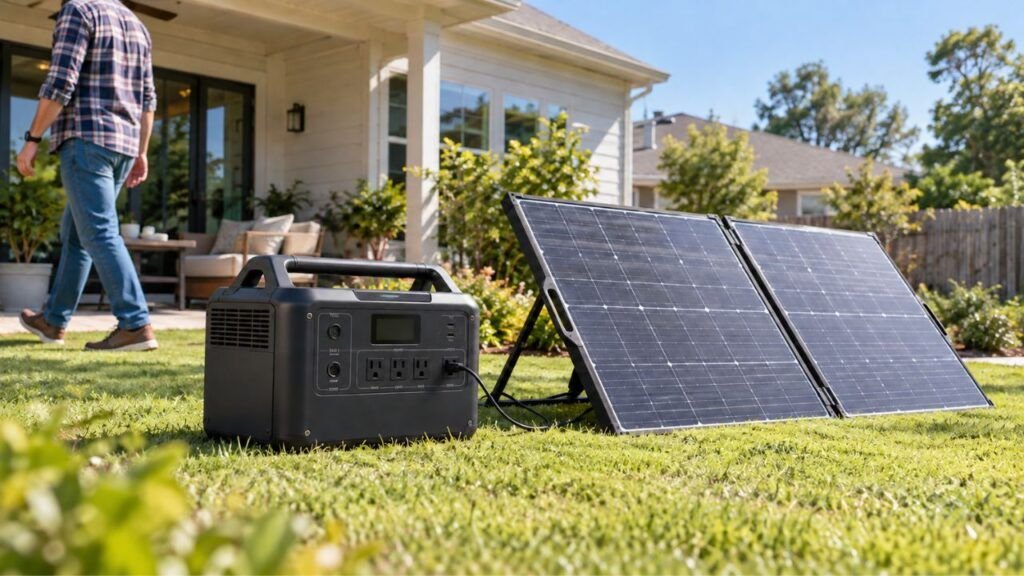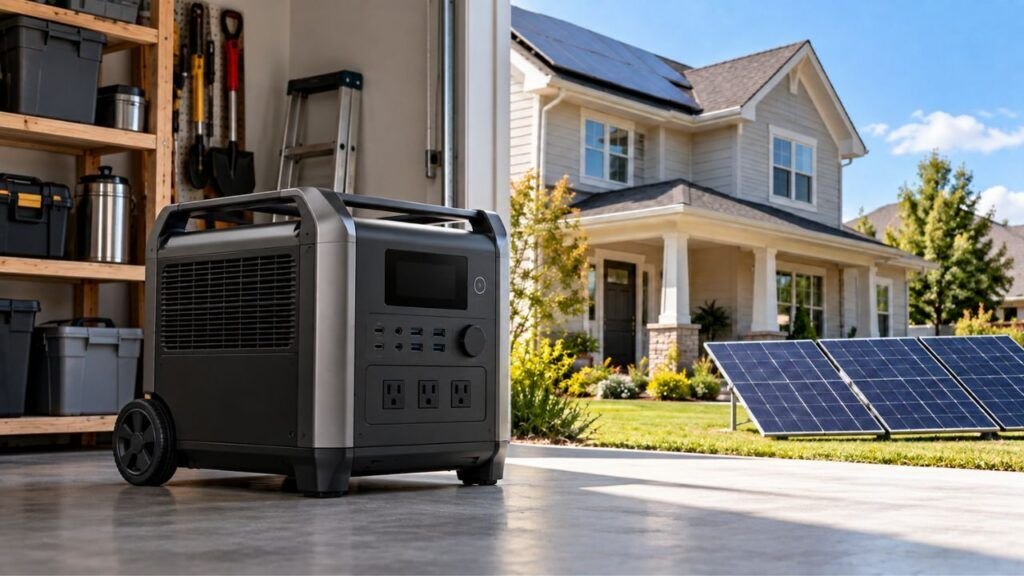
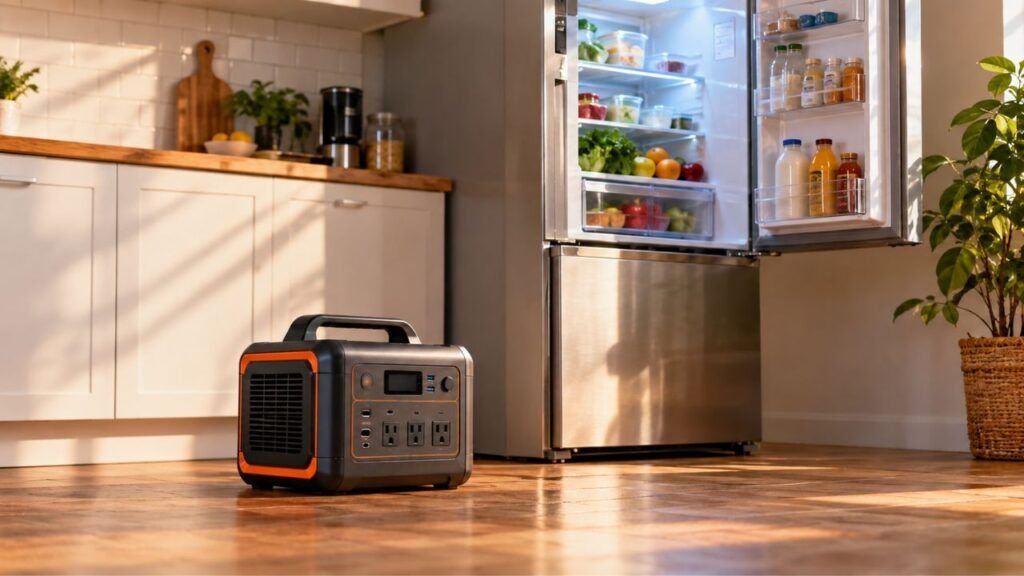
A solar generator can run a household refrigerator for roughly 6 hours to several days. The actual runtime depends on battery capacity, refrigerator energy use, inverter losses, and solar charging. A 1,000Wh unit may cover an efficient fridge overnight, while larger 2,000Wh to 5,000Wh systems can provide much longer backup.
If you are preparing for an outage, guessing is not enough. I’ll show you realistic runtime estimates, simple calculations, surge requirements, and ways to make your battery last longer.
Key Takeaways
- Battery capacity in watt-hours mainly determines refrigerator runtime.
- A 1,000Wh solar generator can often cover overnight refrigeration.
- A 2,000Wh system provides much better extended-outage protection.
- Refrigerator compressors cycle instead of running continuously all day.
- Starting surge determines whether the inverter can start your refrigerator.
- The refrigerator’s daily kWh usage gives better runtime estimates.
- Solar panels can greatly extend runtime during longer power outages.
- Other connected appliances will reduce your available refrigerator runtime.
How Long Will a Solar Generator Run a Refrigerator?
Runtime can vary significantly between refrigerators and solar generators. Battery capacity matters, but refrigerator efficiency matters just as much.
The table below provides practical planning estimates. It assumes about 85% usable AC energy after system losses.
| Solar Generator Capacity | Efficient Fridge | Typical Full-Size Fridge | Higher-Use Fridge | Best For |
| 500Wh | About 12–13 hours | About 8–9 hours | About 5–6 hours | Short outages |
| 1,000Wh | About 24–26 hours | About 16–18 hours | About 10–12 hours | Overnight backup |
| 2,000Wh | About 48–52 hours | About 32–35 hours | About 22–24 hours | One-day outages |
| 3,000Wh | About 72–76 hours | About 48–52 hours | About 32–35 hours | Extended outages |
| 5,000Wh | About 5 days | About 3–4 days | About 2–2.5 days | Multi-day backup |
These estimates assume approximately 0.8 kWh daily for an efficient fridge, 1.2 kWh for a typical model, and 1.8 kWh for a higher-consumption refrigerator.
Your actual runtime may be longer or shorter. Room temperature, door openings, refrigerator age, battery charge, and other connected devices all change the result.
Refrigerator Watts vs. Watt-Hours: Why This Matters
One of the biggest sizing mistakes is confusing watts with watt-hours. They measure two very different things.
Running Watts Tell You Instant Power
Running watts tell you how much power the refrigerator needs while operating.
A refrigerator compressor might use 100W, 150W, or more while running. However, it normally switches on and off throughout the day.
That means a 150W refrigerator does not necessarily consume 150W continuously.
Starting Watts Tell You Whether the Fridge Can Start
A refrigerator compressor briefly needs extra power when starting.
This startup demand can be several times higher than normal running power. Your solar generator needs enough surge capacity to handle that short spike.
For example, a refrigerator may run comfortably at 150W. Its startup demand could briefly be several hundred watts.
Surge wattage determines whether the refrigerator starts properly. It does not determine how many hours your battery lasts.
Watt-Hours Determine Your Available Battery Energy
Battery capacity is normally measured in watt-hours, or Wh.
A 1,000Wh solar generator theoretically stores twice as much energy as a 500Wh unit.
However, you normally cannot use every rated watt-hour through AC outlets. The inverter, battery electronics, and standby operation consume some energy.
That is why real runtime is usually below the simple rated-capacity calculation.
Daily kWh Shows What Your Refrigerator Actually Needs
Daily energy consumption gives you the clearest runtime picture.
Think about these four measurements separately:
- Inverter watts tell you whether the fridge can run.
- Surge watts tell you whether the compressor can start.
- Battery watt-hours tell you how much energy is available.
- Refrigerator kWh tells you how quickly energy gets consumed.
Once you understand those numbers, sizing becomes much easier.
How Much Electricity Does a Refrigerator Actually Use?
Refrigerators vary widely in energy consumption. Size, age, design, temperature, and efficiency all affect daily usage.
| Refrigerator Type | Typical Energy Behavior | Relative Backup Demand |
| Mini fridge | Low energy use | Low |
| Efficient top-freezer model | Relatively low | Low to moderate |
| Standard full-size refrigerator | Moderate | Moderate |
| French-door refrigerator | Often higher | Moderate to high |
| Large side-by-side refrigerator | Often higher | High |
| Older refrigerator | Can vary greatly | Moderate to high |
| Refrigerator/freezer combination | Depends heavily on size | Variable |
The easiest starting point is your refrigerator’s yellow EnergyGuide label.
Look for its estimated annual electricity consumption in kilowatt-hours.
You can convert that figure into daily consumption with simple math.
For example:
400 kWh per year ÷ 365 = about 1.10 kWh daily
That number is much more useful than simply looking at compressor wattage.
You can also measure your refrigerator with a plug-in electricity meter. Some solar generators also track energy use through their displays or mobile apps.
For the best estimate, measure consumption across a full day. Longer measurements are even better because refrigerator usage changes with conditions.
How to Calculate Refrigerator Runtime on a Solar Generator
You do not need complicated electrical knowledge for this calculation. I recommend starting with your refrigerator’s daily energy use whenever possible.
Method 1: Use the Refrigerator’s EnergyGuide Rating
First, find the refrigerator’s annual kWh rating.
Then calculate daily consumption:
Daily refrigerator use = Annual kWh ÷ 365
Next, estimate your usable battery capacity.
For basic planning, you can use around 85% of rated capacity.
Usable battery energy = Battery Wh × 0.85
Then calculate runtime:
Runtime in days = Usable battery kWh ÷ Daily refrigerator kWh
Finally:
Runtime in hours = Runtime in days × 24
This method gives you a practical planning estimate.
Example: 1,000Wh Battery and 400 kWh/Year Refrigerator
Suppose your refrigerator uses 400 kWh each year.
Daily consumption becomes:
400 ÷ 365 = about 1.10 kWh daily
Now consider a 1,000Wh solar generator.
Using an 85% planning efficiency:
1,000Wh × 0.85 = 850Wh usable
That equals 0.85 kWh.
Now calculate runtime:
0.85 ÷ 1.10 × 24 = about 18.5 hours
So, your estimated runtime would be around 18 hours.
Real conditions could push that number higher or lower.
Method 2: Use Measured Average Watts
You can also measure the refrigerator’s actual average power consumption.
Use this formula:
Runtime = Battery Wh × Efficiency ÷ Average watts
Suppose your 1,000Wh battery provides around 850Wh usable.
If your refrigerator averages 50W:
850Wh ÷ 50W = about 17 hours
This method works well when average consumption is measured accurately.
Method 3: Estimate From Running Watts and Duty Cycle
If you cannot find daily kWh usage, use running watts.
Then estimate how often the compressor operates.
For example:
150W × 40% duty cycle = 60W average
Using an 850Wh usable battery:
850Wh ÷ 60W = about 14 hours
However, treat this method as a rough estimate.
Compressor duty cycles change constantly during real-world operation.
Why Refrigerator Compressor Cycling Changes Runtime So Much
A refrigerator does not normally consume full running wattage all day.
The compressor turns on when the interior temperature rises. It switches off again after reaching the desired temperature.
Suppose your refrigerator compressor uses 150W while running.
If it operated continuously for 24 hours, consumption would be:
150W × 24 hours = 3,600Wh
But refrigerators normally cycle throughout the day.
If that same compressor runs only 35% of the time:
150W × 0.35 = about 52.5W average
That dramatically changes your expected battery runtime.
However, you should not assume one fixed duty cycle.
A refrigerator may run more frequently when:
- The kitchen becomes unusually hot.
- The refrigerator door gets opened often.
- Warm groceries are recently added.
- Door seals allow cold air to escape.
- The temperature setting is unnecessarily low.
- Condenser airflow becomes restricted.
- The refrigerator enters a defrost cycle.
That is why measured daily energy use gives better results.
Can Your Solar Generator Handle Refrigerator Startup Surge?
Battery capacity tells you how long refrigeration can continue. Inverter output determines whether the refrigerator can actually start.
Refrigerator Running Watts
Most refrigerators have fairly modest power requirements after starting.
Your solar generator’s continuous AC output should comfortably exceed the refrigerator’s normal running demand.
Having extra capacity also helps when other devices share the generator.
Compressor Starting Surge
The compressor needs additional power for a brief moment.
An inverter that handles running wattage but not startup surge may shut down when the compressor starts.
This becomes especially important with older or larger refrigerators.
What Happens If Surge Power Is Too High?
Modern solar generators generally have overload protection.
If your refrigerator demands more surge power than supported, the AC output may shut down.
The refrigerator will then stop receiving power.
This does not necessarily mean your battery is empty. The inverter simply could not handle the temporary demand.
How to Check Before an Outage
A little preparation can prevent problems during an emergency.
- Check your refrigerator’s electrical label or manual.
- Find the solar generator’s continuous AC rating.
- Check its surge or peak output rating.
- Avoid starting several large appliances simultaneously.
- Disconnect unnecessary loads when testing the fridge.
- Run a complete test before relying on emergency backup.
Testing beforehand is one of the smartest steps you can take.
What Factors Affect Refrigerator Runtime?
Two households using identical solar generators can get different runtimes. Several everyday conditions influence how quickly battery energy gets used.
Battery Capacity
Larger batteries generally provide longer refrigerator runtime.
A 2,000Wh battery stores roughly twice the energy of 1,000Wh.
However, usable AC energy will normally be slightly lower.
Refrigerator Efficiency and Age
An efficient refrigerator can stretch the same battery much further.
Older units may have worn seals, less-efficient compressors, or higher energy demand.
Always check actual consumption instead of assuming every full-size refrigerator behaves equally.
Room Temperature
Refrigerators work harder in warmer environments.
A refrigerator inside a hot garage may run much longer than one inside an air-conditioned kitchen.
That means summer outages can increase battery consumption.
Door Openings
Every door opening allows cold air to escape.
Warm air enters, forcing the compressor to restore the temperature.
During an outage, plan what you need before opening the door.
Refrigerator Temperature Setting
Setting your refrigerator unnecessarily cold increases energy consumption.
Keep it within a safe recommended food-storage range.
There is little benefit in making the compartment colder than necessary.
Inverter and Standby Losses
Your solar generator also consumes power while operating.
The inverter converts stored DC battery energy into AC electricity.
That conversion creates unavoidable losses.
Displays, cooling fans, wireless connections, and internal electronics may consume additional power.
Battery State of Charge and Age
A 1,000Wh generator starting at 65% charge does not provide 1,000Wh.
Older batteries may also hold less energy than when new.
Start predicted outages with the battery fully charged whenever practical.
Other Devices Connected to the Generator
Your refrigerator might not be the only emergency load.
Phones, lights, routers, fans, televisions, and medical devices all consume energy.
Every additional load shortens refrigerator backup time.
How Long Will Different Solar Generator Sizes Run a Refrigerator?
Battery size gives you a useful starting point for outage planning. These ranges assume normal refrigerator cycling and typical conversion losses.
How Long Will a 500Wh Solar Generator Run a Refrigerator?
A 500Wh solar generator may run a typical refrigerator for roughly 6–12 hours.
An efficient model could run longer under favorable conditions.
This size works better for short outages than overnight emergencies.
How Long Will a 1,000Wh Solar Generator Run a Refrigerator?
A 1,000Wh unit may provide roughly 10–25 hours of refrigerator backup.
Efficient refrigerators can approach or exceed one day.
Higher-consumption models may drain the battery before morning or midday.
How Long Will a 2,000Wh Solar Generator Run a Refrigerator?
A 2,000Wh solar generator may provide roughly 22–50 hours.
That makes this size much more practical for extended outages.
Daytime solar charging can stretch backup considerably further.
How Long Will a 3,000Wh Solar Generator Run a Refrigerator?
A 3,000Wh battery may provide roughly 32–75 hours of refrigerator backup.
Actual results depend heavily on daily refrigerator consumption.
Additional appliances will reduce these figures quickly.
How Long Will a 5,000Wh Solar Generator Run a Refrigerator?
A 5,000Wh system can potentially provide around two to five days.
Efficient refrigerators will stay near the higher end.
Larger or older models will usually fall closer to the lower range.
Solar input can make a system this size particularly useful during multi-day outages.
Can Solar Panels Keep a Refrigerator Running Continuously?
Solar panels can dramatically extend refrigerator backup time. However, panel wattage alone does not guarantee continuous operation.
Solar Production Must Replace Daily Refrigerator Consumption
Think of your battery like an energy account.
The refrigerator withdraws energy throughout the day.
Your solar panels must put enough energy back into that account.
Suppose your refrigerator consumes around 1.1kWh daily.
Your solar setup needs to replace approximately that energy, plus system losses.
If solar production remains below consumption, the battery eventually empties.
How Many Solar Panels Do You Need?
Panel requirements depend on refrigerator consumption and local sunlight.
A 100W panel may help extend runtime. However, it usually produces too little daily energy for dependable full-size refrigerator backup.
A 200W system can provide meaningful daytime support.
A 400W setup offers much more useful recharge capacity for many household refrigerators.
A 600W array provides additional margin for poor conditions and extra loads.
The important point is daily energy production, not panel wattage alone.
A 400W panel does not produce 400W continuously from sunrise through sunset.
Clouds, heat, shading, panel angle, season, and charging losses reduce real production.
What Happens Overnight?
Solar panels stop producing useful energy after sunset.
Your battery must carry the refrigerator through nighttime hours.
That is why both battery capacity and panel capacity matter.
A huge solar array with a tiny battery may still struggle overnight.
What About Cloudy Weather?
Cloud cover can reduce solar production substantially.
During prolonged storms, your system may receive very little charging.
That matters most during hurricanes and severe-weather outages.
Building some extra battery reserve gives you better protection.
When Can a Refrigerator Run Long-Term From Solar?
Long-term operation becomes possible when solar production consistently replaces daily refrigerator consumption.
Your battery must also cover nighttime and poor-sun periods.
For reliable planning, avoid assuming perfect sunny conditions every day.
Solar Generator Runtime During Real Power-Outage Scenarios
Thinking in outage length often makes sizing easier. Here’s how different situations may look in real use.
6-Hour Outage
A smaller 500Wh solar generator can often handle this situation.
The refrigerator may only cycle several times during those six hours.
Keeping other loads disconnected preserves your battery reserve.
Overnight Outage
A 1,000Wh class battery can be a practical choice.
Many efficient refrigerators can remain powered through the night.
Higher-energy refrigerators may require more capacity.
24-Hour Outage
A 1,000Wh unit may be enough for some efficient refrigerators.
However, a 2,000Wh system gives you considerably more breathing room.
Solar charging during daylight can further extend your backup.
48-Hour Outage
A 2,000Wh to 3,000Wh system becomes more useful here.
Solar input can make an enormous difference over two days.
You should also limit unnecessary loads during this period.
Multi-Day Outage
Long outages require more than simply buying a large inverter.
You need adequate battery storage and meaningful solar charging.
Expandable batteries become especially useful for this situation.
Load management also becomes increasingly important.
During multi-day outages, I would prioritize refrigeration, communication, essential lighting, and critical medical equipment.
What If You Run Other Devices With the Refrigerator?
Most households will want to power more than refrigeration. Those additional loads directly reduce available backup time.
| Backup Setup | Additional Energy Demand | Effect on Fridge Runtime |
| Refrigerator only | Lowest | Longest runtime |
| Fridge + phones | Low | Small reduction |
| Fridge + Wi-Fi router | Moderate | Noticeable reduction |
| Fridge + LED lights | Moderate | Depends on usage |
| Fridge + CPAP | Moderate to high | Significant reduction |
| Fridge + TV | Higher | Shorter runtime |
| Fridge + fan + router + lights | Higher | Much shorter runtime |
Suppose your refrigerator averages 50W and your router uses another 15W.
Your total average load becomes about 65W.
Add several lights and a fan, and consumption increases further.
That is why outage planning should include every device you expect to use.
How to Make a Solar Generator Run Your Refrigerator Longer
Small changes can meaningfully extend refrigerator runtime during an outage.
- Start with the solar generator fully charged.
- Keep refrigerator doors closed whenever possible.
- Avoid repeatedly checking food during the outage.
- Check refrigerator door seals for air leaks.
- Keep the refrigerator properly ventilated.
- Clean accessible condenser areas when recommended.
- Avoid placing the refrigerator near major heat sources.
- Do not use colder settings than necessary.
- Disconnect unnecessary devices from the solar generator.
- Charge phones during strong daylight hours.
- Use solar panels whenever conditions allow.
- Pre-cool food before an expected storm.
- Freeze suitable items before a predicted outage.
- Keep commonly used drinks inside a separate cooler.
- Monitor refrigerator temperature with an appliance thermometer.
A few careful habits can preserve several valuable battery hours.
Refrigerator Food Safety During a Power Outage
Keeping food cold is the real reason refrigerator backup matters. Your goal is maintaining safe temperatures, not simply keeping the light on.
- Keep refrigerator temperature at 40°F or below.
- Use an appliance thermometer when possible.
- Keep the refrigerator door closed during outages.
- Avoid repeatedly checking food temperatures unnecessarily.
- An unpowered closed refrigerator generally keeps food cold around four hours.
- Use coolers with ice during longer unsupported outages.
- Be cautious with questionable perishable foods.
If your solar generator keeps the refrigerator safely below 40°F, the four-hour unpowered guideline does not apply in the same way.
The key issue is food temperature.
Do not assume food is safe simply because it smells normal.
What Size Solar Generator Do You Need for Refrigerator Backup?
The right system depends more on daily energy demand than refrigerator size. Start with your expected outage length and measured consumption.
| Backup Goal | Battery Capacity to Consider | Solar Charging | Extra Loads |
| Short outage | Around 500Wh | Optional | Minimal |
| Overnight | Around 1,000Wh | Helpful | Very limited |
| Around one day | 1,000–2,000Wh | Recommended | Light |
| One to two days | 2,000–3,000Wh+ | Very useful | Moderate |
| Multi-day outage | Large or expandable system | Important | Carefully managed |
These are planning ranges rather than universal minimum requirements.
Your refrigerator’s actual daily kWh figure should guide your final choice.
For example, a refrigerator consuming 0.8kWh daily needs much less battery than one consuming 1.8kWh.
Also check inverter surge capacity before buying.
A battery can have enough stored energy but still fail to start the compressor.
Common Refrigerator Backup Sizing Mistakes
Most sizing problems come from confusing power with energy. Avoid these mistakes before purchasing your system.
- Choosing a generator based only on inverter wattage.
- Assuming 2,000W automatically means 2,000Wh.
- Treating running watts as continuous 24-hour consumption.
- Ignoring refrigerator compressor startup surge.
- Forgetting AC conversion and standby losses.
- Assuming solar panels produce rated wattage all day.
- Ignoring cloudy or stormy weather.
- Forgetting other connected appliances.
- Starting an outage with a partly charged battery.
- Trusting marketing runtime figures as guaranteed results.
- Never testing the refrigerator before an emergency.
If you avoid these mistakes, sizing becomes much more predictable.
Final Words
A solar generator can run a refrigerator anywhere from several hours to several days. Battery capacity, refrigerator efficiency, operating conditions, and solar charging determine the real runtime.
For the most useful estimate, start with your refrigerator’s daily kWh consumption. Then compare that requirement with the usable watt-hours in your solar generator.
I also recommend testing your complete setup before an outage. Knowing your actual refrigerator consumption removes most of the guesswork when the grid goes down.
Related FAQs
How Long Will a 1,000Wh Solar Generator Run a Refrigerator?
A 1,000Wh solar generator may run a household refrigerator for roughly 10–25 hours. Efficient refrigerators can last closer to one day, while older or larger models may drain the battery much sooner.
How Long Will a 2,000Wh Solar Generator Run a Refrigerator?
A 2,000Wh battery can often provide around 22–50 hours of refrigerator backup. Your actual result depends on refrigerator energy consumption, inverter losses, temperature, and other connected loads.
How Long Will a 3,000-Watt Solar Generator Run a Refrigerator?
A 3,000W rating alone cannot determine runtime because watts measure output power. You also need the generator’s battery capacity in watt-hours before estimating how long your refrigerator will run.
Will a 1,000-Watt Solar Generator Run a Refrigerator?
Yes, many 1,000W solar generators can run household refrigerators if their surge output handles compressor startup. Runtime still depends on the unit’s battery capacity in watt-hours.
What Size Solar Generator Do I Need for a Refrigerator?
For short outages, around 500Wh may be enough for some refrigerators. Around 1,000Wh works better overnight, while 2,000Wh or more provides greater protection during extended outages.
Can a Solar Generator Run a Refrigerator Overnight?
Yes, a properly sized solar generator can run most refrigerators overnight. A 1,000Wh-class unit often works well, but high-consumption refrigerators may need a larger battery.
Can a Solar Generator Run a Refrigerator and Freezer at the Same Time?
Yes, if the inverter handles their combined running and starting wattage. You also need enough battery capacity to cover the combined daily energy consumption of both appliances.
How Many Watts Does a Refrigerator Use During an Outage?
Many household refrigerators draw around 100–400W while their compressors operate, but they cycle on and off. Actual average energy consumption is therefore much lower than continuous running wattage suggests.
How Many Solar Panels Does It Take to Run a Refrigerator?
The answer depends on your refrigerator’s daily kWh use and available sunlight. A 200W to 600W solar setup may support refrigeration, but daily solar production matters more than panel wattage alone.
Can a 200W Solar Panel Run a Refrigerator?
A 200W solar panel may help support an efficient refrigerator, but it usually needs a battery between the panel and appliance. Weather, sunlight hours, charging losses, and refrigerator consumption determine whether daily energy production is sufficient.
Does a Refrigerator Use More Power When the Compressor Starts?
Yes. Refrigerator compressors briefly require more power during startup than normal operation. Your solar generator’s surge rating needs to handle this temporary demand without triggering overload protection.
Can You Leave a Refrigerator Plugged Into a Solar Generator?
Yes, you can keep a refrigerator connected if the solar generator supports continuous AC operation and sufficient battery capacity. Monitor battery level and solar input during extended outages.

Blake Cooper writes practical guides on generators, portable power stations, and home backup systems. He focuses on simplifying power topics and helping homeowners make informed buying decisions.