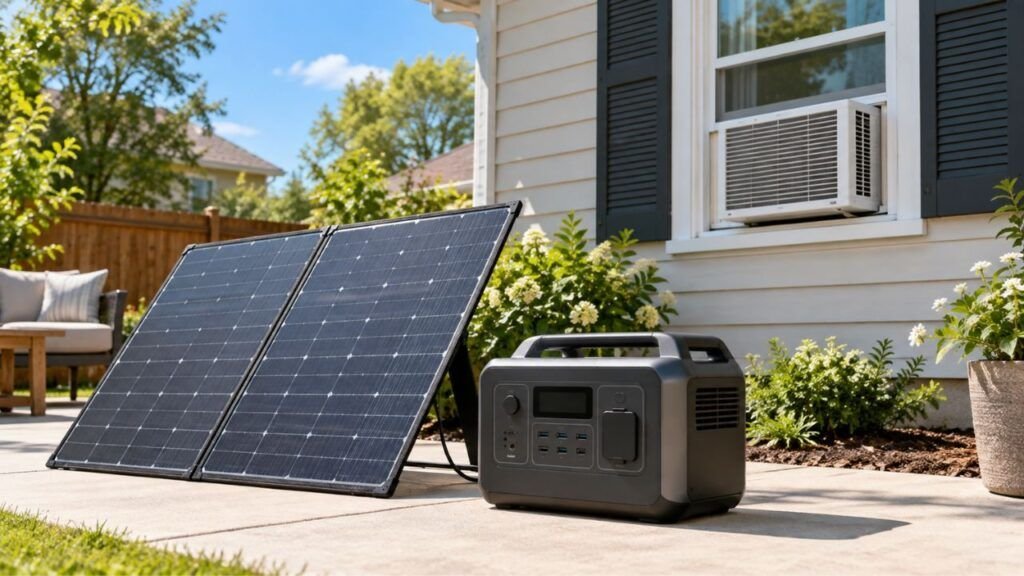
Yes, a solar generator can run an air conditioner. However, its inverter must handle the AC’s running watts, startup surge, and voltage. The battery also needs enough capacity for your desired runtime.
In this guide, I’ll help you calculate those requirements correctly. We’ll also cover window ACs, portable units, RV ACs, mini-splits, and central air systems.
Key Takeaways
- Many solar generators can run window and portable air conditioners.
- Inverter output must exceed the AC’s normal running wattage.
- Surge output must handle the compressor’s startup power demand.
- Battery capacity in watt-hours determines how long cooling can continue.
- Most small room AC units use standard 120V power.
- Larger HVAC systems often need 240V output and larger batteries.
- Solar panels can extend runtime but may not cover the entire load.
- Central air usually requires a large home backup power system.
Can a Solar Generator Really Run an Air Conditioner?
A solar generator can run an air conditioner when its electrical specifications match the AC. You need to check more than just one wattage number.
The most important factors are running watts, starting watts, battery capacity, and voltage.
Running wattage tells you how much continuous power the AC requires. Starting wattage tells you how much power the compressor briefly needs during startup.
Battery capacity is different. It tells you how long stored energy can keep the AC running.
Voltage also matters. A powerful 120V solar generator cannot directly operate equipment requiring 240V unless the system specifically supports it.
Think of a solar generator as a battery backup with an inverter. Solar panels recharge that battery using sunlight.
The AC usually receives power from the battery and inverter. It does not simply run directly from the solar panels.
What Size Solar Generator Do You Need for an Air Conditioner?
The right solar generator depends on your AC type and electrical demand. Always check the actual specifications printed on your unit before buying anything.
Here is a practical starting point.
| Air Conditioner Type | Typical Running Power | Startup Demand | Common Voltage | Suggested Generator Class |
| Small window AC | 400-700W | Moderate | 120V | 1,000-1,500W+ |
| Larger window AC | 700-1,500W | Moderate to high | 120V | 1,500-3,000W+ |
| Portable AC | 700-1,500W | Moderate to high | 120V | 1,500-3,000W+ |
| RV rooftop AC | 1,200-1,800W | High | Usually 120V | 2,000-3,500W+ |
| Inverter mini-split | 500-2,000W+ | Model dependent | 120V or 240V | 2,000W+ |
| Central AC | 2,000-5,000W+ | Very high | Usually 240V | Large home backup system |
These ranges are estimates. AC efficiency, size, compressor type, and cooling conditions can change the actual numbers considerably.
Running Watts vs. Starting Watts
Running watts are the continuous power your air conditioner consumes after starting.
Suppose your window AC normally uses 900 watts. Your solar generator needs more than 900 watts of continuous AC output.
Starting watts are different.
Traditional compressors can require considerably more power for several seconds during startup. This short burst is often called starting surge or peak wattage.
Your generator might have enough battery energy for several hours. However, the AC can still fail to start.
That happens when the inverter cannot handle the startup surge.
For this reason, check both specifications:
- Continuous inverter output
- Surge or peak inverter output
Leave some extra power headroom whenever possible.
Battery Capacity in Wh vs. Generator Output in W
Watts and watt-hours sound similar, but they measure different things.
Watts measure power output.
Watt-hours measure stored energy.
A solar generator with a 2,000W inverter can potentially run appliances totaling around that continuous output limit.
However, that does not tell you runtime.
A 2,000Wh battery describes how much energy the battery stores.
So you should think about sizing in two separate steps.
First, make sure the inverter can start and run your AC.
Second, make sure the battery stores enough energy for your cooling time.
Check the Voltage: 120V vs. 240V
Voltage is especially important when powering air conditioners in U.S. homes.
Many window and portable air conditioners plug into standard 120V outlets. These are generally easier to use with portable solar generators.
Larger mini-splits and central air systems may use 240V instead.
Before choosing a solar generator, check:
- AC operating voltage
- Plug or connection type
- Continuous inverter wattage
- Surge inverter wattage
- Generator output voltage
Do not assume sufficient wattage automatically means compatibility.
A 120V-only solar generator cannot directly power a 240V air conditioner.
How Many Watts Does an Air Conditioner Use?
Air conditioner wattage varies greatly between different cooling systems. Size, efficiency, compressor technology, temperature, and installation all affect consumption.
Here is what you can generally expect from common AC types.
Window Air Conditioner
Small window air conditioners are among the easiest AC units to power.
Many smaller models operate between roughly 400 and 700 watts. Larger window systems may use 1,000 watts or more.
A larger BTU rating usually means higher electrical demand.
However, BTU alone cannot determine exact wattage.
Two air conditioners with similar cooling capacity can have very different efficiency levels.
Always check the electrical label whenever possible.
Portable Air Conditioner
Portable AC units commonly require around 700 to 1,500 watts.
Some smaller units consume less, while powerful models can consume considerably more.
Portable air conditioners can also have compressor startup demands. That surge needs enough inverter headroom.
Do not confuse cooling capacity with electrical consumption.
A BTU rating describes cooling performance rather than exact electrical wattage.
RV Air Conditioner
RV rooftop air conditioners can place a significant load on batteries.
Many RV AC systems draw roughly 1,200 to 1,800 watts while operating.
Startup demand can be considerably higher with conventional compressors.
This startup surge often causes problems with smaller power stations.
A compatible soft-start device can sometimes reduce that startup demand. However, it does not reduce normal running consumption dramatically.
Mini-Split Air Conditioner
Mini-splits can work well with larger solar generator systems.
Many modern mini-splits use inverter-driven compressors. These systems can adjust compressor speed instead of constantly switching fully on and off.
That can improve efficiency under suitable conditions.
Power consumption varies widely between different mini-split sizes.
Some smaller systems may stay below 1,000 watts during lighter operation. Larger systems can require much more.
You also need to check whether your mini-split uses 120V or 240V.
Central Air Conditioner
Central air is much harder to run from portable battery systems.
Depending on size, central AC equipment may consume several thousand watts. Startup requirements can also be very high.
Most residential central systems also use 240V power.
That usually moves you beyond a typical portable power station.
For central AC backup, you may need:
- High-output inverter capacity
- 240V support
- Large expandable batteries
- Substantial solar input
- Appropriate transfer equipment
- Professional electrical installation
Central air can run from battery backup systems. However, the system must be designed specifically for those loads.
How Long Can a Solar Generator Run an Air Conditioner?
Runtime depends mainly on battery capacity and average AC consumption. Inverter losses and changing compressor demand also affect actual results.
A basic calculation gives you a useful estimate.
Use This Runtime Formula
Use this formula:
Estimated runtime = usable battery energy ÷ average AC wattage
Battery specifications normally list total watt-hours.
However, you should not assume every rated watt-hour reaches the appliance.
Some energy is lost through the inverter and internal electronics.
For rough planning, you can apply a conservative usable-energy assumption.
For the examples below, we will assume about 85% usable energy.
Example: 1,000Wh Battery With a 500W AC
Start with a 1,000Wh battery.
Using an 85% usable-energy assumption gives:
1,000Wh × 0.85 = 850Wh
Now divide by the 500W AC load:
850Wh ÷ 500W = about 1.7 hours
That means roughly one hour and forty minutes under continuous 500W operation.
Actual runtime may differ because air conditioners often cycle.
Example: 2,000Wh Battery With a 1,000W AC
Now consider a 2,000Wh battery.
Estimated usable energy:
2,000Wh × 0.85 = 1,700Wh
Divide that by a 1,000W average load:
1,700Wh ÷ 1,000W = about 1.7 hours
Again, this assumes continuous 1,000W consumption.
Real runtime may increase if the compressor cycles frequently.
Estimated AC Runtime by Battery Size
| Battery Capacity | 500W AC Load | 1,000W AC Load | 1,500W AC Load |
| 1,000Wh | About 1.7 hours | About 0.9 hours | About 0.6 hours |
| 2,000Wh | About 3.4 hours | About 1.7 hours | About 1.1 hours |
| 3,000Wh | About 5.1 hours | About 2.6 hours | About 1.7 hours |
| 5,000Wh | About 8.5 hours | About 4.3 hours | About 2.8 hours |
These numbers use an 85% usable-energy assumption.
They are estimates rather than guaranteed runtimes.
Why Your AC May Run Longer Than the Simple Math Suggests
Air conditioners do not always consume their maximum running wattage continuously. Cooling conditions and compressor behavior can change the average load considerably.
Several factors determine your real runtime.
Compressor Cycling
A conventional air conditioner may switch its compressor on and off.
Once the room reaches the thermostat setting, the compressor may stop temporarily.
During that time, electricity consumption drops.
This means average hourly consumption can be lower than continuous rated wattage.
Inverter-Driven Compressors
Inverter air conditioners work somewhat differently.
Instead of repeatedly switching completely on and off, they can adjust compressor speed.
After reaching the desired temperature, the compressor may operate at lower power.
This can reduce average electricity demand under suitable conditions.
Outdoor Temperature
Hotter weather makes your air conditioner work harder.
A room may cool quickly on a mild day.
The same room might require almost continuous compressor operation during extreme heat.
That difference directly affects battery runtime.
Thermostat Setting
Your thermostat setting has a major effect on consumption.
Trying to maintain an extremely cold room increases the cooling workload.
A more moderate temperature usually allows longer battery runtime.
Room Size and Insulation
A poorly insulated room gains heat quickly.
Large windows, direct sunlight, air leaks, and poor insulation increase cooling demand.
A properly sized AC in an insulated room usually runs more efficiently.
How Much Solar Power Do You Need to Run the AC?
Solar panel requirements depend on daily AC energy consumption. You also need to consider your location, weather, shading, panel angle, and charging losses.
Solar panels can extend runtime, but they do not guarantee unlimited cooling.
Solar Input vs. AC Power Consumption
Imagine your air conditioner is using 1,000 watts.
Your solar panels are currently supplying 500 watts into the generator.
The battery still needs to provide the remaining power.
So the battery continues discharging, just more slowly.
If solar input matches or exceeds the total system load, battery discharge may slow dramatically or stop.
Whether that happens depends on real solar production.
Calculate Daily Solar Energy Needed
First, calculate how much energy the AC consumes daily.
Use this formula:
Daily AC energy = average watts × operating hours
Suppose your AC averages 800 watts for five hours.
800W × 5 hours = 4,000Wh
You would need roughly 4,000Wh of usable energy daily just for the AC.
Then account for charging and system losses.
You also need enough solar-panel production during available sunlight.
A larger array gives you more recovery potential after heavy AC use.
Why a 400W Solar Panel Does Not Produce 400W All Day
A solar panel’s wattage is a maximum rated output.
Actual production changes throughout the day.
Several factors reduce real output:
- Morning and evening sun angles
- Cloud cover
- High panel temperature
- Partial shading
- Dust or debris
- Panel orientation
- Charging losses
That is why daily solar energy matters more than panel wattage alone.
Do not assume one 400W panel delivers 400 watts for every daylight hour.
Can a 1,000W Solar Generator Run an Air Conditioner?
A 1,000W solar generator can run some small air conditioners.
However, you need to check the inverter’s continuous and surge ratings.
A small efficient window AC might operate successfully.
A larger compressor unit may exceed the inverter during startup.
Battery capacity is another concern.
A generator with a 1,000W inverter might only contain around 1,000Wh of energy.
That could mean limited AC runtime.
So never size your setup from the inverter wattage alone.
Can a 2,000W Solar Generator Run an Air Conditioner?
A 2,000W solar generator can run many window and portable air conditioners.
It may also run some smaller RV air conditioners.
Startup surge remains important.
Your AC might consume 1,200 watts normally but demand much more during compressor startup.
Make sure the generator can handle that temporary load.
Also check the battery capacity.
A 2,000W inverter paired with 1,000Wh provides very different runtime from one paired with 3,000Wh.
Can a 3,000W Solar Generator Run an Air Conditioner?
A 3,000W solar generator offers more flexibility for cooling loads.
It can potentially run larger window ACs, portable units, and some RV systems.
Certain mini-splits may also work if voltage matches.
However, 3,000 watts does not automatically mean central AC compatibility.
You still need to confirm:
- Operating voltage
- Startup surge
- Continuous wattage
- Battery capacity
- Connection method
For larger cooling systems, check all five before purchasing.
Can a Solar Generator Run Central Air Conditioning?
A solar generator can power central air, but typical portable units are usually too small. Central AC normally requires much higher output, 240V support, and substantial battery storage.
This application should be treated differently from powering a window AC.
Why Central AC Is Much Harder to Power
Central air conditioners use large compressors.
Their running power can reach several thousand watts.
Traditional compressor startup can create an even larger temporary demand.
They are also commonly hardwired into the home’s electrical system.
You therefore need sufficient:
- Continuous inverter output
- Surge capacity
- Battery storage
- 240V capability
- Home electrical integration
A standard portable 120V power station is rarely designed for this job.
Portable Solar Generator vs. Whole-Home Battery System
| Requirement | Portable Solar Generator | Whole-Home or Expandable System |
| Small 120V room AC | Often suitable | Suitable |
| 240V output | Model dependent | Available on suitable systems |
| Large battery capacity | Limited or expandable | Designed for large storage |
| Hardwired HVAC | Usually limited | Can support proper integration |
| Transfer equipment | Model dependent | Commonly supported |
| Central AC | Usually difficult | Much more practical |
Do Not Improperly Connect a Generator to Home Wiring
Never improvise a connection between a power station and household wiring.
Hardwired HVAC systems require proper electrical equipment.
Depending on your setup, this can include approved transfer equipment and professional installation.
If you plan to power central air, work with a qualified electrician.
That helps protect your home, equipment, and anyone working on utility lines.
Does an AC Soft Starter Help With a Solar Generator?
A soft starter can help certain compressor-driven air conditioners start from limited inverter power. However, it only addresses part of the overall power problem.
What a Soft Starter Does
A compressor can demand substantial current during startup.
A compatible soft starter helps reduce that sudden startup demand.
This may allow an appropriately sized inverter to start the AC more reliably.
Soft starters are commonly discussed for RV and residential compressor systems.
However, compatibility depends on the specific AC equipment.
What a Soft Starter Does Not Do
A soft starter does not:
- Increase battery capacity
- Increase solar-panel production
- Eliminate normal running wattage
- Convert 120V output into 240V output
- Guarantee compatibility with every generator
It mainly helps manage startup demand.
Inverter AC vs. Soft-Started Conventional AC
An inverter-driven AC controls compressor speed electronically.
This can create smoother power demand during normal operation.
A conventional AC normally switches its compressor fully on and off.
A soft starter can help reduce the startup stress of that conventional compressor.
Both approaches can make battery backup more manageable.
However, actual performance depends on the specific equipment.
How to Tell Whether Your Solar Generator and AC Will Work Together
Before connecting anything, compare the specifications carefully. This simple checklist can prevent most sizing mistakes.
- Find your AC operating voltage.
- Check the AC’s normal running wattage.
- Find its startup or surge demand.
- Check the generator’s continuous AC output.
- Check the generator’s surge output.
- Confirm 120V or 240V compatibility.
- Decide how many hours you need cooling.
- Calculate the required battery capacity.
- Add the load from other appliances.
- Estimate realistic daily solar recharging.
Where to Find These Numbers
Look in these places:
- AC electrical nameplate
- Owner’s manual
- Manufacturer specification sheet
- Solar generator specification sheet
- Suitable plug-in power meter
- HVAC technician measurements
- Qualified electrician for hardwired systems
Use your actual equipment specifications whenever possible.
Generic online estimates are useful for planning, but they cannot replace exact numbers.
Best Air Conditioner Types for Solar Generator Use
Some air conditioners are easier to run from batteries than others. Lower average power consumption and manageable startup demand make a major difference.
Efficient Window AC
A smaller efficient window unit is one of the easiest choices.
It cools one room instead of your entire house.
This greatly reduces the amount of battery storage required.
Choose the proper cooling capacity for your room.
An oversized unit is not always the most efficient choice.
Inverter Window AC
Inverter window air conditioners can adjust compressor speed.
That often creates steadier electricity demand after the room cools.
This characteristic can make them suitable for battery-powered cooling.
Still, verify the actual electrical specifications first.
Dual-Hose Portable AC
Portable air conditioners offer flexible placement.
Dual-hose designs can reduce some efficiency problems found in single-hose designs.
However, efficiency varies between models.
Check actual power consumption rather than choosing solely by hose design.
Inverter Mini-Split
A properly sized inverter mini-split can be efficient.
These systems can modulate cooling output as conditions change.
They can work well with larger battery systems.
Just confirm voltage before choosing your generator.
Low-Wattage Camping AC
Compact camping air conditioners use much less energy than household systems.
They are designed for tents, small campers, or compact spaces.
Their lower wattage makes them easier to run from portable solar generators.
Cooling capacity is also much lower.
Do not expect one to cool a full-sized home room.
How to Make an Air Conditioner Run Longer on Battery Power
Small changes can noticeably extend your cooling runtime.
Try these practical steps:
- Cool one room instead of the whole house.
- Close doors leading to unused rooms.
- Block direct sunlight with curtains or blinds.
- Seal obvious air leaks around doors and windows.
- Clean or replace dirty AC filters.
- Avoid setting the thermostat unnecessarily low.
- Use a fan to circulate cooled air.
- Pre-cool the room while grid power remains available.
- Run fewer high-wattage appliances simultaneously.
- Keep solar panels free from shade.
- Keep panels clean when needed.
- Use an appropriately sized AC for the room.
The goal is reducing how often the compressor must work hard.
That directly helps preserve battery energy.
When a Solar Generator Makes Sense for Air Conditioning
Solar generators are most practical when your cooling goal matches the available battery capacity. They are especially useful for targeted cooling rather than unlimited whole-home operation.
Short Power Outages
A solar generator works well for short outages.
You can keep one important room cool without running central air.
This approach requires much less battery capacity.
It can also reduce the number of appliances competing for power.
Emergency Bedroom Cooling
Cooling one bedroom can be more practical during a prolonged outage.
A window or portable AC needs much less energy than central air.
This strategy can provide comfortable sleeping conditions while conserving power.
RV and Camping
Solar generators can be very useful for RV cooling.
However, rooftop AC startup demand needs careful attention.
Battery capacity also becomes important during overnight use.
Solar charging during daytime can help restore some consumed energy.
Off-Grid Cabin
An efficient window AC or mini-split can suit off-grid cabins.
The system should be designed around daily energy consumption.
You need enough battery storage for cloudy periods and nighttime cooling.
You also need enough solar capacity to replace used energy.
Whole-Home Backup
Whole-home cooling requires a much larger system.
You may need expandable batteries, 240V output, and high solar input.
Transfer equipment may also be necessary.
This type of installation should be planned like a home backup system.
It should not be treated like a standard portable generator setup.
When a Solar Generator May Not Be the Right Solution
Solar generators work well for many cooling situations.
However, they are not automatically the best solution for every home.
A different backup setup may make more sense when:
- You need central air continuously during long outages.
- Your AC requires unsupported 240V power.
- Compressor surge exceeds the inverter rating.
- Your battery is too small for useful runtime.
- Solar input cannot replace your daily consumption.
- Several large appliances must run simultaneously.
- You have very limited solar exposure.
- You need several days of uninterrupted heavy cooling.
In those situations, a larger battery system may be necessary.
Solar Generator vs. Gas Generator for Running an Air Conditioner
Both systems can run air conditioners when correctly sized. However, their operating characteristics are very different.
| Feature | Solar Generator | Gas Generator |
| Fuel source | Stored electricity and solar | Gasoline, propane, or similar fuel |
| Noise | Usually low | Usually much louder |
| Exhaust | No combustion exhaust | Produces engine exhaust |
| Runtime | Limited by battery capacity | Limited by available fuel |
| Solar recharging | Yes | No |
| Maintenance | Generally low | Requires engine maintenance |
| Indoor battery unit use | Possible | Engine must remain outdoors |
| Large AC startup | Depends on inverter | Depends on generator rating |
A solar generator is attractive for quiet indoor battery backup.
A fuel generator can offer longer runtime when you have enough fuel.
Never operate a combustion generator indoors, inside garages, or near openings.
Common Mistakes When Sizing a Solar Generator for AC
Most sizing problems happen because one important specification gets overlooked.
Avoid these common mistakes:
- Comparing AC watts directly with battery watt-hours
- Ignoring compressor startup surge
- Ignoring 120V and 240V differences
- Choosing generator size using BTU alone
- Assuming solar panels produce rated power all day
- Forgetting inverter and charging losses
- Assuming the AC always draws maximum wattage
- Ignoring additional connected appliances
- Buying an inverter with almost no power headroom
- Assuming a soft starter reduces normal running consumption
- Expecting solar panels to guarantee unlimited runtime
- Forgetting nighttime energy requirements
Check the full system instead of focusing on one specification.
Final Words
Yes, a solar generator can run an air conditioner. Small window units, portable ACs, and some RV systems are particularly realistic applications.
The key is matching running watts, startup surge, voltage, and battery capacity. Ignore any one of those, and the system may disappoint you.
Central air requires a much larger approach. For that level of cooling, look toward high-capacity 240V home backup systems rather than ordinary portable power stations.
Related FAQs
Can a 1,000Wh Solar Generator Run an Air Conditioner?
Yes, a 1,000Wh solar generator can run some small air conditioners if its inverter handles the running and startup load. Runtime may only be one or two hours with moderate AC loads.
How Long Will a 2,000Wh Solar Generator Run an AC?
A 2,000Wh solar generator may run a 1,000W AC for roughly 1.5 to 1.8 hours under continuous load. Compressor cycling can make actual runtime longer in favorable conditions.
Can a 2,000-Watt Solar Generator Run a Window Air Conditioner?
Yes, many 2,000W solar generators can run typical window air conditioners. Check the AC’s startup surge and ensure the generator provides enough battery capacity for your desired runtime.
Can a 3,000-Watt Solar Generator Run an RV Air Conditioner?
A 3,000W solar generator can run many RV air conditioners if its surge rating handles compressor startup. Battery capacity will determine how long the AC continues operating.
Can a Solar Generator Run a 5,000 BTU Air Conditioner?
Yes, many solar generators can run smaller 5,000 BTU window AC units. Check the exact running wattage and startup demand because electrical consumption varies between models.
Can a Solar Generator Run a 10,000 BTU Air Conditioner?
Yes, but a 10,000 BTU AC usually needs more inverter output and battery capacity. A larger 1,500W to 2,500W-class generator may be appropriate depending on the specific AC.
Can Solar Panels Run an Air Conditioner Without a Battery?
Technically, specialized solar systems can operate cooling equipment directly, but typical portable solar-generator setups rely on batteries. The battery stabilizes power when sunlight changes or clouds pass overhead.
How Many Solar Panels Do I Need to Run an Air Conditioner?
The number depends on your AC’s daily energy use and each panel’s real output. Calculate daily watt-hours first, then size the solar array to replace that energy.
Can a Solar Generator Run AC Overnight?
Yes, if the battery stores enough energy for the expected overnight load. Solar panels cannot recharge the system at night, so battery capacity becomes the main limitation.
Can a Solar Generator Run Central AC?
Yes, but central AC normally requires large battery storage, strong surge capacity, and 240V output. A whole-home backup system is usually more appropriate than a small portable unit.
Does an Air Conditioner Need a Soft Start With a Solar Generator?
Not always. A soft starter can help conventional compressors with high startup current. Inverter-driven AC systems may already manage startup demand differently.
Can I Run an Air Conditioner While the Solar Generator Is Charging?
Many modern solar generators support simultaneous charging and AC output. Check your specific model’s pass-through charging limits because input and output restrictions can vary.

Blake Cooper writes practical guides on generators, portable power stations, and home backup systems. He focuses on simplifying power topics and helping homeowners make informed buying decisions.