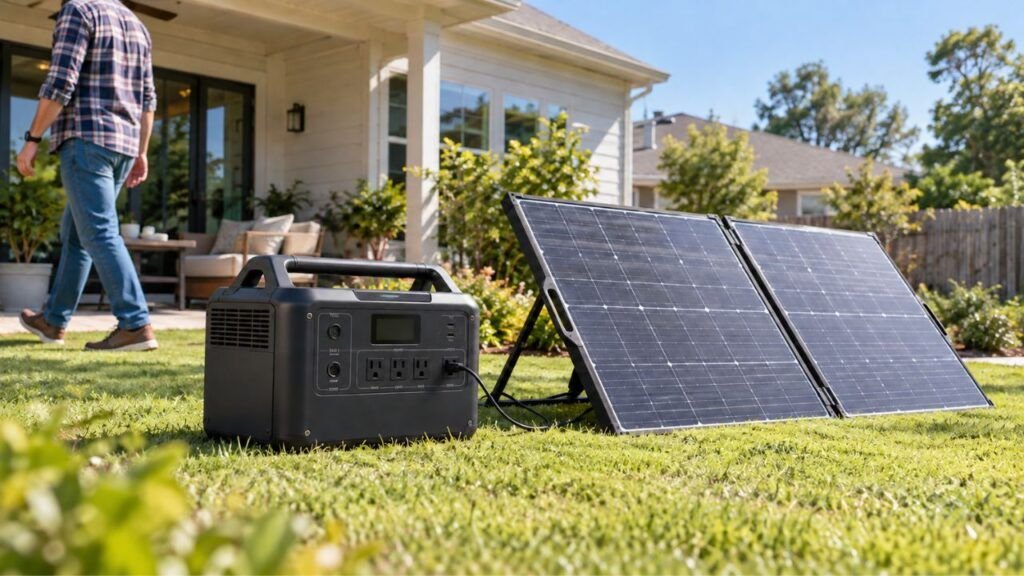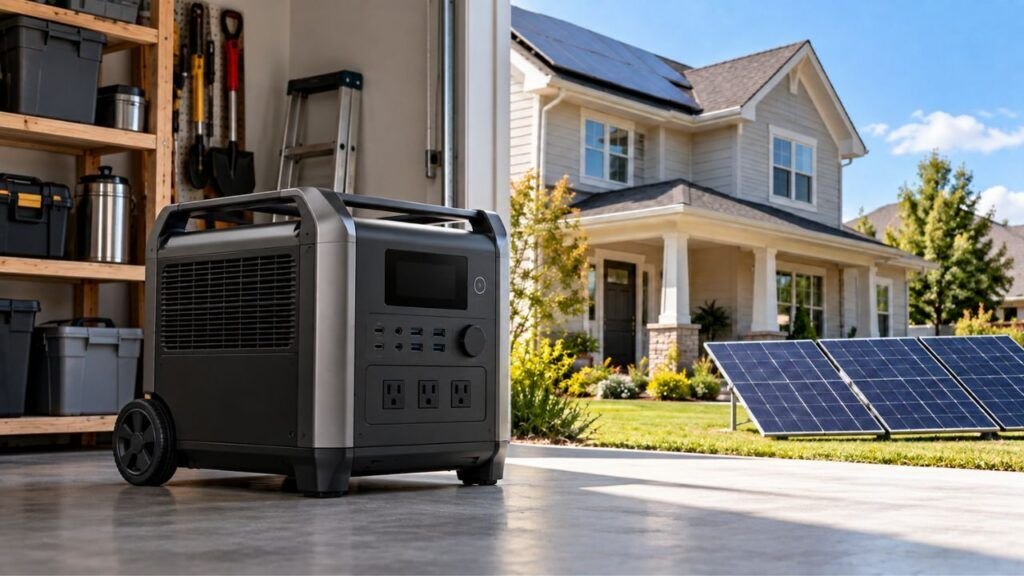
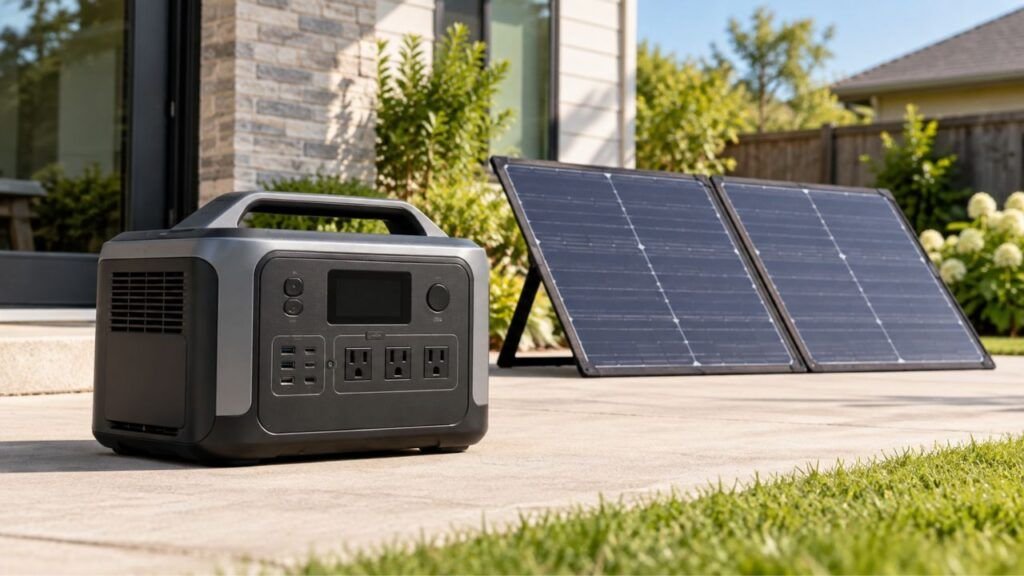
A solar generator can take about 1 to 24+ hours to charge. Many modern units recharge from a wall outlet within 1–3 hours. Solar charging often takes 3–8+ good-sun hours, while standard 12V car charging can take much longer.
Your actual charging time depends on battery capacity, input wattage, sunlight, and charging limits. Below, I’ll show you how to estimate your charging time accurately.
Key Takeaways
- AC wall charging is usually the fastest charging method.
- Solar charging often needs several hours of strong sunlight.
- Larger batteries generally take longer to recharge.
- Higher solar wattage can reduce charging time significantly.
- Your generator’s maximum input limits usable charging power.
- Cloud cover, shade, heat, and panel angle affect solar output.
- Using appliances while charging can noticeably extend charging time.
How Long Does a Solar Generator Take to Charge?
There is no single charging time that applies to every solar generator. Battery size, charging source, and available input power all matter.
Here is a practical comparison for most modern portable power stations.
| Charging Method | Typical Charging Time | Best Use | Main Limitation |
| AC wall outlet | About 1–3 hours | Fast charging before outages or trips | Limited by AC input rating |
| Solar panels | About 3–8+ good-sun hours | Camping and off-grid use | Weather and sunlight |
| 12V car outlet | About 8–24+ hours | Charging while driving | Relatively low wattage |
| DC-DC alternator charger | Several hours | RV and vehicle charging | Requires compatible equipment |
| AC + solar charging | Often very fast | Large batteries and backup systems | Not supported by every model |
These are general planning ranges rather than guaranteed times.
A small 300Wh generator can recharge much faster than a 3,000Wh unit. However, a larger generator with high charging input can sometimes recharge surprisingly quickly.
That is why capacity alone does not determine charging speed.
How to Calculate Solar Generator Charging Time
You can estimate charging time with a simple calculation. The trick is using realistic charging wattage instead of advertised maximum numbers.
Step 1: Calculate How Much Energy the Battery Needs
First, check your solar generator’s battery capacity in watt-hours.
Suppose you have a 1,000Wh portable power station.
If the battery is completely empty, you need about 1,000Wh.
However, batteries are rarely completely empty before charging.
Imagine your battery is already at 20%.
You only need to refill the remaining 80%.
Use this calculation:
1,000Wh × 0.80 = 800Wh
You need approximately 800Wh of energy to reach full charge.
Step 2: Find Your Actual Charging Input
Next, determine how much power enters your generator.
For AC charging, check the charging wattage shown on-screen.
For solar charging, check the actual solar input displayed.
Do not automatically use the panel’s advertised wattage.
A 200W solar panel might produce less than 200W outdoors. Sun angle, temperature, clouds, shade, and other conditions affect output.
Step 3: Divide Energy Needed by Charging Power
Use this basic formula:
Charging Time = Energy Needed ÷ Average Charging Power
Suppose your generator needs 800Wh.
Your panels are providing an average of 160W.
The calculation becomes:
800Wh ÷ 160W = 5 hours
In perfect math, charging would take about five hours.
Real charging can take longer because no system operates perfectly.
Step 4: Allow for Real-World Losses
Power passes through cables, charge controllers, and battery electronics.
The charging rate may also change as the battery fills.
Therefore, treat the basic calculation as an estimate.
If the formula gives you five hours, plan some extra time.
That becomes especially important when charging from solar panels.
Solar Generator Charging Time by Battery and Panel Size
The table below gives simple examples for common battery sizes. These figures assume useful sunshine and a reasonably matched solar setup.
| Battery Capacity | Solar Array | Ideal Calculation | Practical Expectation |
| 300Wh | 100W | About 3 hours | Roughly 4–5+ good-sun hours |
| 500Wh | 100W | About 5 hours | Most of a good solar day |
| 1,000Wh | 200W | About 5 hours | Around 6+ good-sun hours |
| 1,000Wh | 400W | About 2.5 hours | Roughly 3–4+ good-sun hours |
| 2,000Wh | 400W | About 5 hours | Around 6+ good-sun hours |
| 3,000Wh | 800W | About 3.75 hours | Roughly 4.5–6+ good-sun hours |
These examples assume the generator accepts the full panel output.
That detail matters more than many people realize.
A generator accepting only 300W cannot use 800W continuously. Adding panels beyond its usable input may provide limited charging improvement.
Always check the solar input voltage, current, and wattage limits.
Peak Sun Hours vs. Daylight Hours
This is where solar charging estimates often become confusing.
Ten hours of daylight does not mean ten hours of maximum panel output.
Solar panels usually produce their strongest output around brighter midday periods. Morning and late-afternoon production will normally be lower.
Weather also changes production throughout the day.
That is why solar planning often uses peak sun hours.
Think of peak sun hours as the day’s solar energy converted into equivalent hours of strong sunlight.
You might have plenty of daylight but fewer high-output charging hours.
Your location matters as well.
Someone charging in Arizona may see different results from someone in Michigan. Seasons can also make a significant difference.
Long summer days usually provide better charging opportunities. Winter brings shorter days and lower sun angles in many areas.
When planning emergency power, avoid assuming daylight equals full charging power.
How Long Does Solar Charging Take?
Solar charging time depends heavily on your panel wattage. I’ll break down several common setups so you can compare yours.
Charging With a 100W Solar Panel
A 100W panel works well with smaller solar generators.
Under strong conditions, a 300Wh unit may recharge within several hours.
A 500Wh unit will take considerably longer.
Using one 100W panel with a 1,000Wh battery is possible. However, you should expect charging to occupy most of a sunny day.
For a 2,000Wh battery, 100W is generally too slow for convenient daily recharging.
Charging With a 200W Solar Panel
A 200W panel is more practical for medium-sized generators.
It pairs nicely with many 500Wh to 1,000Wh units.
A 1,000Wh battery theoretically needs five hours at 200W.
Actual solar output will usually fluctuate.
Therefore, expect the real charging period to be longer.
Charging With 400W of Solar Panels
A 400W solar setup makes charging much more practical.
It can work well with 1,000Wh and 2,000Wh generators.
A 1,000Wh battery theoretically needs about 2.5 hours at 400W.
Real-world charging may take several hours longer.
Clouds, high temperatures, panel orientation, and charging losses all matter.
Charging With 800W to 1,600W of Solar
Large solar arrays make sense for high-capacity backup systems.
They can refill several kilowatt-hours during a good solar day.
However, the generator must accept that much solar input.
Suppose you connect 1,200W of panels to an 800W input.
Your generator cannot automatically use the entire 1,200W.
The additional panels may help during weaker sunlight. However, peak charging remains limited by the system.
How Long Does Wall Charging Take?
Wall charging is usually the fastest and most predictable option.
Many modern solar generators can charge within about one to three hours. Larger or slower-charging models may require considerably longer.
Your generator’s AC charging input determines the actual rate.
For example, a 1,000Wh battery receiving about 500W requires roughly two hours mathematically. Charging losses and battery management can add additional time.
Some power stations include high-speed charging modes.
These modes increase AC charging wattage for quicker preparation.
That can be useful before storms or camping trips.
However, faster charging can create more heat and fan noise.
You may also notice manufacturers advertising a 0–80% charging time.
Pay close attention to that percentage.
Charging from 0–80% is not the same as reaching 100%.
The last portion may charge more slowly as the battery management system protects the cells.
How Long Does Car Charging Take?
Vehicle charging is convenient when you’re already driving. However, your charging speed depends heavily on the connection type.
Standard 12V Car Outlet Charging
A normal 12V accessory outlet generally provides relatively limited power.
That makes it suitable for smaller batteries or gradual charging.
A large 1,000Wh or 2,000Wh generator may require many driving hours.
For this reason, I would treat standard car charging as supplemental power.
It works well for topping up while traveling.
It is less practical when you need a large battery filled quickly.
DC-DC Alternator Charging
A DC-DC alternator charger can provide considerably more charging power.
These systems are becoming more common for RVs and road trips.
Instead of relying on a low-power cigarette-lighter socket, compatible equipment draws greater usable power from the vehicle’s electrical system.
This can reduce charging time significantly.
However, compatibility and installation requirements vary.
Follow both the vehicle and power station manufacturer’s specifications.
Can You Charge With Solar and AC at the Same Time?
Some solar generators support charging from multiple sources simultaneously.
This can dramatically reduce charging time.
For example, the generator may accept solar energy while also receiving AC power.
The combined input can refill a large battery much faster.
This feature can be particularly useful before an outage.
It also helps when you have expandable batteries attached.
However, not every solar generator supports combined charging.
Some units also limit total input even when using multiple sources.
Check your model’s manual before planning around hybrid charging.
What Affects Solar Generator Charging Time?
Several factors can change charging time considerably. Understanding them helps you troubleshoot slow charging without immediately assuming something is broken.
Battery Capacity and Starting Charge Level
Larger batteries need more energy to reach full charge.
A 2,000Wh battery normally needs more energy than 500Wh.
However, starting percentage also matters.
A 2,000Wh battery at 90% needs only a small refill.
A 500Wh battery at 5% may need almost its full capacity.
Always consider both numbers.
Actual Solar Panel Output
Panel wattage is a maximum rating under standardized conditions.
Your panel may not produce that output continuously outdoors.
Watch the solar input shown on your power station.
That number tells you what the generator is actually receiving.
If your 200W panel is currently delivering 145W, calculate using 145W.
That gives you a much more realistic estimate.
Maximum Solar Input
Every solar generator has a solar charging limit.
This may include maximum wattage, voltage, and current.
Suppose your unit accepts a maximum of 500W.
Connecting 800W of panels does not mean 800W enters the battery.
The system may limit usable input.
More panels can sometimes help during weaker sunlight, though.
Never exceed voltage or configuration limits specified by the manufacturer.
Sunlight, Clouds, and Shade
Bright direct sunlight generally produces the strongest solar output.
Clouds can reduce charging power noticeably.
Even a small shadow can hurt output on some panel configurations.
Trees, buildings, vehicles, antennas, and camping equipment can create shade.
Check your panels periodically as the sun moves.
A clear panel at 10 a.m. may become shaded later.
Panel Angle and Orientation
Panels produce better results when positioned toward direct sunlight.
Portable panels make adjustments fairly easy.
You can reposition them several times throughout the day.
This is particularly helpful during morning and afternoon charging.
Avoid simply laying panels somewhere convenient and forgetting them.
A small positioning adjustment can sometimes improve input noticeably.
Panel Temperature
Strong sunshine does not always mean maximum efficiency.
Solar cells can become less efficient as they get hotter.
This can surprise people during extremely hot summer afternoons.
The panel may receive intense sunlight while still producing below its rating.
Leave panels properly exposed and avoid unnecessarily trapping heat.
Charge Controller and MPPT
Most modern solar generators use an integrated charge controller.
Many use MPPT technology.
MPPT helps the system find an efficient operating point for available solar energy.
This becomes particularly useful when sunlight changes throughout the day.
You normally do not need to adjust it manually.
The generator handles solar conversion automatically.
Battery Temperature and BMS Limits
Battery temperature can also influence charging speed.
A battery management system monitors important operating conditions.
It may reduce or stop charging if temperatures become unsuitable.
Cold weather can be especially important with lithium batteries.
Some models include battery heating systems.
Others require the battery to warm before normal charging begins.
Always check your model’s charging temperature range.
Charging While Using the Generator
Using appliances while charging changes everything.
Suppose your panels provide 300W.
Your appliances are consuming 200W.
Only part of the remaining energy is available for battery charging.
This means the battery fills much more slowly.
If appliance consumption exceeds incoming power, battery percentage may fall.
That can happen even while the charging indicator is active.
Why Is My Solar Generator Charging So Slowly?
Slow charging does not automatically mean your generator has failed. I would check the simple causes first before worrying about the battery.
Common reasons include:
- Clouds are reducing available sunlight.
- Part of the solar panel is shaded.
- The panels are facing away from strong sunlight.
- Dust or debris is covering the panel surface.
- Your generator has reached its maximum solar input.
- Panel voltage or current does not match requirements.
- Long or undersized cables are increasing electrical losses.
- Appliances are running while the battery charges.
- Charging naturally slows as the battery approaches full.
- Battery temperature is outside the preferred charging range.
- The panel itself is extremely hot.
- A loose cable or adapter is limiting power transfer.
Start by checking the input wattage shown on your generator.
If you expect 300W but only receive 80W, investigate the panels first.
Try direct sunlight, better positioning, and clean connections.
If input remains abnormally low under strong conditions, inspect your equipment.
Why Adding More Solar Panels Does Not Always Charge Faster
Adding panels can reduce charging time, but only to a point.
Your generator’s charging hardware eventually becomes the bottleneck.
Imagine your power station accepts a maximum solar input of 400W.
You connect 800W worth of solar panels.
The system still cannot continuously charge at 800W.
Think of it like pouring water through a narrow funnel.
A larger container above does not widen the funnel opening.
There is another important consideration.
Solar input specifications also include voltage and current limits.
You cannot safely combine panels based only on wattage.
Series and parallel connections change electrical characteristics.
Always stay inside the manufacturer’s supported configuration.
How to Make a Solar Generator Charge Faster
You can often improve charging performance without replacing your generator.
Try these practical steps:
- Use more solar wattage within supported limits.
- Keep every panel completely clear of shade.
- Reposition portable panels as the sun moves.
- Clean dusty or dirty solar panel surfaces.
- Use compatible cables with proper wire sizing.
- Keep cable runs reasonably short when possible.
- Keep the power station ventilated while charging.
- Reduce appliance use during battery charging.
- Charge from AC before severe weather arrives.
- Use DC-DC vehicle charging when supported.
- Use combined solar and AC charging when available.
- Check battery temperature during extreme weather.
Never exceed your generator’s allowable solar voltage or current.
More charging power is useful only when the system supports it safely.
How Long Do Different Size Solar Generators Take to Charge?
Battery capacity gives us another useful way to compare charging expectations. The right solar array becomes increasingly important as battery size grows.
| Generator Capacity | Typical Use | Useful Solar Range | General Charging Expectation |
| 200–500Wh | Phones, laptops, lights | 60–200W | Often rechargeable within one sunny day |
| 500–1,000Wh | Camping, RV, emergencies | 100–400W | Usually several strong-sun hours |
| 1–2kWh | Fridge and outage essentials | 200–800W | Needs a properly matched solar array |
| 2–4kWh | Larger RV or home backup | 400–1,600W | High PV input becomes important |
| 5kWh+ | Extended home backup | Large solar array | May require multiple charging sources |
These are broad categories rather than fixed charging requirements.
Two 2,000Wh solar generators can charge at completely different speeds.
One may accept 400W of solar.
Another may accept well above 1,000W.
Always compare battery capacity with maximum charging input.
How Long Does an Expandable Solar Generator Take to Charge?
Expandable systems need special attention when calculating recharge time.
Adding an expansion battery increases total energy storage.
Suppose your base unit stores 2,000Wh.
You add another 2,000Wh battery.
Your system now stores roughly twice as much energy.
If maximum charging power remains unchanged, charging can take much longer.
However, some expandable systems also support higher combined charging input.
That can offset the increased capacity.
Do not assume the original recharge specification applies after expansion.
Check the charging specifications for the complete battery configuration.
Can a Solar Generator Fully Recharge During a Power Outage?
A solar generator can recharge during an outage if enough energy enters the system. What matters is the balance between daily solar production and daily electricity use.
When Solar Production Exceeds Daily Power Use
Suppose your panels collect 2,000Wh during the day.
Your appliances consume 1,200Wh.
You have roughly 800Wh left for restoring battery reserves, before system losses.
In this situation, your battery can recover over time.
This is what you want during an extended outage.
When Appliances Use More Than Your Panels Produce
Now suppose your panels collect 1,500Wh daily.
Your appliances consume 2,000Wh.
You are losing about 500Wh from stored energy each day.
The generator may charge whenever the sun appears.
However, the battery still ends each day with less stored energy.
This is why outage planning should focus on daily energy balance.
Charging speed alone does not tell the full story.
Reducing unnecessary loads can sometimes help more than adding battery capacity.
Common Solar Generator Charging-Time Mistakes
Charging estimates often go wrong because one important detail gets overlooked.
Avoid these common mistakes:
- Confusing watts with watt-hours.
- Assuming every charge starts from 0%.
- Using panel ratings as guaranteed outdoor output.
- Treating daylight hours as peak sun hours.
- Ignoring the generator’s maximum solar input.
- Assuming twice the panels always means half the charging time.
- Forgetting about appliances running during charging.
- Comparing 0–80% claims against full 0–100% charging times.
- Ignoring cable and conversion losses.
- Using ideal calculations as guaranteed real-world results.
If you remember only one thing, use actual input wattage whenever possible.
It gives you the clearest picture of current charging speed.
Final Words
So, how long does a solar generator take to charge? Many modern units need around 1–3 hours from AC power, several good-sun hours from properly sized solar panels, and considerably longer from a standard 12V car outlet.
For your own generator, use a simple approach. Calculate how much battery energy you need, then divide it by your actual charging wattage. Add extra time for real-world losses and changing solar conditions.
Before relying on any estimate, check your battery capacity, maximum solar input, charging temperature range, and panel specifications. That will give you a much more dependable charging plan.
Related FAQs
How Long Does a 100W Solar Panel Take to Charge a Solar Generator?
A 100W panel may recharge a small 300Wh generator in roughly four or more good-sun hours. Larger batteries can require most of a sunny day or multiple days because actual panel output usually stays below 100W.
How Long Does a 200W Solar Panel Take to Charge a Solar Generator?
A 200W panel can theoretically provide 1,000Wh in five hours at constant full output. Real outdoor charging normally takes longer because sunlight, heat, panel position, and conversion losses reduce average input.
How Long Does a 400W Solar Panel Take to Charge a Solar Generator?
A 400W solar array can theoretically charge a 1,000Wh battery in about 2.5 hours. Realistically, expect additional time because panels rarely deliver their rated wattage continuously.
How Long Does It Take to Charge a 1,000Wh Solar Generator?
A 1,000Wh solar generator may need around 1–3 hours from fast AC charging or several hours from a properly sized solar array. Your generator’s charging input rating ultimately determines the time.
How Long Does It Take to Charge a 2,000Wh Solar Generator?
A 2,000Wh generator can take several hours depending on available charging wattage. A high-output AC charger or large solar array can dramatically shorten charging compared with a small 100W or 200W panel.
Can a Solar Generator Charge on a Cloudy Day?
Yes, solar panels can still generate electricity under cloudy skies. However, solar input usually drops, so your generator takes longer to charge than it would during bright, direct sunlight.
Can You Use a Solar Generator While It Is Charging?
Many solar generators support powering devices while charging. However, connected appliances consume incoming energy, so the battery may recharge more slowly or continue discharging when the load exceeds charging input.
Do More Solar Panels Make a Solar Generator Charge Faster?
More panels can increase charging speed when the generator accepts the extra power. Once you reach its maximum solar input, adding additional panel wattage will not provide the same charging improvement.
Why Does Solar Generator Charging Slow Down Near Full?
Battery management systems may reduce charging power as the battery approaches full capacity. This helps control voltage, temperature, and battery stress, so the final percentage can take longer.
Is It Faster to Charge a Solar Generator From the Wall or Solar Panels?
AC wall charging is usually faster and more predictable on modern solar generators. Solar charging varies with weather, panel wattage, sunlight, and the generator’s maximum PV input.
Can You Charge a Solar Generator From a Car While Driving?
Yes, many portable power stations support vehicle charging while you drive. A standard 12V outlet is relatively slow, while compatible DC-DC alternator chargers can provide considerably faster charging.
Can I Leave Solar Panels Connected After the Generator Is Fully Charged?
Many modern solar generators manage charging automatically through their internal charge controller and battery management system. However, follow your specific manufacturer’s instructions regarding long-term connection, storage, and charging.

Blake Cooper writes practical guides on generators, portable power stations, and home backup systems. He focuses on simplifying power topics and helping homeowners make informed buying decisions.