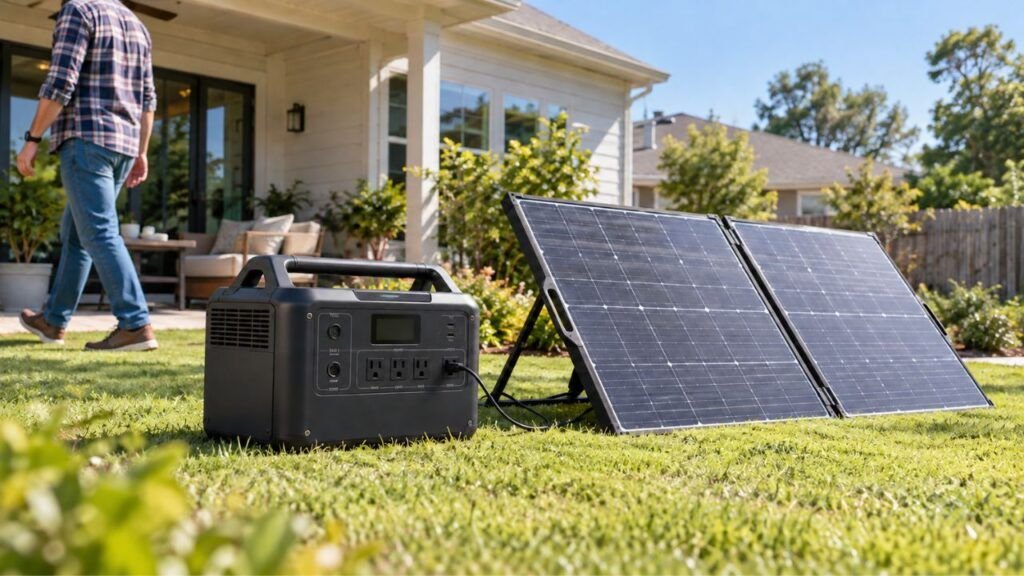
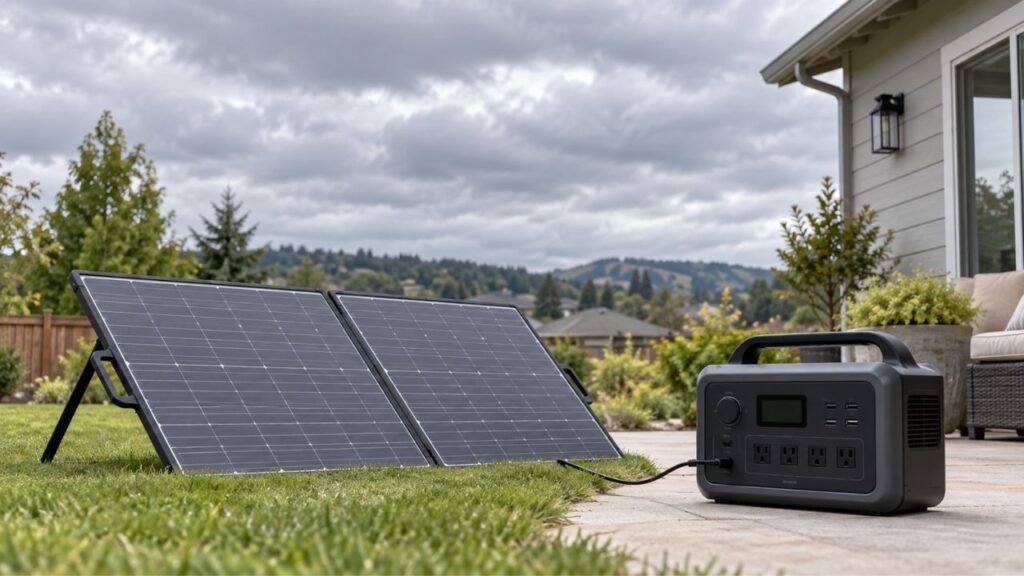
Yes, solar generators work on cloudy days. Their batteries can still power your devices normally, while solar panels continue collecting available daylight. However, cloud cover can significantly reduce solar charging speed and daily energy production.
In this guide, I’ll explain how cloudy weather affects charging, expected solar output, battery runtime, panel performance, and ways to collect more energy when sunshine is limited.
Key Takeaways
- Solar generators continue working normally from stored battery energy.
- Cloudy weather mainly reduces how quickly solar panels recharge batteries.
- Heavy clouds can cut solar output considerably compared with clear conditions.
- Thin clouds usually allow much better charging than dark storm clouds.
- Larger solar arrays can collect more energy during weak sunlight.
- Battery capacity becomes important during several consecutive cloudy days.
- Panel position, shade, dirt, season, and weather affect charging performance.
- Monitoring actual solar input gives better information than panel wattage alone.
Do Solar Generators Work on Cloudy Days?
Yes. A solar generator can still work when the sky is cloudy.
The important thing is understanding what “work” actually means here.
A solar generator has two main sides: energy storage and energy collection. The battery stores electricity, while solar panels collect new energy.
Clouds mainly affect the solar panels.
They do not automatically reduce how much AC power your generator’s inverter can provide.
For example, imagine you have a 2,000W portable power station. Dark clouds arriving overhead do not suddenly turn it into a 500W unit.
If the battery has enough stored energy, the generator can continue powering your refrigerator, television, lights, laptops, or other devices.
What changes is the charging speed.
Your solar panels receive less sunlight through thick clouds. That means fewer watts reach the power station’s battery.
This distinction becomes especially important during long power outages.
You may have enough stored electricity for several hours. However, slow solar charging can make replacing that consumed energy difficult.
So, cloudy weather usually creates a charging problem rather than an immediate power-output problem.
How Can Solar Panels Work Without Direct Sunlight?
Solar panels do not need a perfectly visible sun to generate electricity. They need light energy reaching their photovoltaic cells.
Understanding the difference between direct and scattered sunlight makes cloudy-day performance easier to understand.
Direct Sunlight vs. Diffuse Sunlight
Direct sunlight travels from the sun straight toward your solar panels.
This is why solar production usually becomes strongest during bright, clear conditions.
Diffuse sunlight behaves differently.
Clouds, moisture, dust, and atmospheric particles scatter incoming sunlight across the sky.
Some of that scattered light still reaches your solar panels.
That is why your panels can continue producing electricity under gray skies.
The available energy simply becomes much lower when clouds block more sunlight.
What Happens Inside the Solar Panel?
Photovoltaic cells inside your solar panel absorb available light energy.
That energy causes electrical activity inside the solar cells, producing direct-current electricity.
The electricity then travels through your solar charging system.
Your power station stores that energy inside its battery for later use.
When you connect household devices, an inverter converts stored DC electricity into usable AC electricity.
This process continues during cloudy weather whenever enough usable daylight reaches the panels.
Why Cloud Cover Reduces Output
Clouds reduce the amount of solar energy reaching your panels.
Thin, bright clouds may allow plenty of usable light through.
Heavy storm clouds can block much more incoming sunlight.
That difference explains why your solar input might show 250W one cloudy afternoon and only 50W during another.
“Cloudy” describes many different conditions, so there is no single guaranteed output percentage.
How Much Power Does a Solar Generator Get on a Cloudy Day?
Cloudy-day solar output can vary widely. Cloud thickness, season, location, panel size, time of day, and positioning all influence production.
The table below gives useful planning estimates rather than guaranteed numbers.
| Weather Condition | Approximate Solar Output | 400W Array Example | What to Expect |
| Strong clear sunshine | Highest available output | Up to several hundred watts | Fastest charging |
| Thin clouds | Moderate to high | Around 200W–350W possible | Useful charging |
| Partly cloudy | Constantly changing | Output rises and falls | Usually worthwhile |
| Heavy overcast | Often around 10%–25% of strong-sun output | Roughly 40W–100W | Slow charging |
| Dark storm conditions | Very low | Sometimes only a small trickle | Battery reserve matters |
| Night | 0% solar production | 0W | Battery power only |
These numbers should only be used for rough planning.
A 400W panel does not guarantee 400W during clear weather either.
Panel wattage represents performance under controlled testing conditions.
Real-world output depends on sunlight intensity, panel temperature, angle, cable losses, charging limits, and environmental conditions.
You might see surprisingly good production under bright clouds.
You might also see extremely low production under darker weather.
Your power station’s solar-input display is therefore one of your best tools.
Instead of guessing, look at how many watts actually enter the battery.
How Much Longer Does a Solar Generator Take to Charge When It Is Cloudy?
Cloudy weather can turn a relatively fast solar recharge into an all-day or multi-day process.
A simple calculation helps you estimate what is happening.
Simple Cloudy-Day Charging Formula
You can use this basic formula:
Charging time = Battery energy needed ÷ Actual solar input
Suppose your battery needs another 1,000Wh before becoming fully charged.
If your panels supply 250W consistently, the basic calculation becomes:
1,000Wh ÷ 250W = 4 hours
Real charging takes longer because sunlight changes throughout the day.
Energy conversion also creates small losses.
The battery may also reduce charging speed as it approaches full capacity.
So, use this calculation as an estimate rather than an exact promise.
Example: 1,000Wh Battery With a 400W Solar Array
Imagine your solar generator needs 1,000Wh of additional energy.
Here is how different solar-input levels could affect charging:
- At 300W, theoretical charging takes about 3.3 hours.
- At 160W, theoretical charging takes about 6.3 hours.
- At 80W, theoretical charging takes about 12.5 hours.
- At 40W, theoretical charging takes about 25 hours.
Now you can see the real cloudy-day challenge.
Your panels might still be producing electricity, but not enough to restore everything you used that day.
For example, collecting 80W for five hours gives you roughly 400Wh before accounting for losses.
That energy is still useful.
However, it will not completely recharge a 1,000Wh battery.
This is why cloudy-day planning should focus on daily energy balance, not simply whether the panels are technically producing power.
What Affects Solar Generator Performance on Cloudy Days?
Two cloudy days can produce completely different charging results. Several factors decide how much usable solar energy actually reaches your battery.
Cloud Thickness
Cloud density has one of the biggest effects.
Thin white clouds may still allow substantial sunlight through.
Dark storm clouds can sharply reduce available solar energy.
Cloud cover can also change rapidly throughout the day.
Your input may jump from 70W to 250W within minutes.
Time of Day
Available solar energy usually increases as the sun rises higher.
Around midday, your panels generally have the strongest opportunity for useful production.
Early mornings and late afternoons provide weaker sunlight.
Clouds during those periods can make production especially low.
Season and Location
Solar performance changes throughout the year.
Summer usually provides longer daylight hours across much of the United States.
Winter days are shorter, and the sun often stays lower.
Your geographic location matters as well.
Someone in Arizona may experience different solar conditions than someone in Washington State.
That does not mean cloudy regions cannot use solar effectively.
It simply means system sizing should reflect local conditions.
Panel Angle and Orientation
Portable panels work best when positioned toward available sunlight.
On clear days, aiming directly toward the sun is straightforward.
Cloudy conditions make positioning less obvious because light becomes more scattered.
Still, keeping panels properly tilted and facing the brightest part of the sky can improve output.
Check your power station’s input display while adjusting the panel.
The wattage reading can help you find a better position.
Shade From Trees and Buildings
Clouds and shade are not the same thing.
Clouds reduce overall sunlight reaching a wider area.
Physical shade can directly block sunlight from reaching part of your panel.
A nearby tree, roof edge, vehicle, or building may reduce production dramatically.
Keep the entire panel exposed whenever possible.
Dirt, Dust, Pollen, and Snow
Dirty panels already receive less usable light.
That becomes more noticeable when clouds reduce available sunlight further.
Dust, pollen, leaves, bird droppings, or snow can block additional light.
Keep the panel surface clean according to manufacturer instructions.
Never use abrasive cleaners that could damage protective coatings.
Panel Temperature
Solar panels often operate efficiently in cooler temperatures.
This means a cool cloudy day is not automatically bad because of temperature.
The bigger problem is usually reduced sunlight.
Cold temperatures cannot compensate for extremely dark cloud cover.
However, cool, bright conditions can sometimes deliver surprisingly good solar output.
Does the Solar Panel Type Matter in Cloudy Weather?
Panel quality and system design can influence low-light performance. However, no solar technology can completely eliminate losses caused by heavy cloud cover.
Monocrystalline Panels
Most modern portable solar panels use monocrystalline solar cells.
These panels offer high efficiency and good power density.
That means they can produce more electricity from limited surface area.
They can also perform reasonably well under lower-light conditions.
Still, do not expect rated output during heavy overcast weather.
Clouds affect every photovoltaic panel.
Bifacial Solar Panels
Bifacial panels can collect light from both sides.
The front captures direct and diffuse sunlight.
The rear can capture reflected light from nearby surfaces.
That extra collection can sometimes improve total energy production.
Results depend heavily on how the panel is positioned.
If the rear side sits directly against dark ground, the benefit may become limited.
MPPT Charge Controllers
Many modern solar generators use MPPT solar charge controllers.
MPPT stands for Maximum Power Point Tracking.
The controller continuously adjusts electrical operating conditions to harvest available solar power efficiently.
This becomes useful when sunlight changes throughout the day.
Clouds may repeatedly increase and decrease available solar input.
An MPPT controller helps the power station respond efficiently.
However, remember one important point.
MPPT does not create extra sunlight.
It simply helps the system make better use of available solar energy.
Why Does My Solar Generator Sometimes Show 0W on a Cloudy Day?
Seeing 0W can be concerning, but clouds are not always the only reason.
Several conditions can cause extremely low or zero solar-input readings:
- Cloud cover may be extremely thick.
- The sun may be too low in the sky.
- Trees or buildings may shade the panels.
- Folding panels may not be completely opened.
- Panel positioning may be poor.
- A connector may be loose.
- A cable or adapter may have a problem.
- Available solar voltage may be too low.
- The battery may already be nearly full.
- The power station may limit charging under certain conditions.
Start with the simple checks first.
Fully unfold your solar panels and move them into open daylight.
Check every connector and make sure cables are securely attached.
Then look at the solar-input display again.
You can also reposition the panels slowly while watching the wattage.
If the display remains at zero during reasonably bright conditions, inspect the manual and system connections.
Avoid changing panel wiring or combining panels without checking your power station’s limits.
How to Get More Solar Power on Cloudy Days
You cannot control the weather, but you can improve how efficiently your system uses the available daylight.
A few practical adjustments can make cloudy-day charging much more useful.
Keep the Entire Panel Unshaded
Place your solar panels in the most open area available.
Avoid trees, rooflines, fences, vehicles, and other nearby objects.
Even partial physical shade can reduce already-limited production.
Adjust Portable Panels During the Day
Portable panels give you one major advantage.
You can move them.
Check the input wattage every few hours when conditions allow.
Small angle adjustments may noticeably improve production.
If one section of the sky appears brighter, try facing your panels toward it.
Keep the Panels Clean
Dust and pollen reduce the light reaching solar cells.
Normally, that small loss may not seem important.
During cloudy weather, however, every available watt becomes more valuable.
Clean panels gently using manufacturer-approved methods.
Deploy More Solar Capacity
Adding more compatible solar panels can help compensate for reduced sunlight.
Imagine a 200W array producing only 20% of stronger-sun output.
That would provide around 40W.
A properly configured 600W array under similar conditions could potentially provide much more usable input.
However, never add panels without checking specifications.
Your power station has maximum solar voltage and current limits.
Exceeding those limits can damage equipment or create safety problems.
Reduce Power Consumption
Sometimes conserving energy helps more than chasing another few solar watts.
During long cloudy outages, prioritize important loads.
Consider keeping power available for:
- Refrigerators and freezers
- Essential lighting
- Phones and communication equipment
- Internet equipment
- Medical devices
- Small fans
- Necessary electronics
Delay high-demand devices when possible.
Hair dryers, electric heaters, cooking appliances, and similar loads can drain batteries quickly.
Start With a Charged Battery Before Severe Weather
Solar panels are excellent for replenishing energy.
But your battery is what carries you through periods of weak sunlight.
Before a forecasted storm or outage, charge your solar generator beforehand.
Starting at 100% gives you far more flexibility.
You can then treat cloudy-day solar input as additional energy rather than your only immediate source.
Are More Solar Panels or a Bigger Battery Better for Cloudy Weather?
Both upgrades solve different problems. Choosing the right one depends on whether you need longer runtime or faster energy recovery.
| Upgrade | Main Benefit | Main Limitation | Best For |
| Bigger battery | Stores more energy | Does not create new energy | Overnight use and short outages |
| More solar panels | Collects more available daylight | Still depends on weather | Multi-day use and faster recovery |
| Both | More reserve and more charging capacity | Higher cost and more equipment | Extended outage preparation |
A larger battery determines how long you can operate before recharging becomes necessary.
More solar panels determine how much energy you can potentially collect during daylight.
Think of the battery as your water tank.
Solar panels are the faucet refilling it.
A bigger tank gives you more stored water.
A larger faucet helps replace what you use faster.
For extended cloudy weather, having both can provide the strongest setup.
Can a Solar Generator Handle Several Cloudy Days?
Yes, but this is where proper system sizing becomes important.
One cloudy afternoon usually causes little concern when your battery starts full.
Three or four dark days can create a different situation.
The key is your daily energy balance.
Imagine your essential devices consume 1,200Wh each day.
Your cloudy-weather solar panels collect only 500Wh daily.
That creates a 700Wh daily energy deficit.
Your battery must supply the missing 700Wh.
If the same conditions continue, your stored energy keeps dropping.
During extended cloudy weather:
- Check battery percentage regularly.
- Monitor daily solar energy production.
- Reduce nonessential loads early.
- Use additional compatible panels when available.
- Charge devices during stronger daylight periods.
- Keep another approved charging method available.
Do not wait until your battery reaches 5% before conserving energy.
Planning earlier gives you much more flexibility.
Do Solar Generators Work in Rain?
Solar generators can still receive solar energy during rain because daylight remains available.
However, heavy rain usually arrives with dark cloud cover.
That can reduce charging considerably.
Your panels may only produce a small amount of electricity.
There is also an important safety consideration.
A weather-resistant solar panel does not automatically mean your power station is waterproof.
Many portable power stations should remain protected from rain.
Check the weather-resistance rating for your panels, connectors, cables, and generator separately.
Keep the power station somewhere dry unless its manufacturer specifically allows wet-weather exposure.
Do Solar Generators Work at Night?
The solar generator can work at night, but its panels cannot produce normal solar electricity without sunlight.
After sunset, your devices run from energy already stored inside the battery.
This is another reason battery capacity matters.
A larger battery can carry essential loads through the night.
Solar charging can then begin again after daylight returns.
Think of daytime as your opportunity to refill the battery.
Nighttime becomes your period for carefully using stored energy.
Are Solar Generators Worth Using in Cloudy Parts of the USA?
Yes, solar generators can still be useful in frequently cloudy regions.
The right system depends on your energy needs and available solar conditions.
For Camping and RV Use
Portable solar panels can extend battery runtime during camping or RV trips.
Even reduced charging can replace some energy used during the day.
However, avoid planning around perfect solar output.
Keep enough battery capacity for poor-weather periods.
For Emergency Home Backup
Cloudy weather is especially relevant during storms and grid outages.
A large battery can keep essential devices operating when solar production falls.
Additional panel capacity can help recover energy whenever conditions improve.
For longer emergencies, energy conservation becomes just as important as generation.
For Frequently Cloudy Regions
You do not need perfect sunshine every day.
What matters is how much energy your system collects over time.
A properly sized setup can still provide valuable backup power.
The important thing is avoiding unrealistic expectations.
Plan around average local conditions rather than your best sunny afternoon.
How to Test Your Own Solar Generator on a Cloudy Day
Your own equipment can tell you more than a generic percentage online.
Use this simple test to understand your actual cloudy-day performance:
- Fully unfold your solar panels.
- Place them somewhere completely unshaded.
- Record the panel’s rated wattage.
- Connect the panel to your power station.
- Check solar input around midday.
- Record the actual incoming watts.
- Note the cloud conditions.
- Repeat the test during clear weather.
- Compare both results.
- Repeat on several different days.
For example, imagine your 400W array produces 85W during heavy clouds.
That tells you much more about your system than a general percentage.
You can then estimate how much energy several cloudy hours might provide.
Repeating the test also helps you spot abnormal performance later.
If your usual cloudy input suddenly drops much lower, panel dirt, shade, cables, or connections may deserve inspection.
Common Cloudy-Day Solar Generator Mistakes
Cloudy weather already reduces available energy. Avoid making the situation worse with preventable mistakes.
Common problems include:
- Assuming clouds mean solar panels produce nothing.
- Expecting rated panel wattage throughout the day.
- Confusing solar input watts with inverter output watts.
- Placing panels under partial shade.
- Leaving folding panels poorly positioned.
- Ignoring dirty or obstructed panel surfaces.
- Buying extra panels without checking electrical limits.
- Assuming waterproof panels make the power station waterproof.
- Running unnecessary high-wattage appliances during weak charging.
- Waiting until the battery is almost empty before conserving.
- Planning multi-day outages using sunny-day charging estimates.
A little preparation solves most of these problems.
Final Words
Solar generators do work on cloudy days. Their batteries can continue powering connected devices normally, while solar panels collect whatever usable daylight reaches them.
The main limitation is slower charging. Heavy cloud cover may reduce incoming solar power dramatically, making it difficult to replace all the electricity you consume that day.
For occasional cloudy weather, a properly charged battery may be enough. For extended outages, focus on battery capacity, adequate solar panels, efficient energy use, and another safe charging option.
Related FAQs
Will a Solar Generator Charge on a Completely Overcast Day?
Yes, a solar generator can usually charge under overcast skies because diffuse daylight still reaches the panels. Charging may become very slow when clouds are thick or storm conditions are especially dark.
How Much Solar Power Do Panels Produce on a Cloudy Day?
Production varies considerably, but heavy overcast conditions may reduce output to roughly 10%–25% of strong-sun production. Thin or broken clouds can allow substantially higher output.
How Long Does a Solar Generator Take to Charge on a Cloudy Day?
Charging may take several times longer than during strong sunshine. The actual time depends on battery capacity, solar-array size, cloud thickness, daylight hours, and incoming solar wattage.
Can a 100W Solar Panel Charge a Power Station on a Cloudy Day?
Yes, but charging can be slow. A 100W panel might produce only a fraction of its rated wattage during heavy clouds, so larger batteries may require considerable time.
Can a 400W Solar Panel Still Work in Cloudy Weather?
Yes. A 400W panel can still produce electricity under clouds, although actual output might fall well below 400W depending on sunlight intensity and weather conditions.
Do Solar Generators Work in the Rain?
Yes, solar panels can still produce some electricity during rain. However, protect your power station from water unless the manufacturer specifically rates it for wet conditions.
Do Solar Generators Work at Night?
The battery can power devices at night, but the solar panels stop producing usable solar energy after sunset. The system therefore relies on electricity stored earlier.
Do Solar Panels Work Better in Cold or Hot Weather?
Solar panels generally operate more efficiently electrically in cooler temperatures. However, sunlight intensity still matters much more than temperature when comparing clear and cloudy conditions.
Are Bifacial Solar Panels Better on Cloudy Days?
They can provide an advantage when reflected light reaches their rear surface. However, positioning, surrounding surfaces, and overall sunlight conditions determine how much extra energy they collect.
Does MPPT Help With Cloudy-Day Solar Charging?
Yes. MPPT charge controllers help harvest available panel power efficiently as sunlight changes. They cannot overcome heavy clouds, but they can improve how available energy gets used.
Should I Buy More Panels for Cloudy Weather?
More compatible panels can improve cloudy-day energy collection. Before adding panels, always check your power station’s maximum solar voltage, current, wattage, and connection requirements.
Can a Solar Generator Power a Refrigerator During Cloudy Weather?
Yes, if the generator has enough battery capacity and inverter output for the refrigerator. Cloudy weather affects solar recharging, not the stored battery’s ability to power the appliance.

Blake Cooper writes practical guides on generators, portable power stations, and home backup systems. He focuses on simplifying power topics and helping homeowners make informed buying decisions.