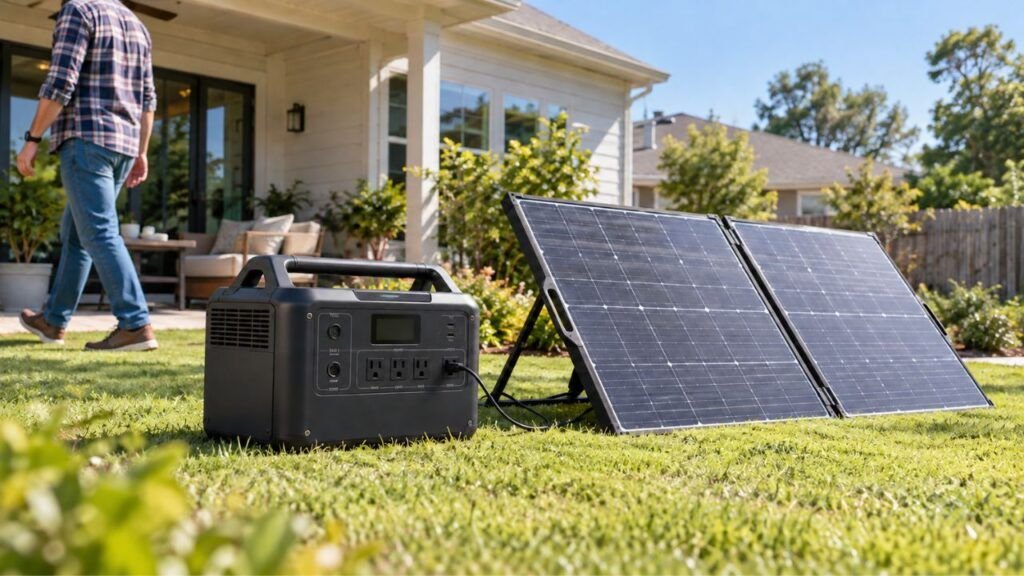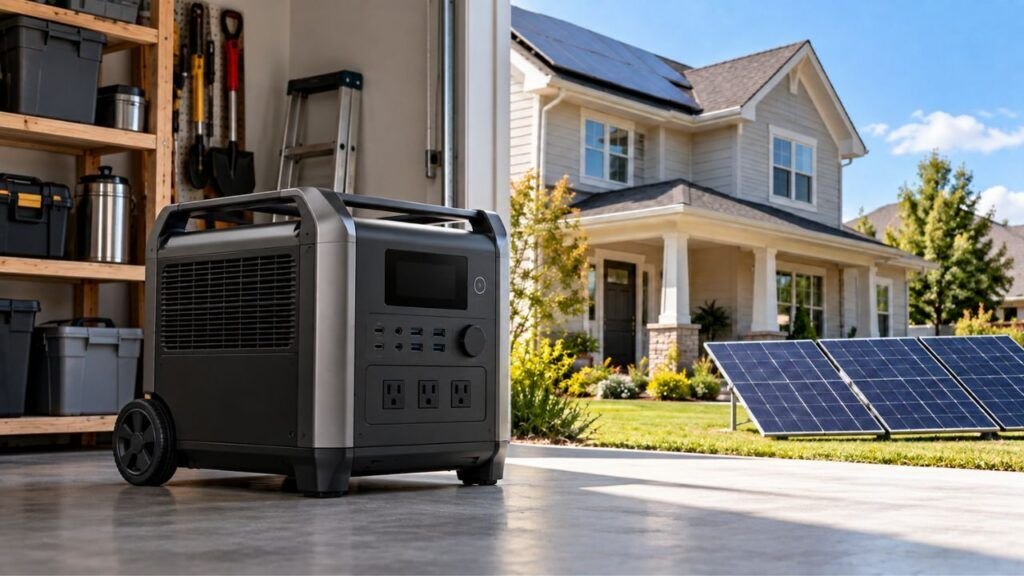
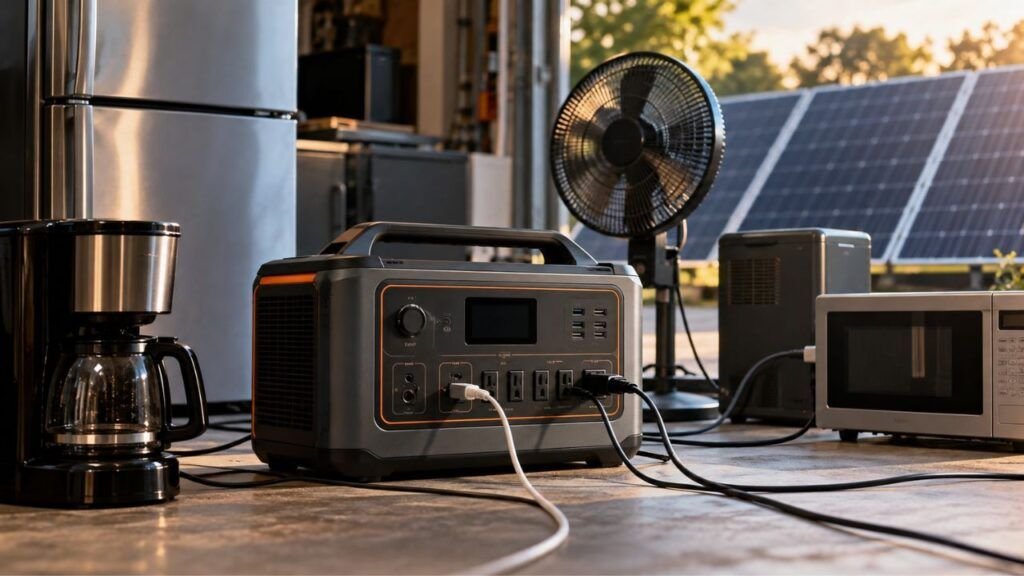
A solar generator overloads when connected devices demand more power than its inverter can safely supply. This can happen from excessive running watts, high appliance startup surges, or several devices operating together.
Sometimes, however, an overload warning has another cause. Heat, low battery voltage, damaged equipment, or an internal fault can create similar symptoms. I’ll help you identify the likely cause and fix it safely.
Key Takeaways
- Solar generators overload when electrical demand exceeds safe inverter limits.
- Running watts and startup surge watts must both stay within limits.
- Refrigerators, pumps, and air conditioners can create large startup surges.
- Battery capacity does not determine maximum AC output power.
- Individual AC, DC, and USB ports may have separate limits.
- Excess heat can reduce how much power an inverter safely delivers.
- Repeated overload warnings without connected appliances need further investigation.
What Does Overload Mean on a Solar Generator?
An overload means the solar generator cannot safely supply the power currently being requested.
Inside the solar generator, an inverter converts battery DC power into AC electricity. Your normal household appliances use this AC power.
Every inverter has a maximum continuous output rating. It may also have a higher short-term surge rating.
For example, your unit might provide 2,000 watts continuously. It could also support 4,000 surge watts briefly.
Problems occur when the load exceeds either limit.
The generator’s protection system may then shut down AC output. Some units display an overload warning before shutting down.
This protection does not automatically mean something has broken.
In many situations, the solar generator is simply protecting its inverter, battery, and internal electronics.
It is also important to separate battery size from inverter output.
A large battery can store plenty of energy. However, its inverter can still have a relatively low output limit.
That difference explains many unexpected solar generator overload problems.
Solar Generator Overload: Quick Diagnosis
Several overload problems produce very similar symptoms. This table can help you narrow down the likely cause quickly.
| What You Notice | Most Likely Cause | What to Check First |
| Overload occurs when one appliance starts | Startup surge | Appliance starting watts |
| Overload happens after adding another device | Excessive continuous load | Combined running watts |
| Unit shuts down after several minutes | Heavy load or excessive heat | Wattage and ventilation |
| Only one output stops working | Port-specific limit | AC, DC, or USB rating |
| Refrigerator or pump triggers overload | Compressor or motor surge | Startup requirements |
| Problem appears with low battery | Voltage or BMS limitation | Battery level and error code |
| Problem appears in UPS mode | Mode-specific output limit | UPS/pass-through specifications |
| Shutdown begins after connecting panels | Solar-input protection may be involved | PV voltage and current limits |
| Overload remains with nothing connected | Internal problem | Error code and manufacturer reset |
The exact error message is important.
A shutdown does not always mean the inverter exceeded its wattage rating. Modern solar generators have several protection systems operating simultaneously.
Why Does a Solar Generator Overload?
Most overloads come from the electrical load connected to the inverter. However, several different conditions can create the same warning.
Total Running Watts Exceed the Inverter Limit
This is probably the simplest overload situation.
Every solar generator has a continuous AC output rating.
Suppose your unit provides 1,800 watts continuously.
Now imagine you are running:
- Refrigerator: 150 watts
- Microwave: 1,200 watts
- Television: 100 watts
- Coffee maker: 900 watts
Running everything together could demand about 2,350 watts.
Your 1,800-watt inverter cannot continuously provide that much power.
The generator may sound an alarm, disable AC output, or shut down.
You can usually solve this problem by reducing simultaneous loads.
An Appliance Has a High Startup Surge
Some appliances consume much more power when starting.
Motors and compressors are common examples.
A refrigerator might use fairly little power while running. However, its compressor needs considerably more power when starting.
The same issue can occur with:
- Refrigerators
- Freezers
- Window air conditioners
- Well pumps
- Sump pumps
- Air compressors
- Power tools
Your generator might comfortably handle the appliance’s running wattage.
Then the appliance starts.
That brief surge can push demand beyond the inverter’s surge capability.
The result is an immediate overload.
Do not assume every motor requires the same startup multiplier. Starting demand varies between different appliances and motor designs.
Check the appliance specifications whenever possible.
Multiple Appliances Start at the Same Time
Sometimes neither appliance causes problems independently.
The overload happens because two startup events overlap.
Imagine your refrigerator compressor starts while your sump pump activates.
Both appliances suddenly need extra power.
Their combined startup demand can exceed your inverter’s surge rating.
This explains why a system may work perfectly for several hours.
Then it suddenly overloads without you turning anything new on.
Automatic appliances can start without warning.
Staggering large loads can reduce this problem significantly.
One Output Port Exceeds Its Own Limit
Your solar generator’s total output rating is not always the whole story.
Individual outputs can have separate electrical limits.
That may include:
- AC outlet groups
- 12V car outlets
- DC5521 ports
- USB-C outputs
- USB-A outputs
For example, a power station may support 2,000 watts overall.
However, its 12V outlet might only support around 120 watts.
Connecting a larger 12V load can trigger protection.
The generator itself may still have plenty of available capacity.
Always check the limit for the exact output being used.
Low Battery Voltage or the BMS Cannot Support the Load
Battery percentage and inverter output are related but different.
A heavily loaded battery experiences voltage drop.
When battery charge becomes low, that voltage drop can become more noticeable.
The Battery Management System, or BMS, constantly monitors these conditions.
If voltage or discharge current becomes unsafe, protection may activate.
Your solar generator could shut down even before reaching zero percent.
This does not always technically mean inverter overload.
Some displays can make different protection events look similar.
Check the exact warning or error code before diagnosing the problem.
A severely aged battery may also struggle more under heavy loads.
The Inverter Is Getting Too Hot
Heat is another common cause of unexpected shutdowns.
Inverters create heat while converting battery power into AC electricity.
Heavy electrical loads create even more heat.
Problems become more likely when:
- Cooling vents are blocked
- The unit sits inside a closed cabinet
- Ambient temperatures are very high
- Direct sunlight heats the generator
- Dust restricts airflow
- The generator operates near maximum output continuously
Many systems reduce output when internal temperatures rise too high.
This behavior is called thermal derating.
If temperatures continue rising, the system may shut down completely.
Give your power station plenty of open ventilation space.
A Faulty Appliance, Cord, or Adapter Draws Excess Current
Sometimes the generator is not the real problem.
A damaged appliance or cable can produce excessive current.
Check for:
- Cracked extension cords
- Loose plugs
- Damaged adapters
- Melted connectors
- Bent electrical contacts
- Failing appliance motors
- Damaged compressor circuits
- Shorted wiring
Stop immediately if you notice heat, discoloration, or burning smells.
Do not repeatedly reset the generator around damaged electrical equipment.
A device working from a household outlet also proves very little.
Grid power may handle startup demand your portable inverter cannot.
UPS or Pass-Through Mode Has a Different Power Limit
Many solar generators support UPS, EPS, bypass, or pass-through operation.
These modes allow appliances to remain connected while grid power is available.
However, operating limits can differ between modes.
For example, battery-mode output might have one wattage limit.
Pass-through mode might use another electrical path with different limits.
Some units also restrict particular functions while charging.
Check your model’s manual for the specific operating mode.
Do not assume every published wattage applies under every condition.
The Warning Is Actually Another Protection Fault
Solar generators monitor much more than inverter wattage.
A shutdown may actually involve:
- Short-circuit protection
- Overtemperature protection
- DC overcurrent protection
- Low-voltage protection
- Battery protection
- PV overvoltage protection
- PV overcurrent protection
These conditions may feel like an overload because output suddenly stops.
That is why the displayed error code matters.
Write down the code before restarting the unit.
You may solve the problem much faster afterward.
The Solar Generator Has an Internal Fault
Occasionally, the overload warning continues despite removing every load.
Possible internal problems can involve:
- Current sensors
- The inverter
- Internal wiring
- Protection circuitry
- Battery communication
- Control electronics
- Firmware
Do not open a lithium power station yourself.
Large lithium battery systems can contain hazardous voltages and currents.
Follow the manufacturer-approved reset procedure first.
If the warning returns immediately, contact manufacturer support.
Running Watts vs. Surge Watts vs. Battery Capacity
These three specifications describe different things. Mixing them up can easily lead to an overloaded solar generator.
Running watts describe how much electrical power the inverter continuously supplies.
Surge watts describe temporary extra power available during appliance startup.
Battery capacity is normally measured in watt-hours.
Watt-hours describe stored energy rather than instantaneous output.
Imagine a solar generator with:
- 3,000Wh battery capacity
- 1,800W continuous inverter
- 3,600W surge output
The battery stores plenty of energy.
However, a 2,200-watt heater still exceeds its continuous inverter rating.
The large battery cannot change that limitation.
Likewise, installing more solar panels usually does not increase inverter output.
Extra panels can improve charging speed when properly matched.
They do not transform a 1,800-watt inverter into a 3,000-watt inverter.
Think about these specifications separately.
Battery capacity controls runtime.
Inverter wattage controls how much you can power simultaneously.
Solar input controls how quickly sunlight can recharge the battery.
How to Check Whether Your Solar Generator Is Actually Overloaded
You can diagnose most load-related overload problems with simple wattage checks. Start with the inverter rating, then work through your appliances.
- Find your solar generator’s continuous AC output rating.
- Find its surge or peak output rating.
- Check how long the surge rating can be sustained.
- List every appliance running at the same time.
- Write down each appliance’s normal running wattage.
- Identify appliances containing motors or compressors.
- Check their documented starting or surge requirements.
- Add together the loads operating simultaneously.
- Compare that total with continuous inverter output.
- Check whether startup demand exceeds surge capability.
- Review the generator display for its exact error code.
Here is the basic idea:
Combined running watts should stay below continuous inverter output.
During appliance startup:
Existing running load + startup demand must remain within available surge capability.
For example, suppose your inverter provides 2,000 continuous watts.
Your existing equipment is already consuming 1,500 watts.
A refrigerator then attempts to start.
If its startup demand pushes total power beyond the inverter’s capability, protection can activate.
This is why some generators overload despite appearing lightly loaded afterward.
The brief startup event may have already caused the shutdown.
How to Fix a Solar Generator Overload
Most genuine overload problems can be narrowed down systematically. Avoid repeatedly restarting everything without identifying what caused the shutdown.
- Check and record the displayed warning or error code.
- Disconnect appliances connected to the affected output.
- Turn off the generator’s AC or DC output.
- Inspect cables, plugs, adapters, and connected appliances.
- Check whether the power station feels unusually hot.
- Move it somewhere cooler with unrestricted airflow.
- Follow your manufacturer’s approved reset procedure.
- Restart the generator without heavy appliances connected.
- Turn on one appliance first.
- Watch the real-time wattage shown on the display.
- Add additional appliances one at a time.
- Stop when the overload returns.
The final device added often reveals the problem.
However, remember that automatic appliances can start unexpectedly.
A refrigerator or pump might create another surge several minutes later.
Also avoid assuming every solar generator uses the same reset procedure.
Some models use a physical reset button.
Others require power cycling or app-based controls.
Follow your specific owner’s manual rather than generic reset instructions.
Why Does My Solar Generator Say Overload With Nothing Plugged In?
An overload warning without connected devices deserves closer attention. First, make sure every AC, DC, and USB device is completely disconnected.
Then try these steps:
- Disconnect every appliance and charging cable.
- Turn off AC and DC output sections.
- Check the display for another fault code.
- Let the power station cool completely.
- Inspect the outlets for visible damage.
- Perform the manufacturer’s approved reset.
- Check for available firmware updates.
- Restart without anything connected.
- Contact support if the warning immediately returns.
An internal sensor or inverter problem could be responsible.
The unit could also have damaged wiring or protection circuitry.
Do not repeatedly force the unit back online.
Persistent no-load overload warnings should be professionally diagnosed.
Why Does My Solar Generator Overload While Charging?
Charging introduces another set of electrical limits. First determine whether the problem happens during AC charging or solar charging.
AC Pass-Through or UPS Mode
Some solar generators can charge while simultaneously powering appliances.
This feature is often called bypass, pass-through, UPS, or EPS operation.
However, the output limit may differ during this mode.
Suppose several appliances are already connected.
Starting another heavy appliance could exceed the allowed pass-through load.
Charging may continue while the output circuit disconnects.
Always check your model’s pass-through specifications.
Solar Charging
Solar-panel input has completely different limits from AC inverter output.
Your power station may specify maximum:
- Solar wattage
- PV voltage
- Open-circuit voltage
- PV current
- Input current
Exceeding those limits may trigger solar-input protection.
That does not necessarily mean your AC inverter overloaded.
This distinction becomes especially important with panels connected in series.
Series wiring increases voltage.
If combined open-circuit voltage exceeds the allowed PV range, problems can occur.
Always design your panel configuration around the manufacturer’s input specifications.
Which Appliances Are Most Likely to Overload a Solar Generator?
Certain household appliances create much heavier electrical demands than others. These are the devices I would check first when troubleshooting repeated overloads.
- Refrigerators and freezers can create compressor startup surges.
- Window air conditioners have demanding compressors and fan motors.
- Portable air conditioners can use considerable continuous power.
- Well pumps often require significant startup current.
- Sump pumps can suddenly start during already-heavy electrical loads.
- Air compressors may require substantial motor startup power.
- Circular saws and power tools can create changing motor loads.
- Microwaves can draw considerable input power while operating.
- Coffee makers use powerful internal heating elements.
- Electric kettles commonly draw heavy continuous wattage.
- Space heaters can consume 1,500 watts continuously.
- Hair dryers often operate near similar high wattages.
- Several moderate appliances together can exceed inverter capacity.
Heating appliances usually create heavy continuous demand.
Motor-driven appliances are more likely to cause startup problems.
Knowing which type you are dealing with makes troubleshooting easier.
How to Prevent Solar Generator Overloads
Preventing overload is much easier than repeatedly resetting your generator. A little load planning can eliminate most problems.
- Calculate expected electrical loads before an outage.
- Check both continuous and surge inverter ratings.
- Leave reasonable unused capacity for unexpected startup loads.
- Measure uncertain appliances with a suitable watt meter.
- Start large motor-driven appliances one at a time.
- Avoid starting several compressors simultaneously.
- Monitor real-time wattage on the generator display.
- Respect individual AC, DC, and USB output limits.
- Keep ventilation openings completely unobstructed.
- Avoid operating the unit inside closed cabinets.
- Inspect extension cords and adapters regularly.
- Use appropriately rated cables and connectors.
- Learn your generator’s UPS and pass-through limitations.
- Keep solar panels within the allowed PV input range.
- Size inverter output separately from battery runtime.
I also recommend planning your essential outage loads beforehand.
Decide what truly needs power.
A refrigerator, lights, router, and phone chargers may be priorities.
A space heater and electric kettle might need to wait.
Load management becomes much easier when you already have a plan.
When Should You Stop Using the Solar Generator?
Some problems should not be solved by repeatedly pressing reset. Stop using the unit when you notice signs of electrical or battery damage.
Stop operation if you notice:
- Smoke coming from the power station
- Visible sparks
- Burning electrical smells
- Chemical or unusual battery odors
- A swollen or distorted enclosure
- Melted outlets or plugs
- Severe unexplained heating
- Repeated short-circuit warnings
- Visible battery or enclosure damage
- Persistent overload warnings with nothing connected
- Internal fault codes that immediately return
Disconnect loads and stop charging the unit.
Move away from the equipment if conditions appear unsafe.
Do not open the battery enclosure yourself.
Contact the manufacturer or an appropriate service professional instead.
Conclusion
A solar generator usually overloads because electrical demand exceeds its inverter’s continuous or surge output capability. High-wattage devices, compressor startup surges, and several appliances running together are the most common reasons.
Start troubleshooting by checking actual watts rather than battery percentage. Compare your appliance loads against continuous output, surge capability, and individual port limits.
If overload warnings continue with everything disconnected, stop treating it as a normal load problem. The generator itself may need professional inspection or manufacturer support.
Related FAQs
Can Overloading Damage a Solar Generator?
Yes, repeated or severe overloads can stress electrical components. However, modern solar generators normally use protection systems that disconnect output before serious damage occurs.
How Do I Reset a Solar Generator After an Overload?
Disconnect the connected loads and let the unit cool when necessary. Then follow the reset procedure listed in your specific solar generator’s owner’s manual.
Why Does My Solar Generator Overload When the Refrigerator Starts?
Your refrigerator’s compressor may require substantially more power during startup. That short surge can exceed the inverter’s surge capability despite low normal running wattage.
Can a Low Battery Cause a Solar Generator to Overload?
A low battery can contribute to shutdowns under heavy loads because battery voltage may drop. However, some systems classify this separately as low-voltage or battery protection.
Why Does My Solar Generator Overload After Running for a Few Minutes?
The continuous load may be too high, or internal temperatures may be rising. Check real-time wattage, ventilation, ambient temperature, and your inverter’s continuous output rating.
Why Does It Say Overload With Nothing Plugged In?
A persistent no-load overload warning can indicate an inverter, sensor, wiring, protection-system, or firmware problem. Try the approved reset and contact support if it returns.
Can Solar Panels Overload a Solar Generator?
Solar panels can exceed the generator’s permitted PV voltage or current limits. However, this is a solar-input protection issue rather than a normal AC inverter overload.
Does a Bigger Battery Prevent Overloading?
Not necessarily. A larger battery mainly increases available stored energy and runtime. Maximum appliance power still depends heavily on inverter output and battery discharge capability.
Is Surge Wattage the Same as Starting Wattage?
They describe closely related concepts from different sides of the system. Starting wattage is appliance demand, while surge wattage describes temporary extra inverter output available.
Can a Solar Generator Overload While Charging?
Yes. Some models have different limits during UPS, bypass, or pass-through operation. Connected loads can exceed those limits while the battery is also charging.
Can More Solar Panels Increase My Generator’s AC Output?
No. Additional panels can increase available charging power when properly matched. They do not increase the inverter’s rated continuous AC output.

Blake Cooper writes practical guides on generators, portable power stations, and home backup systems. He focuses on simplifying power topics and helping homeowners make informed buying decisions.