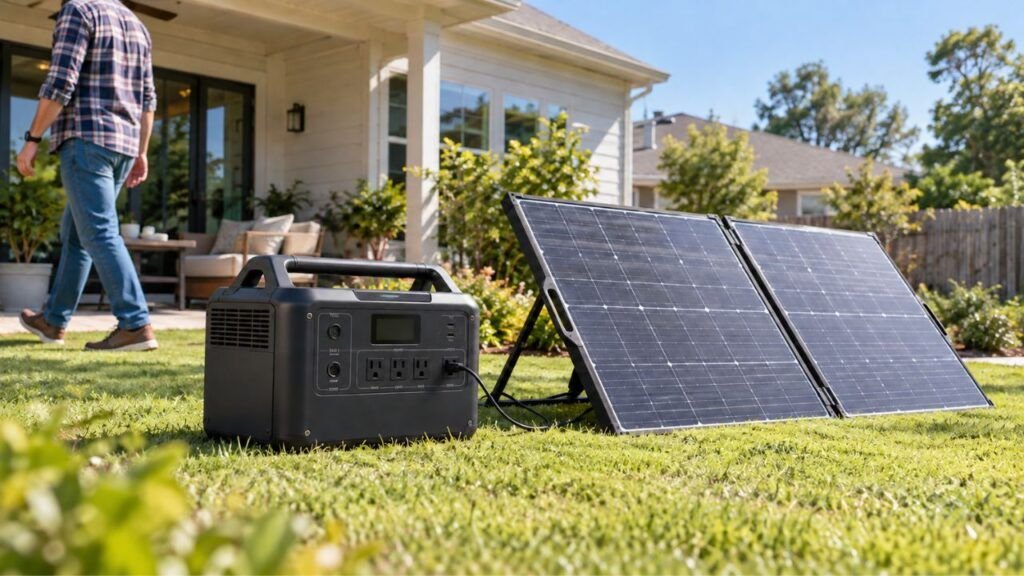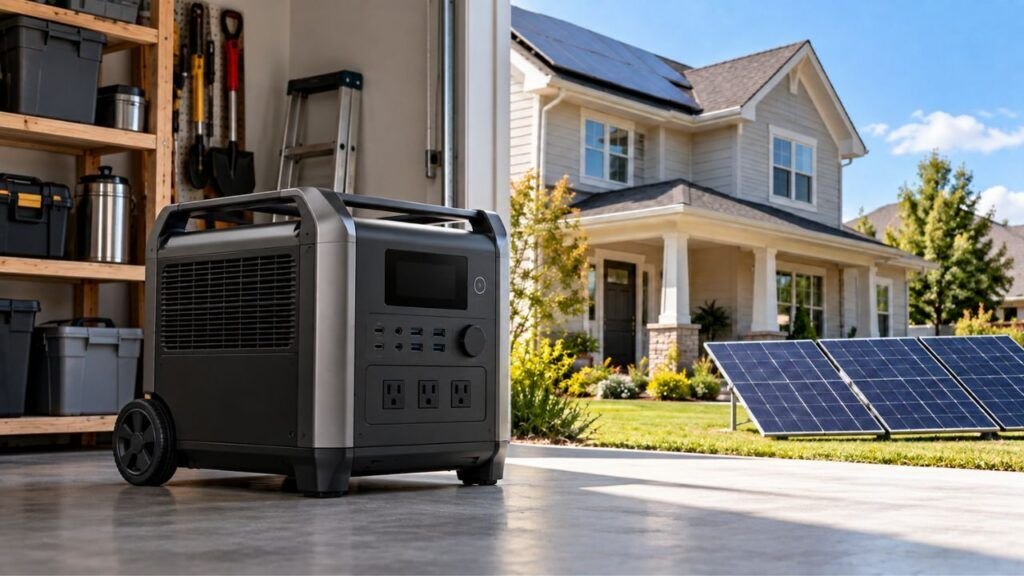
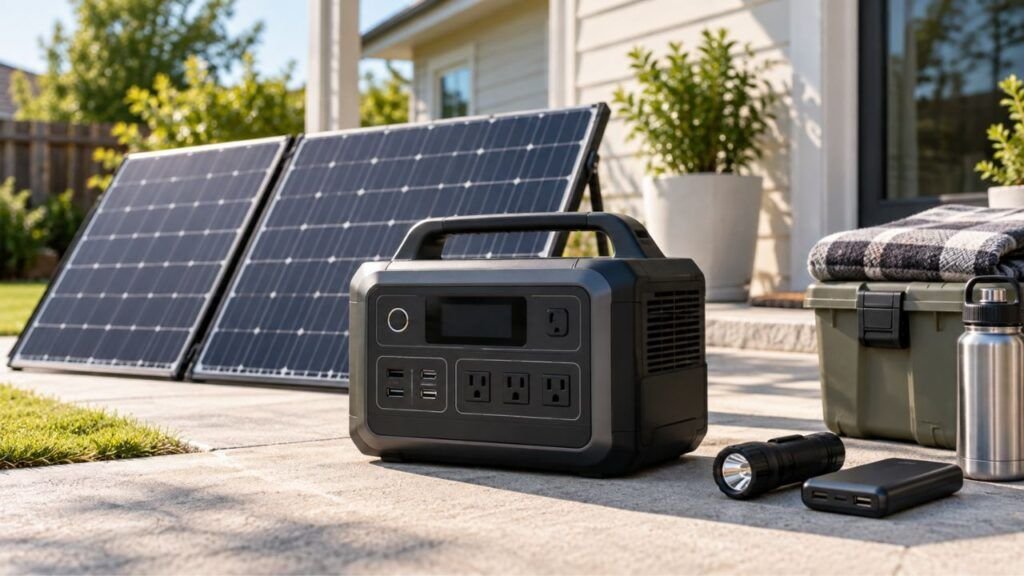
To prepare a solar generator for long outages, fully charge it, identify essential loads, calculate daily power needs, and prepare enough solar charging capacity. You should also test your panels, cables, appliances, and backup charging options before the grid goes down.
Long outages require more planning than a short blackout. In this guide, I’ll help you prepare your solar generator, manage daily power use, recharge efficiently, and stretch your available battery power for several days.
Key Takeaways
- Fully charge your solar generator before a predicted outage.
- Calculate daily energy use in watt-hours before planning backup power.
- Prioritize refrigeration, medical equipment, communication, and basic lighting.
- Make sure your inverter handles both running and starting watts.
- Prepare enough solar panels to replace daily battery consumption.
- Have another charging option for cloudy or rainy periods.
- Keep some battery capacity reserved for nighttime and emergencies.
- Test your entire backup setup before you actually need it.
How Do You Prepare a Solar Generator for a Long Power Outage?
Preparing for an extended outage means thinking beyond battery capacity alone. Your generator must store enough power and regularly replace what you consume.
Here is a simple preparation process:
- Fully charge the solar generator.
- Identify your essential electrical loads.
- Calculate your expected daily energy consumption.
- Check continuous and surge output requirements.
- Prepare enough compatible solar panels.
- Inspect your charging cables and adapters.
- Arrange another charging option when possible.
- Create a daytime and nighttime power schedule.
- Test your appliances with the generator.
- Keep emergency battery capacity in reserve.
The earlier you prepare these things, the easier an outage becomes. You do not want to discover missing cables after power disappears.
Calculate How Much Power You Actually Need Each Day
Before worrying about battery size, figure out your daily consumption. This gives you a realistic target for both storage and recharging.
List Your Critical Loads First
Start by writing down everything you may need during an outage.
Then separate those items into three groups:
- Essential appliances
- Useful but optional appliances
- High-power convenience appliances
Your essential list might include a refrigerator, medical equipment, lights, phones, internet equipment, or a sump pump.
Some homes may also depend on an electric well pump. Others may need fans during extremely hot weather.
The important thing is prioritizing your own household needs.
A television might be useful during an emergency. However, refrigeration or medical equipment usually deserves power first.
Calculate Daily Watt-Hours, Not Just Watts
Appliance wattage tells you how much power something uses instantly.
For long outages, watt-hours are more useful.
Use this basic calculation:
Running Watts × Hours Used Per Day = Daily Watt-Hours
For example, imagine a device averages 50 watts.
If you use it for six hours:
50W × 6 hours = 300Wh per day
Repeat this calculation for each appliance you expect to use.
Then add those numbers together.
That gives you an estimated daily energy budget.
Account for Starting and Surge Watts
Battery capacity is only one part of generator sizing.
Some appliances briefly require considerably more power when starting.
Refrigerators, pumps, compressors, and similar motor-driven equipment are common examples.
Your generator therefore needs enough:
- Battery capacity for total runtime
- Continuous wattage for normal operation
- Surge wattage for appliance startup
A large battery does not automatically mean a powerful inverter.
Always check both specifications before connecting larger appliances.
Daily Emergency Power Budget
You can create a basic table before the outage begins.
| Appliance | Running Watts | Estimated Hours Per Day | Daily Energy | Startup Surge | Priority |
| Refrigerator | Check appliance | Estimate cycling | Watts × hours | Yes | Essential |
| Wi-Fi router | Check device | Planned runtime | Watts × hours | Usually no | Important |
| LED lights | Total connected load | Planned runtime | Watts × hours | No | Important |
| Medical device | Check manufacturer | Required runtime | Watts × hours | Varies | Essential |
| Laptop and phones | Check chargers | Planned charging | Watts × hours | No | Important |
| Fan | Check appliance | Planned runtime | Watts × hours | Varies | Seasonal |
I recommend checking actual appliance consumption whenever possible.
A plug-in electricity meter can provide better estimates than guessing.
Appliance labels are useful, but real consumption often changes during operation.
Decide How Much Battery Capacity You Need
Once you know your daily watt-hours, battery planning becomes easier. You can now compare actual needs against your generator capacity.
Calculate Your One-Day Battery Requirement
Suppose your essential equipment needs 2,000Wh each day.
A 2,000Wh battery may appear large enough at first.
However, you should not assume every advertised watt-hour reaches your appliances.
The inverter consumes some power while converting DC electricity into AC electricity. The power station itself may also consume electricity while operating.
Some systems also reserve battery capacity for protection.
That means your usable AC energy can be lower.
Give yourself additional capacity rather than planning at the exact limit.
Build in a Reserve for Bad Weather and Unexpected Loads
A long outage rarely follows a perfect schedule.
Maybe the next day becomes cloudy.
Perhaps a family member needs additional device charging.
Your refrigerator might run longer because indoor temperatures rise.
That is why I recommend planning some reserve capacity.
The reserve can help cover:
- Poor solar production
- Unexpected appliance use
- Overnight emergencies
- Longer refrigerator operation
- Communication needs
- Medical equipment
- Missed charging opportunities
Your exact reserve depends on your household and generator size.
Avoid draining everything simply because power remains available.
Consider Expansion Batteries Before the Emergency
Expandable power stations can make extended outages easier to manage.
Additional batteries increase stored energy without necessarily replacing your main unit.
This can be helpful when overnight loads are significant.
Extra storage also gives you more flexibility during cloudy weather.
Just make sure expansion batteries actually support your power station model.
Test the complete battery setup before emergency season arrives.
Fully Charge and Test the Solar Generator Before the Outage
A solar generator sitting in storage may not be outage-ready. Check its condition whenever severe weather or another outage risk approaches.
Before a predicted outage:
- Recharge the main battery.
- Recharge compatible expansion batteries.
- Test AC and DC outputs.
- Connect several expected appliances.
- Check the display for warning messages.
- Confirm solar charging works correctly.
- Inspect charging cables and connectors.
- Make sure necessary adapters are available.
- Check your mobile app if the generator uses one.
- Keep operating instructions available offline.
Storage charging recommendations vary between manufacturers.
Follow your specific manual during normal long-term storage.
However, when an outage is approaching, prioritize emergency readiness according to the manufacturer’s instructions.
Do not wait until electricity disappears before testing everything.
Prepare Enough Solar Panels for Daily Recharging
Solar panels become especially important during multi-day outages. Your goal is replacing enough daily consumption to remain operational.
Check the Generator’s Maximum Solar Input
Every solar generator has charging limits.
Check your manual for:
- Maximum solar input wattage
- Supported input voltage
- Maximum current
- Connector requirements
- Supported panel configurations
- Series or parallel connection limits
This matters because more panel wattage does not always mean faster charging.
Your generator can only accept power within its input limits.
Improper panel combinations may also exceed voltage limits.
Do not connect random panels simply because their connectors fit.
Estimate How Much Solar Energy You Need Each Day
Your solar array should ideally replace most daily electricity consumption.
A simplified planning formula looks like this:
Solar Panel Watts × Effective Sun Hours × System Efficiency = Estimated Daily Solar Energy
Imagine you use 1,500Wh each day.
Your solar setup should ideally produce around that amount or more.
However, actual output changes throughout the day.
Clouds, panel angle, temperature, shade, and season all affect production.
That is why rated panel wattage should not be treated as guaranteed output.
For long outages, give yourself charging headroom whenever practical.
Plan for Less-Than-Ideal Solar Conditions
Do not build your entire strategy around perfect sunshine.
Extended outages often follow storms that produce difficult charging conditions.
Solar production may decrease because of:
- Cloud cover
- Rain
- Smoke
- Snow
- Trees and buildings
- Short winter daylight
- Poor panel angles
- Dirt or debris
- Storm damage
Your battery reserve becomes especially important during these periods.
If possible, prepare another charging method as additional protection.
Choose and Test Your Solar Panel Location Before You Need It
Panel placement affects how quickly your generator can recover each day. Find a practical charging location before an emergency happens.
Before outage season:
- Find an area receiving several hours of direct sunlight.
- Check whether trees create afternoon or morning shading.
- Confirm charging cables comfortably reach your generator.
- Keep cables away from walkways whenever possible.
- Plan how panels will be secured against movement.
- Follow manufacturer requirements for wet conditions.
- Make sure panels can be repositioned when useful.
- Keep connectors clean and properly protected.
Never risk your safety to deploy panels during dangerous weather.
Wait until outdoor conditions become safe.
Stored battery energy should carry your essential loads until then.
Create a Backup Charging Plan for Cloudy or Rainy Days
Solar should be your main renewable charging source during outages. Still, several cloudy days can make another charging method extremely useful.
AC Charging Before the Grid Goes Down
Wall charging is usually the easiest preparation method.
Top up your solar generator before severe weather arrives.
This gives you maximum stored energy when the outage starts.
It also means early sunlight can replace consumed energy instead.
If grid power returns temporarily, use that opportunity wisely.
Recharging your battery can help prepare for another interruption.
Vehicle or DC Charging
Many portable power stations support some form of vehicle charging.
This can provide another option when sunlight remains limited.
Check your generator for:
- Supported vehicle charging method
- Required charging cable
- Maximum vehicle input
- Compatibility requirements
- Recommended vehicle operation procedure
Vehicle charging is often slower than AC charging.
Still, even partial charging may help during prolonged outages.
Recharging From a Fuel Generator
Some households combine battery backup with a traditional fuel generator.
The fuel generator can run briefly to recharge batteries.
You can then return to quiet battery operation afterward.
This hybrid approach can help during several low-solar days.
However, fuel generators produce dangerous combustion exhaust.
Always operate them outside and follow manufacturer safety instructions.
Never operate a combustion generator inside your house or garage.
Make Your Battery Last Longer During a Multi-Day Outage
Conservation becomes just as important as generation during long outages. Every unnecessary watt reduces how long your stored energy lasts.
Try these strategies:
- Run essential appliances before convenience appliances.
- Avoid unnecessary electric heating equipment.
- Use efficient LED lighting.
- Turn lights off when rooms are empty.
- Charge phones during strong solar production.
- Run higher-demand tasks during daylight when practical.
- Turn unnecessary AC outputs off when appropriate.
- Use USB or DC outputs where they offer better efficiency.
- Unplug devices you are not using.
- Monitor current output frequently.
- Check estimated runtime periodically.
- Reserve enough energy for overnight essentials.
Think of your solar generator as a daily energy budget.
You are not trying to make everything operate normally.
You are trying to maintain important functions until power returns.
Create a Daytime and Nighttime Power Schedule
Long outages become easier when you divide electricity use by time. Daytime solar production should handle tasks that can wait.
During Peak Sunlight
Strong solar hours are usually your best time for flexible loads.
You might prioritize:
- Recharging the solar generator
- Charging phones and laptops
- Running refrigeration
- Charging power banks
- Using short-duration kitchen appliances
- Charging expansion batteries
- Running other optional devices
Watch the generator display while doing these activities.
If solar input exceeds consumption, your battery can still recover.
If consumption stays higher, reduce optional loads.
After Sunset
Once sunlight disappears, every watt comes from stored energy.
Nighttime power should therefore focus on essentials.
Common priorities include:
- Medical equipment
- Refrigerator or freezer operation
- Essential lighting
- Communication devices
- Internet equipment
- Necessary fans
Avoid large unnecessary loads overnight.
You want enough stored energy remaining when morning arrives.
Keep an Overnight Battery Reserve
Do not choose one universal reserve percentage for every household.
Instead, calculate your expected overnight energy use.
Suppose your essential overnight loads need around 700Wh.
Your goal should be reaching sunset with comfortably more than 700Wh available.
Add extra capacity for unexpected needs.
This approach is more useful than choosing an arbitrary battery percentage.
Prepare Your Cables, Adapters, and Accessories
Small missing accessories can make expensive equipment nearly useless. Put your outage charging kit together before severe weather arrives.
Consider keeping these items together:
- Solar charging cables
- Compatible solar connectors
- Required adapters
- AC charging cable
- Vehicle charging cable
- Approved extension cords
- USB and USB-C cables
- Expansion battery cables
- Spare approved fuses if applicable
- Flashlight or headlamp
- Plug-in electricity meter
- Printed appliance priority list
- Printed operating instructions
Test every important cable beforehand.
Never assume two products work together because connectors look similar.
Decide How You Will Power Your Appliances
Your connection method changes how the generator should be prepared. Some homes use direct outlets, while others power selected household circuits.
Plugging Appliances Directly Into the Solar Generator
Direct connection is usually the simplest approach.
You plug appliances directly into the power station outlets.
Before the outage, check:
- Total AC output limit
- Individual outlet limitations
- Appliance running watts
- Appliance startup requirements
- Extension cord ratings
Avoid connecting several high-draw appliances simultaneously.
Monitor total output on the generator display.
Powering Selected Home Circuits
Larger solar generator systems may power selected household circuits.
This usually requires approved transfer or home integration equipment.
Do not improvise connections to your home’s electrical panel.
Incorrect connections can create serious electrical hazards.
Have proper home-backup equipment installed by a qualified electrician.
Complete this work before an emergency begins.
Using UPS or EPS Features
Some portable power stations include backup switching features.
They can supply connected equipment when utility power disappears.
Switching speeds and supported loads differ between products.
Check your specific generator before relying on this feature.
This becomes particularly important for sensitive or medical equipment.
Protect Refrigeration Without Wasting Battery Power
Refrigeration can consume a meaningful part of your outage energy budget. Smart usage helps protect food without wasting stored electricity.
During an outage:
- Keep refrigerator doors closed whenever possible.
- Keep freezer doors closed.
- Use refrigerator and freezer thermometers.
- Organize commonly used items before the outage.
- Freeze extra water containers beforehand.
- Reduce unnecessary door openings.
- Monitor internal temperatures instead of guessing.
- Measure refrigerator energy use before emergency season.
Refrigerators do not normally draw their rated power continuously.
The compressor cycles on and off as temperatures change.
Actual energy use can vary significantly between models.
Hot indoor temperatures may also increase compressor runtime.
Your best planning method is measuring your own refrigerator beforehand.
Adjust Your Plan for the Type of Long Outage
Not every outage creates the same solar charging conditions. Prepare your generator around the weather risks common in your area.
- Hurricanes: Charge everything early because panel deployment may remain unsafe during the storm.
- Winter storms: Expect shorter daylight, snow coverage, and increased heating-related electricity needs.
- Heat waves: Fans and cooling equipment can significantly increase daily consumption.
- Wildfire outages: Smoke and poor sunlight may reduce panel production during daytime hours.
The same generator may perform very differently between these situations.
Your load priorities should change with conditions.
What Should You Do Once the Outage Begins?
Your preparation does not end when utility electricity disappears. The first two days tell you whether your energy plan is sustainable.
First 15 Minutes
Start conservatively.
Check your solar generator’s battery percentage.
Then connect only your most important appliances.
Watch the display for total output.
Avoid immediately connecting every device in your house.
Confirm refrigerators, medical equipment, and other critical loads operate correctly.
This gives you a clean starting point.
During the First Day
Track how quickly your battery percentage falls.
Deploy solar panels once outdoor conditions become safe.
Compare solar input with current consumption.
You want to answer one simple question:
Are you replacing enough energy to continue tomorrow?
If battery levels recover during the day, your plan is working.
If they continue falling quickly, reduce optional loads immediately.
After 24–48 Hours
This is where long-outage planning becomes important.
Look at the overall battery trend.
If you begin each morning with less energy than yesterday, your current plan is not sustainable.
You have several options:
- Reduce electricity consumption.
- Improve solar panel placement.
- Add compatible solar capacity.
- Use another charging source.
- Shorten appliance operating times.
- Reserve remaining energy for critical equipment.
Do not wait until the battery reaches zero.
Adjust early while you still have options.
Common Solar Generator Preparation Mistakes
Most long-outage problems start before the outage itself. Avoiding a few mistakes can make your backup system much more useful.
Common mistakes include:
- Waiting until the outage starts before charging.
- Never testing appliances with the generator.
- Confusing battery watt-hours with inverter watts.
- Ignoring appliance startup surge.
- Assuming panels always produce rated power.
- Connecting more solar voltage than supported.
- Forgetting essential adapters.
- Planning only for sunny weather.
- Running unnecessary high-draw appliances.
- Using too much battery before sunset.
- Forgetting overnight energy requirements.
- Using improper household electrical connections.
- Leaving equipment exposed to water.
- Storing important cables in different locations.
A practice outage can reveal many of these problems.
Turn off unnecessary grid-powered devices for several hours.
Then try operating essentials from your backup system.
You may discover weaknesses while they are still easy to fix.
Long-Outage Solar Generator Preparation Checklist
A timeline makes preparation easier and reduces last-minute mistakes. Work through these steps before outage risks become immediate.
One Week or More Before Storm Season
- Test the solar generator.
- Test every solar panel.
- Measure important appliance consumption.
- Confirm starting loads.
- Check all charging cables.
- Prepare extension cords.
- Test expansion batteries.
- Identify your best panel location.
- Create your appliance priority list.
- Practice using the complete system.
48–72 Hours Before a Predicted Outage
- Recharge your solar generator.
- Charge expansion batteries.
- Recharge phones and power banks.
- Check cables and adapters.
- Review expected weather conditions.
- Prepare refrigeration.
- Move equipment somewhere accessible.
- Check your generator monitoring app.
- Review your daily energy budget.
Immediately Before the Outage
- Top up available batteries.
- Charge personal electronics.
- Disconnect unnecessary electrical loads.
- Put emergency cables together.
- Prepare panel equipment for safe deployment.
- Review appliance priorities.
- Make sure everyone knows the power plan.
Simple preparation can prevent a lot of stress later.
Final Words
Preparing a solar generator for long outages requires more than charging its battery. You need to understand your daily consumption, solar production, inverter limits, and essential household loads.
The most reliable strategy is creating a repeatable energy cycle. Use stored energy overnight, recharge during daylight, and reduce consumption whenever solar production falls behind.
Most importantly, test everything before an actual emergency. A few hours of practice can expose missing cables, oversized loads, poor panel locations, or unrealistic runtime expectations.
When a long outage finally happens, you will already know exactly how your system behaves.
Related FAQs
Should I Fully Charge My Solar Generator Before a Power Outage?
Yes, if an outage is expected, charging your generator beforehand gives you the most stored energy available. Follow the manufacturer’s instructions for emergency charging and long-term battery care.
How Much Battery Capacity Do I Need for a Three-Day Outage?
It depends on your daily watt-hour consumption and available recharging. Instead of multiplying capacity by three immediately, calculate essential daily loads and estimate how much solar energy you can replace each day.
How Much Solar Panel Wattage Do I Need for an Extended Outage?
Your panel array should ideally produce enough daily energy to replace most essential consumption. The correct size depends on daily watt-hours, sunlight availability, charging losses, and your generator’s maximum solar input.
Can a Solar Generator Keep Running Indefinitely With Enough Solar Panels?
Potentially, but only when average solar production continues matching or exceeding average consumption. Poor weather, seasonal sunlight changes, equipment limits, and unusually high loads can still reduce runtime.
What Appliances Should I Avoid Running During a Long Outage?
Avoid unnecessary high-consumption devices such as electric space heaters, large cooking appliances, and other heavy loads unless your system was specifically sized for them. Preserve energy for essential equipment first.
Can I Recharge a Solar Generator When It Is Cloudy?
Yes, solar panels can still produce electricity during cloudy conditions, but charging will usually be slower. Having extra battery capacity or another charging option helps during several low-solar days.
Can I Charge a Solar Generator From My Car During an Outage?
Many portable power stations support vehicle charging with compatible cables. Check your specific model’s input requirements and vehicle-charging instructions before relying on this method.
How Much Battery Should I Save for Overnight Use?
Calculate how many watt-hours your essential overnight appliances require. Then reach sunset with that amount available plus an additional reserve for unexpected power needs.
Do I Need a Transfer Switch to Use a Solar Generator During an Outage?
Not when plugging appliances directly into the power station. However, powering household circuits through an electrical panel requires approved connection equipment and proper professional installation.
How Often Should I Test My Solar Generator for Emergency Backup?
Test it periodically and before major storm seasons. Verify the battery, outputs, solar charging, cables, panels, and important appliances so problems do not appear during an actual outage.

Blake Cooper writes practical guides on generators, portable power stations, and home backup systems. He focuses on simplifying power topics and helping homeowners make informed buying decisions.