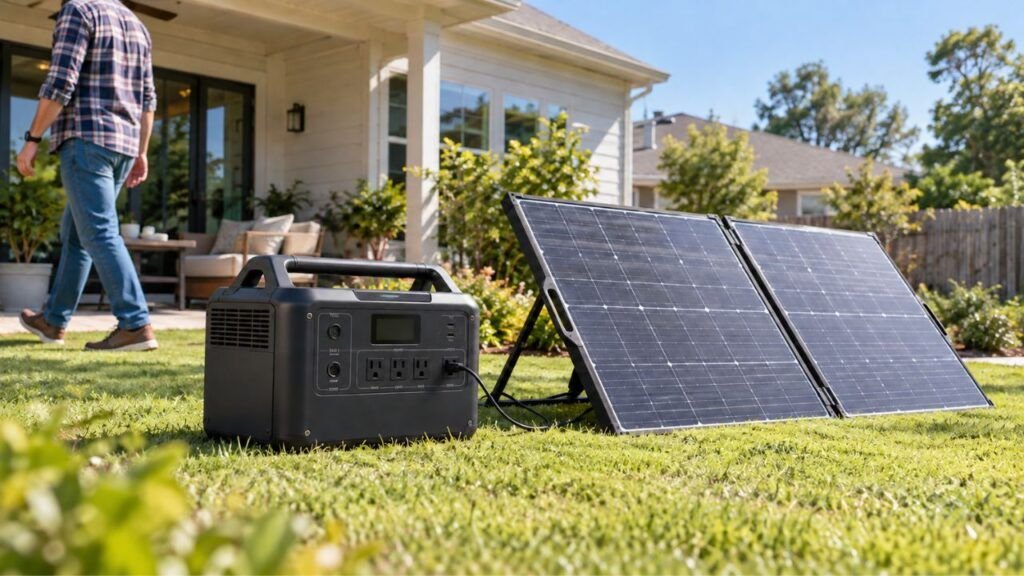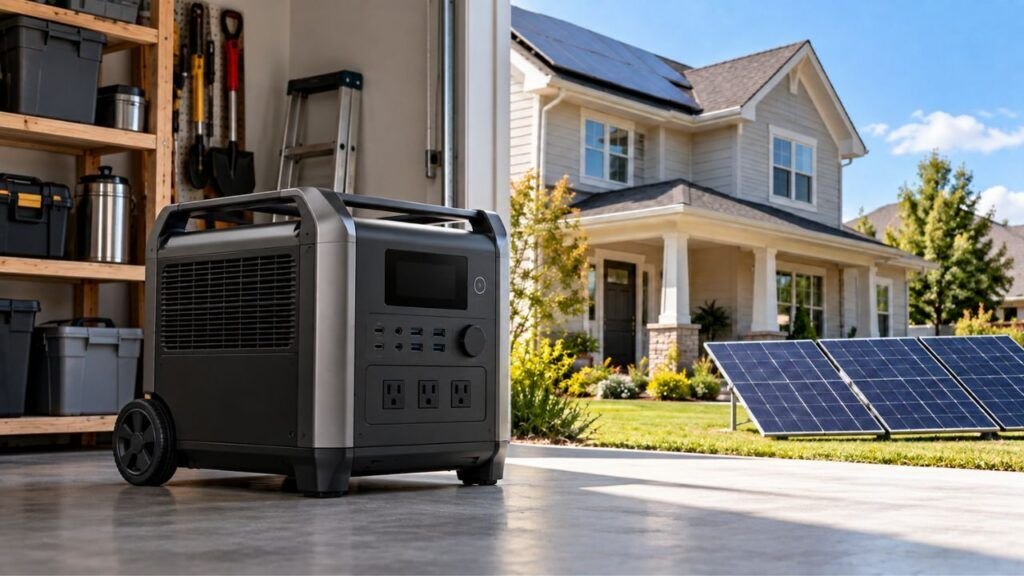
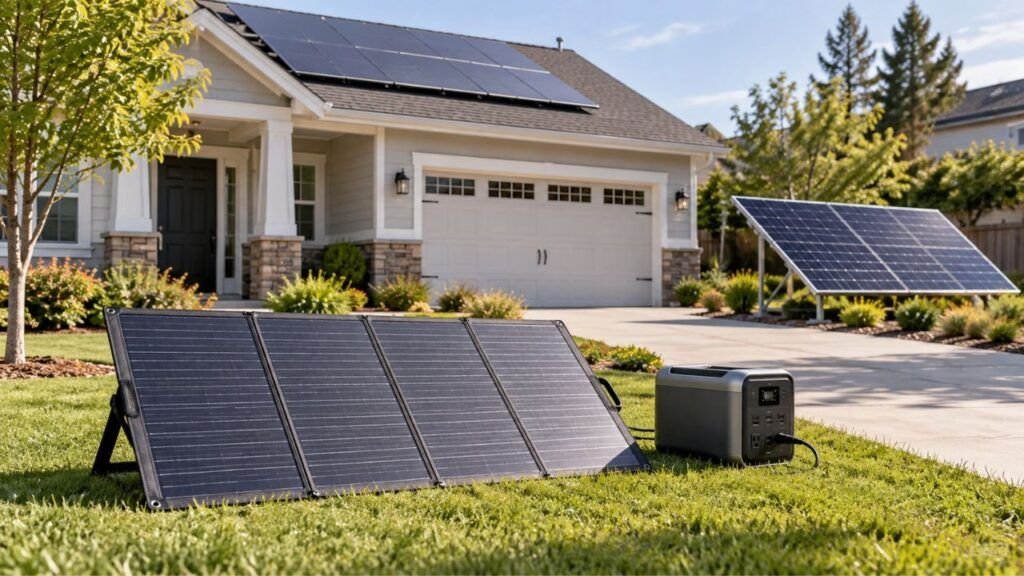
Rigid solar panels are usually better for permanent home backup systems. They offer strong durability, easier expansion, and lower long-term cost per watt. Portable solar panels are better when you need fast setup, easy storage, or temporary emergency charging without permanent installation.
In this guide, I’ll compare both options for real home outages. We’ll look at output, charging speed, durability, cost, compatibility, weather, installation, and which setup fits different homes.
Key Takeaways
- Rigid solar panels usually offer better long-term home backup value.
- Portable panels are easier to store, move, and deploy temporarily.
- Either type can charge many solar generators when specifications match.
- Portable panels are not automatically less efficient than rigid panels.
- Rigid arrays are easier to scale for larger battery systems.
- Portable panels can move around shadows and changing sunlight.
- Your power station’s solar input can limit charging speed.
- A hybrid rigid and portable setup can provide added flexibility.
Portable vs Rigid Solar Panels: Quick Comparison
Both panel types can recharge a home backup battery. The bigger differences involve installation, durability, portability, cost, and how easily you can build a larger solar array.
| Factor | Portable Solar Panels | Rigid Solar Panels |
| Best use | Temporary or emergency backup | Permanent or frequent backup |
| Installation | Very little | Mounting usually required |
| Portability | Excellent | Low |
| Storage | Easy when folded | Usually stays installed |
| Cost per watt | Usually higher | Usually lower |
| Durability | Moderate to high | Generally high |
| Long-term weather exposure | Depends on model | Usually designed for it |
| Repositioning | Very easy | Limited after mounting |
| Large-array scalability | Moderate | Excellent |
| Power station use | Often very convenient | May need adapters or wiring |
| Outage setup | Requires manual deployment | Can already be ready |
| Long-term value | Better for occasional use | Better for frequent use |
For occasional outages, portability may matter more than cost. For frequent outages, durability and solar capacity usually become more important.
What Is the Difference Between Portable and Rigid Solar Panels?
The basic solar technology can be very similar between both types. Their biggest differences come from construction, mounting, handling, and intended use.
Portable Solar Panels
Portable solar panels are designed for temporary deployment and easy transport.
Many fold into suitcase-style packages with handles and kickstands. You unfold them in a driveway, yard, deck, or patio. Then, you connect them directly to a solar generator.
Portable panels are especially useful when permanent installation is difficult. Renters and people with shaded roofs may find them convenient.
You can also reposition them as the sun moves. That gives portable panels an advantage in locations with changing shade.
However, you must deploy and pack them away manually. That can become inconvenient during frequent or extended outages.
Rigid Solar Panels
Rigid solar panels use solid frames, usually with tempered glass. They are commonly installed on rooftops or ground-mounted racks.
You can also mount them on garages, sheds, pergolas, or dedicated structures.
Their solid construction makes them suitable for long-term outdoor exposure. They are also easier to combine into large solar arrays.
For home backup, this matters when you need substantial daily charging. A large battery bank may require far more solar than portable panels conveniently provide.
Portable Does Not Always Mean Flexible
This distinction is important because these terms often get mixed together.
A portable solar panel does not automatically mean a flexible panel.
Many portable panels fold but still contain relatively rigid cell sections. Their fabric or polymer backing simply allows the entire unit to collapse.
Flexible panels are physically bendable and fit curved surfaces.
Rigid panels have a solid frame and stay flat.
For home backup, the more useful comparison is usually foldable portable panels versus conventional rigid modules.
Which Produces More Power During a Home Outage?
Rated wattage gives you a starting point, not guaranteed output. Real solar production changes throughout the day and across different conditions.
Rated Watts vs Real-World Solar Output
A 400-watt solar panel rarely produces exactly 400 watts all day.
Its actual output depends on:
- Sun intensity
- Panel temperature
- Cloud cover
- Shade
- Panel angle
- Time of day
- Season
- Wiring losses
- Dirt and dust
- Charge controller limitations
A 400W portable panel and 400W rigid panel can perform similarly under ideal conditions.
Their design alone does not determine the final output.
The way you position, cool, connect, and use them matters greatly.
Panel Angle and Sun Tracking
Portable panels have one useful advantage during an outage.
You can change their direction as sunlight changes.
For example, you might face them southeast during the morning. Later, you can reposition them toward stronger afternoon sunlight.
A rigid rooftop array usually stays at one fixed angle.
That sounds like a disadvantage, but fixed panels require no manual work. Once installed correctly, they can produce electricity every sunny day automatically.
Portable panels can gain better positioning temporarily. Rigid panels provide much greater convenience over long periods.
Heat and Airflow
Solar panels normally produce less power as cell temperatures rise.
Rigid panels mounted on racks often have airflow underneath them. This airflow helps remove some heat.
Portable folding panels can also stay relatively cool when positioned correctly. Their kickstands usually create space behind the panel.
Problems can appear when portable panels lie flat on hot pavement. Heat can build beneath them and reduce output.
I recommend keeping airflow around any temporary panel setup whenever possible.
Shade Can Change the Result
This is one area where portable panels can be surprisingly useful.
Suppose your roof receives morning sun but afternoon tree shade. A fixed rigid array cannot move away from that shade.
A portable panel can.
You might place it in the driveway during morning hours. Later, you can move it into a sunnier part of the yard.
This flexibility can sometimes produce better real-world results than expected.
However, constant repositioning becomes tiring during a long outage.
Which Recharges a Solar Generator Faster?
Charging speed depends on more than portable versus rigid construction. Your array size and power station’s input limits are often more important.
Solar Panel Wattage Matters
Larger solar arrays can usually send more energy into your battery.
For example, an 800W array has much more charging potential than 400W.
But that does not mean it always produces exactly twice as much energy.
Sun conditions and system losses still matter.
A large rigid array is generally easier to build economically. Portable panels become expensive and physically bulky as capacity increases.
Your Power Station Sets the Charging Limit
This is one of the most important things to understand.
Suppose your portable power station accepts 500W maximum solar input.
Connecting 1,000W of solar panels does not automatically give you 1,000W charging.
The power station still limits how much solar power it accepts.
Before buying panels, check the solar input specifications first.
Look for:
- Maximum solar input wattage
- Maximum input voltage
- MPPT voltage range
- Maximum input current
- Supported connector type
Your power station determines how large an array you can safely use.
Voltage and Current Must Match
Panel wattage alone is not enough.
You also need compatible voltage and current.
Important specifications include:
- Open-circuit voltage, or Voc
- Maximum power voltage, or Vmp
- Short-circuit current, or Isc
- Maximum power current, or Imp
These numbers become especially important when combining multiple rigid panels.
Series connections raise voltage. Parallel connections increase available current.
Never assume a high-wattage array is safe because the wattage looks acceptable.
Always keep the system within the manufacturer’s voltage and current limits.
Connectors and Adapters Matter Too
Portable panels often come with convenient power station connectors.
Rigid panels commonly use standard solar connectors and separate cables.
You may need an adapter before connecting them to a power station.
Check connector type and polarity carefully.
A plug fitting physically does not guarantee electrical compatibility.
How Much Solar Capacity Do You Need for Home Backup?
Start with the energy you want to replace each day. Then compare that requirement with your available sunlight and battery charging limits.
A basic planning formula looks like this:
Required solar watts = daily energy needed ÷ usable peak-sun hours ÷ expected system efficiency
This is only a planning estimate because weather changes daily.
| Daily Energy You Need | Solar Capacity to Consider | Possible Backup Use |
| Around 1 kWh | 300W–500W | Phones, lights, router, electronics |
| Around 2 kWh | 500W–800W | Refrigerator plus smaller devices |
| Around 3–5 kWh | 800W–1,600W+ | Multiple essential household loads |
| More than 5 kWh | Large expandable array | Extended home backup |
These numbers should not be treated as guaranteed sizing recommendations.
Your actual needs depend on location, season, weather, battery capacity, appliance use, and solar input limits.
For example, a household in Arizona may receive very different solar production from one in Washington during winter.
Start with your daily energy requirement rather than panel wattage alone.
Portable Solar Panels for Home Backup: Where They Make Sense
Portable panels work best when flexibility matters more than permanent installation.
They may be a strong choice when:
- You rent your home.
- You cannot modify the roof.
- You experience occasional outages.
- You want to store panels indoors.
- You also use solar while traveling.
- Your property has changing shade.
- You need simple emergency deployment.
- You use a smaller portable power station.
- You do not want professional installation.
They are especially useful for homeowners who only expect occasional emergencies.
You can keep the panels protected in storage until needed.
The main trade-off is manual work. Every outage means retrieving, unfolding, positioning, connecting, and eventually packing the panels again.
Rigid Solar Panels for Home Backup: Where They Make Sense
Rigid panels become more attractive as your backup system grows. Their durability and scalability make them suitable for regular charging.
Rigid panels may make sense when:
- Your area experiences frequent outages.
- You want long-term backup preparation.
- You expect multi-day outages.
- You own a large solar generator.
- Your battery system can accept high solar input.
- You have usable roof or yard space.
- You want lower cost per watt.
- You plan to expand your battery capacity.
- You want solar available without deployment.
A permanent rigid array can be waiting before the outage even begins.
That convenience becomes increasingly valuable during multi-day grid failures.
However, permanent installations require more planning. Roof condition, mounting, wiring, local rules, and electrical safety may all become relevant.
Cost: Are Portable or Rigid Panels Cheaper?
Panel price tells only part of the story. Installation, lifespan, system size, and replacement costs all affect long-term value.
Upfront Panel Cost
Rigid panels generally offer a lower purchase cost per watt.
That becomes important as system size increases.
Buying one portable 200W panel may be reasonable.
Building a 2,000W portable array can become much more expensive.
Portable panels include additional features such as folding frames, handles, kickstands, protective layers, and specialized connectors.
You are partly paying for convenience.
Installation Cost
Portable panels usually win here.
You can often set them up without professional installation.
Rigid panels may require:
- Mounting rails
- Roof brackets
- Ground racks
- Wiring
- Disconnect equipment
- Weatherproof cable routing
- Professional labor
A roof-mounted system can therefore cost more initially.
Ground-mounted rigid panels may provide another option if you have yard space.
Cost Over Years of Use
Long-term value deserves more attention than the sticker price.
Rigid panels usually make sense when you expect years of regular use.
Portable panels may provide better value if they sit in storage most of the year and only come out during emergencies.
Think about how frequently you expect to use them.
A cheap panel you cannot conveniently deploy is not useful. An expensive portable system that stays unused may also be unnecessary.
Durability and Lifespan During Emergency Use
Your solar panels may need to work during difficult conditions. Construction quality and storage habits can therefore matter as much as rated output.
Rigid Panels
Rigid solar panels are built for permanent outdoor installation.
Their construction generally includes:
- Tempered glass
- Aluminum framing
- Sealed junction boxes
- Weather-resistant connectors
- Strong mounting points
Quality rigid modules are designed to remain outside through years of changing weather.
That makes them appealing for long-term backup systems.
However, the panel is only part of the installation.
Mounting hardware and roof attachment must also handle local wind and snow conditions.
Portable Panels
Portable panels face different kinds of wear.
They are repeatedly:
- Folded
- Unfolded
- Carried
- Dragged
- Stored
- Repositioned
- Connected
- Disconnected
That puts additional stress on hinges, cables, stands, fabric edges, and connectors.
Good portable panels can still last for years.
But they should not automatically be treated like permanent rooftop equipment.
Storage Matters More Than Many Buyers Expect
How you store portable panels can strongly affect their condition.
Avoid crushing them under heavy equipment.
Keep sharp tools away from the solar surface.
Do not tightly bend cables around connectors.
Keep panels clean and dry before long-term storage.
I also recommend testing them periodically instead of waiting for an outage.
The worst time to discover a damaged cable is after the grid fails.
What Happens in Rain, Wind, Snow, and Storm Conditions?
Weather matters because outages often happen during severe conditions. You should know how your panel type behaves before relying on it.
Rain and Water Resistance
Many modern solar panels have strong water-resistance ratings.
However, not every portable panel has identical protection.
Check the rating for the exact model you own.
Pay attention to connectors as well.
A water-resistant panel does not automatically make every connection safe in standing water.
Rigid panels are generally intended for long-term outdoor exposure.
Portable panels should follow the manufacturer’s specific weather guidance.
Strong Wind
Large portable panels can behave like sails.
Strong wind can flip them, damage kickstands, or pull cables loose.
Secure them properly whenever conditions permit.
During severe winds, bringing portable panels indoors may be safer.
Do not deploy temporary panels outside during dangerous storm conditions simply because the power is out.
Snow and Cold Weather
Solar panels can still produce electricity in cold conditions.
In fact, cooler cell temperatures can sometimes support good electrical performance.
The bigger issue is sunlight.
Snow covering the panel blocks light.
Winter also brings shorter daylight hours across much of the United States.
That means you may need more panel capacity during winter outages.
Hurricanes and Severe Storms
Solar backup is most useful after dangerous conditions pass.
A portable array should not be deployed during extreme winds.
Wait until outdoor conditions are safe.
Permanently installed rigid panels should use mounting systems designed for local environmental requirements.
Home backup equipment should reduce risk, not create another one.
Setup Speed: Which Is Easier During an Outage?
Portable panels require less preparation before an outage.
You buy them, store them, and bring them outside when needed.
The process normally looks like this:
Retrieve the panel, unfold it, position it, connect it, and adjust it.
Rigid panels reverse that situation.
Installation requires more planning before an emergency.
Once installed, however, they can already be collecting sunlight when the grid fails.
That gives us an easy way to think about the difference.
Portable panels require less work before an outage but more work during one.
Rigid panels require more work beforehand and less work afterward.
For frequent outages, that distinction can become very important.
Storage Space and Deployment Area
Portable panels look compact when folded, but their deployed size can surprise people.
A large folding solar panel may occupy several feet of ground.
Using several panels can quickly fill a driveway, deck, patio, or yard.
You also need space without major shading.
Then you need a safe cable route between the panels and power station.
Long cable runs can introduce additional voltage losses.
Rigid panels solve the storage problem by remaining installed.
But they permanently occupy roof, rack, or yard space instead.
Before choosing either type, think about where the panels will physically go during an outage.
Do not wait until the first blackout to figure that out.
Can You Use Rigid Solar Panels With a Portable Power Station?
Yes, many portable power stations can work with rigid solar panels.
The important requirement is electrical compatibility.
Before connecting anything, check:
- Maximum solar input wattage
- Maximum solar input voltage
- MPPT voltage range
- Maximum input current
- Panel Voc
- Panel Vmp
- Panel Isc
- Panel Imp
- Connector type
- Connector polarity
- Number of panels
- Series or parallel configuration
- Cold-weather voltage limits
This allows you to use inexpensive residential-style rigid panels with some portable power stations.
However, never assume compatibility from wattage alone.
For example, a power station may accept 1,000W of solar but still have a strict voltage limit.
A panel combination exceeding that voltage could damage equipment.
Follow the power station manufacturer’s solar input specifications.
Can You Connect Multiple Portable or Rigid Panels Together?
Multiple panels can often be combined to increase charging capacity. The wiring configuration changes how voltage and current behave.
Connecting Panels in Series
Series wiring adds panel voltage.
Current generally stays close to the current of one panel.
For example, two similar 40V panels in series can produce around 80V.
That may work well with some high-voltage MPPT inputs.
It may exceed the limit of smaller portable power stations.
Always calculate total open-circuit voltage before connecting panels.
Connecting Panels in Parallel
Parallel wiring keeps voltage roughly similar while increasing available current.
Two similar panels producing 10 amps each could provide about 20 amps together.
Your solar generator must be able to accept that current.
Parallel setups may also require suitable branch connectors and wiring.
Never Exceed the Solar Generator’s Input Limits
This is the rule that matters most.
Stay below the manufacturer’s maximum input voltage.
Also stay within supported current and power limits.
Remember that panel voltage can rise in cold temperatures.
Leave appropriate voltage headroom instead of designing directly against the maximum limit.
Portable vs Rigid Panels for Different Home Backup Situations
Your home, outage frequency, battery size, and available space should guide your choice.
| Situation | Better Fit | Main Reason |
| Apartment or rental home | Portable | No permanent installation |
| Occasional short outage | Portable | Easy emergency deployment |
| Frequent outages | Rigid | Always ready |
| Multi-day outage | Rigid or hybrid | Easier large-array charging |
| Shaded roof | Portable or ground-mounted rigid | Better access to sunny areas |
| Budget-focused large array | Rigid | Lower cost per watt |
| Small solar generator | Portable | Simple setup |
| Large expandable battery | Rigid | Easier scalability |
| Camping plus home backup | Portable | Multi-purpose |
| Maximum flexibility | Hybrid | Fixed and movable solar |
There is no universal winner for every homeowner.
The right answer depends heavily on how often you expect to use solar backup.
Is a Hybrid Solar Panel Setup Better?
A hybrid setup can provide a useful balance between permanent capacity and emergency flexibility.
Rigid panels can serve as your main charging source.
They stay mounted and provide regular solar production without daily setup.
Portable panels can then provide additional charging during extended outages.
You can move them into sunny areas or deploy them when more capacity is needed.
This approach can be especially useful for expandable power stations.
However, do not simply connect mismatched panels together.
Different voltages and electrical characteristics can create compatibility problems.
Some systems support separate solar inputs, which may simplify mixed-panel setups.
Check the exact requirements before building a hybrid array.
Mistakes to Avoid When Choosing Solar Panels for Home Backup
Home backup systems work best when everything is tested beforehand.
Avoid these common mistakes:
- Buying panels based only on advertised watts
- Confusing portable panels with flexible panels
- Ignoring the power station’s voltage limit
- Ignoring the MPPT operating range
- Assuming every connector is compatible
- Connecting panels without checking polarity
- Buying more wattage than your station accepts
- Forgetting portable panels need deployment space
- Leaving portable panels permanently exposed outdoors
- Ignoring shadows around your home
- Using very long or undersized cables
- Expecting full rated output all day
- Forgetting winter solar production can be lower
- Waiting until an outage to test everything
- Mounting rigid panels without proper structural planning
- Mixing different panels without checking electrical specifications
Testing is one of the easiest ways to improve emergency reliability.
Run your system during normal conditions first.
You will learn where to place panels, which cables you need, and how quickly your battery actually charges.
Portable vs Rigid Solar Panels: Which Should You Choose?
Choose portable solar panels when mobility and simplicity matter most.
They are especially useful for renters, occasional outages, small solar generators, and homeowners who cannot permanently modify their property.
You can also use them for camping or other off-grid situations.
Choose rigid panels when you want a more permanent home backup system.
They usually make more sense for large batteries, frequent outages, long-term ownership, and higher daily charging requirements.
Rigid panels also become more economical as array size increases.
For serious home backup, I usually prefer thinking beyond one panel type.
A permanent rigid array can handle everyday charging.
Portable panels can remain available as supplemental emergency capacity.
The best setup is the one that matches your actual energy use, property, and power station.
Final Words
Portable and rigid solar panels can both work well for home backup.
The important difference is how you plan to use them.
Portable panels prioritize mobility, easy storage, and fast temporary deployment. Rigid panels prioritize durability, capacity, scalability, and long-term value.
Before buying either type, check your daily energy needs first.
Then check your solar generator’s maximum wattage, voltage, and current limits.
That approach helps you build a backup system that works when you actually need it.
Related FAQs
Are Rigid Solar Panels Better Than Portable Panels for Home Backup?
Rigid panels are usually better for frequent or long-term home backup because they are durable, scalable, and economical per watt. Portable panels are more convenient for temporary or occasional emergency use.
Can I Connect Rigid Solar Panels to a Portable Power Station?
Yes, many portable power stations support rigid solar panels. You must confirm that panel voltage, current, wattage, connector type, and polarity match the power station’s solar input requirements.
Do Portable Solar Panels Charge Slower Than Rigid Panels?
Not necessarily. Charging speed depends more on available solar wattage, sunlight, panel positioning, temperature, and the power station’s input limit than whether the panel folds.
Can Portable Solar Panels Stay Outside All Year?
Some can handle rain and outdoor use, but most portable panels are designed for temporary deployment. Check the manufacturer’s weather rating before leaving any portable panel permanently exposed.
How Many Watts of Solar Do I Need for Emergency Home Backup?
The answer depends on how much energy you use daily. Small emergency systems may use several hundred watts, while larger home backup batteries may benefit from 1,000W or more.
Can I Use Two 400W Solar Panels With a Portable Power Station?
Possibly. Two 400W panels provide 800W of rated capacity, but their combined voltage and current must remain within the power station’s solar input specifications.
Are Portable Solar Panels Worth the Higher Cost?
They can be worth it when portability, storage, and fast deployment matter. For larger permanent arrays, rigid panels usually provide stronger long-term value per watt.
Can I Use Different Brands of Solar Panels With My Solar Generator?
Often yes. Brand matching is less important than electrical compatibility. Check voltage, current, connector type, polarity, and the solar generator manufacturer’s requirements before connecting them.
Can I Combine Portable and Rigid Solar Panels?
Yes, some systems can use both. However, mixed panels should only be connected when their electrical characteristics and the power station’s input design support the configuration.
Do Rigid Solar Panels Work During a Power Outage?
Yes, but the complete system matters. Rigid panels can recharge a compatible battery or solar generator during an outage when sunlight is available and the system is configured for backup operation.
Where Should I Place Portable Panels During an Outage?
Place them in an open, sunny location with minimal shade. Angle them toward strong sunlight, keep cables protected, and avoid locations exposed to dangerous wind or standing water.
Which Solar Panel Type Is Better for Multi-Day Outages?
Rigid panels generally make more sense for multi-day outages because large arrays are easier and cheaper to build. Portable panels remain useful as supplemental charging or where permanent installation is impossible.

Blake Cooper writes practical guides on generators, portable power stations, and home backup systems. He focuses on simplifying power topics and helping homeowners make informed buying decisions.