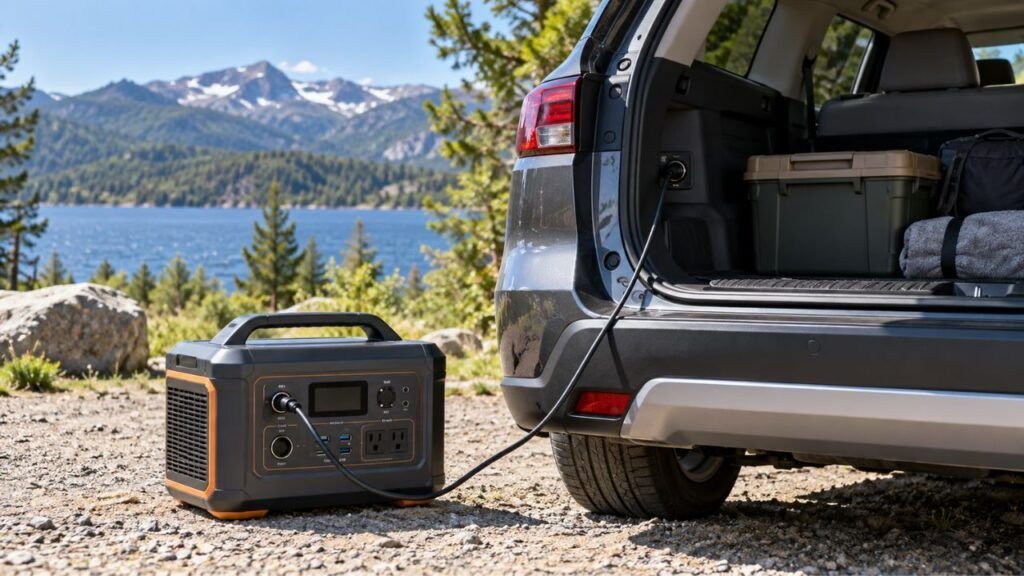
Yes, you can charge a solar generator from a car. Most portable power stations support 12V car charging through an accessory socket. However, standard car charging is relatively slow compared with wall or solar charging.
You can also use faster vehicle charging methods for larger batteries. Below, I’ll explain each option, expected speeds, safety limits, and common problems.
Key Takeaways
- Most solar generators support charging from a 12V car outlet.
- Standard car charging often provides around 80W to 120W.
- Large solar generators can take many hours through a 12V outlet.
- Keep the vehicle running during significant charging whenever recommended.
- Dedicated alternator chargers can provide several hundred watts of charging power.
- Never exceed your vehicle outlet’s voltage, amperage, or wattage rating.
- Check both your vehicle and solar generator manuals before connecting anything.
How Does Charging a Solar Generator From a Car Work?
Your vehicle produces electrical power while the engine is running. A compatible charging cable transfers some of that energy into your portable power station.
The exact process depends on your vehicle and charging method.
The Vehicle Supplies DC Power
Most gasoline and diesel vehicles use a 12V electrical system.
While the engine runs, the alternator generates electricity. That electricity supports the vehicle’s systems and keeps its starter battery charged.
Your accessory socket can supply some of this power to your solar generator.
However, the amount available through that socket is limited.
The Solar Generator Regulates Incoming Power
Your solar generator does not simply accept unlimited vehicle power.
Its charging electronics control incoming voltage and current. The battery management system also helps protect the battery from unsafe conditions.
The power station may reduce charging if temperatures become excessive.
It may also stop charging if input voltage becomes unsuitable.
Car Output Port vs. Solar Generator Charging Input
This part sometimes confuses new solar generator owners.
Many portable power stations have a cigarette-lighter-style socket on them. That socket is usually an output for powering 12V devices.
You normally do not use that output to recharge the power station.
Instead, you connect the vehicle charging cable to the power station’s designated DC, solar, or car charging input.
Always confirm the correct port before connecting the cable.
Three Ways to Charge a Solar Generator From a Car
There are several ways to recharge portable power stations using vehicles. The right method depends mainly on battery capacity and charging speed.
1. Standard 12V Cigarette Lighter or Accessory Socket
This is the simplest method for most people.
You connect the manufacturer’s compatible car charging cable between the vehicle’s 12V outlet and the solar generator.
The setup normally takes only a few seconds.
Standard accessory outlets usually provide limited charging power. Around 80W to 120W is common, although exact limits vary.
This method works particularly well for:
- Small solar generators
- Emergency charging
- Camping trips
- Road trips
- Occasional battery top-ups
- Keeping small electronics powered
The biggest drawback is charging speed.
A large 1,000Wh or 2,000Wh battery can take many hours.
2. Factory AC Outlet or Properly Installed Power Inverter
Some vehicles include a built-in 120V AC outlet.
In that situation, you may be able to connect the solar generator’s normal AC charging cable.
The available charging speed depends on the outlet’s wattage rating.
For example, a vehicle outlet rated for several hundred watts may recharge faster than an ordinary 12V socket.
You should still check the solar generator’s charging requirements first.
Another possibility is using a separate power inverter.
An inverter converts the vehicle’s DC electricity into AC electricity. You can then connect your solar generator’s AC charger.
However, there is an important limitation.
Plugging a powerful inverter into an ordinary 12V accessory socket does not magically create hundreds of extra watts.
The accessory socket still has its original current limit.
A 1,000W inverter connected to a low-power socket cannot safely deliver 1,000W continuously.
Higher-powered inverter systems normally require proper wiring to the vehicle battery.
Professional installation is the safer choice for these setups.
3. Dedicated DC-to-DC Alternator Charger
A dedicated alternator charger is the fastest vehicle-based solution.
These systems connect more directly to the vehicle’s electrical system. They regulate power before sending it to your portable power station.
Current systems can provide several hundred watts while driving.
Some are rated around 500W, 600W, or even 800W.
That difference becomes significant with larger power stations.
A 2,000Wh battery charged at roughly 100W can take most of a day.
At several hundred watts, the same battery becomes much more practical.
Alternator chargers are especially useful for:
- RV owners
- Van travelers
- Overlanders
- Long road trips
- Large portable power stations
- Off-grid camping
- Emergency backup preparation
Installation requirements vary considerably between systems.
Always follow the manufacturer’s wiring and fuse requirements.
Car Charging Methods Compared
The table below gives you a general idea of each method. Actual numbers depend on your vehicle and portable power station.
| Charging Method | Typical Power | General Speed | Setup | Best For |
| 12V accessory outlet | Around 80W–120W | Slow | Very easy | Small units and top-ups |
| 24V vehicle outlet | Model-dependent | Slow to moderate | Easy | Compatible trucks and RVs |
| Factory AC outlet | Vehicle-dependent | Moderate | Easy | Vehicles with adequate AC output |
| Installed inverter | System-dependent | Moderate to fast | More complex | Specialized vehicle setups |
| DC-to-DC alternator charger | Around 500W–800W on many current systems | Fast | More involved | Large power stations and frequent travelers |
These numbers should only be treated as general examples.
Your actual limit is whichever component has the lowest rating.
That could be your car outlet, wiring, charger, or power station.
How Long Does It Take to Charge a Solar Generator From a Car?
Charging time depends mainly on battery capacity and actual input wattage. Standard vehicle outlets are much slower than dedicated alternator charging systems.
Simple Charging-Time Formula
You can estimate charging time with this basic formula:
Battery capacity in Wh ÷ charging watts = approximate charging hours
For example:
A 1,000Wh battery receiving 100W needs roughly ten hours theoretically.
Real charging may take longer because input wattage can fluctuate.
Charging losses and battery management can also increase total time.
Example Car Charging Times
These numbers are only approximate examples.
| Solar Generator Capacity | Around 100W Car Input | Around 600W Alternator Input |
| 300Wh | About 3–4+ hours | Under 1 hour |
| 500Wh | About 5–6+ hours | Around 1 hour |
| 1,000Wh | About 10–12+ hours | Around 2 hours |
| 2,000Wh | About 20–24+ hours | Around 4 hours |
Your actual charging speed may be slower.
Temperature, battery percentage, vehicle voltage, and charger settings can all matter.
How to Charge a Solar Generator From a 12V Car Outlet
Charging from a standard vehicle outlet is usually straightforward. Still, checking the ratings first can prevent blown fuses and damaged connectors.
- Check your solar generator manual. Confirm that your power station supports car charging.
- Check your vehicle outlet rating. Look for its voltage, amperage, and maximum wattage.
- Use the correct charging cable. Manufacturer-approved cables are generally the safest option.
- Start the vehicle when recommended. This helps prevent excessive starter-battery discharge.
- Connect the charging cable. Plug it into the vehicle outlet and power station input.
- Check the display. Confirm that the solar generator shows incoming charging power.
- Monitor the connection. Watch for unusual heat, smells, or intermittent charging.
- Disconnect when finished. Remove the cable carefully after charging.
Do not assume every car outlet supports the same wattage.
Some may support around 120W. Others may allow more or less.
Can Charging a Solar Generator Drain Your Car Battery?
Yes, charging a solar generator can drain your starter battery if the engine is off.
Whether this happens quickly depends on your vehicle and outlet behavior.
Some vehicles switch their accessory outlets off automatically after shutdown. Others may continue providing power.
If the socket stays active, the solar generator keeps drawing electricity.
That energy eventually comes from your starter battery.
You could then return to a vehicle that will not start.
For significant charging, keep the engine running when the manufacturer recommends it.
Dedicated alternator charging systems often provide additional protection. Many monitor vehicle voltage and reduce or stop charging when necessary.
That protection should not replace proper installation.
Is It Safe to Charge a Solar Generator While Driving?
Yes, charging while driving can be safe with compatible equipment. You still need to secure the power station and respect electrical limits.
Follow these basic precautions:
- Secure the solar generator so it cannot slide around.
- Keep cooling vents completely uncovered.
- Keep cables away from pedals and moving components.
- Never exceed the vehicle outlet’s electrical rating.
- Check plugs occasionally for unusual heat.
- Stop charging if a connector becomes extremely hot.
- Do not use damaged charging cables.
- Use properly fused wiring for hardwired chargers.
- Follow your power station’s temperature requirements.
- Keep liquids away from electrical connections.
If you are charging during a power outage, there is another important rule.
Never run a gasoline or diesel vehicle inside an attached garage.
Opening the garage door does not make that setup safe.
Vehicle exhaust contains carbon monoxide, which can become deadly indoors.
Move the vehicle completely outdoors before running the engine.
Why Is Car Charging So Slow?
The main reason is not your solar generator. The limitation is usually the vehicle’s accessory circuit.
A large portable power station might accept 1,000W or more from AC power.
It could also accept several hundred watts from solar panels.
That does not mean its car charging cable can deliver those amounts.
A normal vehicle accessory socket uses relatively thin wiring and limited fuse capacity.
The vehicle manufacturer therefore limits how much current it can safely supply.
That protects the outlet and wiring from overheating.
Your solar generator may consequently receive only around 100W.
This feels especially slow with larger batteries.
For example, adding 100Wh each hour to a 2,000Wh battery requires many driving hours.
This is why alternator chargers have become useful for larger systems.
When Is an Alternator Charger Worth It?
An alternator charger solves the biggest problem with ordinary car charging: low wattage. However, many people do not actually need one.
It Makes Sense If You…
Consider an alternator charger when you:
- Own a 1,000Wh or larger power station
- Drive for several hours regularly
- Camp away from electrical hookups
- Travel in an RV or converted van
- Frequently use large appliances off-grid
- Need reliable charging during cloudy weather
- Want faster charging while traveling
- Use your vehicle during emergency preparation
The more often you depend on vehicle charging, the more useful it becomes.
You Probably Do Not Need One If You…
A standard charging cable may be enough if you:
- Own a small portable power station
- Only need emergency top-ups
- Mostly recharge at home
- Rarely take long road trips
- Have plenty of solar charging available
- Only power phones, lights, or laptops
There is little reason to install an expensive system for occasional charging.
What About Hybrids, EVs, Trucks, and RVs?
Not every vehicle uses the same electrical architecture. This becomes especially important when moving beyond a normal 12V accessory socket.
Gasoline and Diesel Cars
Conventional cars normally have a starter battery and alternator.
Standard 12V accessory charging works with many compatible solar generators.
Dedicated alternator chargers may also work when properly installed.
Always confirm how much additional load your vehicle can support.
Hybrid Vehicles
Hybrid vehicles can have different charging and electrical systems.
Do not assume an alternator charger designed for a conventional vehicle will work.
Check compatibility with both manufacturers before installing anything.
Simple factory accessory-outlet charging may still be possible.
Electric Vehicles
Electric vehicles require special consideration.
Most EVs do not use the same conventional alternator arrangement found in gasoline vehicles.
Therefore, ordinary alternator chargers may not be compatible.
However, some EVs provide factory AC outlets or vehicle-to-load power.
A compatible solar generator might charge from that source.
Always check the EV’s output limit before connecting the charger.
Trucks and RVs With 24V Systems
Some trucks, commercial vehicles, and RV systems operate at 24V.
Never assume your normal 12V car charging cable supports 24V.
Too much input voltage can damage incompatible equipment.
Check the solar generator’s supported DC input voltage first.
Can You Charge a Solar Generator From a Car and Solar Panels at the Same Time?
Sometimes you can, but it depends on your specific power station.
Some modern solar generators support multiple charging inputs simultaneously.
For example, they may combine vehicle and solar charging.
Other models use one shared port for both solar and car input.
In that case, you cannot connect both sources there simultaneously.
Some dedicated alternator chargers can also integrate additional solar input.
Again, this depends entirely on the equipment.
Check your solar generator’s manual before combining charging sources.
Do not use homemade adapters to combine two power sources.
Why Is My Solar Generator Not Charging From the Car?
A solar generator refusing to charge does not always mean something is broken. Most problems involve the outlet, cable, settings, or input voltage.
The Car Outlet Has No Power
Some accessory outlets work only when the ignition is on.
Start the vehicle and check whether the outlet becomes active.
You can also test it with another compatible 12V device.
The 12V Outlet Fuse Has Blown
Vehicle accessory outlets are protected by fuses.
Drawing too much current can blow that fuse.
Check your owner’s manual to locate the correct fuse.
Replace it only with the manufacturer’s specified rating.
Never install a larger fuse just to stop it blowing.
The Charging Cable Is Loose or Damaged
Cigarette-lighter plugs can loosen while driving.
That may cause charging to start and stop repeatedly.
Reconnect both ends firmly.
Inspect the cable for damaged insulation or burned connectors.
The Power Station Is Using the Wrong Input Setting
Some portable power stations let you choose different DC charging modes.
Incorrect settings can reduce or prevent charging.
Open the device settings or mobile app when applicable.
Confirm that car charging is configured correctly.
Input Voltage Is Too Low
Your power station may stop charging when voltage drops.
This protects the battery and charging electronics.
Try charging while the engine is running.
If the problem continues, check the vehicle electrical system.
The Battery Is Too Hot or Too Cold
Lithium batteries have safe charging temperature limits.
Charging may slow or stop in extreme temperatures.
Move the solar generator into an appropriate environment.
Allow its battery temperature to return to normal.
The Cable or Power Station Is Not Compatible
Not every DC charging cable works with every power station.
Connector shape alone does not prove electrical compatibility.
Voltage, polarity, amperage, and connector wiring can differ.
Use the cable specified for your model whenever possible.
Car Charging vs. Solar vs. Wall Charging
Each charging source has a different advantage. Car charging is convenient while traveling, while AC charging is usually better before leaving home.
| Charging Method | Typical Speed | Works While Driving? | Needs Sunlight? | Best Use |
| Standard car charging | Slow | Yes | No | Road-trip top-ups |
| Alternator charging | Fast | Yes | No | Large batteries and travel |
| Solar charging | Variable | Not usually practical while driving | Yes | Camping and off-grid use |
| AC wall charging | Usually fast | No | No | Home charging before trips |
I would not think of these methods as competitors.
They work better as different tools for different situations.
Charge fully from AC before leaving home. Use vehicle charging while driving. Then use solar panels after reaching your campsite.
That combination can dramatically extend off-grid runtime.
Final Words
Yes, you can charge a solar generator from a car, and the process is usually simple. A standard 12V accessory outlet works well for emergency top-ups and smaller portable power stations.
The main drawback is speed. Around 100W of vehicle charging feels slow when your battery holds 1,000Wh, 2,000Wh, or more. A compatible DC-to-DC alternator charger can make much larger systems practical while driving.
Most importantly, check the limits of both your vehicle and your solar generator. Using the correct cable and staying within those limits gives you reliable charging without unnecessary electrical problems.
Related FAQs
Can You Charge a Solar Generator From a Cigarette Lighter?
Yes. Many portable power stations include a car charging cable designed for a 12V cigarette-lighter or accessory socket. Charging is convenient but usually much slower than AC charging.
Can You Charge a Solar Generator While Driving?
Yes. Charging while driving is one of the most practical ways to use car charging. Secure the power station, keep ventilation clear, and use compatible charging equipment.
How Long Does It Take to Charge a Solar Generator From a Car?
It depends on battery capacity and input wattage. A 1,000Wh power station receiving around 100W could need roughly 10 to 12 hours or longer.
Will Charging a Power Station Drain My Car Battery?
It can if the engine is off and the accessory outlet remains powered. Running the vehicle while charging helps prevent excessive starter-battery discharge when recommended.
Can I Leave My Solar Generator Plugged Into the Car Overnight?
It is usually better not to leave it charging overnight with the engine off. If the outlet stays energized, the solar generator could drain your starter battery.
Can I Charge a 2000Wh Power Station From a Car?
Yes, if the power station supports car charging. However, a standard 12V outlet may require around 20 hours or more, making an alternator charger much more practical.
Can I Use a Power Inverter to Charge a Solar Generator From My Car?
Yes, but only within the vehicle electrical system’s safe limits. A high-wattage inverter should not be connected to a low-power accessory socket expecting full rated output.
Can You Charge a Solar Generator From a 24V Truck?
Possibly, but only if the solar generator and charging cable support that input voltage. Never connect a 12V-only charger directly to an unsupported 24V system.
Can You Use an Alternator to Charge a Portable Power Station?
Yes. Compatible DC-to-DC alternator chargers can use vehicle-generated electricity to recharge portable power stations much faster than standard accessory outlets.
Can You Charge With Solar Panels and a Car at the Same Time?
Some power stations support simultaneous solar and vehicle charging, while others do not. Check the charging ports and manufacturer instructions for your specific model.
Can an Electric Car Charge a Solar Generator?
Some electric vehicles can, particularly when they provide compatible AC or vehicle-to-load power. Conventional alternator chargers may not work because EV electrical systems operate differently.
Why Won’t My Solar Generator Charge From My Car?
Common causes include a blown vehicle fuse, inactive accessory socket, loose charging cable, incorrect input settings, low voltage, extreme temperature, or incompatible charging equipment.

Blake Cooper writes practical guides on generators, portable power stations, and home backup systems. He focuses on simplifying power topics and helping homeowners make informed buying decisions.