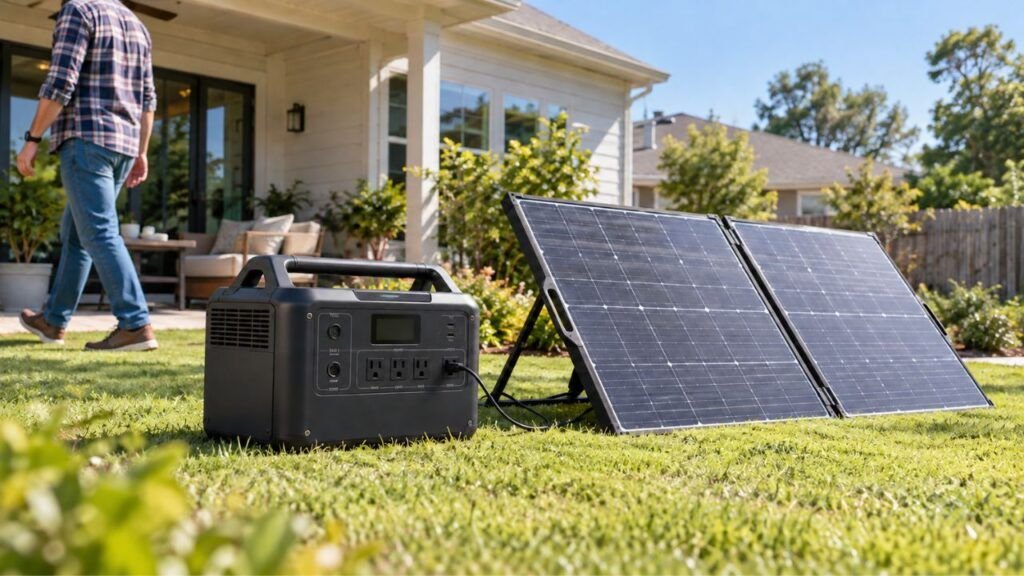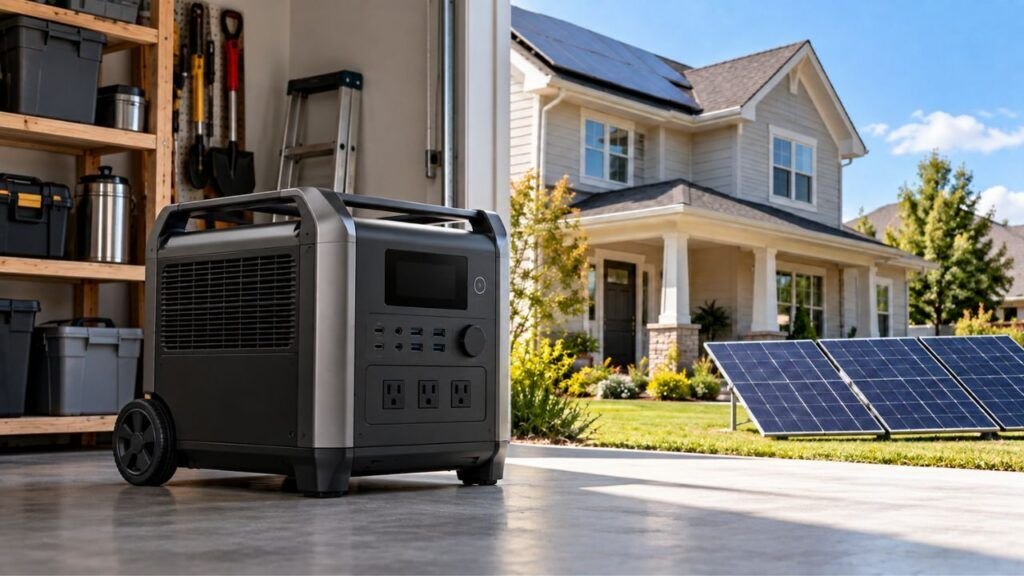
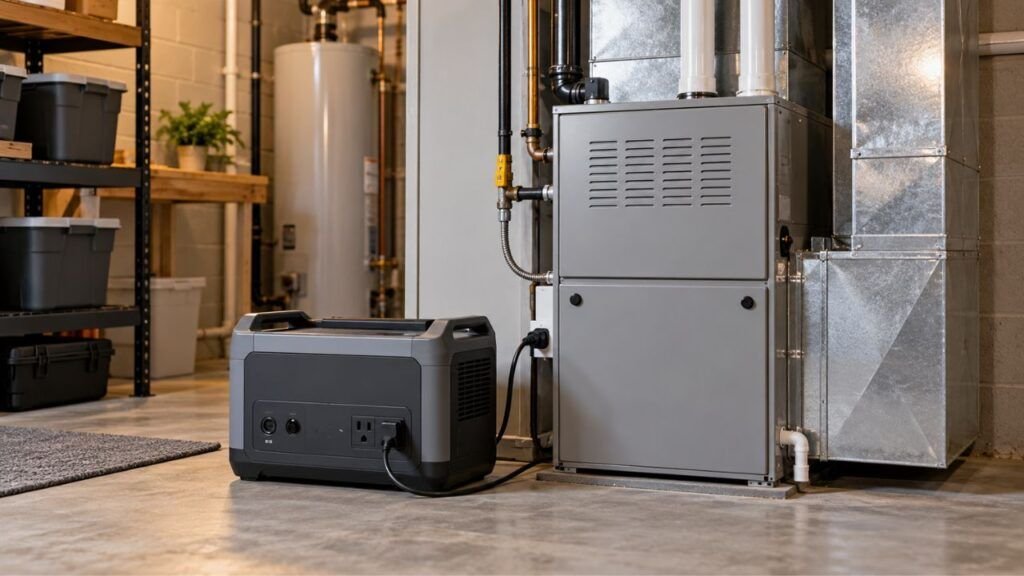
Yes, a solar generator can run many residential gas furnaces. It must provide enough running power, startup power, and battery capacity.
In this guide, I’ll help you size the system correctly. We’ll also cover runtime, grounding, safe connections, and common furnace problems.
Key Takeaways
- Gas creates the heat, but your furnace still needs electricity.
- The blower motor usually creates the largest electrical demand.
- Running watts alone do not tell the complete story.
- Startup demand can briefly exceed normal furnace power consumption.
- Battery watt-hours determine how long your furnace can operate.
- Your furnace nameplate provides better information than generic wattage estimates.
- Many hardwired furnaces need an approved backup-power connection.
- Grounding and polarity can affect whether some furnaces ignite.
- Never backfeed your home through a normal wall outlet.
- Winter solar charging can help, but production varies significantly.
Can a Solar Generator Really Run a Gas Furnace?
In many cases, yes. A gas furnace is actually one of the more practical home heating systems to support with battery backup.
Natural gas or propane provides the actual heat. The solar generator only needs to supply electricity for supporting components.
These commonly include the blower, control board, igniter, and inducer motor.
That electrical load is usually much smaller than electric resistance heating.
However, three things must still be true.
Your gas supply must remain available during the outage. Your solar generator must meet the furnace’s electrical requirements. You also need a safe way to connect both systems.
If one of those conditions is missing, the furnace may not operate.
Why Does a Gas Furnace Need Electricity?
A gas furnace does not simply burn gas continuously. Several electrical components control combustion and move heat throughout your home.
Common electrically powered furnace components include:
- Blower motor that moves warm air through your ductwork
- Draft inducer motor that helps establish proper combustion airflow
- Electronic igniter that starts the gas burner
- Control board that manages the furnace heating sequence
- Electronic gas valve controls
- Flame sensors and other safety devices
- Thermostat and control wiring
- Condensate equipment on some high-efficiency furnaces
- Zone controls, dampers, and optional accessories
Without electricity, the furnace normally cannot complete its heating cycle.
That explains why your gas may still work during an outage while your furnace remains completely silent.
How Many Watts Does a Gas Furnace Use?
There is no single wattage number that applies to every furnace. Furnace size, blower design, operating stage, and accessories all affect consumption.
Running Wattage
Many residential gas furnaces consume several hundred watts while actively heating.
A rough planning range of around 400 to 800 watts is commonly used. However, your particular furnace may fall outside that range.
Several factors affect its real consumption:
- Blower motor size
- Blower speed
- Furnace capacity
- Number of heating stages
- Airflow resistance
- Duct static pressure
- Filter condition
- Additional furnace accessories
That is why I recommend checking the actual furnace instead.
Startup or Surge Wattage
Startup power can matter even more than normal running power.
When an electric motor starts, it may briefly demand additional power.
The blower and inducer motors can therefore create short startup spikes.
For planning purposes, you may see estimates around two or three times normal running power. However, that is not a universal rule.
Your furnace may require considerably less or more.
This explains an issue homeowners sometimes experience with portable power stations.
The battery may show plenty of remaining capacity. However, the inverter suddenly shuts down when the blower starts.
In that situation, battery capacity may not be the problem.
The startup load may simply exceed the inverter’s available output.
ECM vs. PSC Blower Motors
The type of blower motor also affects electrical behavior.
Older furnaces commonly use permanent split capacitor, or PSC, motors.
Newer furnaces often use electronically commutated motors, commonly called ECM motors.
ECM motors can operate at variable speeds and may use electricity differently.
Airflow settings, duct pressure, and furnace controls can also affect consumption.
For that reason, comparing two similar-sized furnaces does not guarantee identical electrical requirements.
How to Find Your Furnace’s Actual Power Requirements
Before choosing a solar generator, gather information from your own furnace. A few minutes of checking can prevent buying an undersized system.
Check the Furnace Nameplate
Start by finding the furnace data plate.
It is commonly located inside or near an access panel.
Look for information including:
- Voltage
- Frequency
- Amperage
- Motor specifications
- Model number
- Electrical ratings
- Circuit requirements
Most residential gas furnaces in the United States operate from 120V power.
Still, verify your equipment rather than assuming.
Check the Furnace Manual
Next, find the manual using your furnace model number.
Look for sections covering:
- Electrical specifications
- Grounding requirements
- Polarity
- Circuit requirements
- Backup power
- Generator operation
- Installation requirements
Manufacturer instructions should always take priority over generic online advice.
Measure Actual Furnace Consumption
Actual measurements can give you even better sizing information.
A qualified HVAC technician or electrician can measure electrical demand during operation.
Ideally, you want to know both normal consumption and startup behavior.
If your furnace already has an approved plug connection, an appropriate power meter may also provide useful operating data.
However, do not modify a hardwired furnace simply for testing.
Do Not Confuse Breaker Size With Furnace Consumption
This mistake can make a solar generator seem unnecessarily large.
Suppose your furnace uses a 15-amp circuit.
At 120V, that circuit can theoretically provide up to 1,800 watts.
That does not mean the furnace continuously consumes 1,800 watts.
Circuit capacity and actual operating consumption are different measurements.
Use the furnace specifications or measured consumption whenever possible.
What Size Solar Generator Do You Need for a Gas Furnace?
Sizing requires more than checking one number on the solar generator. You need enough inverter output, startup capability, and stored battery energy.
Continuous AC Output
The inverter’s continuous rating must exceed your furnace’s running demand.
Suppose your furnace normally consumes 600 watts.
I would not choose an inverter rated for exactly 600 watts.
You want operating headroom for normal variations and additional furnace components.
This headroom also reduces the chance of inverter overload.
Surge Output
The solar generator must also tolerate startup demand.
A furnace that consumes 600 watts while running might briefly require considerably more when its motors start.
Check the solar generator’s surge rating.
Then compare it against your furnace’s real startup requirements.
Do not confuse these two specifications:
Running watts determine whether the furnace can keep operating.
Surge capacity determines whether certain loads can successfully start.
Battery Capacity
Battery capacity is measured in watt-hours, or Wh.
This number determines how much electrical energy the unit stores.
Imagine two solar generators both have 2,000-watt inverters.
One contains a 1,000Wh battery.
The other contains a 3,000Wh battery.
Both might successfully start your furnace.
However, the larger battery could operate it considerably longer.
Voltage, Frequency, and AC Output
For a typical US residential gas furnace, verify the following:
- Correct AC voltage
- 60Hz frequency
- Pure sine wave output
- Suitable grounding arrangement
- Compatible connection method
- Adequate continuous inverter output
- Adequate startup capability
Meeting the wattage requirement alone does not guarantee compatibility.
Leave Capacity for Other Essential Loads
You may want more than furnace backup during an outage.
Common essential loads include:
- Refrigerator
- Freezer
- Internet router
- Phones
- Basic lighting
- Medical equipment
- Security equipment
Add those loads when calculating inverter output and battery capacity.
You can also operate certain appliances at different times.
That strategy can reduce the inverter and battery size required.
Gas Furnace Solar Generator Sizing Examples
The examples below can help explain the sizing process. They are planning examples rather than universal furnace requirements.
| Example Furnace Load | Continuous Inverter Need | Startup Consideration | Battery Consideration |
| 400W running | More than 400W with headroom | Verify actual startup load | Smaller batteries may handle short outages |
| 600W running | More than 600W with headroom | Allow room for motor startup | 1–2kWh may provide useful short-term backup |
| 800W running | More than 800W with headroom | Surge capability becomes more important | Larger capacity helps during longer outages |
| Furnace plus refrigerator | Add simultaneous running loads | Consider both startup events | Calculate total energy needed |
Do not use this table as a replacement for your furnace specifications.
The safest approach is sizing from your actual equipment.
How Long Will a Solar Generator Run a Gas Furnace?
Battery runtime depends on capacity, furnace consumption, inverter losses, and heating cycles. A simple formula can provide a useful planning estimate.
Estimated runtime:
Battery capacity in Wh × usable efficiency ÷ furnace load in watts
For basic planning, you might use around 85% usable efficiency.
Actual results can vary between different systems.
Continuous Runtime Examples
The following estimates assume approximately 85% usable battery energy.
| Battery Capacity | 400W Load | 600W Load | 800W Load |
| 1,000Wh | About 2.1 hours | About 1.4 hours | About 1.1 hours |
| 2,000Wh | About 4.3 hours | About 2.8 hours | About 2.1 hours |
| 3,000Wh | About 6.4 hours | About 4.3 hours | About 3.2 hours |
These figures assume the furnace consumes power continuously.
Real heating operation is usually different.
Furnace Cycling Can Extend Runtime
Gas furnaces normally cycle on and off.
Your thermostat calls for heat, the furnace starts, and your home warms.
Once the desired temperature is reached, the furnace stops heating.
Suppose your furnace consumes 600 watts while operating.
It does not necessarily consume 600Wh every hour.
If it operates for only 30 minutes during that hour, energy consumption could be closer to 300Wh, excluding other loads and losses.
That cycling can greatly extend the elapsed backup time.
Why Very Cold Weather Changes Runtime
A furnace may operate much longer during severe winter conditions.
Several things can increase heating demand:
- Lower outdoor temperatures
- Higher thermostat settings
- Poor home insulation
- Air leakage around doors or windows
- Strong winds
- Leaky ductwork
- Dirty furnace filters
- Large indoor temperature differences
During extreme cold, your furnace may cycle far more frequently.
Always keep some battery capacity in reserve.
Can a Solar Generator Run a Gas Furnace Overnight?
Yes, but whether your solar generator lasts overnight depends heavily on the furnace duty cycle.
Consider a furnace consuming 600 watts.
Running continuously for eight hours would require about 4,800Wh before accounting for power losses.
However, furnaces normally do not operate continuously.
If that furnace operates for four total hours during an eight-hour night, the furnace itself would consume about 2,400Wh.
Add inverter losses and any other connected equipment.
Outdoor temperature can change this calculation significantly.
A battery that easily lasts overnight during mild winter weather may drain much faster during an extreme cold spell.
For overnight backup, I recommend sizing around colder conditions rather than ideal ones.
How to Connect a Solar Generator to a Gas Furnace Safely
Connection method matters just as much as solar generator size. Many gas furnaces are permanently connected to your home’s electrical system.
Hardwired Furnaces
A typical residential furnace may be hardwired into a dedicated electrical circuit.
That means there is no ordinary plug you can simply move into the solar generator.
Do not cut wires or add a homemade extension cord.
Fixed electrical wiring requires a proper backup-power arrangement.
Transfer Switch or Approved Backup Circuit
A transfer switch or properly designed backup system can isolate selected home circuits from utility power.
The backup source can then safely supply those circuits.
A furnace circuit may be included when the equipment and installation support it.
The important word here is isolation.
Your solar generator must not energize utility wiring unexpectedly.
Have a licensed electrician evaluate and install fixed transfer equipment.
Dedicated Furnace Plug and Receptacle
Some furnaces may use an approved cord-and-receptacle arrangement.
This can sometimes allow backup power to be supplied more simply.
However, that setup must be appropriate for your furnace and local requirements.
Do not convert a hardwired furnace yourself based on an online tutorial.
An electrician can determine whether this option is suitable.
Never Backfeed a Wall Outlet
Never connect a solar generator to a normal wall receptacle intending to power your home’s wiring.
This practice is commonly called backfeeding.
It can energize circuits in unintended ways and create serious electrical hazards.
Use approved transfer equipment or another professionally accepted connection method.
Use a Licensed Electrician for Fixed Wiring
The best time to prepare your furnace backup is before winter.
Ask an electrician to review:
- Furnace electrical requirements
- Transfer equipment
- Backup power source
- Grounding
- Neutral configuration
- Circuit protection
- Connection method
Then test the complete system before you actually need it.
Grounding, Neutral Bonding, and Furnace Polarity
Grounding is one of the most overlooked furnace backup issues. A solar generator may provide enough power while the furnace still refuses to ignite.
Why Some Furnaces Refuse to Ignite
Modern furnaces use electronic controls and safety monitoring.
Some models can be sensitive to:
- Grounding
- Neutral arrangement
- Line polarity
- Voltage quality
- Frequency
- Improper wiring
You may see symptoms such as:
- Furnace starts but never ignites
- Burner shuts down quickly
- Control board shows an error
- Furnace enters lockout
- Blower operates but heat never starts
Do not immediately assume the solar generator lacks enough wattage.
Electrical compatibility may be the real issue.
Floating Neutral Power Stations
Some portable power stations use what is commonly described as a floating neutral.
The neutral-to-ground arrangement may therefore differ from your normal household electrical service.
Certain furnace controls may respond differently to that configuration.
That does not mean every floating-neutral solar generator will fail with every furnace.
It simply means compatibility should be verified.
Is a Neutral-Ground Bonding Plug the Answer?
You may see bonding plugs recommended online for furnace backup.
Do not automatically assume you need one.
Whether bonding is appropriate depends on the power station, furnace, transfer arrangement, and overall electrical system.
Using the wrong configuration can create additional electrical problems.
Before changing neutral or grounding arrangements, confirm requirements with:
- Furnace manufacturer
- Solar generator manufacturer
- Licensed electrician
- Qualified HVAC technician
That is much safer than experimenting during a winter outage.
Does a Gas Furnace Need a Pure Sine Wave Solar Generator?
A pure sine wave solar generator is the better choice for modern furnaces.
Today’s furnaces contain circuit boards, electronic igniters, sensors, and electronically controlled motors.
Pure sine wave output more closely resembles normal utility AC power.
However, pure sine wave output does not automatically guarantee compatibility.
You still need correct voltage, frequency, grounding, polarity, startup capability, and safe connection.
Think of pure sine wave power as one requirement rather than the complete solution.
Why Won’t My Furnace Run From My Solar Generator?
If your furnace refuses to operate, do not immediately assume something is broken. Several backup-power issues can cause the same symptom.
Check possibilities such as:
- Solar generator continuous output is too low.
- Furnace startup exceeds the inverter’s surge capability.
- The inverter has entered overload protection.
- Battery charge is too low.
- Incorrect voltage is being supplied.
- Frequency does not match furnace requirements.
- Grounding configuration is incompatible.
- Neutral arrangement causes a control problem.
- Line polarity is incorrect.
- Furnace connection is not properly configured.
- A condensate pump was overlooked.
- Another appliance created a simultaneous startup surge.
- The furnace itself has entered a safety lockout.
- Battery temperature is outside its operating range.
Never bypass a furnace safety sensor to make backup power work.
If the furnace runs normally from utility power but fails from backup power, have the electrical configuration checked.
Can Solar Panels Recharge the Battery While Running the Furnace?
Solar panels can help extend furnace backup time during longer outages. However, actual winter charging depends heavily on sunlight and system conditions.
Solar Can Extend Furnace Backup Time
Suppose your furnace uses battery energy overnight.
During daylight, solar panels may replace part of that energy.
This can stretch a backup system through a longer outage.
The result depends on how much solar energy you collect compared with how much your furnace consumes.
Winter Solar Production Is Variable
Do not size your emergency system assuming perfect panel output.
Winter production can change because of:
- Shorter daylight hours
- Heavy cloud cover
- Snow on the panels
- Shading
- Low winter sun angle
- Panel orientation
- Panel temperature
- Solar generator input limitations
- Local weather conditions
A 400-watt solar array will not necessarily produce 400 watts continuously.
Actual daily energy matters more than the panel’s printed wattage.
Check Pass-Through Operation
Some power stations can run AC loads while charging.
Others may apply output or charging limitations in certain situations.
Check the manufacturer’s instructions for your particular model.
Make sure simultaneous solar charging and furnace operation are supported.
Gas Furnace vs. Electric Furnace vs. Heat Pump on Solar Power
These heating systems can have completely different electrical demands. Do not apply gas-furnace sizing advice directly to an electric furnace or heat pump.
| Heating System | Main Heat Source | Electrical Demand | Solar Generator Practicality |
| Gas furnace | Natural gas or propane | Usually moderate | Often practical with proper sizing |
| Gas boiler | Gas plus pumps and controls | Varies | Often possible after calculating loads |
| Heat pump | Electricity | Higher | Requires larger compatible equipment |
| Electric furnace | Electric resistance heat | Very high | Usually requires substantial home backup |
A gas furnace is generally easier to support because electricity does not create the main heating energy.
Electric resistance heating is a completely different situation.
Solar Generator vs. Gas Generator for Furnace Backup
Both systems can keep a compatible gas furnace operating during outages. The better choice depends on outage duration and your home setup.
A solar generator offers several advantages:
- Quiet operation
- No engine exhaust
- No gasoline storage
- Minimal routine maintenance
- Indoor operation when manufacturer conditions are followed
- Solar charging capability
- Simple monitoring through built-in displays
A fuel generator offers different benefits:
- Longer operation when fuel remains available
- Fast refueling
- High output available from many models
- Practical support for extended outages
However, combustion generators must never operate inside your home or attached garage.
They produce dangerous carbon monoxide.
Battery backup is particularly useful for quiet overnight furnace operation.
For extended winter outages, total stored energy becomes increasingly important.
How to Make Your Solar Generator Last Longer During a Winter Outage
Battery conservation can make a major difference during cold weather.
Try these practical steps:
- Lower the thermostat slightly.
- Keep exterior doors closed.
- Close curtains or blinds during cold nights.
- Seal obvious drafts where practical.
- Avoid unnecessary high-watt appliances.
- Schedule refrigerator operation when appropriate.
- Avoid large loads while the furnace starts.
- Keep the furnace filter clean.
- Monitor actual power consumption.
- Recharge whenever reliable power becomes available.
- Use solar charging during favorable daylight conditions.
- Keep some battery energy in reserve.
A few small changes can add meaningful backup time.
Gas Furnace Backup Checklist Before the Next Outage
Preparing beforehand is much easier than troubleshooting during freezing weather.
Use this checklist before relying on your system:
- Photograph your furnace nameplate.
- Save a copy of the furnace manual.
- Confirm furnace voltage and frequency.
- Determine normal operating consumption.
- Check startup demand.
- Verify solar generator continuous output.
- Verify inverter surge capability.
- Calculate expected battery runtime.
- Confirm pure sine wave AC output.
- Check grounding requirements.
- Check polarity requirements.
- Confirm the correct connection method.
- Have fixed wiring reviewed professionally.
- Test furnace startup from backup power.
- Run a complete heating cycle.
- Watch for control-board error codes.
- Record actual battery consumption.
- Test other essential loads.
- Fully charge the battery before winter storms.
A real test is far more useful than discovering compatibility problems during an outage.
Final Words
So, can a solar generator run a gas furnace? In many homes, absolutely.
Gas furnaces are good candidates for battery backup because gas supplies the heat. The battery mainly supports the blower, ignition system, controls, and safety equipment.
The important part is choosing your solar generator from actual furnace requirements.
Check running watts, startup demand, battery capacity, and electrical compatibility. Then make sure the furnace has a safe approved connection.
If you prepare the system before an outage, you can avoid most surprises when winter weather arrives.
Related FAQs
Will a Gas Furnace Work During a Power Outage?
Usually not by itself. A modern gas furnace needs electricity for its blower, control board, ignition system, inducer motor, and safety controls, even when natural gas remains available.
How Many Watts Does a Gas Furnace Blower Use?
Blower consumption varies widely depending on motor type, speed, airflow, and furnace design. Use your furnace specifications or actual measurements instead of relying entirely on a generic wattage estimate.
Is a 1,000W Solar Generator Enough for a Gas Furnace?
It may be enough for some furnaces, but inverter output alone cannot answer the question. You must also check startup demand, battery capacity, voltage, grounding, and the furnace’s actual operating load.
Is a 2,000W Solar Generator Enough for a Gas Furnace?
A 2,000W inverter may handle many residential gas furnaces, but compatibility still depends on startup demand and electrical requirements. Check the furnace before choosing your backup system.
How Long Will a 2,000Wh Battery Run a Gas Furnace?
Runtime depends on the furnace load and heating cycle. At a continuous 600W load and roughly 85% usable efficiency, 2,000Wh provides about 2.8 hours of continuous operation.
Can a Solar Generator Run a Gas Furnace All Night?
Yes, if the battery has enough usable capacity for the furnace’s total overnight energy consumption. Furnace cycling, outdoor temperature, insulation, thermostat settings, and additional loads all affect runtime.
Can I Plug My Furnace Directly Into a Portable Power Station?
Only if the furnace already has an approved compatible connection. Many residential furnaces are hardwired and require professionally installed transfer equipment or another approved backup-power arrangement.
Why Does My Furnace Have Power but Not Ignite on a Solar Generator?
Possible causes include insufficient startup power, grounding issues, neutral configuration, incorrect polarity, voltage problems, or furnace safety lockout. Electrical compatibility should be checked before changing furnace controls.
Does a Gas Furnace Need a Neutral-Ground Bond?
Some furnaces may require a specific grounding or neutral arrangement, but there is no universal answer. Verify requirements with the furnace manufacturer, power-station manufacturer, and a qualified electrician.
Can I Run My Furnace and Refrigerator From the Same Solar Generator?
Yes, if their combined running and startup loads remain within the inverter’s limits. You also need enough battery capacity to support both loads for your desired outage duration.
Can Solar Panels Keep a Gas Furnace Running Indefinitely?
Not reliably. Solar production changes with weather, daylight, shading, snow, and panel orientation. Solar charging can extend runtime, but it should not be treated as guaranteed continuous energy.
Can a Solar Generator Run an Electric Furnace?
Technically possible with a sufficiently large system, but electric furnaces consume far more electricity than gas furnaces. Most portable solar generators are better suited to lower-demand heating systems.

Blake Cooper writes practical guides on generators, portable power stations, and home backup systems. He focuses on simplifying power topics and helping homeowners make informed buying decisions.