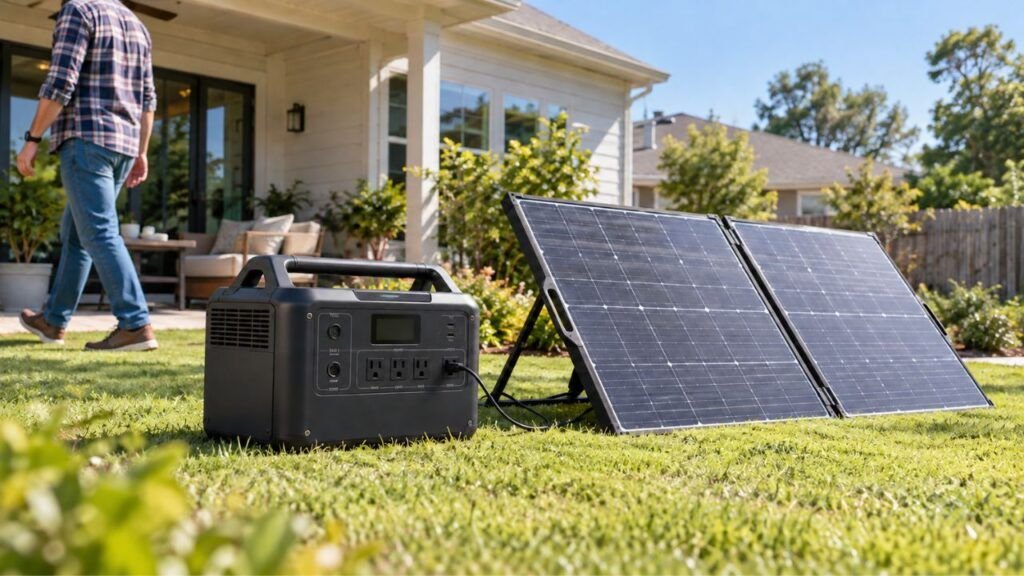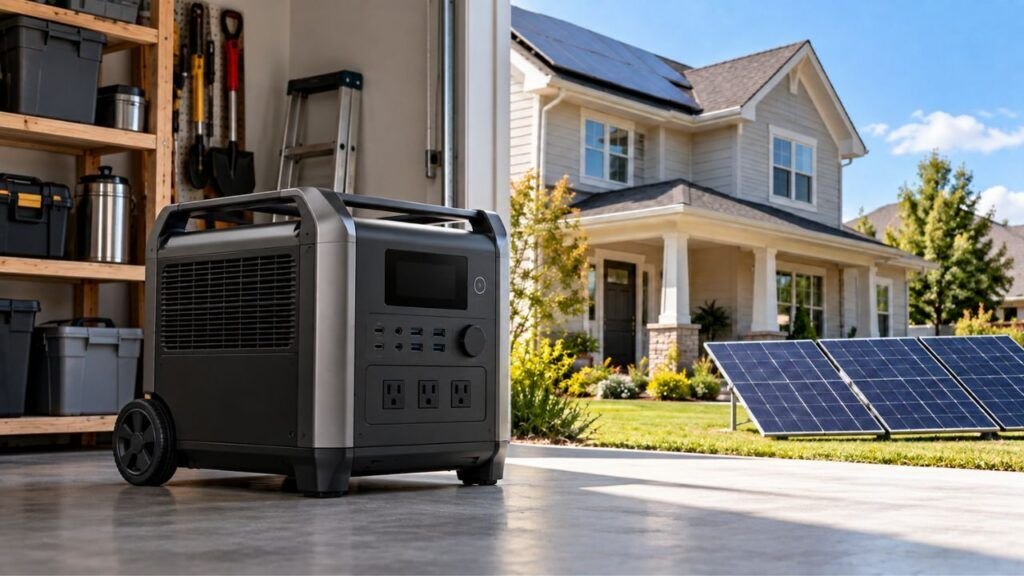
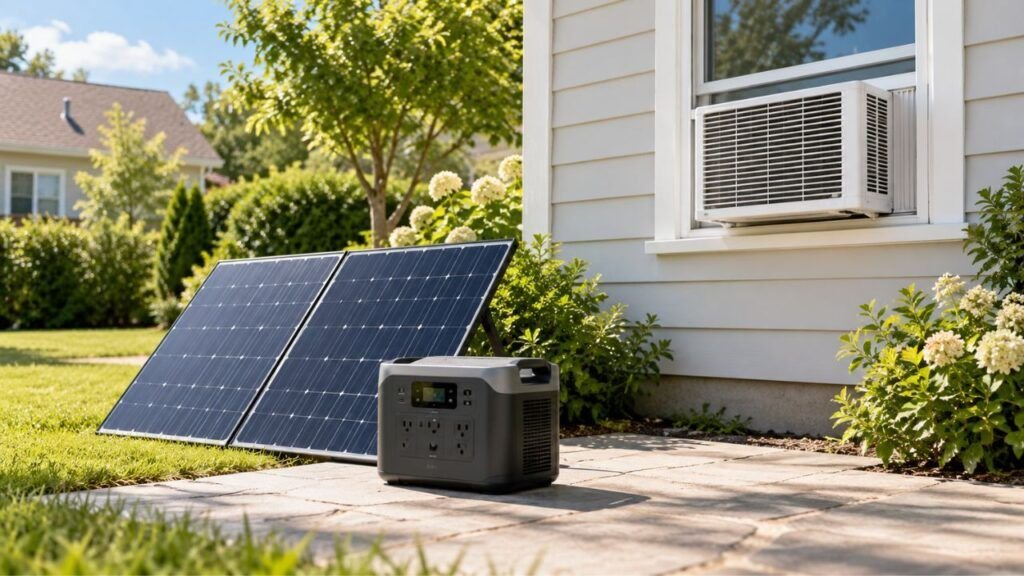
Most window air conditioners need a solar generator with roughly 1,500W to 3,000W of inverter output. Smaller 5,000 BTU units may need less, while larger 12,000 BTU units may need more. Battery capacity is separate and determines how long the AC runs.
The right size depends on your AC’s running watts, startup demand, voltage, and desired runtime. Below, I’ll help you check each number and choose a practical setup.
Key Takeaways
- Most window AC units fit within a 1,500W to 3,000W solar generator range.
- A 5,000 BTU window AC may work with a 1,200W to 1,800W unit.
- An 8,000 BTU AC often fits a 1,800W to 2,500W power station.
- Larger 12,000 BTU units may require 2,500W to 3,500W or more.
- Inverter watts determine whether the AC can start and run.
- Battery watt-hours determine how long the AC keeps running.
- Always check your specific AC instead of sizing by BTU alone.
What Size Solar Generator Do You Need for a Window AC?
Window AC power use varies considerably between models. The table below gives practical starting ranges, but your AC label should always take priority.
| Window AC Size | Typical Running Watts | Possible Startup Range | Solar Generator Output to Consider | Practical Battery Range |
| 5,000 BTU | 450-550W | 900-1,500W | 1,200-1,800W | 1,000-1,500Wh |
| 6,000 BTU | 500-650W | 1,000-1,600W | 1,500-2,000W | 1,000-2,000Wh |
| 8,000 BTU | 600-900W | 1,200-2,500W | 1,800-2,500W | 1,500-2,500Wh |
| 10,000 BTU | 700-1,100W | 1,500-3,000W | 2,000-3,000W | 2,000-3,000Wh |
| 12,000 BTU | 900-1,300W+ | 2,000-3,500W+ | 2,500-3,500W+ | 2,500-4,000Wh |
| 14,000 BTU+ | Model dependent | Model dependent | Usually 3,000W+ | 3,000Wh+ |
These figures are planning ranges rather than guaranteed requirements. Newer efficient models can use much less electricity than older units.
The safest approach is simple. Start with the table, then verify your AC’s actual electrical specifications.
Why Solar Generator Watts and Watt-Hours Are Different
Two numbers matter when you’re shopping for a solar generator. One tells you whether the AC can operate, while the other tells you how long it operates.
Continuous Output Determines Whether the AC Can Run
Continuous inverter output is measured in watts.
If your window AC uses 800W continuously, your generator must provide more than 800W.
I would avoid choosing an inverter that barely matches the load. Some extra headroom keeps the system from constantly operating near its limit.
For example, an 800W AC paired with a 2,000W inverter has comfortable operating headroom.
Surge Output Determines Whether the Compressor Can Start
A window AC compressor may briefly draw much more electricity when starting.
This startup spike is one reason a power station can shut down even when its continuous rating looks sufficient.
Suppose your AC runs at 700W but briefly needs 1,800W during startup. A 1,000W power station may handle the running load but fail when the compressor starts.
Conventional fixed-speed compressors generally create a larger startup spike. Variable-speed units usually ramp up more gradually.
Battery Capacity Determines Runtime
Battery capacity is measured in watt-hours, or Wh.
Think about the difference this way:
Watts tell you how much power is available right now.
Watt-hours tell you how much energy is stored for later.
A 2,000Wh battery does not automatically have a 2,000W inverter. Likewise, a 3,000W inverter does not guarantee several hours of cooling.
Always check both numbers.
Do Not Size a Solar Generator by BTU Alone
BTU tells you how much cooling an air conditioner can provide. It does not directly tell you how many electrical watts the AC consumes.
That distinction matters.
Two 8,000 BTU window air conditioners can use very different amounts of electricity. Their compressor technology, efficiency, fan design, and age can all change power consumption.
A newer variable-speed 8,000 BTU model may use much less average power than an older fixed-speed unit.
That means you should use BTU only for an initial estimate.
Before buying your solar generator, check the actual wattage, voltage, amperage, and startup requirements of your AC.
How to Find Your Window AC’s Real Power Requirements
Your AC itself is the best source for sizing information. Spend a few minutes checking its specifications before buying a power station.
Check the AC Nameplate or Owner’s Manual
Look for the specification label on the side, rear, or inside panel.
Check for:
- Rated watts
- Rated voltage
- Amps
- Frequency
- Plug type
- Starting amps
- Locked rotor amps, if listed
If watts are clearly listed, use that number as your starting point.
If you only see voltage and amperage, those values can help estimate the electrical load. However, measured wattage gives a better runtime estimate.
Use a Watt Meter for a Better Real-World Number
A plug-in watt meter can remove much of the guesswork.
Plug the AC into the meter and test it during warm weather. A hot afternoon gives you more useful results than a cool evening.
Try recording three numbers:
- Peak reading when the compressor starts
- Normal running wattage
- Total watt-hours used over several hours
The total energy reading is especially useful for battery sizing.
It accounts for compressor cycling and shows what the AC actually consumes over time.
Check Voltage Before Buying the Generator
Most smaller U.S. window air conditioners use standard 115V or 120V power.
However, some larger room air conditioners can require higher voltage or different outlet configurations.
A huge battery will not solve a voltage mismatch.
If your AC requires 240V, you need a power station designed to provide compatible 240V output.
Check Whether You Have a Fixed-Speed or Variable-Speed AC
This can change the sizing calculation considerably.
A traditional compressor generally switches between fully running and fully off. Each restart can create a noticeable power spike.
A variable-speed compressor adjusts its operating speed instead.
That usually means smoother startup behavior and lower average consumption after the room reaches the desired temperature.
For solar generator use, variable-speed AC units are often easier to support.
How Much Battery Capacity Do You Need?
Once you know the AC can start, the next question becomes runtime. This depends mainly on battery capacity and your AC’s average power use.
Use This Window AC Runtime Formula
A practical estimate is:
Runtime = Battery Capacity × 0.85 ÷ Average AC Watts
The 0.85 factor provides a planning allowance for inverter losses and unusable reserve capacity.
It is not a fixed number for every battery.
Different power stations have different conversion efficiencies and battery management limits.
For example, consider a 2,000Wh solar generator running an 800W AC:
2,000 × 0.85 = 1,700Wh usable
1,700 ÷ 800 = about 2.1 hours
That assumes the AC continuously draws 800W.
Real runtime can change once the thermostat begins cycling.
Window AC Runtime by Battery Size
The following estimates assume roughly 85% usable AC energy.
| Battery Capacity | 500W AC | 800W AC | 1,200W AC |
| 1,000Wh | About 1.7 hours | About 1.1 hours | About 0.7 hours |
| 2,000Wh | About 3.4 hours | About 2.1 hours | About 1.4 hours |
| 3,000Wh | About 5.1 hours | About 3.2 hours | About 2.1 hours |
| 5,000Wh | About 8.5 hours | About 5.3 hours | About 3.5 hours |
These calculations assume continuous power use.
Once a room becomes cool, the compressor may run less often. That can increase actual runtime.
Why Actual Runtime Can Be Longer or Shorter
Several real-world conditions affect how fast the battery drains.
A poorly insulated room may force the compressor to run almost constantly. The same AC may cycle much less often inside a shaded bedroom.
Outdoor temperature also matters.
During extreme summer heat, your air conditioner may work continuously. That makes the simple runtime calculation more realistic.
Other factors include thermostat settings, fan speed, direct sunlight, battery temperature, and additional appliances using the generator.
For emergency planning, I recommend sizing around demanding conditions rather than ideal ones.
Three Real-World Solar Generator Sizing Examples
Sizing becomes much easier when you work through actual numbers. Here are three simple examples using common window AC sizes.
Example 1: 5,000 BTU Window AC
Suppose your small bedroom AC uses 500W while running.
Its compressor briefly reaches around 1,200W during startup.
A solar generator with around 1,500W of inverter output would provide reasonable headroom.
Now consider runtime.
With a 1,000Wh battery:
1,000 × 0.85 = 850Wh usable
850 ÷ 500 = about 1.7 hours
A 2,000Wh battery could provide roughly 3.4 hours of continuous operation.
Thermostat cycling may extend those figures.
Example 2: 8,000 BTU Window AC
Now suppose your 8,000 BTU AC draws 750W.
Startup demand briefly reaches 1,900W.
I would look toward roughly a 2,000W to 2,500W solar generator instead of choosing one that barely clears the startup requirement.
With a 2,000Wh battery:
2,000 × 0.85 = 1,700Wh
1,700 ÷ 750 = about 2.3 hours
If the compressor averages only 60% duty after cooling the room, runtime could become considerably longer.
Example 3: 12,000 BTU Window AC
Imagine a larger window AC drawing 1,100W.
Its startup demand reaches around 2,800W.
A generator around the 3,000W class would make more sense here.
A 3,000Wh battery provides roughly:
3,000 × 0.85 = 2,550Wh
2,550 ÷ 1,100 = about 2.3 hours
A larger 5,000Wh system becomes more practical if you need several hours of cooling.
This is why inverter size and battery size must be considered separately.
How Much Solar Do You Need to Run a Window AC?
Solar panels can extend your cooling time significantly. However, panels do not automatically make the system run indefinitely.
Solar Panels Usually Extend Runtime, Not Replace the Battery
Suppose your AC consumes 800W.
Your solar panels are currently sending 400W into the power station.
The battery still needs to provide the remaining 400W.
Instead of draining at 800W, it drains at roughly 400W.
That can substantially extend runtime during good sunlight.
However, clouds, panel temperature, shade, and solar angle constantly change production.
Use Net Battery Drain to Estimate Runtime
The basic calculation is:
Net battery drain = AC consumption – actual solar input
Then:
Runtime = usable battery capacity ÷ net battery drain
Suppose you have:
- 800W AC load
- 350W actual solar input
- 2,000Wh battery
- About 1,700Wh usable capacity
Your battery supplies roughly:
800 – 350 = 450W
Then:
1,700 ÷ 450 = about 3.8 hours
Without solar charging, the same example would provide roughly 2.1 hours.
That’s a meaningful improvement.
Check the Generator’s Maximum Solar Input
Before adding more panels, check your power station’s solar charging specifications.
Look for:
- Maximum solar input wattage
- Solar input voltage range
- Maximum input current
- MPPT controller specifications
- Connector compatibility
- Supported panel configurations
A 1,200W solar array cannot provide 1,200W into a station limited to 500W of solar input.
The charging system always sets the limit.
Can You Run the Window AC While the Solar Generator Is Charging?
Yes, many modern solar generators can power appliances while charging from solar panels.
This setup is useful during daytime outages because incoming solar power reduces battery drain.
However, check your specific power station first.
Some systems have different output limits during pass-through operation. Others may reduce charging or output power when internal temperatures rise.
Also remember that incoming solar power constantly changes.
Your panels may produce strong output at noon but much less during morning, evening, clouds, or partial shade.
Treat solar input as support rather than guaranteed constant power.
Fixed-Speed vs Inverter Window AC: Which Is Better for Solar Power?
Compressor design can affect both startup demand and battery runtime. Variable-speed window units are generally easier to support with stored power.
| Feature | Conventional Window AC | Variable-Speed/Inverter Window AC |
| Compressor operation | Usually on or off | Adjusts operating speed |
| Startup demand | Often higher | Generally smoother |
| Power after room cools | Compressor cycles | Can reduce compressor speed |
| Battery efficiency | Moderate | Usually better |
| Generator sizing | More surge headroom helpful | Often easier |
| Noise level | Often louder during cycling | Usually smoother |
A variable-speed AC can reduce its power after reaching the thermostat setting.
That can make a major difference during a long outage.
However, you should still check the specific unit’s electrical requirements.
What Features Should a Solar Generator Have for a Window AC?
Choose the generator around your actual AC rather than focusing on one headline number.
Look for:
- Pure sine wave AC output
- Continuous inverter output above the AC load
- Enough startup capacity for the compressor
- Battery capacity matching your required runtime
- LiFePO4 battery chemistry for frequent cycling
- High solar charging input
- MPPT solar charging
- Expandable battery support when possible
- Correct outlet and voltage support
- Effective cooling and thermal management
- Pass-through charging support if required
Pure sine wave output is particularly important for compressor-based appliances.
It provides cleaner AC power and is generally the safer choice for modern electronics and motors.
Common Mistakes When Sizing a Solar Generator for Window AC
Most sizing mistakes happen because one important specification gets ignored.
Avoid these common problems:
- Looking only at running watts
- Ignoring compressor startup power
- Confusing inverter watts with battery watt-hours
- Choosing a generator only by AC BTU rating
- Treating total battery capacity as fully usable
- Assuming solar panels always produce rated output
- Forgetting refrigerators, fans, or lights sharing the generator
- Ignoring voltage and plug requirements
- Assuming extra batteries increase inverter power
- Testing the system only during mild weather
One point deserves extra attention.
Adding an expansion battery usually increases runtime.
It does not automatically increase inverter output.
If your generator cannot start the compressor, adding more battery capacity may not solve the problem.
How to Test Your Setup Before a Summer Power Outage
Do not wait for a 100°F afternoon and a grid outage to discover your setup cannot handle the AC. Test everything beforehand.
Test It During Hot Weather
An AC works much harder during extreme heat.
Testing during cooler weather can create an unrealistic impression of battery life.
Try the system during conditions similar to the weather you’re preparing for.
Test the Compressor Restart
Getting the AC to start once is not enough.
Allow the room to cool until the compressor shuts off.
Then wait for it to restart.
Repeat this process several times.
This tells you whether the generator can consistently handle compressor cycling.
Test With the Battery Partially Discharged
Do not perform every test with the battery at 100%.
Try operating the AC when the station reaches around 30% to 50%.
This gives you a better idea of how the system behaves later during an outage.
Measure Several Hours of Energy Use
A single wattage reading only shows one moment.
Run the AC for two or three hours and measure total energy consumption.
That gives you a much better average for battery calculations.
You can then divide your usable battery capacity by the measured hourly consumption.
When a Portable Solar Generator May Not Be Enough
Window air conditioners are generally easier to back up than central AC systems. However, some setups still push beyond typical portable power stations.
You may need a larger expandable system when:
- Your window AC requires 240V
- You have a very large room air conditioner
- You want to power multiple AC units
- You need overnight cooling
- Several appliances share the same power station
- You expect multi-day outages
- You need whole-home air conditioning
Running a refrigerator, freezer, lights, internet equipment, and an AC together can quickly change the calculation.
Always add those loads before choosing your generator.
For long outages, expandable batteries and higher solar charging capacity can become more important than simply buying a larger inverter.
Final Words
So, what size solar generator runs a window air conditioner?
For most common window AC units, a solar generator with roughly 1,500W to 3,000W of inverter output is the practical range. Smaller 5,000 BTU units may need less, while larger 12,000 BTU models can require 3,000W or more.
But inverter output is only half the decision.
You also need enough battery capacity for the hours you want cooling. A 1,000Wh battery may provide short emergency cooling, while 2,000Wh to 5,000Wh is more practical for extended use.
The easiest way to get this right is checking four things:
running watts, startup demand, battery capacity, and voltage.
Once those numbers match, your solar generator has a much better chance of starting the AC reliably and keeping your room comfortable during an outage.
Related FAQs
Will a 1,000W Solar Generator Run a Window Air Conditioner?
A 1,000W solar generator may run a very small and efficient window AC, but startup surge can cause problems. Check both the AC’s running watts and compressor startup demand before relying on it.
Will a 2,000W Solar Generator Run a Window AC?
Yes, a 2,000W solar generator can run many small and medium window air conditioners. Make sure its startup capability can handle the compressor and that its battery capacity meets your runtime needs.
What Size Solar Generator Do I Need for a 5,000 BTU Window AC?
A 5,000 BTU window AC often fits a 1,200W to 1,800W solar generator. Around 1,000Wh to 2,000Wh of battery capacity provides more useful emergency runtime.
What Size Solar Generator Do I Need for an 8,000 BTU Window AC?
Many 8,000 BTU window units work well with roughly 1,800W to 2,500W of inverter output. Check the exact startup demand because compressor designs vary considerably between models.
What Size Solar Generator Do I Need for a 10,000 BTU Window AC?
A 10,000 BTU window AC may need roughly a 2,000W to 3,000W solar generator. Battery capacity around 2,000Wh or more is more practical for several hours of cooling.
What Size Solar Generator Do I Need for a 12,000 BTU Window AC?
A 12,000 BTU window AC may require roughly 2,500W to 3,500W or more. Check the specific unit’s wattage, startup demand, voltage, and plug before choosing your generator.
How Long Will a 2,000Wh Solar Generator Run a Window AC?
A 2,000Wh solar generator may run a 500W AC for around 3.4 hours or an 800W AC for about 2.1 hours using conservative continuous-load estimates. Compressor cycling can extend runtime.
Can a Solar Generator Run a Window AC Overnight?
Yes, but overnight cooling usually needs substantial battery capacity. A small efficient AC may need roughly 4,000Wh to 5,000Wh or more for extended operation, depending on average consumption and thermostat cycling.
How Many Solar Panels Do I Need to Run a Window Air Conditioner?
The answer depends on your AC’s average power consumption and your power station’s solar input limit. Several hundred watts of panels can extend runtime, while near-continuous daytime cooling may require a much larger array.
Can I Run a Window AC While Charging the Solar Generator?
Many solar generators support simultaneous charging and AC output. Check your power station’s pass-through charging limits because some models reduce charging or output under certain operating conditions.
Does a Window AC Need a Pure Sine Wave Solar Generator?
A pure sine wave inverter is strongly preferred for window air conditioners. It provides clean AC power suitable for compressor motors, fans, and modern electronic controls.
Does an Inverter Window AC Use Less Power From a Solar Generator?
An inverter or variable-speed window AC can often use less average power after reaching the desired temperature. Its smoother compressor operation can also reduce the startup challenge for a solar generator.
Can Adding an Extra Battery Help My Solar Generator Start the AC?
Usually, an extra battery increases runtime rather than inverter output. If your generator cannot handle the compressor startup demand, adding battery capacity alone may not solve the problem.
Does a Soft Start Help a Solar Generator Run a Window AC?
A compatible soft-start device can reduce startup demand on some compressor systems. However, not every window AC supports one, so check the AC manufacturer’s recommendations before considering a modification.

Blake Cooper writes practical guides on generators, portable power stations, and home backup systems. He focuses on simplifying power topics and helping homeowners make informed buying decisions.