Yes, you can safely use a solar generator indoors because it runs on stored battery power instead of burning gasoline, propane, or diesel. That means it does not produce carbon monoxide or engine exhaust during normal operation. However, you still need to keep the unit dry, allow cooling airflow, stay within its power limits, and follow the manufacturer’s safety instructions.
In this guide, I’ll explain why solar generators are different from fuel generators, where you can place one indoors, what risks still matter, and how to use one safely during a power outage.
Key Takeaways
- Solar generators generally work safely indoors because they do not burn fuel.
- They do not produce carbon monoxide during normal battery operation.
- Cooling vents still need open space around them.
- Keep the unit away from water, heat, and combustible materials.
- Never exceed the generator’s continuous or surge output rating.
- Solar panels normally stay outdoors while the battery unit remains indoors.
- Stop using the unit if you notice swelling, smoke, unusual heat, or strange odors.
Can You Safely Use a Solar Generator Indoors?
Yes, most portable solar generators can be used safely inside a home when operated correctly.
A solar generator is essentially a large rechargeable battery combined with an inverter, charge controller, outlets, and safety electronics. It stores electricity and sends that stored power to your appliances when needed.
There is no engine running inside the unit. There is also no gasoline or propane being burned.
That makes it very different from a traditional portable generator.
However, I would not describe any battery system as completely risk-free. You still need to think about heat, water, electrical loads, battery condition, and proper placement.
The easiest rule to remember is this:
A solar generator does not need exhaust ventilation, but it still needs cooling airflow.
Why Are Solar Generators Safer Indoors Than Gas Generators?
Solar generators and gas generators can both provide backup electricity, but they create power in completely different ways. That difference is the main reason one can usually operate indoors while the other cannot.
No Fuel Is Burned
A gasoline or propane generator creates electricity by running an internal combustion engine.
A solar generator does not.
Instead, electricity is stored inside its battery before being delivered through the inverter to your devices.
Because nothing is being burned, you do not have combustion gases building up inside your home.
They Do Not Produce Carbon Monoxide
Carbon monoxide is one of the biggest dangers associated with portable fuel generators.
You cannot see it or smell it, which makes indoor generator use particularly dangerous.
A battery-powered solar generator does not create carbon monoxide during normal charging or discharging because there is no combustion process involved.
That is why you can keep the battery power station inside while using it during an outage.
There Is No Engine Exhaust
Traditional generators also produce hot exhaust gases.
A solar generator has no exhaust pipe because there is no engine.
You may feel warm air coming from cooling vents or hear internal fans running, but that is normal heat management rather than combustion exhaust.
They Are Much Quieter Indoors
Solar generators are also much quieter than conventional portable generators.
Many units remain almost silent under light loads.
Cooling fans may turn on while fast charging or powering high-wattage appliances, but the noise is usually much lower than an outdoor engine generator.
| Safety Factor | Solar Generator | Gas or Propane Generator |
| Burns fuel | No | Yes |
| Produces carbon monoxide | No during normal battery operation | Yes |
| Engine exhaust | No | Yes |
| Indoor use | Generally suitable when used correctly | Never recommended indoors |
| Cooling airflow needed | Yes | Yes |
| Fuel storage required | No | Yes |
| Main noise source | Cooling fans | Combustion engine |
| Main concerns | Battery, heat, moisture, electrical load | Carbon monoxide, exhaust, fuel, fire |
What Are the Real Risks of Using a Solar Generator Indoors?
Solar generators remove the carbon monoxide risk associated with fuel generators, but they are still powerful electrical devices containing large batteries. Here are the risks I would pay attention to.
Battery Overheating and Thermal Problems
Modern solar generators normally include a Battery Management System, or BMS.
The BMS monitors things such as voltage, temperature, current, charging conditions, and battery status.
If something moves outside a safe range, the system may reduce output or shut the unit down.
That is useful protection, but it does not mean you should ignore overheating.
If the power station becomes unusually hot, produces a strange smell, starts swelling, or shows repeated temperature warnings, stop using it.
Blocked Cooling Vents
Your solar generator creates heat while charging and delivering power.
Higher loads generally create more heat.
Most units use vents and internal fans to move that heat away from important components.
Do not push the generator tightly against a wall, hide it behind furniture, place clothes over it, or operate it under blankets.
Give the vents enough room to breathe according to the manufacturer’s instructions.
Water and Moisture
Electricity and water are never a good combination.
Keep your solar generator away from:
- Sinks
- Showers
- Bathtubs
- Leaking windows
- Wet basement floors
- Standing water
- Heavy condensation
A solar panel may be designed for outdoor conditions while the power station itself has much less water protection.
Always check the rating of your specific unit.
Electrical Overloading
Every solar generator has a maximum AC output.
For example, a unit rated for 1,800 watts should not be expected to continuously power appliances drawing much more than that.
Some appliances also require a brief surge of extra power when starting.
Refrigerators, pumps, air conditioners, and compressors are common examples.
Check both continuous wattage and startup wattage before connecting demanding appliances.
Damaged Batteries or Cables
Do not continue using a unit that has obvious physical damage.
Watch for:
- Cracked casing
- Swollen battery housing
- Bent or damaged charging ports
- Burn marks
- Frayed cables
- Melted connectors
- Strong chemical smells
- Smoke
- Abnormal heat
I would also check whether an older or unfamiliar power station has been recalled before relying on it regularly.
How to Use a Solar Generator Indoors Safely
You do not need a complicated setup. A few basic habits can make indoor use much safer.
- Place the generator on a stable, hard, level surface.
- Keep all cooling vents unobstructed.
- Leave the airflow clearance recommended by the manufacturer.
- Keep the unit away from water and damp areas.
- Avoid heaters, radiators, fireplaces, and direct heat sources.
- Keep it within the recommended operating temperature range.
- Inspect the power station before using it.
- Stop using a swollen, cracked, leaking, or unusually hot unit.
- Keep appliance loads below the rated continuous output.
- Consider startup surge when powering motors or compressors.
- Use compatible charging cables and accessories.
- Follow the manual before using pass-through charging.
- Keep blankets, clothing, curtains, and papers away from vents.
- Never attempt to power your home’s wiring through a regular wall outlet.
- Check the display occasionally for temperature or overload warnings.
You do not need to watch the unit every second, but I would avoid treating it like an appliance you can completely forget about.
Does a Solar Generator Need Ventilation Indoors?
A solar generator does not need ventilation to remove carbon monoxide or exhaust because it does not burn fuel.
However, it still needs normal airflow for cooling.
That distinction is important.
You do not usually need to open a window simply because a battery power station is operating in the room. You do need to make sure warm air can leave the unit and cooler room air can reach its vents.
Avoid closed cabinets, sealed storage boxes, tight shelves, and other spaces where heat can accumulate.
Think of ventilation here as cooling, not exhaust removal.
Where Should You Put a Solar Generator Indoors?
You have several good indoor placement options, but the best location is always dry, stable, cool, and open enough for airflow.
Living Room or Home Office
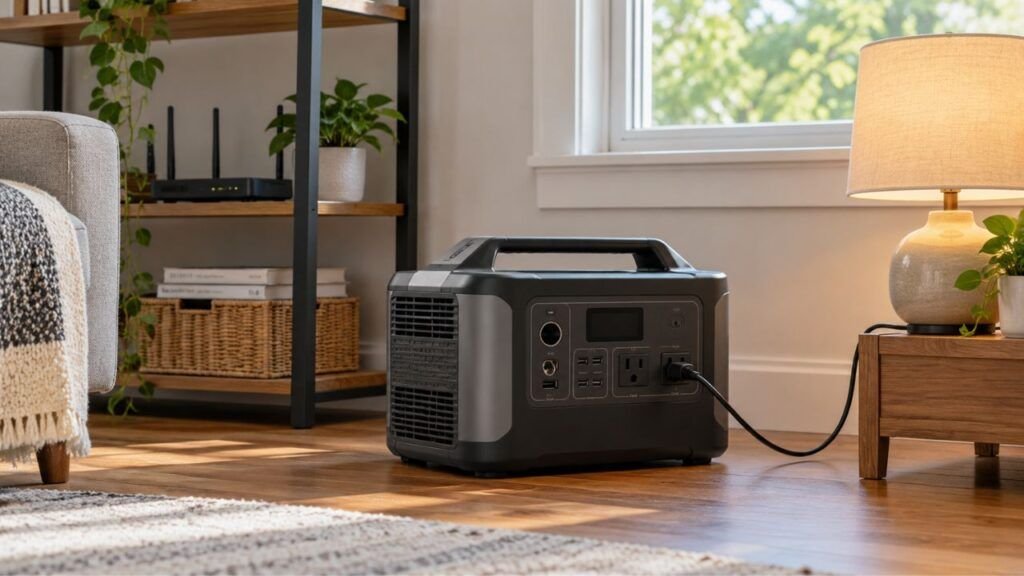
A living room or home office can work well during an outage.
You might place the power station on a hard floor or sturdy table while running:
- Wi-Fi equipment
- Laptops
- Monitors
- Lamps
- Televisions
- Phone chargers
Just keep the cooling vents clear and make sure cables do not create a trip hazard.
Bedroom
A solar generator can generally operate in a bedroom because it does not release engine exhaust.
However, I would never place it on a bed or cover it with bedding.
Put it on a solid surface where airflow is not blocked.
If you are powering equipment overnight, check the expected runtime beforehand so you know whether the battery has enough capacity.
Basement
A basement can be a suitable location if it stays dry.
The biggest concern is moisture.
If your basement sometimes floods, has standing water, or develops heavy condensation, keep the unit raised and away from those areas.
You should also make sure the temperature stays within the manufacturer’s operating range.
Garage
A garage can work for some portable power stations, but conditions matter.
Avoid placing the unit:
- Near gasoline containers
- Beside running vehicles
- On wet floors
- In extreme summer heat
- In temperatures below its rated range
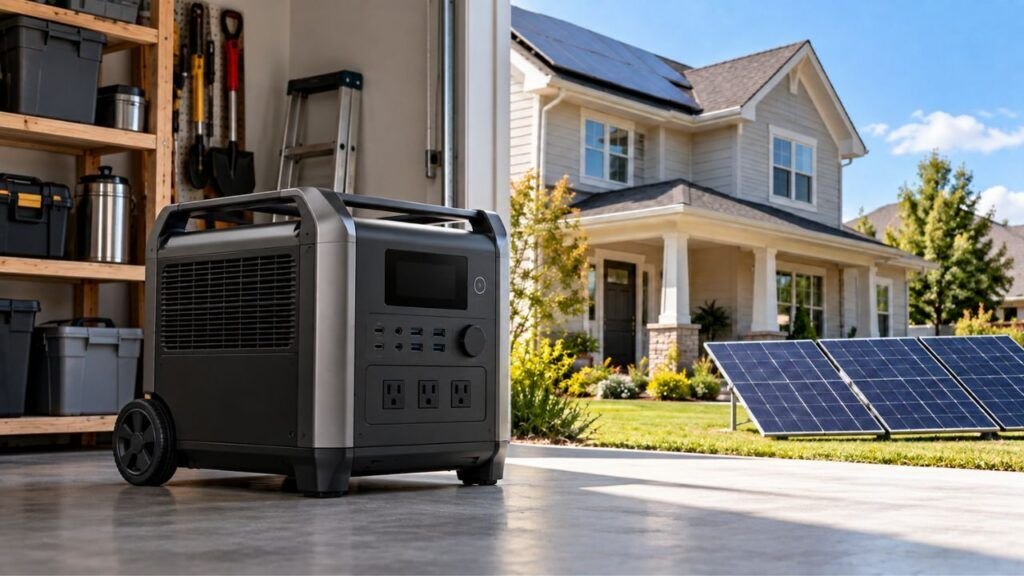
A climate-controlled or dry attached garage may work much better than an uninsulated garage exposed to extreme temperatures.
Apartment or Condo
Solar generators can be especially useful in apartments because running a gasoline generator outside may not be practical.
A portable power station can keep small essentials operating during an outage without producing engine fumes.
However, very large permanent battery systems are a different category. Those may have additional building, electrical, or installation requirements.
Should the Solar Panels Stay Outside?
In most situations, yes.
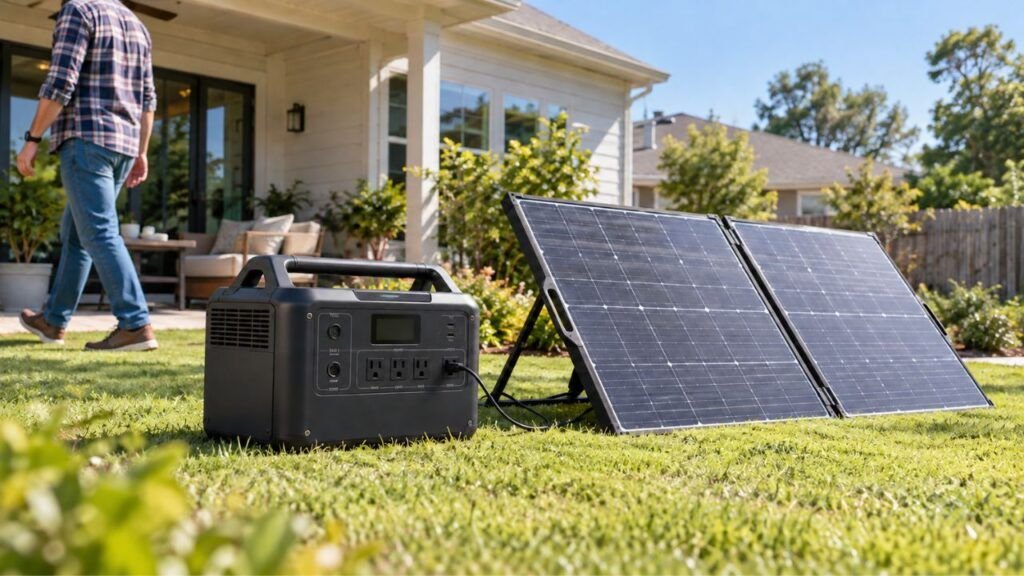
The normal setup is simple: your solar panels stay outside where they receive strong sunlight, while the battery power station stays indoors.
You can then connect the panels to the generator using a compatible solar charging cable.
For the best setup:
- Place the panels outdoors in direct sunlight.
- Keep the power station inside in a dry location.
- Use the correct solar charging cable.
- Avoid pinching the cable in doors or windows.
- Keep cables away from walkways when possible.
Some solar panels will produce electricity behind a window, but output can drop because of glass, coatings, poor angles, shadows, and limited exposure.
If you want faster solar charging, putting the panels outside is usually the better choice.
Can You Charge and Use a Solar Generator Indoors at the Same Time?
Many modern solar generators can charge while powering appliances, but you should confirm that your specific model supports this feature.
Pass-Through Charging
Pass-through charging means the power station can receive electricity while also supplying power to connected devices.
For example, you might recharge the battery from a wall outlet while your Wi-Fi router and laptop remain connected.
Some models support this very well. Others have restrictions.
Always check the manual before relying on it.
Why Heat Can Increase
Charging the battery generates heat.
Running appliances through the inverter also generates heat.
Doing both at the same time can make the internal cooling system work harder.
You may hear the fans running more frequently, especially under heavy loads.
That is another reason to keep the vents clear.
UPS Mode Is Different
Some power stations offer a dedicated UPS or backup function.
This can keep certain devices running when grid power suddenly disappears.
However, not every portable power station has the same transfer time or UPS capabilities.
If you need uninterrupted power for sensitive equipment, check the specifications rather than assuming every solar generator works like a true UPS.
What Appliances Can You Safely Run Indoors?
A solar generator can power many normal household devices as long as the appliance stays within the power station’s output limit.
Good Everyday Loads
Common options include:
- Wi-Fi routers
- LED lights
- Phones
- Tablets
- Laptops
- Desktop computers
- Televisions
- Fans
- Refrigerators
- Small electronics
These loads are often practical during a normal outage.
High-Wattage Loads Need More Attention
You need to check wattage more carefully with:
- Space heaters
- Microwaves
- Coffee makers
- Hair dryers
- Portable air conditioners
- Sump pumps
- Well pumps
- Power tools
- Electric cooking appliances
These devices are not necessarily unsafe.
They simply consume much more power.
For example, a space heater can drain a medium-sized battery quickly even if the solar generator technically has enough inverter capacity to run it.
Always check both wattage and expected runtime.
Can You Use a Solar Generator for a CPAP or Medical Device Indoors?
A solar generator can power many CPAP machines and other small medical devices, but you should verify compatibility before relying on it.
Check the device’s required wattage, voltage, plug type, expected overnight runtime, and whether the manufacturer recommends pure sine wave AC power.
If the device needs uninterrupted electricity, also check the solar generator’s UPS transfer time.
I would also keep extra battery capacity available rather than planning to drain the power station completely.
For critical medical equipment, follow the equipment manufacturer’s backup recommendations and maintain an additional emergency power plan where necessary.
Is LiFePO4 Safer for Indoor Solar Generators?
LiFePO4, also called LFP or lithium iron phosphate, is widely used in modern portable power stations.
One reason is its strong thermal stability compared with several older lithium-ion chemistries.
That can make it a good choice for a battery expected to sit inside a home for years.
However, I would not judge safety based on battery chemistry alone.
You should also consider:
- Battery cell quality
- BMS protection
- Pack construction
- Cooling design
- Charging system
- Product certification
- Manufacturer reputation
- Physical condition
LiFePO4 is a useful safety advantage, but proper engineering around the battery still matters.
What Safety Certifications Should You Look For?
Certifications can give you another way to evaluate a power station instead of relying only on advertising claims. Large battery systems and small portable power stations may fall under different standards.
UL 2743 for Portable Power Packs
UL 2743 is commonly associated with portable power packs.
When shopping, look for legitimate safety testing or certification from recognized testing organizations.
A product displaying a familiar safety mark should still be used according to the manufacturer’s instructions.
Certification does not make poor placement or misuse harmless.
UL 9540 for Installed Battery Energy Storage
UL 9540 generally applies to larger energy storage systems rather than normal plug-and-play portable power stations.
If you are installing a permanently connected whole-home battery system, you are dealing with a different category of equipment.
Electrical codes, installation requirements, and professional installation may apply.
Why a BMS Alone Is Not Enough
A BMS is important, but almost every modern battery product can advertise some form of battery management.
What matters is how well the complete system is designed.
Think of BMS protection as one part of the safety system, not proof that every portable power station is equally well built.
Can You Connect a Solar Generator Directly to Your Home?
You should not connect a portable solar generator to a normal household wall outlet in an attempt to send electricity backward through your home’s wiring.
That practice is commonly called backfeeding and can create serious electrical hazards.
The safest basic setup is to plug appliances directly into the solar generator.
Some larger systems support approved home-backup panels, transfer equipment, or manufacturer-designed connections.
Those systems should be installed and used exactly as intended.
If you want your solar generator to power household circuits rather than individual appliances, use equipment designed for that purpose.
When Should You Not Use a Solar Generator Indoors?
Do not continue using the unit when:
- The manufacturer prohibits the intended location.
- The battery housing is swollen.
- The enclosure is cracked.
- The generator has suffered major impact damage.
- You see smoke.
- You notice an unusual chemical or burning smell.
- The unit becomes abnormally hot.
- The product is under an unresolved safety recall.
- Charging ports are damaged.
- Cables are frayed or melted.
- The unit has been exposed to flooding.
- Water has entered the enclosure.
- Cooling vents cannot remain open.
- Room temperature is outside the rated operating range.
- Your connected load exceeds the rated output.
If something feels clearly abnormal, do not keep pushing the unit simply because it still produces power.
Solar Generator Indoor Safety: Simple Setup Example
If you are preparing for an outage, your setup can be straightforward:
- Put the solar generator on a hard, stable indoor surface.
- Make sure every cooling vent has open space around it.
- Place the solar panels outside if you plan to recharge from sunlight.
- Route the solar cable indoors without pinching or damaging it.
- Check the running and starting wattage of your appliances.
- Connect essential devices directly to the solar generator.
- Watch the display for battery level, power draw, and warnings.
- Stop using the unit if you notice unusual heat, swelling, odor, smoke, or repeated error messages.
That is usually all you need for a simple indoor backup setup.
Final Words
Yes, you can safely use a solar generator indoors when it is a battery-based power station designed for that purpose.
The biggest advantage is simple: there is no gasoline engine creating carbon monoxide inside your home.
Still, I would treat it like any high-capacity battery system. Keep it dry, give it room to cool, stay within its power limits, inspect it for damage, and follow the manufacturer’s instructions.
If you remember one rule, make it this: keep the battery power station indoors when appropriate, but keep fuel-burning generators outdoors.
Related FAQs
Does a Solar Generator Produce Carbon Monoxide?
No. A battery-powered solar generator does not produce carbon monoxide during normal operation because it does not burn gasoline, propane, diesel, or another fuel.
Do Solar Generators Need an Open Window Indoors?
Usually no. You do not need an open window for exhaust removal, but the solar generator still needs enough surrounding airflow to cool itself properly.
Can You Use a Solar Generator in a Bedroom?
Yes, you can generally use a portable solar generator in a bedroom if the manufacturer permits indoor use. Keep it on a hard surface with clear vents and away from bedding, water, and heat sources.
Can You Sleep in the Same Room as a Solar Generator?
Generally, yes. A properly functioning battery power station does not create combustion fumes, but you should still place it safely and make sure its vents are not blocked.
Can You Use a Solar Generator in an Apartment?
Yes. Portable solar generators can be useful apartment backup solutions because they do not require gasoline or produce engine exhaust during normal operation.
Can You Use a Solar Generator in a Garage?
Yes, if the garage stays dry and within the generator’s operating temperature range. Keep the unit away from fuel containers, water, vehicle exhaust, and extreme heat or cold.
Can You Charge a Solar Generator Indoors Overnight?
Many models can be charged indoors, but follow the manufacturer’s charging instructions. Keep the unit on a stable surface with clear ventilation and stop charging if you notice unusual heat, odor, swelling, or warnings.
Can Solar Panels Charge a Generator Through a Window?
They can sometimes produce electricity through a window, but output is usually lower. For faster charging, place the solar panels outdoors in direct sunlight whenever possible.
Can You Plug a Power Strip Into a Solar Generator?
Some solar generators can support a power strip, but the combined load must stay below the generator’s rated output. Avoid daisy-chaining multiple power strips or overloading the unit.
Can You Run a CPAP Machine From a Solar Generator?
Yes, many solar generators can run a CPAP machine. Check the CPAP’s power requirements, expected runtime, plug type, and whether your power station provides the correct output before relying on it overnight.

Blake Cooper writes practical guides on generators, portable power stations, and home backup systems. He focuses on simplifying power topics and helping homeowners make informed buying decisions.