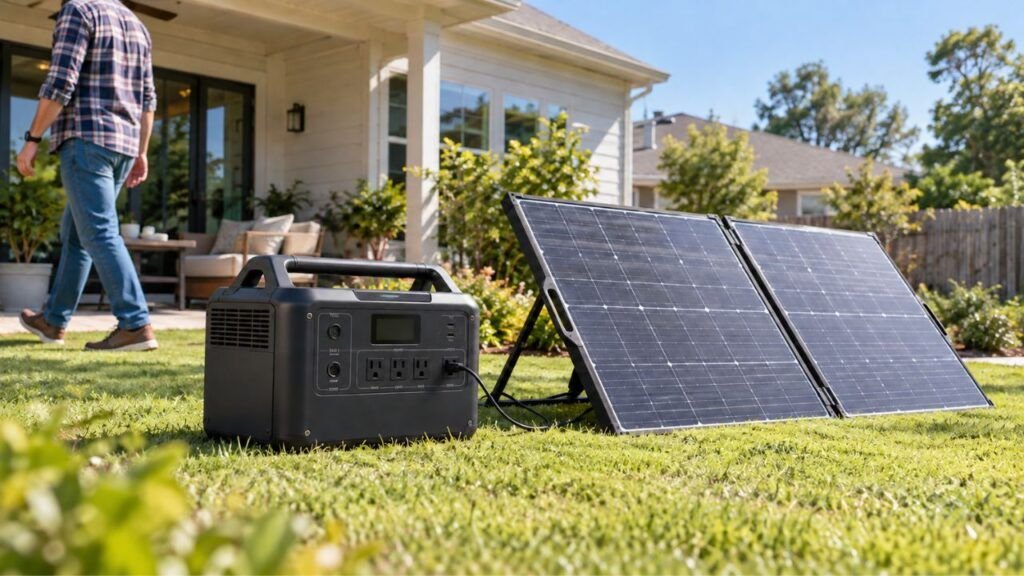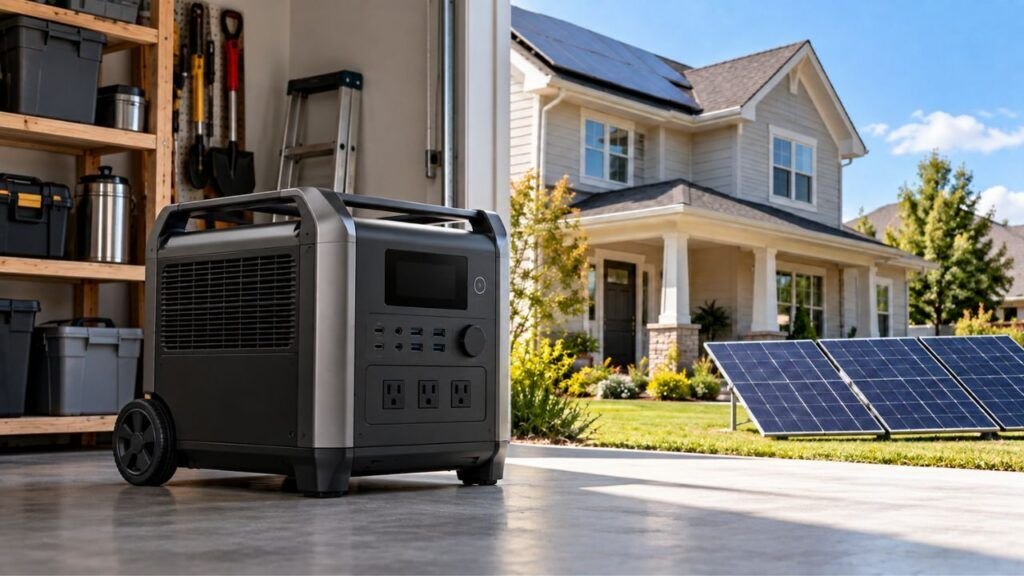
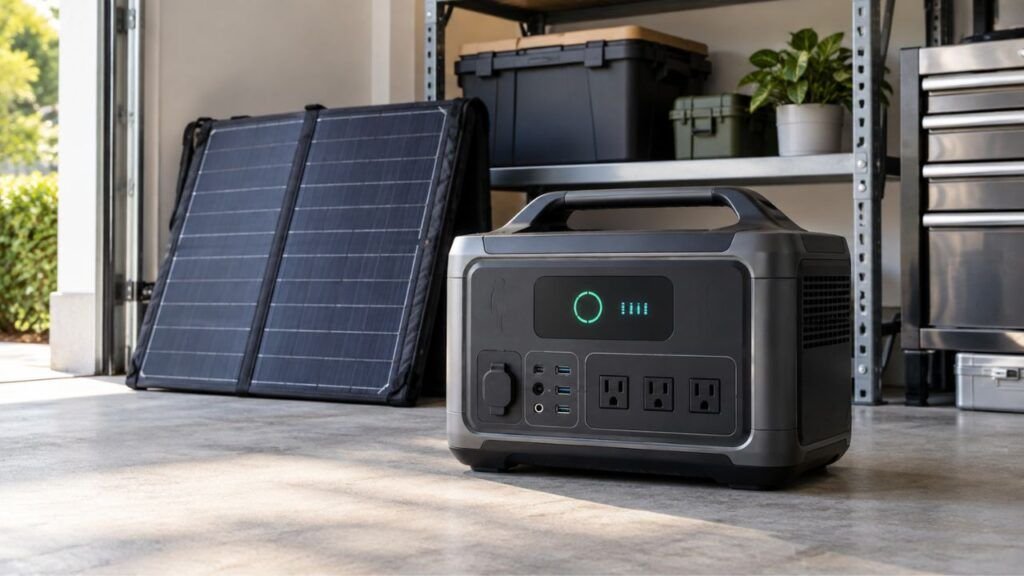
You should keep a solar generator fully charged when you expect to need maximum backup power soon. However, keeping it at 100% continuously during long-term storage is usually unnecessary and can increase battery aging over time.
The best charging approach depends on how you use your generator. Below, I’ll explain daily charging, emergency readiness, storage levels, battery chemistry, charge limits, and simple habits that can help your battery last longer.
Key Takeaways
- Charging to 100% is perfectly reasonable before an outage or trip.
- Long-term storage at 100% is generally not ideal for lithium batteries.
- Storage charge recommendations differ between manufacturers and models.
- A Battery Management System helps prevent dangerous overcharging.
- BMS protection does not completely prevent normal battery aging.
- Heat can accelerate battery degradation, especially at high charge levels.
- Avoid storing your solar generator completely discharged for long periods.
- Follow your specific owner’s manual for long-term storage recommendations.
- An 80% charging limit can help with frequent everyday use.
- Maximum charge makes more sense when backup runtime matters most.
Should You Keep a Solar Generator at 100%?
You do not need to keep your solar generator at 100% constantly. Whether a full charge makes sense depends mainly on when you expect to use the stored energy.
If severe weather is approaching, I would rather have maximum available battery capacity. The same applies before camping, RV travel, or a planned off-grid trip.
Long-term storage is different.
A lithium battery sitting unused at maximum charge experiences more chemical stress than one stored at a moderate state of charge. That does not mean reaching 100% immediately damages your battery.
The real concern is leaving it fully charged unnecessarily for weeks or months.
Think of 100% as a useful tool rather than a required setting. Use the entire battery when you need maximum runtime. Give the battery an easier storage environment when you do not.
Best Charge Level for a Solar Generator by Use Case
There is no single charge percentage that works for every situation. Your priority changes depending on whether you need readiness, convenience, or longer battery life.
| How You Use Your Solar Generator | Practical Charging Approach | Main Priority |
| Daily or frequent use | Recharge when needed and consider charge limits | Convenience and battery health |
| Emergency home backup | Keep near full when outage risk increases | Maximum backup runtime |
| Before camping | Charge to 100% shortly before leaving | Maximum available capacity |
| Before RV travel | Charge fully before your trip | Reliable off-grid power |
| Occasional weekend use | Recharge after use without constantly maintaining 100% | Convenience |
| Storage for several weeks | Follow manufacturer storage guidance | Reduced battery aging |
| Storage for several months | Use manufacturer-recommended storage SOC | Long-term battery health |
| Severe weather season | Maintain higher charge when outages are likely | Emergency readiness |
The most important point is simple. Do not assume every solar generator should be stored at exactly 50%, 60%, or 80%.
Manufacturers use different battery cells, BMS settings, charging controls, and storage procedures. Your owner’s manual should always take priority.
Why Keeping a Lithium Battery at 100% Can Increase Aging
Lithium batteries slowly change chemically even when you are not using them. Keeping them at high charge levels for long periods can increase this natural aging process.
High State of Charge Increases Calendar Aging
Battery degradation does not happen only when you charge and discharge.
Lithium batteries also experience something called calendar aging. That simply means the battery gradually loses capacity while sitting unused.
Higher states of charge can increase stress inside lithium cells. The effect becomes more important when the battery remains full for long periods.
That is why storing a solar generator at 100% for months is different from charging it fully before an outage.
One is short-term preparation.
The other keeps the battery under unnecessary high-voltage conditions for much longer.
Heat Makes High Charge Levels More Stressful
Temperature is another major factor affecting battery life.
A fully charged battery stored inside a climate-controlled room faces very different conditions from one sitting inside a hot vehicle.
Heat speeds up unwanted chemical reactions inside lithium batteries. Combining high temperatures with a high state of charge can increase battery aging further.
Avoid storing your power station in places like:
- A hot parked vehicle
- An attic during summer
- Direct sunlight
- A poorly ventilated shed
- Near a furnace or heater
- Beside other heat-producing equipment
A cool, dry environment is usually much easier on the battery.
Battery Aging Is Gradual, Not Immediate
Charging your solar generator to 100% will not suddenly ruin it.
Modern portable power stations are designed to reach full charge. Manufacturers expect people to use their full advertised battery capacity.
Problems usually come from repeated long-term habits rather than one charging session.
If you charge fully before a storm, use the generator, and recharge afterward, that is normal use.
There is little reason to avoid 100% when that extra capacity matters.
Does the BMS Protect a Fully Charged Solar Generator?
Modern solar generators typically use a Battery Management System, commonly called a BMS. It continuously monitors important battery conditions and helps keep operation within safe limits.
A BMS commonly monitors:
- Individual cell voltage
- Battery pack voltage
- Charging current
- Discharging current
- Battery temperature
- Overcharge conditions
- Excessive discharge
- Short circuits
- Other abnormal operating conditions
When your display reaches 100%, the charging system does not simply keep forcing unlimited energy into the cells.
The BMS and charging electronics control what happens next. Charging current is reduced or stopped according to the battery’s programmed limits.
That makes modern solar generators much safer than an unmanaged battery.
However, there is an important distinction.
Overcharge protection is not the same thing as preventing battery aging.
Your BMS protects the battery from operating beyond safe limits. It cannot completely eliminate chemical aging caused by time, temperature, and high state of charge.
So, seeing 100% on the display is normally safe. Keeping the battery there unnecessarily for months is a separate battery-health question.
LiFePO4 vs. Lithium-Ion: Does Battery Type Change the Answer?
Battery chemistry matters because different lithium batteries respond differently to charging, storage, temperature, and repeated cycling.
| Factor | LiFePO4 (LFP) | NMC Lithium-Ion |
| Typical cycle durability | Generally very high | Generally lower than LFP |
| High-charge tolerance | Usually more tolerant | Often more sensitive |
| Charging to 100% | Fine when needed | Fine when needed |
| Long-term storage | Partial charge commonly recommended | Partial charge commonly recommended |
| Heat resistance | Generally better thermal stability | More sensitive to excessive heat |
| Best approach | Follow model-specific guidance | Follow model-specific guidance |
LiFePO4 Solar Generators
LiFePO4 batteries have become common in modern portable power stations.
They are popular because they typically offer long cycle life, good thermal stability, and strong durability during repeated charging.
That makes LFP particularly suitable for home backup and frequent use.
Still, durable does not mean indestructible.
An LFP battery can still experience calendar aging. Heat and prolonged high charge levels can still affect long-term capacity.
You therefore should not assume an LFP solar generator must remain at 100% constantly.
NMC Lithium-Ion Solar Generators
Many older or lightweight portable power stations use NMC-based lithium batteries.
NMC batteries offer excellent energy density. Manufacturers can fit considerable capacity into a relatively compact power station.
However, these batteries can be somewhat more sensitive to high state of charge and elevated temperatures.
If your generator allows adjustable charging limits, using something below 100% during routine use may help reduce unnecessary battery stress.
Charge it fully again whenever you need maximum runtime.
What Percentage Should You Store a Solar Generator At?
Most lithium solar generators should be stored at a moderate charge rather than completely full or completely empty. However, the correct percentage varies between manufacturers.
Some manufacturers recommend around 40% to 60%. Others suggest roughly 50% to 80%, while certain products specify their own maintenance procedure.
That variation is why I would not give every reader one universal storage percentage.
| Situation | Practical Approach |
| Manufacturer specifies 40% to 60% | Use that range |
| Manufacturer recommends around 60% | Store near that level |
| Manufacturer recommends 50% to 80% | Stay within its stated range |
| Manual gives a maintenance cycle | Follow that procedure |
| Guidance differs between models | Follow your exact model’s manual |
| No guidance is available | Avoid 0% and prolonged 100% storage |
If you remember only one thing from this section, remember this:
Your solar generator’s owner’s manual should override a generic charging rule found online.
The manufacturer knows the cell chemistry, BMS calibration, standby consumption, and charging system inside your specific unit.
When Keeping Your Solar Generator Fully Charged Makes Sense
Keeping your solar generator at 100% is not always something you should avoid. There are several situations where maximum stored energy is more important than minimizing battery aging.
Before a Power Outage or Severe Weather
If a hurricane, thunderstorm, winter storm, or other severe weather event is approaching, charge your generator completely.
During an outage, every extra watt-hour can matter.
A fully charged generator can provide longer runtime for refrigerators, routers, lighting, phones, medical equipment, and other essential devices.
Battery longevity matters, but emergency preparedness comes first when an outage appears likely.
Before Camping or RV Travel
Charge your solar generator to 100% before leaving for camping or RV travel.
You may not know how much sunlight will be available later. Clouds, shade, poor panel positioning, or short winter days can reduce solar charging.
Starting with a full battery gives you more flexibility.
You can then use solar panels during the trip to replace consumed energy.
When You Depend on It for Critical Backup Power
Some households keep a portable power station ready for important electronics.
Examples include:
- Internet equipment
- Phones
- Refrigerators
- Freezers
- Lights
- Communication devices
- Compatible medical equipment
When dependable backup capacity matters, keeping the battery near full can be a reasonable tradeoff.
Just make sure your equipment stays within the generator’s output limits.
When It Is Designed for Standby or UPS Use
Some modern solar generators provide UPS or EPS functionality.
These systems may remain connected to utility power while supplying backup energy automatically during an outage.
If your manufacturer specifically supports this type of operation, continuous connection may be part of the intended design.
Still, check your model’s manual.
Not every solar generator supports permanent standby operation in exactly the same way.
When You Should Avoid Leaving It at 100%
Keeping the battery full becomes less useful when you have no reason to use the stored energy soon.
Consider reducing the charge level when:
- The unit will remain unused for several months.
- You are putting it away after camping season.
- Maximum emergency readiness is unnecessary.
- The generator will be stored somewhere relatively warm.
- Your app provides a lower routine charging limit.
- Your manufacturer specifically recommends partial-charge storage.
- You have another dedicated emergency backup system available.
Again, duration matters.
Leaving a generator at 100% overnight is very different from leaving it untouched for six months.
Fully Charged and Plugged In Are Not the Same Thing
These two ideas are often treated as the same thing, but they are different.
A solar generator can reach 100%, finish charging, and then be disconnected from the wall.
Another generator may stay connected to AC power continuously while operating as backup power.
The second situation depends heavily on the product’s design.
Modern units usually control charging automatically after reaching full capacity. However, continuous connection can create different charging behavior depending on firmware, battery settings, and UPS functionality.
If your generator supports adjustable charge limits, you may have another option.
For example, you could keep it plugged in while setting the maximum battery level below 100% during ordinary use.
Then you can increase the limit before severe weather.
This gives you everyday battery protection without sacrificing emergency readiness when you actually need it.
Should You Use an 80% Charging Limit?
An 80% charging limit can be useful if you use your solar generator frequently but rarely need its full battery capacity.
It is not mandatory for every generator.
When an 80% Limit Can Help
Suppose you use your power station daily for laptops, tools, lighting, or home office equipment.
You may only consume 20% to 40% of its capacity each day.
In that situation, charging to 100% every night may provide little practical benefit.
An 80% limit keeps the battery away from maximum charge during routine use.
It can also reduce how long the cells remain at higher voltage.
When You Should Change It Back to 100%
Do not let a battery-life optimization setting leave you underprepared.
Increase the limit before:
- Severe storms
- Hurricanes
- Planned outages
- Camping trips
- RV trips
- Off-grid travel
- Extended outdoor work
- Any situation requiring maximum runtime
This is where smart charging becomes useful.
You can prioritize battery longevity during normal weeks and maximum capacity when conditions change.
How to Store a Solar Generator for Several Months
Long-term storage requires more than simply turning the generator off. A few basic steps can help protect the battery until you need it again.
- Check the storage instructions in your owner’s manual.
- Charge or discharge to the recommended storage percentage.
- Turn off unnecessary AC and DC outputs.
- Disconnect devices drawing standby power.
- Remove charging cables when required by the manufacturer.
- Store the generator somewhere cool and dry.
- Keep it away from moisture and direct sunlight.
- Avoid excessively hot garages, vehicles, and attics.
- Check the battery at the recommended interval.
- Recharge or cycle it according to manufacturer instructions.
- Charge to 100% before you need maximum backup power.
I also recommend checking the generator before storm season begins.
You do not want to discover a low battery, damaged cable, or charging problem after the electricity has already gone out.
How Often Should You Recharge a Stored Solar Generator?
There is no universal recharge schedule for every portable power station. Some manufacturers recommend checking every few months, while others provide different maintenance intervals.
| Situation | What You Should Do |
| Manual specifies three months | Inspect and service every three months |
| Manual specifies six months | Follow the six-month interval |
| Charge drops unusually quickly | Inspect the generator sooner |
| Storm season approaches | Recharge and test beforehand |
| Unit has been stored for months | Check SOC before relying on it |
| Manufacturer requires a full cycle | Follow its stated procedure |
Lithium batteries have low self-discharge compared with older battery technologies.
However, the complete power station includes more than battery cells.
Its BMS, display, wireless connectivity, inverter controls, and standby electronics may consume small amounts of power.
That is another reason to check your generator occasionally instead of forgetting about it completely.
Common Charging and Storage Mistakes to Avoid
Most battery problems are easier to prevent than repair. Avoid these habits whenever possible:
- Storing the battery completely empty for months
- Keeping it at 100% unnecessarily during long storage
- Leaving a fully charged unit inside a hot vehicle
- Assuming every LFP battery needs exactly 50% storage charge
- Applying the 20% to 80% rule to every generator
- Intentionally draining the battery to 0% before every recharge
- Performing unnecessary full charge cycles constantly
- Ignoring storage instructions in the owner’s manual
- Leaving AC outputs running accidentally during storage
- Charging below the permitted battery temperature
- Charging above the permitted battery temperature
- Blocking cooling vents during charging
- Assuming BMS protection eliminates every type of battery wear
- Forgetting to check the generator before outage season
The biggest mistake is treating every solar generator exactly the same.
Battery chemistry matters. Firmware matters. Battery capacity matters. The manufacturer’s charging strategy matters too.
Simple Charging Routine for Better Battery Life
You do not need a complicated battery-maintenance routine.
A few sensible habits can balance convenience, readiness, and battery longevity.
| Situation | Recommended Routine |
| Everyday use | Charge as needed without deliberately reaching 0% |
| Light daily use | Consider a lower maximum charge setting |
| Finished using it | Recharge before the battery becomes deeply discharged |
| Outage expected | Charge to 100% |
| Camping tomorrow | Charge to 100% |
| RV trip approaching | Fully charge before leaving |
| Long-term storage | Use the manufacturer’s recommended storage SOC |
| Every few months | Perform the recommended battery check |
| Coming out of storage | Inspect, test, and recharge before relying on it |
You do not have to obsess over every percentage point.
Your goal is simply to avoid unnecessary extremes while keeping enough energy available for the way you actually use the generator.
Final Words
So, should you keep a solar generator fully charged?
Keep it fully charged when maximum runtime matters. That includes approaching storms, power outages, camping trips, RV travel, and other situations where dependable backup energy is important.
For long-term storage, I would not automatically leave it sitting at 100%. Use the storage percentage recommended for your exact model and keep the unit somewhere cool and dry.
Most importantly, do not become so focused on battery longevity that your generator is unavailable when you actually need it. A solar generator is ultimately a tool for providing power, so balance battery care with practical readiness.
Related FAQs
Should I Charge My Solar Generator to 100% Before a Power Outage?
Yes. If an outage is expected, charging to 100% gives you the maximum available battery capacity and usually makes more sense than maintaining a lower charge limit for battery longevity.
Is 80% Better Than 100% for a Solar Generator?
An 80% limit can reduce the time a lithium battery spends near maximum charge during routine use. However, 100% is more useful when you need the longest possible backup runtime.
Can I Leave a LiFePO4 Solar Generator at 100%?
You can charge a LiFePO4 generator to 100% when needed. For long-term storage, however, follow the manufacturer’s recommended storage percentage rather than automatically leaving it fully charged.
What Percentage Should I Store a Solar Generator At?
Many manufacturers recommend storing lithium power stations at a moderate state of charge, but the exact percentage varies. Check your model’s manual rather than relying on one universal number.
Can I Leave My Solar Generator Plugged In All the Time?
Some models support continuous AC connection or UPS operation, while others have different recommendations. Check whether your specific generator is designed for continuous plugged-in use.
Does a Solar Generator Stop Charging Automatically at 100%?
Modern solar generators normally use charging electronics and a BMS to limit or stop battery charging when the cells reach their programmed maximum voltage.
Can a Solar Generator Battery Overcharge?
A properly functioning modern solar generator should have protection against normal overcharging. Its BMS monitors voltage, current, and temperature to keep the battery within safe operating limits.
Should I Drain My Solar Generator to 0% Before Recharging?
No. Lithium batteries do not require regular complete discharge before charging. Frequent deep discharges can create unnecessary battery stress and leave you without emergency backup capacity.
How Often Should I Charge a Solar Generator I Don’t Use?
Check the battery according to the manufacturer’s storage schedule. Many units require periodic inspection or charging every few months, but the exact interval varies by model.
Is It Safe to Store a Solar Generator in a Garage?
It can be, provided the garage stays within the manufacturer’s storage temperature range and remains dry. Extremely hot, freezing, damp, or poorly ventilated garages are less suitable.
Does an 80% Charge Limit Extend Battery Life?
Keeping lithium batteries away from maximum charge during routine use can reduce high-state-of-charge stress. The practical benefit depends on battery chemistry, temperature, usage patterns, and product design.
Should I Fully Charge My Solar Generator Before Storing It?
Not automatically. Many manufacturers recommend partial charge for long-term storage. Check your model’s instructions and reserve a full 100% charge for situations where maximum available runtime matters.

Blake Cooper writes practical guides on generators, portable power stations, and home backup systems. He focuses on simplifying power topics and helping homeowners make informed buying decisions.