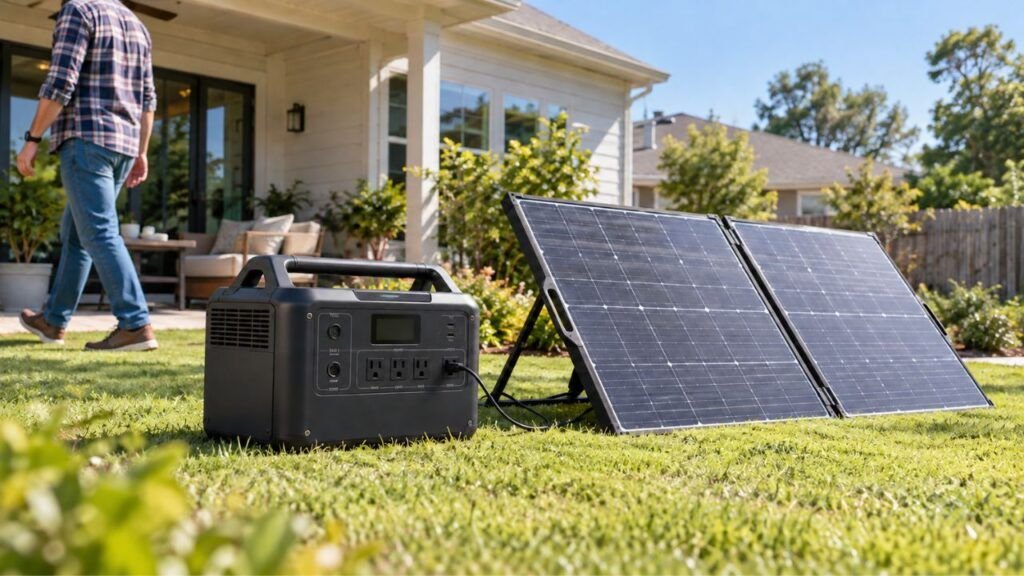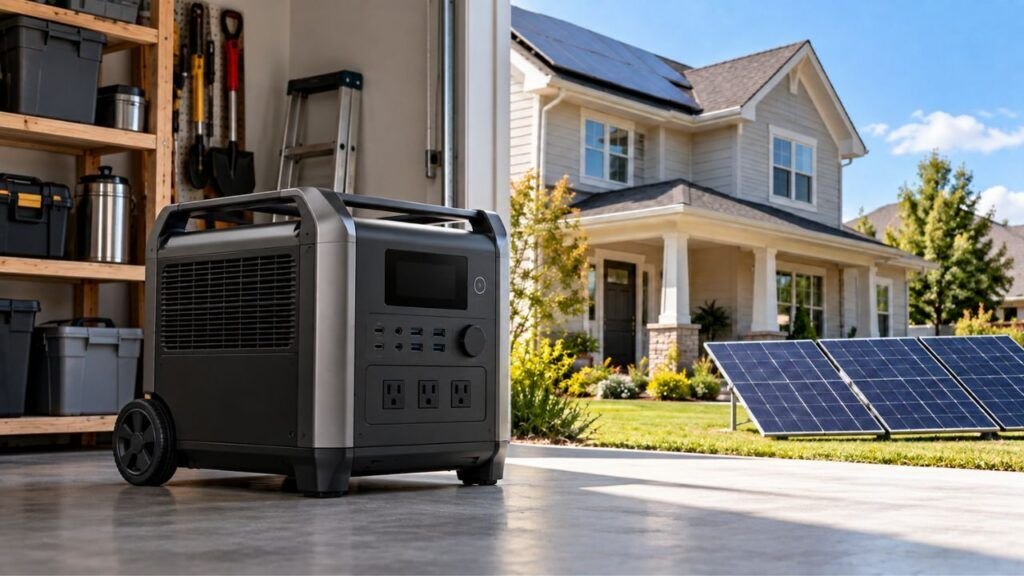
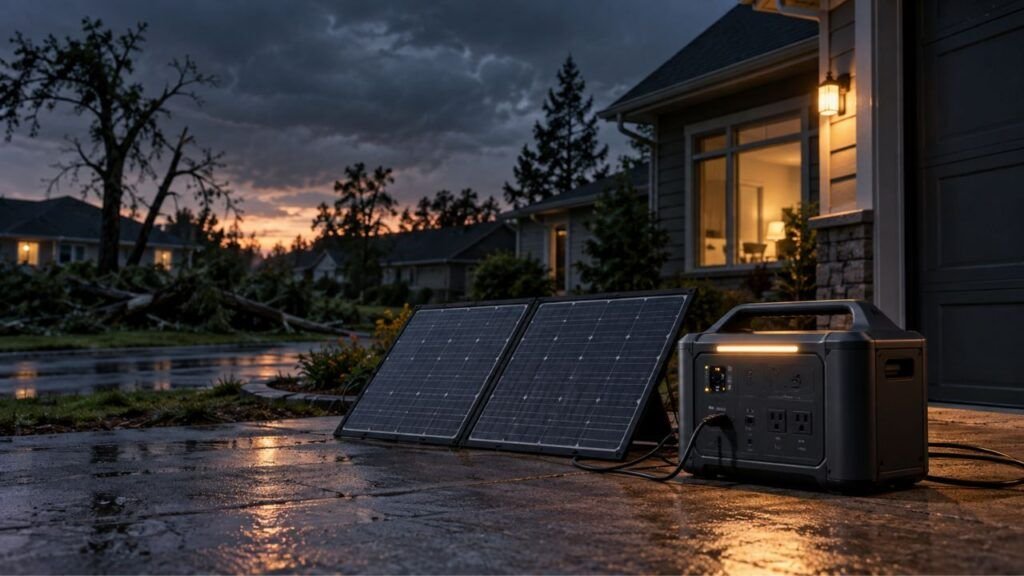
Yes, a solar generator works during a power outage because it stores electricity in a battery and operates independently from the utility grid. As long as the battery has power, it can run compatible appliances even when your neighborhood loses electricity.
However, how useful it becomes depends on its capacity, output, and your power needs. Below, I’ll explain what it can run, how long it lasts, how solar charging works, and how to use it safely during a blackout.
Key Takeaways
- A solar generator continues working when utility power goes out.
- Stored battery energy powers your appliances during the blackout.
- Solar panels can recharge the battery when sunlight is available.
- Portable models are best suited for selected essential appliances.
- Larger systems can support several circuits or substantial home loads.
- Battery capacity controls runtime, while inverter wattage controls appliance compatibility.
- Standard grid-tied solar panels usually shut down during an outage.
- Never backfeed a solar generator through a regular wall outlet.
Does a Solar Generator Work When the Power Goes Out?
A solar generator does not need the utility grid to provide power. That is what makes it useful during outages.
Inside the unit is a rechargeable battery that stores electricity. An inverter converts that stored battery power into the AC electricity most household appliances need.
When the grid goes down, the energy inside your battery remains available.
You can connect compatible appliances directly to the generator and continue using them until the battery runs low.
However, there is an important distinction.
A solar generator working during an outage does not automatically mean it can power everything inside your house.
Its usefulness depends on three main factors:
- Battery capacity
- Inverter output
- Power consumption of your appliances
A small unit may handle phones, lights, laptops, and Wi-Fi. A larger solar generator can also support refrigerators, televisions, medical equipment, and other household essentials.
How Does a Solar Generator Provide Power During a Blackout?
A solar generator relies on stored battery energy rather than an operating power grid. Three parts of the system play important roles during an outage.
The Battery Supplies Stored Electricity
Think of the battery as your personal electricity reserve.
Before an outage, you can usually charge a solar generator using:
- A household wall outlet
- Solar panels
- A vehicle charging connection
- Other compatible charging sources
Once that electricity is stored, losing grid power does not remove it.
If your generator contains 2,000Wh of stored energy, that energy remains available until appliances consume it or battery protection shuts the unit down.
That is why keeping your generator reasonably charged before severe weather can make such a difference.
The Inverter Powers Household Appliances
Solar generator batteries store DC electricity, while most household appliances use AC electricity.
The inverter handles that conversion.
Its wattage rating also determines how much equipment you can run.
For example, having a large battery does not necessarily mean you can run a large air conditioner.
Your inverter must also provide enough continuous wattage.
You should also consider startup or surge wattage.
Appliances containing motors or compressors can briefly draw much more power when starting. Refrigerators, pumps, and air conditioners are common examples.
Solar Panels Can Replenish the Battery
The biggest advantage during a longer outage is the ability to recharge.
You can place compatible solar panels outside and connect them to your generator. The panels then produce electricity during daylight and send it into the battery.
How much energy you actually recover depends on several factors:
- Solar panel wattage
- Available sunlight
- Panel angle and orientation
- Weather conditions
- Generator solar input limit
- Power being consumed simultaneously
Solar charging can extend your backup time considerably.
Still, it should not be viewed as unlimited electricity. Your daily consumption must stay reasonably close to what your solar setup can replace.
Solar Generator vs. Grid-Tied Solar During a Power Outage
This is where homeowners often get confused. A portable solar generator and a standard rooftop solar installation do not necessarily behave the same way during a blackout.
| System | Works During Outage? | Stored Energy | Solar Charging During Outage | Typical Use |
| Portable solar generator | Yes | Yes | Yes | Individual appliances |
| Standard grid-tied solar | Usually no | No | Usually unavailable for backup | Normal household solar |
| Solar with battery backup | Yes, when properly configured | Yes | Usually yes | Essential home circuits |
| Whole-home solar backup system | Yes | Yes | Yes | Larger household loads |
Most standard grid-tied solar systems shut down when utility electricity disappears.
This safety feature helps prevent electricity from feeding back into utility lines while workers may be repairing them.
A portable solar generator works differently.
Its battery, inverter, outlets, and solar input form an independent power system. It does not need the neighborhood grid to remain active.
That independence is what allows it to keep working during a blackout.
Portable vs. Whole-Home Solar Generators During an Outage
Not every solar generator provides backup power in the same way. The experience depends heavily on whether you use a portable unit or an integrated home backup system.
Portable Solar Generator
A portable solar generator is the simplest option.
When power fails, you can connect selected appliances directly to its AC, USB, or DC ports.
Common choices include:
- Refrigerator
- Wi-Fi router
- Phones
- Laptop
- LED lights
- Fans
- Television
- CPAP machine
Portable units work especially well when you focus on important loads instead of trying to power everything.
Portable Solar Generator With UPS or EPS
Some modern power stations include UPS or EPS functionality.
These units can remain connected between a wall outlet and selected equipment.
When utility power disappears, compatible models can switch connected devices over to battery power automatically.
However, switching time varies between models.
Not every portable solar generator should be treated as a true UPS. Check the manufacturer’s specifications before using one with sensitive equipment.
Whole-Home Solar Generator
Larger systems can provide a much more integrated backup experience.
When properly connected through suitable transfer equipment, they may power selected household circuits instead of requiring individual appliances to be plugged directly into the generator.
Depending on the system, you may be able to support:
- Refrigeration
- Lighting circuits
- Internet equipment
- Kitchen appliances
- Well pumps
- HVAC equipment
- Other 120V or 240V loads
Whole-home backup still requires careful sizing. A large house can consume an enormous amount of electricity when several high-demand appliances run together.
What Can a Solar Generator Run During a Power Outage?
The exact answer depends on your generator’s output and battery capacity. These approximate ranges can help you understand which appliances are easier to support.
| Appliance | Typical Power Demand | Main Consideration | Suitability |
| Wi-Fi router | 10–30W | Continuous operation | Excellent |
| LED light | 5–15W | Very low consumption | Excellent |
| Laptop | 40–100W | Battery charging varies | Excellent |
| CPAP machine | 30–70W+ | Humidifier may increase usage | Very good |
| Refrigerator | 100–250W running | Compressor startup surge | Very good |
| Television | 60–150W | Size affects consumption | Very good |
| Microwave | 800–1,500W | High short-term load | Larger units |
| Sump pump | 800–1,500W+ | High startup surge | Larger units |
| Window AC | 500–1,500W+ | Compressor surge | Larger units |
| Central AC | 2,000–5,000W+ | Often 240V with high surge | Whole-home systems |
These numbers are only general estimates.
Always check the actual appliance label or power meter when possible.
The most important thing to remember is that battery capacity and inverter wattage answer two different questions.
Battery capacity tells you how long you can run something.
Inverter output tells you whether you can run it at all.
How Long Will a Solar Generator Last During a Power Outage?
Runtime depends mainly on your available battery energy and average power consumption. You can make a useful estimate with a simple calculation.
Simple Solar Generator Runtime Formula
Use this basic formula:
Estimated runtime = usable battery capacity ÷ average appliance load
Suppose you have a 2,000Wh solar generator.
You may not receive every watt-hour as usable AC electricity because the inverter and other electronics consume some energy.
For a simple example, assume about 85% usable AC energy:
2,000Wh × 0.85 = 1,700Wh
If your connected equipment averages 300 watts:
1,700Wh ÷ 300W = about 5.7 hours
That does not mean every 2,000Wh generator will produce exactly 5.7 hours.
It simply gives you a practical starting estimate.
Why Actual Runtime Can Change
Several factors can increase or decrease real-world runtime:
- Appliance cycling
- Compressor startup
- Inverter losses
- Battery temperature
- Battery age
- AC inverter idle consumption
- Eco modes
- Number of connected appliances
- Solar power entering the battery
Reducing unnecessary loads can make a surprisingly large difference during a long outage.
Why Refrigerator Runtime Is Different
A refrigerator makes runtime calculations slightly more complicated.
It does not normally consume its full running wattage every second.
The compressor turns on when cooling is needed and turns off once the desired temperature is reached.
For this reason, daily energy consumption is usually more useful than simply multiplying the refrigerator’s running wattage by 24 hours.
The compressor’s startup surge still matters, though.
Your solar generator must provide enough temporary surge power whenever that compressor starts.
Can You Recharge a Solar Generator During a Power Outage?
Yes. Recharging during an outage is one of the biggest advantages of a solar generator. However, charging performance changes depending on sunlight and your equipment.
Recharging With Solar Panels
You can connect compatible solar panels directly to many portable power stations.
During daylight, they send electricity into the generator while the utility grid remains offline.
For the best results, make sure your panels match the generator’s supported:
- Voltage range
- Current limit
- Connector type
- Maximum solar input
Adding more panels does not always mean faster charging.
Once you reach the generator’s maximum solar input, additional panel capacity may provide little benefit under perfect conditions.
What Happens on Cloudy Days?
Solar panels still produce electricity in cloudy weather because daylight continues reaching them.
However, charging will usually be slower.
Heavy clouds, rain, shadows, shorter winter days, and poor panel positioning can all reduce production.
During extended bad weather, conserving battery power becomes especially important.
What Happens at Night?
Solar panels do not generate useful energy without sunlight.
At night, your generator simply draws from stored battery power.
That is why your daytime goal should be simple: recharge enough energy to cover as much of the next evening and night as possible.
Can It Charge While Powering Appliances?
Many solar generators allow charging and power output at the same time.
For example, your solar panels might produce 500 watts while appliances consume 300 watts.
In that situation, some remaining solar energy may recharge the battery.
However, simultaneous charging capabilities vary by model.
Always stay within the manufacturer’s input and output limits.
Will a Solar Generator Automatically Turn On During an Outage?
Not every solar generator automatically takes over when electricity fails.
A standard portable unit normally remains available, but you may need to turn on its AC output and plug your appliances into it manually.
Models with compatible UPS or EPS functions can behave differently.
They may automatically switch connected equipment from utility electricity to battery power when the grid fails.
An integrated whole-home system can provide an even smoother transition when installed with appropriate transfer equipment.
So, if automatic backup is important to you, do not look only at battery capacity.
Check whether the system specifically supports automatic switching and whether its transfer time suits your equipment.
Can a Solar Generator Power an Entire House During an Outage?
Some solar generators can support substantial portions of a home, but smaller portable systems are better suited to essential appliances.
Small Portable Solar Generators
Smaller systems work best when you prioritize.
Instead of running every appliance, you might reserve your available power for:
- Refrigeration
- Internet
- Phones
- Lighting
- Medical equipment
- Fans
- Computers
That approach can stretch a relatively modest battery much further.
High-Capacity Expandable Systems
Larger power stations often support expansion batteries.
That allows you to increase stored energy without replacing the entire generator.
High-capacity systems may also provide:
- Higher continuous output
- Larger surge capability
- More solar charging input
- Additional battery capacity
- Multiple AC circuits
- Home transfer equipment
These systems are more practical when you need longer backup or several appliances running together.
120V vs. 240V Appliances
Voltage is another important detail people sometimes overlook.
Most basic portable solar generators provide 120V AC power.
However, some large household equipment may require 240V.
Examples can include:
- Central air conditioners
- Well pumps
- Electric dryers
- Electric ranges
- Large workshop equipment
Even if your generator has enough wattage, it cannot run a 240V appliance unless the system actually provides compatible 240V output.
Always check both voltage and wattage.
How to Connect a Solar Generator During a Power Outage
There are several ways to use solar backup safely. The right approach depends on whether you’re powering individual appliances or household circuits.
Plug Appliances Directly Into the Generator
This is the simplest method.
Place the power station in a suitable location and connect your essential devices directly to its outlets.
If you need an extension cord, make sure it is properly rated for the load and used according to manufacturer instructions.
This method also helps you control energy consumption because you choose exactly what receives backup power.
Power Selected Home Circuits
Some larger solar backup systems can connect to household circuits using appropriate transfer equipment.
This setup can be much more convenient because selected lights and outlets can continue working through your existing wiring.
However, electrical panel connections should be properly designed and installed.
A qualified electrician can help ensure your system meets the equipment requirements and applicable local electrical rules.
Never Backfeed Through a Wall Outlet
Never try to power your home’s electrical wiring by connecting a generator to a regular wall outlet.
This unsafe practice is often called backfeeding.
It can energize wiring unexpectedly and create serious shock, electrocution, and fire hazards.
If you want your generator connected to household circuits, use properly installed transfer equipment designed for that purpose.
How to Make Your Solar Generator Last Longer During a Blackout
Your battery can last much longer when you manage loads carefully. During a long outage, focus on what genuinely needs power.
- Start with the battery properly charged.
- Prioritize refrigeration and necessary medical equipment.
- Keep phones and communication devices available.
- Use LED lights whenever possible.
- Turn off appliances when they are not needed.
- Avoid electric heaters and other large resistance loads.
- Run high-wattage appliances one at a time.
- Recharge during strong daylight whenever possible.
- Turn off unused AC outputs if your generator allows it.
- Use appliance eco modes when practical.
- Monitor input and output wattage on the display.
- Add expansion batteries for longer emergency coverage.
You do not need to make your outage feel exactly like a normal day.
Keeping essential equipment operating is usually a much better use of limited stored energy.
What Size Solar Generator Do You Need for a Power Outage?
There is no single correct size for every household. Start by deciding which appliances you genuinely want available when the grid fails.
| Backup Goal | Approximate Battery Class | Typical Use |
| Basic communication | 300–1,000Wh | Phones, router, lights |
| Essential appliances | 1,000–2,000Wh | Refrigerator plus electronics |
| Extended essentials | 2,000–4,000Wh | Several household devices |
| Heavy backup | 4,000Wh+ | Larger loads and longer runtime |
| Whole-home backup | Expandable multi-kWh system | Several circuits and larger appliances |
Battery size is only half of the decision.
Suppose you buy a 4,000Wh system with insufficient inverter output. It may store plenty of energy but still fail to start a high-powered appliance.
Before choosing a unit, check:
- Total running watts
- Highest startup surge
- Daily energy consumption
- Desired backup hours
- 120V or 240V requirements
- Maximum solar charging input
Sizing around those factors gives you a much more useful emergency system.
What Can Stop a Solar Generator From Working During an Outage?
A solar generator is fairly straightforward, but several problems can prevent it from powering your equipment.
Common causes include:
- Battery was already discharged
- Connected load exceeds inverter capacity
- Appliance startup surge is too high
- Battery reaches its low-voltage cutoff
- Solar panels cannot replace daily consumption
- Cloudy weather reduces solar charging
- Panel voltage is outside the supported range
- Battery temperature protection activates
- Generator enters overload protection
- AC or DC outputs were not switched on
If your generator suddenly stops supplying power, disconnect unnecessary appliances first.
Then check the battery level, error messages, inverter status, and total connected wattage.
That simple process solves many overload-related problems.
Is a Solar Generator Reliable for Multi-Day Power Outages?
A solar generator can work well during a multi-day outage, but you need to think in terms of a daily energy budget.
Imagine your appliances use 2,000Wh each day.
If your solar panels can put roughly that amount of usable energy back into the battery daily, your backup system may continue operating for an extended period.
But suppose your household consumes 4,000Wh daily while your panels replace only 1,500Wh.
You now have an energy deficit.
The battery will eventually run down even though you recharge it every day.
This is why long-outage planning involves more than buying a large battery.
You need enough storage to get through poor solar conditions and enough panel capacity to recover energy when the weather improves.
Solar Generator or Gas Generator for a Long Blackout?
Both options can provide useful emergency power, but they work differently.
A solar generator offers quiet operation, no engine exhaust, minimal routine maintenance, and renewable daytime recharging. Its biggest limitations are stored battery capacity and available sunlight.
A gas generator can support substantial continuous loads and can be refueled quickly. However, it requires fuel, engine maintenance, and safe outdoor operation because combustion produces dangerous carbon monoxide.
For many households, the better choice depends on outage duration, required appliances, available solar exposure, and how much fuel storage or maintenance you want to manage.
Final Words
Yes, a solar generator can work very well during a power outage. It keeps supplying electricity from its battery even when the utility grid goes completely offline.
The key is choosing a system that matches your actual needs. Battery capacity controls your runtime, while inverter output, surge capability, voltage, and solar input determine what you can realistically power.
For most homes, I recommend thinking about essential loads first. Keep your refrigerator, communication devices, lights, and important equipment running before worrying about powering every appliance in the house.
A properly sized solar generator can make an outage far easier to handle, especially when you have enough solar capacity to recharge it during the day.
Related FAQs
Does a Solar Generator Work if There Is No Sun?
Yes. A solar generator runs from electricity already stored inside its battery, so sunlight is not required while using it. Sunlight is only needed when you want your solar panels to recharge the battery.
Does a Solar Generator Work at Night During a Power Outage?
Yes. At night, the generator simply uses stored battery energy to power connected appliances. The solar panels will begin producing electricity again after sufficient daylight returns.
Can a Solar Generator Run a Refrigerator During a Blackout?
Yes, many solar generators can run a refrigerator. Make sure the inverter can handle both the refrigerator’s normal running wattage and the brief compressor startup surge.
Can a Solar Generator Power a House During a Blackout?
Larger solar generator systems can power several household circuits and sometimes substantial parts of a home. Smaller portable units are generally better for refrigerators, lights, electronics, medical devices, and other essentials.
Will a Solar Generator Automatically Turn On When Power Goes Out?
Some models with UPS, EPS, or automatic transfer capabilities can switch to battery backup automatically. Basic portable solar generators may require you to manually connect or turn on your appliances.
Can Solar Panels Charge a Generator While the Power Is Out?
Yes. Compatible solar panels can recharge a solar generator while the utility grid is offline. Charging speed depends on sunlight, panel wattage, weather, and the generator’s maximum solar input.
Why Don’t Normal Rooftop Solar Panels Work During an Outage?
Most standard grid-tied solar systems shut down during outages to prevent electricity from feeding into utility lines. Solar systems designed with compatible battery backup and islanding capability can continue providing power.
Can I Connect a Solar Generator to My Breaker Panel?
Some larger solar generators support home electrical connections through compatible transfer equipment. The system should be properly designed and installed rather than connected through an ordinary wall outlet.
How Long Can a Solar Generator Run During a Blackout?
Runtime depends on battery capacity, appliance consumption, inverter losses, and incoming solar power. Dividing usable battery watt-hours by average load wattage provides a useful starting estimate.
What Size Solar Generator Do I Need for a Power Outage?
Add the running wattage and daily energy use of the appliances you want to back up. Then choose enough battery capacity for your desired runtime and enough inverter output to handle the highest combined load and startup surge.

Blake Cooper writes practical guides on generators, portable power stations, and home backup systems. He focuses on simplifying power topics and helping homeowners make informed buying decisions.