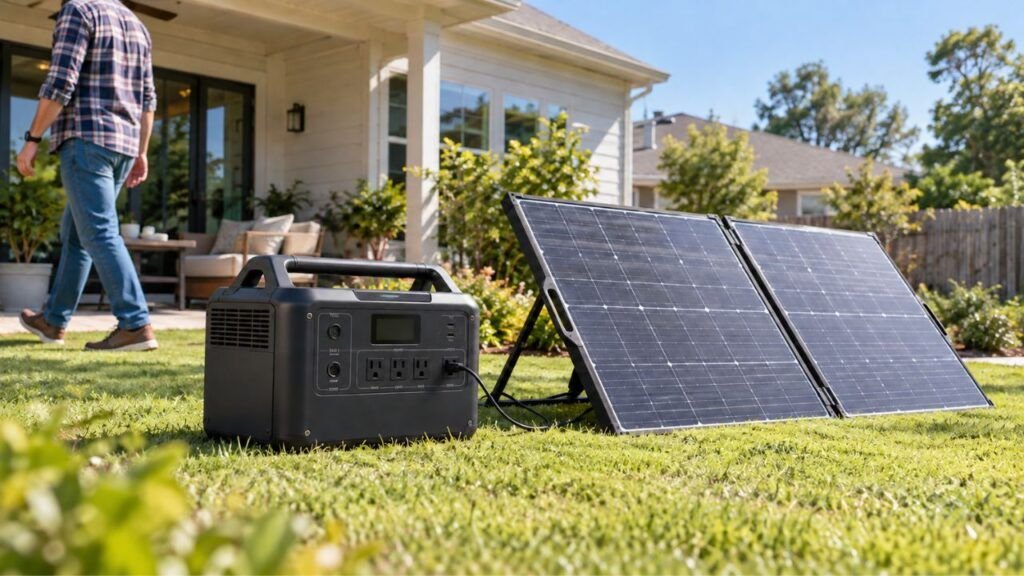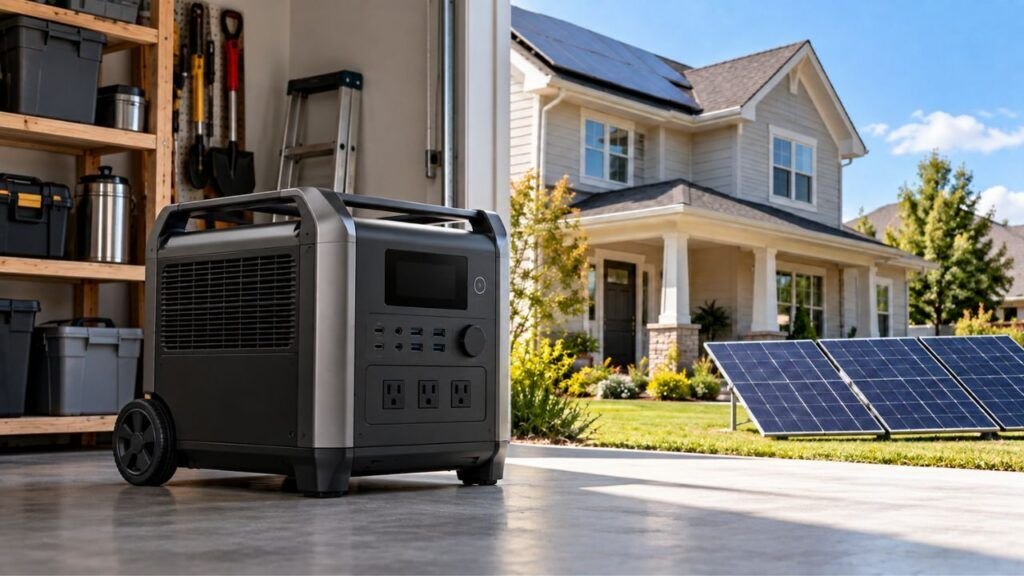
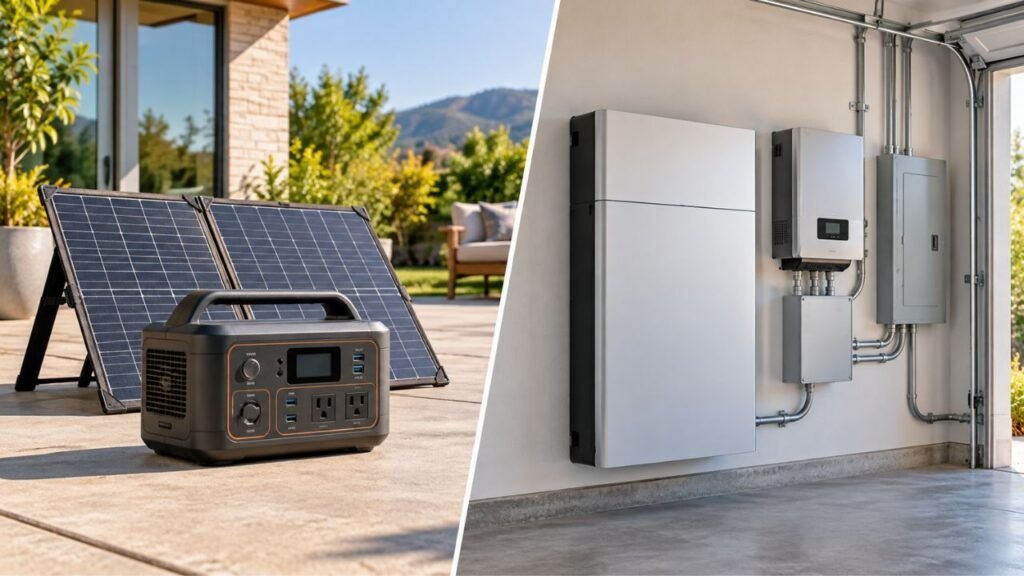
A solar generator is usually better for portable, flexible backup power, while a home battery backup is better for automatic, panel-connected home protection. However, larger expandable solar generators can now support heavy appliances and selected home circuits when paired with compatible transfer equipment.
In this guide, we’ll compare power output, capacity, runtime, installation, 120V and 240V support, solar charging, costs, and whole-home capability. By the end, you should have a much clearer idea of which backup system fits your home.
Key Takeaways
- Solar generators are usually portable and easier to set up.
- Home batteries are permanently connected to your electrical system.
- Battery capacity determines how long your backup power lasts.
- Inverter output determines what you can power simultaneously.
- Home batteries normally provide better automatic outage protection.
- Some large solar generators now support 120V and 240V loads.
- Solar panels can extend runtime during longer power outages.
- Whole-home backup usually requires careful load planning.
- Your best choice depends on budget, loads, and outage duration.
Solar Generator vs Home Battery Backup at a Glance
Both systems store electricity inside rechargeable batteries. The biggest differences involve portability, electrical integration, output, automation, and how you use that stored energy.
| Feature | Solar Generator | Home Battery Backup |
| Basic design | Portable battery, inverter, outlets, and charging system | Permanently installed home energy storage system |
| Installation | Usually plug-and-play | Professional installation normally required |
| Portability | Usually portable | Permanently installed |
| Electrical panel connection | Optional on compatible models | Normally integrated into the home |
| Automatic backup | Depends on system | Commonly available |
| 120V appliances | Yes | Yes |
| 240V appliances | Available on some larger systems | Common with properly sized systems |
| Battery capacity | Small to highly expandable | Usually larger and modular |
| Solar charging | Yes | Yes when configured with solar |
| Whole-home backup | Possible with certain advanced systems | Designed for this when properly sized |
| Hardwired appliances | Requires proper transfer equipment | Can support them when correctly configured |
| Daily energy management | Limited on basic units | Common |
| Permits | Usually unnecessary when used independently | Often required |
| Best for | Portable and essential-load backup | Integrated household backup |
What Is a Solar Generator?
A solar generator is basically a rechargeable battery system with an inverter, charging electronics, and several electrical outlets built into one unit.
Despite the name, the unit itself does not create solar electricity. Solar panels produce the electricity, while the generator stores and delivers it.
You can normally recharge one using solar panels, a wall outlet, a vehicle connection, or another supported charging source.
Smaller models are designed for phones, lights, refrigerators, laptops, and camping equipment. Larger models can support appliances, power tools, heating equipment, and other demanding loads.
Some modern systems also accept expansion batteries. This lets you start small and increase capacity later.
High-end units can even provide 120V and 240V power. Certain models can also connect to selected household circuits through compatible electrical equipment.
Because of these improvements, the term “solar generator” now covers a much wider range of products than it once did.
What Is a Home Battery Backup?
A home battery backup is permanently connected to your home’s electrical system. It stores electricity and releases that energy when your home needs it.
The battery may charge using rooftop solar panels. Many systems can also charge directly from utility electricity.
During an outage, properly configured equipment disconnects your home from the utility grid. The battery then supplies electricity to selected circuits or the entire home.
Unlike a basic solar generator, you normally do not connect appliances individually. Your refrigerator, lights, outlets, internet equipment, and other protected circuits keep receiving electricity through your home’s wiring.
Home batteries can also serve purposes outside emergencies. Some systems store electricity during cheaper periods and use it when utility rates rise.
Others store excess rooftop solar electricity during the afternoon. You can then use that stored energy later in the evening.
That makes a home battery both a backup system and an energy-management tool.
Solar Generator vs Home Battery Backup: Key Differences
Choosing between these systems becomes much easier once you separate capacity, output, voltage, installation, and automation. These specifications matter more than the product name printed on the box.
Installation and Electrical Panel Connection
Most solar generators require almost no installation.
You charge the battery and plug your appliances into its outlets. This works well for refrigerators, lights, routers, televisions, laptops, and other essential equipment.
A home battery works differently.
It becomes part of your home’s electrical system. An electrician normally installs the battery, inverter, disconnect equipment, and any required backup panel.
Some larger solar generators sit between these two categories.
They remain removable but can connect to compatible transfer switches or smart panels. This lets them power selected household circuits without running extension cords everywhere.
Power Output
Power output tells you how much electricity the system can deliver at once.
This specification is usually shown in watts or kilowatts.
For example, having a large battery does not automatically mean you can run a central air conditioner. The inverter must also provide enough continuous and starting power.
Imagine having a large water tank connected to a tiny pipe. The tank contains plenty of water, but the pipe limits how quickly you can use it.
Battery systems work similarly.
Always check both battery capacity and inverter output before buying.
Battery Capacity and Runtime
Battery capacity tells you how much electricity the system can store.
You will usually see this measurement in watt-hours or kilowatt-hours.
One kilowatt-hour equals 1,000 watt-hours.
A 2 kWh battery theoretically contains enough energy to supply a 500-watt load for about four hours.
Real-world runtime will normally be shorter.
The inverter consumes some electricity, and battery systems may reserve a small amount of capacity for protection.
Your actual appliance consumption also changes throughout the day.
120V and 240V Appliance Support
Most everyday household electronics use 120-volt electricity.
Examples include:
- Refrigerators
- Televisions
- Lamps
- Routers
- Computers
- Phone chargers
- Small kitchen appliances
Larger household equipment may require 240 volts.
Common examples include:
- Central air conditioners
- Electric clothes dryers
- Electric ranges
- Some heat pumps
- Well pumps
- Electric water heaters
- Level 2 EV chargers
Basic solar generators often provide only 120V power.
However, some larger systems now provide 120V and 240V output. This gives them considerably more home-backup flexibility.
Home battery systems are normally designed around household electrical requirements. They can support 240V equipment when properly sized and configured.
Voltage alone does not guarantee that a system can handle everything.
You still need sufficient inverter output and battery capacity.
Starting Watts and Motor Loads
Certain appliances briefly require much more power when starting.
A refrigerator compressor provides a simple example.
It may use a few hundred watts while running. However, startup demand can be several times higher for a brief moment.
The same issue affects:
- Sump pumps
- Well pumps
- Air conditioners
- Freezers
- Furnace blowers
- Heat pumps
- Workshop equipment
Your backup system must handle that short power surge.
This is why comparing only running watts can lead to disappointing results.
Automatic Backup and Transfer Time
A basic solar generator usually requires manual action during an outage.
You may need to move appliances, connect extension cords, or plug important equipment directly into the power station.
Some units include UPS-style features for connected electronics. However, that does not automatically mean they can transfer your entire home during an outage.
Larger systems connected to compatible home electrical equipment can provide more automated backup.
Home batteries are usually much more seamless.
When properly installed, the system detects the outage and begins supplying protected circuits automatically.
For homeowners who travel frequently or want uninterrupted household backup, this can be a major advantage.
Solar Recharging During an Outage
Both systems may recharge from solar panels during an extended blackout.
However, solar charging does not create unlimited electricity.
Your available energy still depends on:
- Solar panel wattage
- Sunlight conditions
- Battery capacity
- Daily household consumption
- Solar input limits
- Panel placement
- Weather conditions
Suppose your appliances consume 8 kWh each day.
If your solar array only restores 4 kWh, your battery will continue losing stored energy each day.
Good outage planning therefore means balancing consumption with expected solar production.
Portability
Portability remains one of the strongest solar generator advantages.
You can use the same system inside your home, garage, workshop, RV, campsite, or jobsite.
Renters can also take the system when they move.
A home battery stays with the property.
Once installed, moving it usually requires professional electrical work.
Expandability
Many modern backup systems allow additional batteries.
With a solar generator, expansion may involve connecting one or more compatible battery modules.
Home batteries can often be installed in multiple units.
This flexibility lets you increase stored energy as your needs grow.
However, always check whether expansion increases only capacity or also increases inverter output.
Adding more battery storage does not always mean more appliance-running power.
Everyday Energy Management
A basic solar generator usually spends most of its life waiting for an outage.
You may occasionally use it around the house or outdoors.
More advanced units can support scheduled charging, solar prioritization, and smart energy controls.
Home batteries tend to offer much deeper everyday integration.
Depending on your utility plan and system configuration, a battery may store cheaper electricity and supply your home when rates increase.
When paired with rooftop solar, it can also store electricity that would otherwise return to the grid.
Lifespan, Battery Chemistry, and Warranty
Battery chemistry affects lifespan, safety, weight, and cycle durability.
Many modern solar generators and home batteries use lithium iron phosphate, commonly called LFP or LiFePO4.
LFP batteries generally provide long cycle life and good thermal stability.
However, battery life still depends on several factors.
These include:
- Temperature
- Charging habits
- Depth of discharge
- Daily cycling
- Battery management
- Storage conditions
Do not judge longevity using cycle count alone.
Also check warranty length and how much battery capacity the manufacturer guarantees after several years.
How Long Can Each System Power Your Home?
Backup runtime depends on stored energy and your average electrical load. A simple calculation can give you a useful starting estimate before choosing battery capacity.
Start With Your Average Load
The basic formula is:
Runtime = Usable Battery Capacity ÷ Average Power Consumption
Suppose you have 5 kWh of usable battery storage.
If your essential equipment averages 500 watts, or 0.5 kW:
5 kWh ÷ 0.5 kW = 10 hours
Real runtime may be somewhat shorter because of conversion losses.
You should also remember that many appliances cycle on and off.
Example: Refrigerator, Wi-Fi, Lights, and Chargers
Imagine you want to keep several basic items operating.
Your average load could look something like this:
- Refrigerator: 100 to 200 watts while running
- Wi-Fi equipment: 15 to 30 watts
- Several LED lights: 30 to 80 watts
- Phones and laptops: 50 to 150 watts
Your combined average may remain below 500 watts.
A 2 kWh solar generator could therefore provide several hours of useful backup.
Reducing unnecessary loads can stretch runtime even further.
Example: Refrigerator, Furnace Blower, and Sump Pump
Now add heating equipment and a sump pump.
Your normal consumption increases, but startup power also becomes important.
A sump pump may briefly demand much more electricity when its motor starts.
Your backup system needs enough surge output to handle these moments.
In this situation, choosing the battery using capacity alone would be risky.
Check continuous output and surge capability as well.
Example: Central Air Conditioning or Heat Pump
Heating and cooling can quickly change your backup requirements.
Central air conditioners may draw thousands of watts while operating.
Their compressors can also require high starting power.
Running air conditioning therefore requires both adequate inverter output and significant battery capacity.
A powerful inverter might start your AC successfully.
But a small battery could still drain quickly.
For longer HVAC runtime, you normally need substantially more stored energy.
Why Whole-Home Runtime Varies So Much
Two homes with identical batteries can experience completely different runtimes.
One household may use only refrigeration, lighting, internet, and a few outlets.
Another may operate:
- Central air conditioning
- Electric water heating
- Electric cooking
- Well pumps
- Pool pumps
- Electric dryers
- EV charging
These large loads can consume stored energy surprisingly quickly.
This is why “How long will this battery power my house?” rarely has one universal answer.
Your home’s actual loads determine the result.
Can a Solar Generator Really Power a Whole House?
Some solar generators can provide serious home backup, but not every model can power an entire house. You need to look beyond the marketing and examine the complete electrical system.
For meaningful whole-home or selected-circuit backup, check:
- 120V and 240V output
- Continuous inverter wattage
- Surge capacity
- Battery capacity
- Maximum solar input
- Expansion options
- Transfer switch compatibility
- Smart panel compatibility
- Supported household circuits
- Required electrical installation
A small portable unit should not be treated like a whole-house battery.
However, large modular systems have changed what portable power stations can accomplish.
Some can run demanding appliances and connect to home circuits through approved equipment.
Once you start connecting a portable system permanently to household wiring, professional installation becomes much more important.
Whole-Home Backup vs Essential-Circuit Backup
You do not necessarily need enough battery capacity to run every electrical device in your house. Protecting a carefully selected group of essential circuits can dramatically reduce your backup requirements.
Essential-Circuit Backup
Essential-circuit backup focuses on equipment you genuinely need during an outage.
Typical loads include:
- Refrigerator
- Freezer
- Internet equipment
- Basic lighting
- Security equipment
- Furnace blower
- Sump pump
- Selected outlets
- Medical equipment
This approach can significantly extend battery runtime.
It also lets you build a useful backup system without paying for enormous battery capacity.
Whole-Home Backup
Whole-home backup means the battery system connects broadly to your home’s electrical system.
However, it does not necessarily mean unlimited electricity.
You might still need to avoid running several large appliances simultaneously.
For example, running central air conditioning, an electric dryer, an oven, and an EV charger together can place a huge demand on the system.
The battery and inverter must both be sized accordingly.
Load Shedding
Load shedding automatically reduces electricity demand when necessary.
For example, the backup system might temporarily disable:
- EV charging
- Water heating
- Pool equipment
- Clothes dryers
- Other nonessential circuits
This protects battery capacity and prevents inverter overload.
Load management can make a smaller battery system much more useful during outages.
Do You Need Solar Panels With Either System?
No. You can use both solar generators and home batteries without solar panels.
Most solar generators can recharge using a household wall outlet.
A home battery may also charge from utility electricity if the system supports that configuration.
However, solar panels become extremely valuable during long outages.
Without solar, your battery contains a fixed amount of stored electricity.
Once that energy disappears, you need another charging source.
Solar panels can restore at least some energy each day.
There is another important detail.
Having rooftop solar panels does not automatically mean your house stays powered during a blackout.
A standard grid-connected solar system normally needs compatible backup equipment that safely disconnects your home from the utility grid.
If outage operation matters to you, confirm exactly how your solar and battery equipment works together.
Installation, Transfer Equipment, and Home Electrical Safety
Installation can range from plugging appliances into a portable battery to permanently connecting a large energy storage system to your home’s electrical panel. The setup you choose determines how much professional electrical work is required.
Plug-In Appliance Backup
This is the easiest approach.
Place the solar generator somewhere safe and connect your necessary appliances directly.
You might power your:
- Refrigerator
- Router
- Laptop
- Lights
- Television
- Phone chargers
No permanent household wiring is required.
This makes plug-in backup attractive for renters and people wanting simple emergency power.
Transfer Switch or Power Inlet
A properly installed transfer setup can let compatible backup equipment supply selected household circuits.
This removes the need to run extension cords throughout your home.
However, the electrical connection must prevent electricity from feeding backward into utility lines.
Never attempt improvised backfeeding through household outlets.
Use equipment designed for the purpose and have household wiring handled professionally.
Smart Home Panel or Automatic Transfer Equipment
Some advanced solar generator systems use smart panels or transfer equipment.
These systems can monitor circuits and decide which loads receive battery power.
They may also provide automatic switching during outages.
This creates a middle ground between a traditional portable power station and a permanently installed home battery.
Permanently Installed Home Battery
A home battery usually requires the most installation work.
Depending on the system, installation may involve:
- Electrical panel modifications
- Inverter installation
- Disconnect equipment
- Backup gateway
- Critical-load panel
- Permits
- Inspections
- Utility requirements
A qualified installer should also review your household loads before sizing the system.
Proper installation affects both safety and backup reliability.
Solar Generator vs Home Battery Backup Cost
Cost comparisons can become misleading very quickly. Make sure you compare complete systems rather than comparing one product’s retail price against another system’s fully installed price.
Solar Generator Costs
Solar generator expenses may include:
- Main power station
- Expansion batteries
- Portable solar panels
- Permanent solar panels
- Charging accessories
- Transfer equipment
- Smart electrical panel
- Professional electrical work
A small portable setup may cost far less than a home battery.
However, a large expandable 240V system with several batteries can become a major investment.
Home Battery Backup Costs
A home battery installation can include much more than the battery itself.
Possible costs include:
- Battery modules
- Inverter
- System controller
- Backup gateway
- Electrical upgrades
- Critical-load panel
- Permits
- Labor
- Solar integration
- Additional battery modules
Installation difficulty can also change the final price considerably.
Why Installed Cost Matters More Than Battery Price
Imagine comparing a $4,000 portable battery with a $15,000 installed home battery.
That comparison looks simple until you add several expansion batteries, solar panels, transfer equipment, and electrical work to the portable system.
The price gap can quickly shrink.
Always compare systems providing similar:
- Battery capacity
- Inverter output
- 240V capability
- Automatic transfer
- Circuit coverage
- Solar integration
This gives you a much more useful comparison.
Federal Incentives in 2026
Be careful when reading older battery-buying guides.
Federal residential clean-energy rules changed after 2025, so older articles may show incentives that no longer apply to a new 2026 purchase.
State, utility, and local programs may still exist.
Incentives can also depend on installation date, ownership structure, location, and system type.
Before building your budget around any rebate or tax benefit, verify the current rules for your specific installation.
Solar Generator Pros and Cons
A solar generator offers excellent flexibility, especially when you want backup power without committing to permanent installation. Larger modern systems also provide far more capability than older portable units.
Pros
- Lower starting cost for smaller systems
- Portable
- Simple setup
- Useful outside your home
- No fuel storage required
- No exhaust during normal operation
- Solar charging available
- Expansion batteries available on many systems
- Good option for renters
- Some systems support 240V equipment
- Some systems support home circuit integration
Cons
- Small systems have limited runtime
- Basic models cannot support heavy 240V loads
- Hardwired appliances need additional equipment
- Automatic backup may require extra hardware
- Whole-home setups can become complicated
- High-capacity systems become heavy
- Larger setups can become expensive
Home Battery Backup Pros and Cons
A home battery is built around household electrical integration. It makes the most sense when automatic backup and protected home circuits matter more than portability.
Pros
- Automatic outage backup
- Direct home electrical integration
- Supports hardwired equipment
- Can support 120V and 240V loads
- Modular battery capacity
- Strong rooftop solar integration
- Quiet operation
- No fuel storage
- Low routine maintenance
- Useful for everyday energy management
- Can support critical-load or whole-home configurations
Cons
- Higher upfront investment
- Professional installation required
- Permits may be required
- Permanently attached to the property
- Battery runtime remains finite
- Heavy household loads require larger systems
- Expanding capacity can become expensive
Which One Should You Choose?
Your decision becomes easier when you think about what you actually want powered during an outage. Do not buy around the word “generator” or “battery.” Buy around your loads.
Choose a Solar Generator If…
A solar generator probably makes more sense when:
- You mainly need refrigerator and freezer backup.
- You want to keep internet equipment running.
- Your outages are usually short.
- You want portable emergency power.
- You rent your home.
- You also camp or travel regularly.
- You want to start with a smaller budget.
- You prefer avoiding permanent electrical work.
- You do not need every circuit backed up automatically.
You can always choose an expandable model if your needs may grow later.
Choose a Home Battery Backup If…
A home battery may fit better when:
- You own your home.
- Automatic backup matters to you.
- You want several circuits protected.
- You have important hardwired appliances.
- You regularly experience outages.
- You already have rooftop solar.
- You plan to install rooftop solar.
- You want daily energy management.
- You want minimal manual setup during outages.
- You need a more permanent backup solution.
Careful sizing becomes especially important if you want central HVAC coverage.
Consider an Expandable Solar Generator Home System If…
There is also a useful middle ground.
A large expandable solar generator system may work well if you want:
- 120V and 240V output
- Multiple expansion batteries
- Solar recharging
- Selected household circuits
- Smart panel integration
- Automatic transfer on compatible equipment
- Some level of portability
- Easier future expansion
These systems can provide serious home-backup capability.
Just remember that complete installed costs may approach traditional home battery pricing once you add batteries and electrical equipment.
Common Mistakes When Comparing These Systems
Backup systems involve several specifications that sound similar but mean very different things. Avoiding these mistakes can save you from buying an expensive system that cannot handle your actual loads.
- Comparing only battery capacity
- Ignoring continuous inverter output
- Confusing kW with kWh
- Forgetting appliance starting watts
- Assuming every solar generator provides 240V
- Assuming every 240V system can power a whole home
- Assuming UPS capability means whole-home automatic backup
- Ignoring transfer equipment requirements
- Assuming rooftop solar always works during blackouts
- Comparing hardware prices with fully installed prices
- Ignoring solar charging limits
- Assuming battery runtime remains identical at every load
- Ignoring cloudy-weather solar production
- Forgetting future battery expansion
- Relying on outdated tax-credit information
The safest approach is to make a list of your essential appliances first.
Write down their running wattage, starting wattage, voltage, and desired runtime.
Then size your backup system around those numbers.
Solar Generator vs Home Battery Backup: Final Verdict
A solar generator makes the most sense when you want flexible, portable, and relatively simple backup for selected appliances. It can keep essentials running without requiring a permanent home installation.
A home battery backup makes more sense when you want automatic switching, household circuit integration, hardwired load support, and deeper solar or energy-management capabilities. It is a more permanent solution but usually costs more upfront.
The gap between these categories is also getting smaller. Large expandable solar generators can now provide 120V and 240V power, added battery storage, and home-panel integration. Instead of choosing based only on the product label, compare output, usable capacity, voltage, transfer equipment, solar charging, and your actual household loads.
Related FAQs
Is a Solar Generator the Same as a Home Battery?
No. Both store electricity in rechargeable batteries, but a solar generator is normally portable and self-contained. A home battery is permanently installed and connected directly to the home’s electrical system.
Can a Solar Generator Power an Entire House?
Some large expandable solar generators can support many household circuits or even broad home backup. However, the system needs enough inverter output, battery capacity, 120V/240V support, and compatible transfer equipment.
How Many kWh of Battery Backup Does a House Need?
There is no single number for every home. A small essential-load setup may need only several kWh, while longer whole-home backup can require 10 kWh, 20 kWh, or considerably more depending on household consumption.
Can a Solar Generator Run Central Air Conditioning?
Some high-output solar generators can run central air conditioning, especially models supporting 240V power. You must check continuous wattage, compressor startup demand, battery capacity, and your specific AC system before relying on it.
Can You Connect a Solar Generator to a Home Electrical Panel?
Yes, certain solar generators can connect to household circuits using compatible transfer switches, power inlets, or smart panels. The connection should use approved equipment and proper electrical installation rather than improvised backfeeding.
Do You Need Solar Panels for a Home Battery Backup?
No. Many home batteries can charge from utility electricity without solar panels. However, adding solar can recharge the battery during longer outages and may also improve everyday energy independence.
Will Solar Panels Recharge a Battery During a Power Outage?
They can when the solar, inverter, battery, and isolation equipment are designed for outage operation. Standard grid-connected solar panels alone may shut down during an outage for utility safety.
How Long Will a 10 kWh Home Battery Last During an Outage?
Runtime depends on your average load. A 10 kWh battery supplying an average 500-watt load could theoretically last around 20 hours, while a 2,000-watt average load could reduce that to roughly five hours before accounting for system losses.
Is a Home Battery Worth It Without Solar Panels?
It can be, especially when you value automatic outage protection or have electricity rates that vary throughout the day. However, solar generally gives the battery another charging source during extended grid outages.
Can You Use a Solar Generator and Home Battery Together?
Potentially, yes, but compatibility depends on the equipment and electrical design. Some homeowners use a home battery for automatic primary backup and keep a portable solar generator for additional appliances, mobility, or emergency redundancy.

Blake Cooper writes practical guides on generators, portable power stations, and home backup systems. He focuses on simplifying power topics and helping homeowners make informed buying decisions.