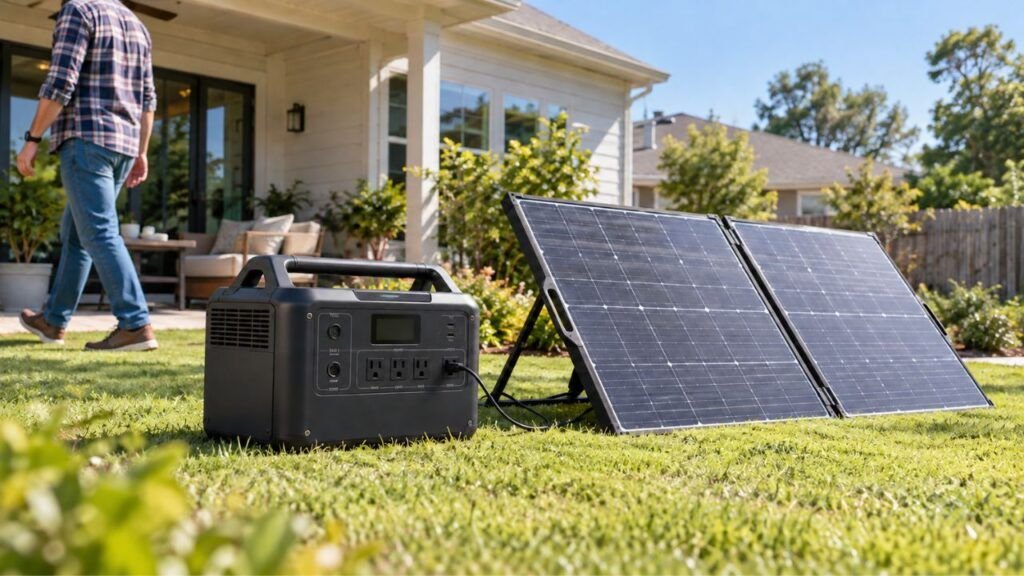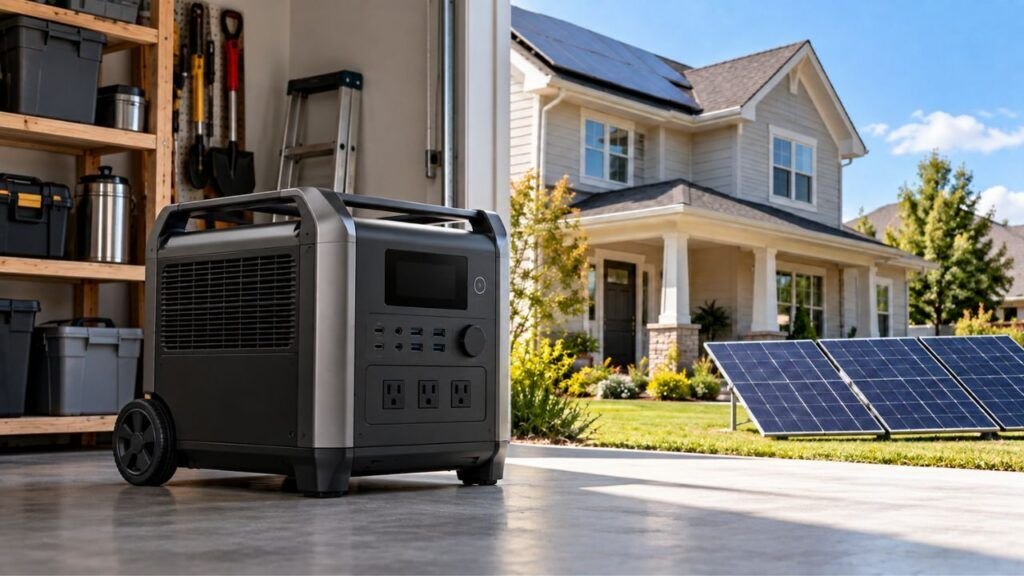
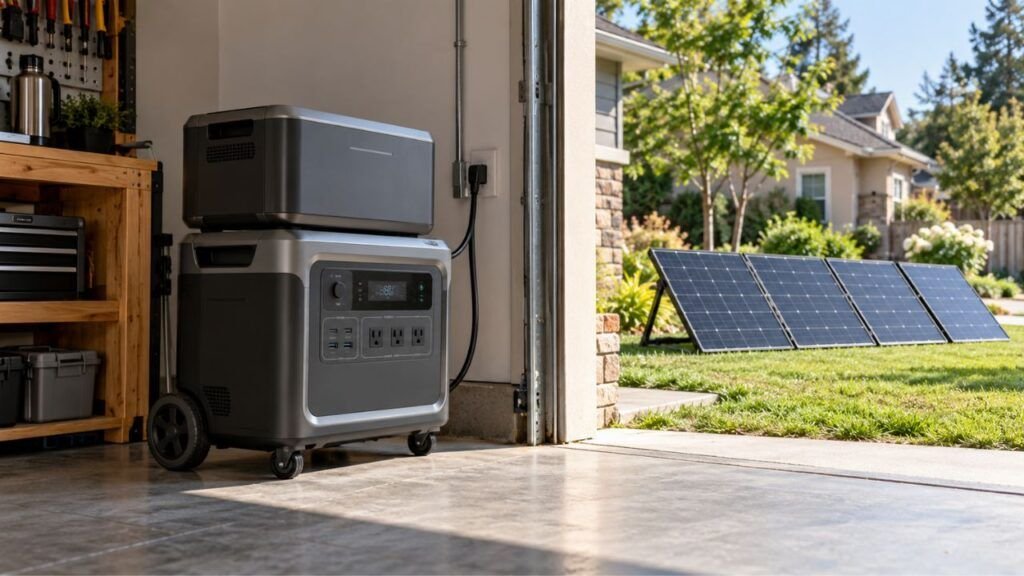
You need a 240V solar generator if your backup plan includes 240V appliances. Central air conditioners, electric water heaters, dryers, and some well pumps commonly need 240V. For refrigerators, lights, Wi-Fi, TVs, and chargers, a 120V solar generator is usually enough.
The important part is matching the system to your actual loads. Below, I’ll help you compare 120V and 240V backup, check your appliances, calculate power needs, and decide which setup makes sense.
Key Takeaways
- Basic home essentials usually run from standard 120V power.
- Many large household appliances require 240V electrical service.
- A larger battery does not automatically provide 240V output.
- Voltage, inverter watts, surge watts, and battery capacity are different specifications.
- Central AC and many heat pumps commonly need 240V.
- Well pumps may use either 120V or 240V.
- Whole-home backup often benefits from true 120/240V split-phase output.
- Always check appliance specifications before choosing your solar generator.
Do You Really Need a 240V Solar Generator for Home Backup?
Not every home backup system needs 240V. Your decision mainly depends on which appliances you want available during an outage.
You Probably Do Not Need 240V for Basic Essentials
A 120V solar generator can handle many important outage loads. This makes it a practical option for simpler emergency backup.
Common 120V loads include:
- Refrigerator
- Freezer
- LED lights
- Wi-Fi router
- Modem
- Television
- Phone chargers
- Laptop chargers
- Fans
- CPAP machines
- Small kitchen appliances
- Most standard wall-outlet electronics
Exact power requirements vary by appliance. Always check the appliance label before assuming its voltage.
A refrigerator, for example, normally uses a standard 120V outlet. However, its compressor can briefly demand much more starting power.
That means voltage is only your first consideration.
You Probably Need 240V for Larger Home Loads
The situation changes when you want larger appliances available during outages. Many of these use dedicated 240V circuits.
Common examples include:
- Central air conditioner
- Many heat pumps
- Electric water heater
- Electric clothes dryer
- Electric range
- Electric oven
- Some well pumps
- Level 2 EV charger
- Certain workshop equipment
Not every appliance within these categories uses identical voltage. Check the nameplate or manufacturer specifications before buying anything.
A Simple Rule to Follow
If every essential appliance uses 120V, you probably do not need 240V.
If one important appliance requires 240V, your backup system must support it. The generator must also provide enough running and starting power.
That second requirement is where many homeowners get caught.
A solar generator offering 240V cannot automatically run every 240V appliance. Its inverter still needs enough power for that appliance.
120V vs. 240V Solar Generator: Quick Comparison
Both systems can work well for home backup. The better choice depends on what you expect to keep running.
| Feature | 120V Solar Generator | 120/240V Solar Generator |
| Standard household electronics | Yes | Yes |
| Refrigerator and freezer | Usually | Yes |
| Lights and Wi-Fi | Yes | Yes |
| Microwave | Usually | Yes |
| Central AC | Generally no if 240V | Potentially |
| Heat pump | Limited | Potentially |
| Electric water heater | Generally no | Potentially |
| Electric dryer | No | Potentially |
| Electric range | No | Potentially |
| 240V well pump | No | Potentially |
| Essential-load backup | Very good | Very good |
| Broader home backup | More limited | Better suited |
| Typical size and weight | Lower | Higher |
| Typical cost | Lower | Higher |
| Battery capacity | Depends on runtime | Depends on runtime |
Notice that I used “potentially” for larger appliances.
Having 240V available does not guarantee the appliance will run. You still need enough inverter output and startup capacity.
What Does 120/240V Split-Phase Actually Mean?
Most American homes receive both 120V and 240V electrical service. Understanding this basic arrangement makes solar generator shopping much easier.
How a U.S. Home Gets 120V and 240V
A typical U.S. residential electrical service has two hot legs and a neutral.
Either hot leg to neutral provides around 120V.
Using both hot legs together provides around 240V.
That arrangement lets the same home support small 120V devices and larger 240V appliances.
Your standard wall outlets normally supply 120V. Larger appliances often connect through dedicated 240V circuits.
Why 240V and 120/240V Split-Phase Are Not Always Identical
This is an important detail when shopping for backup power.
Some solar generators provide native 120/240V split-phase output. Others create 240V only after connecting two compatible power stations.
Certain systems may also switch operating modes depending on configuration.
Do not simply look for “240V” on a product page.
Check whether the system provides:
- 120V output
- 240V output
- Simultaneous 120V and 240V operation
- True split-phase output
- Required pairing accessories
- Compatible home integration equipment
These details matter if you plan to connect several household circuits.
Which Home Appliances Actually Need 240V?
Appliance voltage varies by design and installation. The table below gives you a useful starting point for planning.
| Appliance | Typical U.S. Voltage | Is 240V Backup Usually Needed? | What Else to Check |
| Refrigerator | 120V | No | Startup surge |
| Freezer | 120V | No | Startup surge |
| Wi-Fi router | 120V | No | Runtime |
| Television | 120V | No | Running watts |
| Microwave | 120V | No | Running watts |
| Sump pump | Often 120V | Usually no | Nameplate and surge |
| Gas furnace blower | Often 120V | Usually no | Hardwired connection |
| Central AC | Commonly 208/230/240V | Often yes | Compressor surge |
| Heat pump | Commonly 208/230/240V | Often yes | Startup and auxiliary heat |
| Well pump | 120V or 240V | Depends | Nameplate voltage |
| Electric water heater | Commonly 240V | Usually yes | Heating-element wattage |
| Electric dryer | Commonly 240V | Usually yes | Running watts |
| Electric range | Commonly 240V | Usually yes | Element usage |
| Level 2 EV charger | 240V | Yes | Charging amperage |
Treat these numbers as general guidance.
Your appliance label, manual, or manufacturer specifications should be the final reference.
How to Tell Whether Your Home Needs 240V Backup
You can make this decision without guessing. Start with your essential appliances and work through them one by one.
Step 1: Decide What Must Stay Powered
First, make a list of appliances you genuinely need during an outage.
Separate necessities from convenience items.
Your essential list might include:
- Refrigerator
- Freezer
- Internet equipment
- Lighting
- Medical equipment
- Sump pump
- Furnace blower
- Well pump
- Air conditioning
You may discover that your real backup requirements are smaller than expected.
For example, you may not need an electric dryer during an outage. Leaving it off can dramatically reduce your system requirements.
Step 2: Check the Voltage of Every Essential Appliance
Look for the electrical information printed on each appliance.
You can usually find it on:
- Appliance nameplate
- Product label
- Owner’s manual
- Manufacturer specification sheet
Look specifically for voltage.
If your critical loads all show around 120V, a 120V system may be enough.
Finding a required 208V, 230V, or 240V appliance changes that decision.
Step 3: Separate Your 120V and 240V Loads
Create two groups after checking appliance voltage.
The first group contains your 120V essentials.
The second group contains anything requiring 240V.
If your 240V group is empty, you can probably avoid buying a more complicated split-phase system.
If an essential well pump or central AC belongs there, continue planning around 240V.
Step 4: Add Your Running Watts
Voltage tells you whether the equipment is electrically compatible.
Wattage tells you whether the generator can actually power it.
Use this simple calculation:
Total running watts = combined watts of appliances running simultaneously
Suppose your refrigerator uses 200 watts while running.
Your freezer uses another 200 watts.
Lights require 100 watts, while internet equipment uses 30 watts.
Your basic continuous load would be around 530 watts.
However, motors complicate things because they may need higher startup power.
Step 5: Check Startup Surge Requirements
Motor-driven appliances can briefly demand far more power when starting.
Common examples include:
- Refrigerator compressors
- Freezer compressors
- Central AC systems
- Heat pumps
- Sump pumps
- Well pumps
This extra demand is often called startup, starting, or surge wattage.
Your solar generator must handle that temporary demand.
For example, a generator might easily handle an appliance’s running watts but shut down when its motor starts.
Check both continuous and surge ratings before choosing a system.
Step 6: Calculate Your Battery Capacity
After voltage and inverter power, consider runtime.
Battery capacity is normally measured in watt-hours or kilowatt-hours.
A simple estimate looks like this:
Required watt-hours = appliance watts × operating hours
For example, a steady 500-watt load running four hours uses:
500W × 4 hours = 2,000Wh
Real-world calculations are less perfect.
Inverter losses, standby consumption, cycling appliances, and battery management affect usable energy.
I recommend leaving reasonable extra capacity rather than sizing everything exactly.
240V Does Not Tell You How Powerful the Solar Generator Is
This distinction is extremely important. Four specifications determine whether your backup setup actually works.
Voltage Determines Compatibility
Voltage tells you which electrical equipment the solar generator can supply.
A 120V-only generator cannot directly operate an appliance requiring 240V.
However, voltage alone tells you nothing about runtime.
Continuous Watts Determine What You Can Run
Continuous inverter output tells you how much power the generator can steadily deliver.
Suppose a system provides 240V but only 3,000 watts continuously.
A 5,000-watt load would still exceed its capabilities.
This is why buying based only on voltage is risky.
Surge Watts Determine What Can Start
Motors and compressors can briefly require substantial startup power.
Central AC systems are a common example.
A generator might have enough continuous output after the compressor starts. However, insufficient surge capability could prevent startup completely.
Watt-Hours Determine Your Runtime
Battery capacity tells you approximately how much stored energy is available.
This is measured in Wh or kWh.
For example:
1,000Wh = 1kWh
A larger battery normally provides longer runtime under the same load.
However, adding battery capacity does not change a 120V inverter into 240V.
Solar Input Determines How Quickly You Recover Energy
Solar input is another specification worth checking.
A large battery does little good during a long outage if recharging takes too long.
Higher solar input can help replenish more energy during available sunlight.
Panel size, weather, shading, season, and orientation still affect charging performance.
Remember this simple distinction:
Voltage determines compatibility. Watts determine load capability. Watt-hours determine runtime. Solar input determines recharge potential.
Example: 120V Essential Backup vs. 240V Home Backup
Different households can have completely different backup requirements. These examples show why choosing by appliance load works better than choosing by house size.
| Backup Plan | Example Loads | Voltage Needed | Typical System Direction |
| Basic emergency backup | Refrigerator, lights, router, phones | 120V | Portable 120V system |
| Essential home backup | Fridge, freezer, lights, furnace blower | Often 120V | Larger 120V system |
| Water-system backup | Essentials plus 240V well pump | 120/240V | Split-phase system |
| Summer outage backup | Essentials plus central AC | Usually 120/240V | High-surge split-phase system |
| Broader home backup | Multiple circuits and large appliances | 120/240V | Expandable home system |
This is why I would never choose a solar generator based only on home square footage.
A smaller house with electric heating, central AC, and a well pump might require much more power than a larger house using natural gas appliances.
Your actual load list matters more.
Do You Need 240V to Connect a Solar Generator to Your Home Electrical Panel?
Not necessarily. Panel integration and appliance voltage are related, but they are not exactly the same question.
Selected 120V Circuits Can Use a Different Backup Strategy
Some homeowners only want important 120V circuits available during outages.
That could include:
- Refrigerator circuit
- Lighting circuit
- Internet equipment
- Selected bedroom outlets
- Furnace controls
- Other essential circuits
A properly designed essential-load system can focus on these circuits rather than backing up the entire house.
You therefore should not assume that panel backup automatically means every appliance needs 240V.
When 120/240V Split-Phase Becomes More Important
Split-phase capability becomes much more useful for broader home backup.
It is especially important when you want to support:
- 240V household appliances
- Central HVAC
- 240V pumps
- Loads distributed across both electrical legs
- Larger whole-home backup configurations
A proper system can then support both ordinary 120V loads and compatible 240V equipment.
Why Proper Transfer Equipment Matters
Never feed backup electricity into household wiring through an improvised connection.
A properly installed transfer switch, backup panel, smart panel, or manufacturer-approved interconnection system helps isolate backup power from utility power.
That separation prevents dangerous backfeeding.
If your solar generator will power home circuits through the electrical panel, have a qualified electrician design and install the connection.
Local electrical rules and equipment requirements can vary.
Native 240V vs. Paired 240V Solar Generators
Not every 240V solar generator creates its output the same way. Check the system architecture before assuming two products work identically.
Native 120/240V Split-Phase Systems
Some larger backup systems provide split-phase output from a single integrated setup.
This arrangement is convenient for users planning broader home backup.
However, you should still confirm output limits and connection requirements.
Native 240V does not eliminate the need to calculate loads.
Two Power Stations Paired for 240V
Some manufacturers let two compatible power stations work together.
The paired units can create split-phase 240V using approved connecting equipment.
This approach can offer useful expandability.
However, pairing normally requires specific models and manufacturer-approved accessories.
Never assume two ordinary 120V power stations can simply be combined.
What to Check Before Buying
Before purchasing a 240V system, confirm:
- Whether 240V output is native or paired
- Whether one or two power stations are required
- Whether 120V and 240V work simultaneously
- Continuous 240V output
- Surge output
- Available 240V connections
- Battery expansion limits
- Maximum solar input
- Home-panel compatibility
- Required manufacturer accessories
- Installation requirements
These details can be more important than the headline power rating.
Is a 240V Solar Generator Worth the Extra Cost?
A 240V system can be an excellent investment for the right household. However, paying more for capabilities you never use makes little sense.
A 120V System Makes More Sense When…
A standard 120V solar generator may be enough when:
- You only need basic emergency power.
- Your essential appliances use standard outlets.
- Portability matters.
- You want a simpler setup.
- Central HVAC is not part of your backup plan.
- Your water supply does not depend on a 240V pump.
- Outages are normally short.
- You mainly want refrigerator and electronics backup.
A capable 120V system can still offer substantial home emergency power.
Do not underestimate it simply because the voltage number is lower.
A 120/240V System Makes More Sense When…
Consider 120/240V split-phase backup when:
- An essential appliance requires 240V.
- You rely on a 240V well pump.
- Central AC is important during outages.
- Your heat pump requires 240V.
- You want broader electrical-panel backup.
- You plan to expand toward whole-home coverage.
- Several large appliances need backup power.
The higher cost starts making more sense when those capabilities directly match your needs.
Do Not Buy 240V Just Because It Sounds Better
Bigger numbers can make a product look automatically superior.
That does not mean the extra capability helps your household.
If you only need a refrigerator, router, lights, television, and chargers, a quality 120V system can be simpler and more economical.
Put your money toward useful battery capacity rather than unnecessary voltage capability.
What to Look for in a 240V Solar Generator for Home Backup
Once you know you need 240V, compare the entire system rather than one specification.
Look for:
- True 120/240V split-phase capability
- Simultaneous 120V and 240V output
- Adequate continuous inverter wattage
- Strong startup surge capability
- Enough battery capacity
- Expandable battery support
- High solar charging input
- Fast AC charging
- Suitable 240V output connection
- Home-panel integration support
- LiFePO4 battery chemistry
- Long battery cycle life
- Useful warranty coverage
- Manufacturer-approved expansion accessories
- Recognized safety certifications
- Suitable operating temperature range
- App-based monitoring if useful
- Clear load and battery information
Do not let one impressive specification distract you from weaknesses elsewhere.
A balanced backup system matters more than one oversized number.
Common Mistakes When Choosing 120V or 240V Backup
Most sizing mistakes come from comparing the wrong specifications. Avoid these common problems before spending thousands on equipment.
- Assuming high wattage automatically means 240V output
- Assuming a large battery automatically supports 240V
- Confusing watts with watt-hours
- Ignoring compressor startup surge
- Assuming every well pump uses 240V
- Assuming every sump pump uses 120V
- Buying 240V without checking actual appliance needs
- Assuming voltage alone determines AC compatibility
- Ignoring simultaneous load requirements
- Assuming any two power stations can create 240V
- Using unapproved adapters for home integration
- Ignoring solar recharge limitations
- Sizing backup based only on house square footage
- Forgetting inverter conversion losses
- Planning to power every appliance simultaneously
The easiest way around these mistakes is simple.
Start with your appliances instead of starting with generator specifications.
How to Make the Final 120V vs. 240V Decision
You can narrow your choice quickly by answering a few practical questions. Start with voltage, then work through output and runtime.
| Ask Yourself | If No | If Yes |
| Do any essential appliances require 240V? | 120V may be enough | Consider 120/240V |
| Do you need central AC? | Continue checking | Likely 120/240V |
| Do you have a 240V well pump? | Continue checking | 120/240V needed for it |
| Are you backing up only plug-in essentials? | Review other loads | 120V is often enough |
| Do you want broader panel backup? | Portable setup may work | Consider split-phase |
| Can the inverter support your running loads? | Choose more output | Continue |
| Can it handle startup surge? | Choose higher surge output | Continue |
| Is battery capacity enough? | Add storage | System may fit |
For most homeowners, voltage should be the first filter.
After identifying your required voltage, check continuous watts and surge output. Then choose enough battery capacity for your desired runtime.
Finally, make sure you have enough charging capability for longer outages.
That process gives you a much more reliable backup setup.
Final Words
You do not need a 240V solar generator simply because you are backing up a house. If your essential appliances all operate on 120V, a capable 120V system can provide practical emergency power.
A 240V or 120/240V split-phase system becomes important when your backup plan includes compatible central AC, heat pumps, well pumps, electric water heaters, ranges, dryers, or other 240V loads.
Start by checking the appliances you cannot live without during an outage. Once you know their voltage, running watts, starting requirements, and desired runtime, choosing the right solar generator becomes much easier.
Related FAQs
Is a 120V Solar Generator Enough for Home Backup?
Yes, a 120V solar generator can be enough if you mainly need a refrigerator, lights, Wi-Fi, electronics, chargers, and other standard 120V appliances.
Can a 120V Solar Generator Run a Refrigerator?
Yes. Most U.S. refrigerators use 120V power, but make sure your solar generator can handle the refrigerator compressor’s startup surge.
Can a 120V Solar Generator Power a Breaker Panel?
It may support selected compatible 120V circuits through properly designed transfer equipment. Panel connections should always follow manufacturer requirements and local electrical rules.
Can a 120V Solar Generator Run a 240V Appliance?
Not directly. A 240V appliance requires a compatible power source providing the correct voltage and sufficient continuous and startup output.
Can You Convert a 120V Solar Generator to 240V?
Only when the manufacturer specifically supports an approved 240V configuration. Do not rely on improvised adapters or unsupported power-station combinations.
Does a Bigger Solar Generator Automatically Provide 240V?
No. Battery size and voltage output are separate specifications. A large-capacity power station may still provide only 120V AC output.
What Household Appliances Normally Use 240V?
Common examples include electric dryers, ranges, water heaters, many central AC systems, heat pumps, well pumps, and Level 2 EV chargers.
Do I Need 240V to Run Central Air Conditioning?
Many residential central AC systems use approximately 208V to 240V. Check your outdoor unit’s nameplate before selecting a backup power system.
Do I Need a 240V Solar Generator for a Well Pump?
It depends on the pump. Some well pumps operate on 120V, while many larger systems use 240V. Always verify the pump’s nameplate.
Is 240V the Same as Split-Phase Power?
Not exactly. U.S. split-phase service normally provides both 120V and 240V using two hot legs and a neutral connection.
Can a 240V Solar Generator Also Run 120V Appliances?
Many 120/240V split-phase systems can supply both voltages. Check the generator’s specifications because capabilities vary between designs.
Do I Need a Transfer Switch for a Solar Generator?
You generally need approved transfer or interconnection equipment when powering household circuits. Directly plugging appliances into the power station does not require one.
How Many Watts Should a 240V Solar Generator Have?
There is no universal number. Add your simultaneous running loads, then confirm the system can also handle the highest expected motor or compressor startup surge.
How Much Battery Capacity Do I Need for Home Backup?
Multiply appliance wattage by expected operating hours, then allow extra capacity for conversion losses, cycling loads, and unexpected outage duration.

Blake Cooper writes practical guides on generators, portable power stations, and home backup systems. He focuses on simplifying power topics and helping homeowners make informed buying decisions.