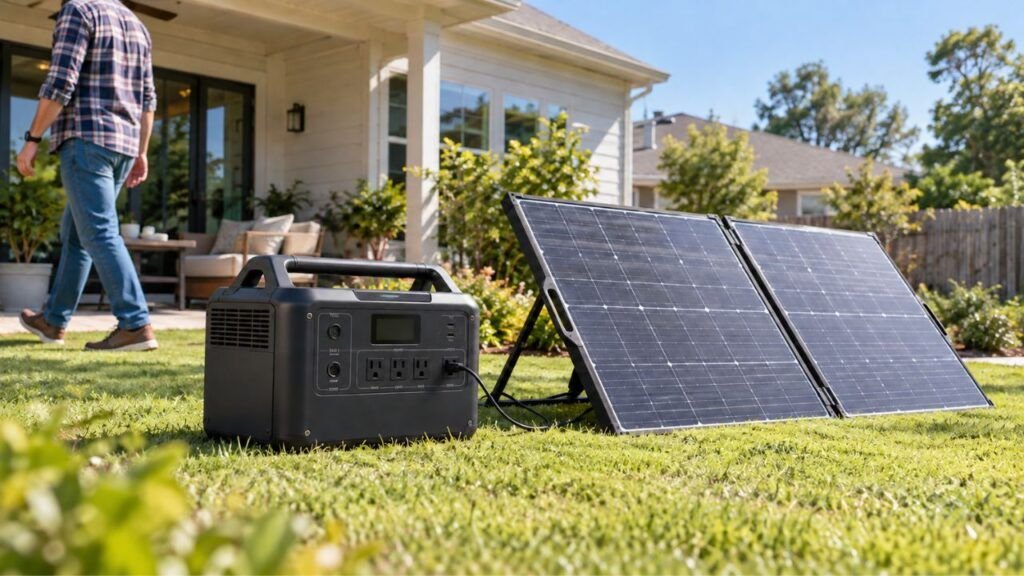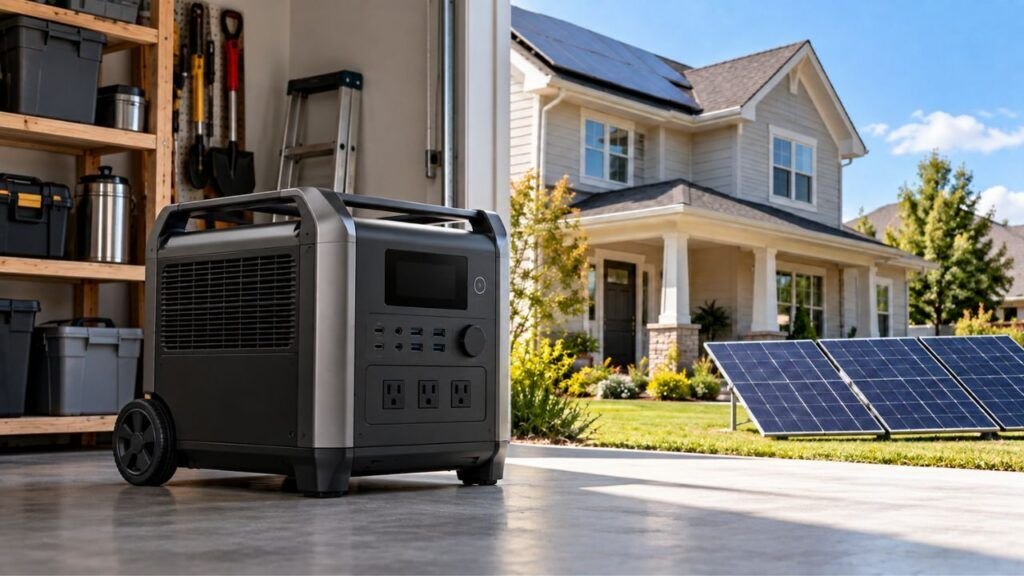
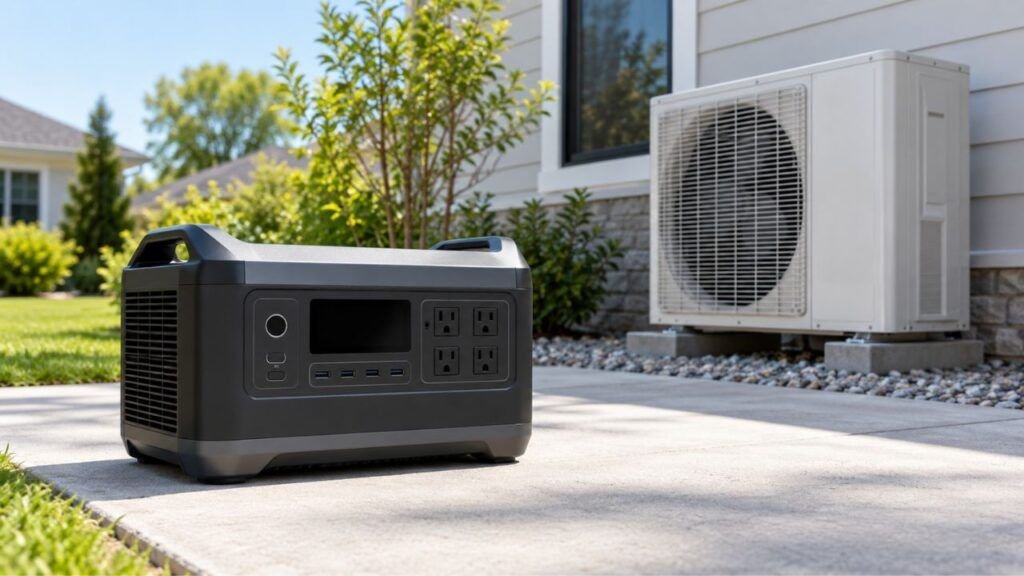
Yes, a solar generator can run a heat pump. However, it needs enough inverter output, battery capacity, correct voltage, and startup power for the compressor.
In this guide, I’ll explain heat pump wattage, generator sizing, battery runtime, 240V requirements, winter performance, and how to build a practical backup setup.
Key Takeaways
- Many heat pumps can operate from a properly sized solar generator.
- Small inverter mini-splits are generally easier to power.
- Most central heat pumps require 208V to 240V power.
- Compressor startup demand can exceed normal running wattage.
- Battery capacity determines how long the heat pump can operate.
- Auxiliary heat strips can dramatically increase electricity consumption.
- A soft starter may reduce startup demand on compatible systems.
- Solar panel output determines how quickly batteries can recharge.
- Hardwired heat pumps need a proper home backup connection.
- Always check your actual HVAC specifications before buying equipment.
Can a Solar Generator Really Run a Heat Pump?
A solar generator can run many heat pumps during an outage. The challenge is matching the generator to the HVAC system.
A small ductless mini-split might use relatively modest power. A large central heat pump can require several thousand watts.
The difference matters because solar generators vary enormously.
A portable 2 kWh power station and a 20 kWh home battery are both sometimes called solar generators. Their capabilities are completely different.
You therefore need to consider four main things.
First, the inverter must provide enough continuous power.
Second, it must handle the compressor’s startup demand.
Third, the generator must provide the correct voltage.
Finally, the battery needs enough stored energy for your desired runtime.
Meeting all four requirements gives you a much better chance of reliable operation.
How Much Electricity Does a Heat Pump Use?
Heat pump electricity consumption varies considerably between systems. Capacity, efficiency, compressor design, outdoor temperature, and operating mode all affect demand.
Running Wattage
Running wattage is the electricity your heat pump consumes while operating normally.
A smaller mini-split might consume several hundred watts under light conditions. Larger central systems can draw several thousand watts.
Power consumption also changes while the heat pump operates.
An inverter-driven system can reduce compressor speed once the room approaches its target temperature. That means it might draw much less power after startup.
Traditional single-stage systems usually operate differently. They tend to switch between full operation and completely off.
Because of these differences, tonnage alone cannot tell you exact wattage.
Check your equipment specifications whenever possible.
Starting or Surge Wattage
The compressor can briefly demand extra power when starting.
This startup demand is important when choosing a solar generator.
Imagine your heat pump normally consumes 3,000 watts. A 3,000-watt power station might appear large enough.
However, the compressor could demand considerably more power during startup. The generator may overload before normal operation begins.
This is why both continuous output and surge capability matter.
Modern variable-speed compressors can behave differently. Many ramp up gradually instead of producing the same startup spike associated with older compressors.
Do not automatically apply one startup multiplier to every heat pump.
120V vs. 240V Heat Pumps
Voltage is another specification people often overlook.
Some smaller mini-split systems operate from a standard 120V circuit.
Many larger mini-splits and central heat pumps require approximately 208V to 240V.
That means a powerful 120V solar generator still may not work.
For example, imagine you own a 3,600-watt power station. That wattage might appear sufficient for your HVAC load.
But if the unit only produces 120V and your heat pump requires 240V, they are not directly compatible.
Always check voltage before comparing wattage.
Auxiliary and Emergency Heat
Auxiliary electric heat can completely change your backup requirements.
Heat pumps normally move heat instead of producing it through resistance. That is one reason they can be highly efficient.
However, many central systems include electric resistance heating strips.
Those heating elements may activate during very cold conditions, defrost cycles, or when the thermostat demands rapid heating.
A heat-strip package can consume several kilowatts by itself.
Your compressor might therefore operate successfully from your battery system while the auxiliary heat causes an overload.
If your heat pump includes electric backup heat, check its rating separately.
Typical Heat Pump Backup Requirements
The table below provides general planning guidance. Actual requirements depend on the specific model installed in your home.
| Heat Pump Type | Common Electrical Setup | Backup Difficulty | Main Concern |
| Small inverter mini-split | 120V or 240V | Lower | Runtime and inverter output |
| Larger mini-split | Usually 240V | Moderate | Voltage and maximum draw |
| Central air-source heat pump | Usually 240V | High | Compressor startup and storage |
| Variable-speed central system | Usually 240V | Moderate to high | Maximum power and runtime |
| System with electric heat strips | Usually 240V | Very high | Resistance heating load |
| Geothermal heat pump | Usually hardwired | High | Compressor, pumps, and blower |
Treat this table as a starting point.
Your equipment nameplate and manufacturer specifications should guide final sizing.
What Size Solar Generator Do I Need for a Heat Pump?
Choosing the correct size becomes easier when you separate voltage, inverter output, surge capacity, and battery storage.
Step 1: Check Your Heat Pump Voltage
Start by finding the electrical voltage requirement.
Look at the outdoor unit nameplate or equipment manual.
You may see specifications such as:
- 120V
- 208V
- 230V
- 240V
Your solar generator needs compatible AC output.
If your heat pump requires 240V, choose a system designed to supply 240V loads.
Do not assume high wattage automatically means 240V capability.
Step 2: Find the Actual Electrical Requirements
Next, look at your heat pump’s electrical information.
Useful specifications include:
- Rated voltage
- Rated current
- Compressor current
- Minimum circuit ampacity
- Maximum input power
- Startup or locked-rotor information
- Indoor air-handler requirements
- Electric heat-strip rating
The manufacturer’s manual is usually better than generic online estimates.
If the startup requirement remains unclear, an HVAC technician or electrician can measure it.
Step 3: Match the Continuous Inverter Output
Your solar generator must support the heat pump during normal operation.
A simple planning rule is:
Required continuous output = heat pump load + other simultaneous loads
Suppose your heat pump consumes around 2,500 watts.
You may also want to run:
- A refrigerator
- Wi-Fi equipment
- Several lights
- A freezer
- Phone chargers
Those additional devices increase your total load.
Avoid sizing the inverter only around the HVAC equipment.
Leaving additional headroom generally makes the system more practical.
Step 4: Check Compressor Startup Capability
Now check whether the inverter can start the compressor.
Some power stations advertise impressive peak-watt ratings. However, peak output can sometimes last only briefly.
You need enough real surge capability for your heat pump.
This is especially important with traditional fixed-speed compressors.
A compatible soft starter can sometimes reduce startup demand.
However, not every heat pump needs or supports one.
Step 5: Calculate Battery Capacity
Inverter output tells you whether the system can run.
Battery capacity tells you how long it can run.
A basic estimate looks like this:
Battery watt-hours ÷ average load watts = approximate runtime
Real runtime will normally be somewhat lower because of system losses.
Suppose you have 5,000Wh of usable battery capacity.
If the heat pump averages 1,500 watts continuously:
5,000 ÷ 1,500 = about 3.3 hours
Actual runtime could be shorter because of inverter losses.
It could also be longer if the heat pump cycles off regularly.
Step 6: Add Other Essential Loads
Your heat pump probably will not be your only outage load.
Consider everything you want powered simultaneously.
Common essentials include:
- Refrigerator
- Freezer
- Sump pump
- Well pump
- Internet equipment
- Lights
- Medical equipment
- Phone chargers
- Small kitchen appliances
Add these loads before choosing your final battery system.
Estimated Solar Generator Size by Heat Pump Type
The following categories provide a general starting point. Do not use them instead of checking your actual equipment.
| Application | Practical Solar Generator Category | What You Should Verify |
| Small 120V inverter mini-split | High-output portable system | Maximum watts and battery capacity |
| 240V mini-split | 120/240V-capable system | Voltage and maximum electrical input |
| 2 to 3-ton central heat pump | Large expandable backup system | Startup current and 240V output |
| 4 to 5-ton central system | Whole-home-class system | High inverter output and battery capacity |
| Heat pump with electric strips | Very large system may be needed | Heat-strip kilowatt rating |
| Heat pump plus home circuits | Expandable whole-home backup | Combined simultaneous load |
One important point is worth repeating.
Heat pump tonnage describes heating and cooling capacity. It does not directly tell you electrical consumption.
Two 3-ton heat pumps can have very different electrical requirements.
Always use the actual equipment specifications when making a purchase.
How Long Will a Solar Generator Run a Heat Pump?
Runtime depends mainly on battery capacity and average heat pump consumption. Temperature and thermostat behavior also make a significant difference.
Simple Heat Pump Runtime Formula
You can make a rough estimate using:
Usable battery Wh ÷ average load watts = runtime hours
Suppose your battery offers approximately 8,000Wh of usable energy.
Your heat pump averages 2,000 watts while running.
8,000 ÷ 2,000 = about 4 hours
This calculation assumes continuous operation.
Real heat pumps usually cycle or adjust compressor speed.
Why Actual Runtime Is Hard to Predict
Several conditions can change energy consumption.
These include:
- Outdoor temperature
- Thermostat setting
- Home insulation
- House size
- Compressor speed
- Defrost operation
- Auxiliary heating
- Indoor temperature
- Air leakage
- Other electrical loads
A well-insulated house may require shorter heating cycles.
A poorly insulated house may keep the compressor running much longer.
That is why two homeowners can get very different runtimes from identical batteries.
Example Runtime Calculation
Imagine your heat pump averages 1,500 watts.
You have a 10 kWh battery system.
After accounting for usable capacity and normal conversion losses, suppose approximately 9,000Wh remains available.
9,000 ÷ 1,500 = approximately 6 hours
If the compressor operates only half the time, runtime could increase substantially.
However, very cold weather could produce the opposite result.
Treat this number as a planning example rather than a guarantee.
Why Running a Heat Pump in Winter Is Harder
Heat pumps can be particularly demanding during severe winter outages. Heating demand rises while available solar energy may become less predictable.
Heating Demand Increases During Cold Weather
Your home loses heat faster as outdoor temperatures fall.
The heat pump therefore needs to work longer.
Modern cold-climate heat pumps can continue operating at very low temperatures. However, energy consumption still changes with conditions.
Longer compressor operation means faster battery depletion.
Auxiliary Heat Can Become the Biggest Load
Electric backup heat can consume enormous amounts of stored energy.
Suppose the compressor needs 2,500 watts.
If a 5,000-watt resistance heater activates simultaneously, the total HVAC load can increase dramatically.
Your system could suddenly require 7,500 watts or more.
That changes both inverter and battery requirements.
If backup heat is installed, include it in your planning.
Defrost Cycles Affect Energy Consumption
Outdoor heat pump coils can develop frost during winter.
The system periodically enters defrost mode to clear the coil.
Energy consumption may temporarily change during this process.
Some systems also use auxiliary heat to maintain indoor comfort during defrost.
Those temporary loads should not be ignored.
Winter Solar Production Can Be Lower
Winter creates another challenge.
Days are shorter in many parts of the United States.
Cloud cover, snow, panel angle, shading, and regional weather also influence production.
A battery that lasts overnight still needs recharging tomorrow.
If your solar array cannot replace the energy consumed daily, the battery eventually becomes depleted.
This becomes especially important during multi-day outages.
Check Battery Temperature Specifications
Cold weather also affects battery operation.
Different solar generators have different charging and discharging temperature limits.
Do not assume every battery has the same cutoff point.
Check the manufacturer’s specifications before storing or operating your unit in freezing conditions.
Indoor installation can help protect many battery systems.
However, follow the manufacturer’s placement and ventilation requirements.
Can a Soft Starter Help a Solar Generator Run a Heat Pump?
A soft starter can sometimes make compressor startup easier for backup systems.
Traditional compressors can pull significant current during startup.
A compatible soft starter reduces that initial electrical demand.
This can help prevent an inverter from overloading when the compressor starts.
However, not every heat pump needs one.
Modern inverter-driven and variable-speed systems already control compressor speed electronically.
Adding a soft starter to those systems may be unnecessary or incompatible.
Check with the HVAC manufacturer before installing one.
If you are unsure, ask a qualified HVAC technician.
Mini-Split vs. Central Heat Pump on Solar Generator Power
Not every heat pump creates the same backup challenge. Mini-splits and central systems can differ considerably in voltage, output, and startup behavior.
Ductless Mini-Split
Mini-splits are often easier to run from battery backup.
Many use variable-speed inverter compressors.
Instead of constantly starting at maximum power, they can adjust output based on demand.
Smaller models can also consume much less electricity than large central systems.
This makes a mini-split especially useful for outage heating.
Rather than conditioning your entire house, you can heat one important room.
That strategy can significantly extend battery runtime.
Central Heat Pump
Central heat pumps usually create a larger electrical load.
Most residential central systems use approximately 240V power.
The outdoor compressor is only part of the system.
The indoor air handler and blower also require electricity.
Some installations include large electric heat strips.
This means the complete HVAC system needs to be considered.
Variable-Speed Heat Pump
Variable-speed heat pumps deserve separate consideration.
They can adjust compressor speed gradually.
This can reduce the severe startup characteristics found with some older systems.
However, you still need enough inverter capacity for maximum expected electrical demand.
Do not assume variable-speed automatically means low power consumption.
Check the manufacturer’s maximum input specifications.
Can You Plug a Heat Pump Directly Into a Solar Generator?
Small plug-connected equipment may sometimes connect directly. Central heat pumps generally require a properly designed electrical connection.
Plug-Connected Equipment
Certain small heating and cooling systems use regular electrical plugs.
If the voltage, amperage, outlet configuration, and generator capacity match, direct operation may be possible.
Always follow the equipment manufacturer’s instructions.
Avoid makeshift adapters or undersized extension cords.
Hardwired Central Heat Pumps
Most central heat pumps are permanently wired into the home’s electrical system.
You cannot simply unplug them and connect them to a portable power station.
Whole-home battery systems may connect through:
- Transfer switches
- Backup load panels
- Smart electrical panels
- Manufacturer-designed backup interfaces
The exact method depends on your home and equipment.
Have a qualified electrician handle permanent electrical integration.
Never Backfeed Your House
Never connect backup power to household wiring using unsafe methods.
Backfeeding can energize circuits unexpectedly.
That creates serious risks for your equipment, utility workers, and anyone near the electrical system.
Use approved transfer equipment or manufacturer-supported home backup hardware.
Electrical safety matters more than squeezing extra convenience from your generator.
What to Look for in a Solar Generator for a Heat Pump
A heat pump puts more demands on a backup system than phones or lights.
Look for these features when comparing equipment:
- Correct 120V or 240V output
- High continuous inverter wattage
- Strong motor-starting capability
- Pure sine wave AC output
- Large battery capacity
- Expandable battery support
- High solar charging input
- Appropriate cold-weather specifications
- Transfer switch or home-panel compatibility
- Useful power monitoring
- Reliable battery management
- Clear warranty coverage
- Manufacturer support for home backup applications
Avoid choosing a system from one impressive number.
Voltage, watts, surge power, and storage all matter together.
How Much Solar Do You Need to Keep the Heat Pump Running?
Solar panels can extend outage runtime significantly. However, your array needs to replace a meaningful amount of the energy your heat pump consumes.
Calculate Daily Heat Pump Energy
Start with this simple formula:
Average watts × operating hours = daily watt-hours
For example, suppose your heat pump averages 1,500 watts.
If it effectively operates six hours daily:
1,500 × 6 = 9,000Wh
That equals approximately 9 kWh per day.
Your backup system would need to replace roughly that amount of energy daily to remain sustainable.
Calculate Required Solar Recovery
Solar output changes throughout the day.
A panel does not produce its rated wattage continuously.
Actual production depends on:
- Peak sun hours
- Panel orientation
- Shade
- Clouds
- Snow
- Temperature
- Charging efficiency
- Maximum solar input
A larger array can replace battery energy faster.
However, the power station also needs enough solar input capacity.
Connecting more panels than the system can accept may not improve charging speed.
Battery Capacity and Solar Array Size Solve Different Problems
This distinction makes sizing much easier.
Battery capacity tells you how much energy you can store.
Solar capacity tells you how quickly that energy returns.
Inverter capacity tells you how much power you can deliver.
You need all three specifications to work together.
A huge battery with tiny solar input may take too long to recharge.
A huge solar array paired with a small battery may waste available production.
Balance matters more than simply buying the largest component.
Three Realistic Heat Pump Backup Scenarios
Looking at real-world situations can make the sizing process much easier.
Small Inverter Mini-Split During a Short Outage
Suppose you use a small inverter mini-split in one bedroom.
The unit consumes relatively modest power once the room reaches temperature.
A high-capacity portable power station may keep it operating for several hours.
This is one of the most realistic solar generator applications.
You can also close unused rooms and concentrate heating where needed.
That reduces energy consumption considerably.
3-Ton Central Heat Pump During a Summer Outage
Now imagine a central heat pump serving an entire house.
The system operates on 240V and requires several thousand watts.
You also want refrigeration, lighting, and internet service.
A small portable power station probably will not be enough.
You may need a larger expandable system with:
- 240V output
- Strong compressor-starting capability
- Several kilowatt-hours of battery storage
- High solar recharge capacity
- Proper home electrical integration
The exact system size depends on the actual HVAC specifications.
Central Heat Pump During a Freezing Winter Outage
This scenario is much harder.
The compressor may operate for long periods.
Defrost cycles can occur.
Electric auxiliary heat may activate.
Solar production can also be less reliable during winter storms.
A battery system that performs well during mild weather can drain surprisingly fast.
For serious winter backup, plan around worst-case electrical demand rather than normal spring conditions.
Common Mistakes When Sizing Solar Backup for a Heat Pump
Heat pump backup becomes much easier when you avoid these common mistakes:
- Choosing a solar generator from heat pump tonnage alone
- Looking only at normal running wattage
- Ignoring compressor startup demand
- Confusing watts with watt-hours
- Forgetting the 240V requirement
- Applying the same surge multiplier to every compressor
- Forgetting the indoor air-handler load
- Ignoring electric auxiliary heat strips
- Forgetting refrigerators and other essential loads
- Assuming peak inverter output lasts indefinitely
- Assuming solar panels produce rated power all day
- Expecting perfect winter solar conditions
- Using unsafe household backfeeding methods
- Buying before checking the HVAC specifications
A little planning before purchasing can save you considerable money.
When a Solar Generator May Not Be Practical
Solar backup works well for many heat pumps. However, it is not always the easiest solution.
A very large central system may require substantial inverter output.
Electric resistance backup heat can make the problem even harder.
Long winter outages also require significant battery storage and solar recovery.
You may need a large whole-home battery system rather than one portable power station.
Some homeowners also choose to back up only part of their HVAC system.
For example, powering one efficient mini-split during an outage may be easier than heating the entire house.
That approach can dramatically reduce battery requirements.
Think about the comfort you actually need during an emergency.
You may not need normal whole-house operation.
Final Words
So, can a solar generator run a heat pump? Yes, when the generator matches the heat pump’s actual electrical requirements.
Start by checking voltage, normal power consumption, startup demand, and auxiliary heat.
Then choose enough battery capacity for your desired runtime.
Finally, make sure your solar array can replace meaningful daily energy.
Small inverter mini-splits are usually the easiest option.
Large central systems often need expandable 240V whole-home backup equipment.
Most importantly, do not choose a solar generator using tonnage alone.
Check your actual heat pump specifications before spending your money.
That small step can prevent most sizing mistakes.
Related FAQs
Can a 2,000-Watt Solar Generator Run a Heat Pump?
A 2,000-watt solar generator may run a small efficient mini-split, but many central heat pumps require more continuous and startup power. Check the heat pump’s voltage and maximum electrical demand first.
Can a 3,000-Watt Solar Generator Run a Heat Pump?
A 3,000-watt model may run certain smaller heat pumps when voltage and startup requirements match. Larger central systems can exceed that output, especially when compressors or auxiliary heating activate.
Can a 5,000-Watt Solar Generator Run a Heat Pump?
A 5,000-watt solar generator can support more heat pumps, including some central systems. However, you still need compatible 240V output, sufficient surge capability, and enough battery capacity.
What Size Solar Generator Do I Need for a 3-Ton Heat Pump?
There is no universal solar generator size for every 3-ton heat pump. Check voltage, running current, compressor startup demand, air-handler power, and auxiliary heat before sizing the system.
Can a Solar Generator Run a 240V Heat Pump?
Yes, but the solar generator must provide proper 240V output. A 120V-only power station cannot directly operate most 240V central heat pumps regardless of its advertised wattage.
Can a Solar Generator Run a Mini-Split Heat Pump?
Yes. Mini-splits are often among the easiest heat pumps to run from solar backup, especially smaller inverter-driven models that adjust compressor speed according to heating or cooling demand.
Can a Solar Generator Run a Heat Pump Overnight?
Yes, if the battery stores enough usable energy for the overnight load. Runtime depends on outdoor temperature, thermostat settings, insulation, compressor cycling, auxiliary heat, and other connected devices.
Can Solar Panels Run a Heat Pump Without a Battery?
Technically, specialized solar systems can operate loads directly under certain conditions. However, most backup setups use batteries because solar output constantly changes with clouds, shading, and available sunlight.
Does a Heat Pump Need a Soft Starter When Running on Backup Power?
Not always. A soft starter may help older fixed-speed compressors reduce startup demand. Modern inverter-driven heat pumps often already control compressor startup electronically, so compatibility should be checked first.
Can a Heat Pump Run During a Winter Power Outage?
Yes, a properly sized battery system can run a heat pump during winter. However, colder temperatures increase heating demand and may activate auxiliary heat, causing the battery to discharge much faster.
Will Emergency Heat Work on a Solar Generator?
It can, but emergency resistance heat often requires several thousand watts. Running it may demand a much larger inverter and battery system than operating the heat pump compressor alone.
How Many Batteries Do I Need to Run a Heat Pump?
The answer depends on your heat pump’s average wattage and desired runtime. Calculate the expected daily energy consumption in kWh, then choose enough usable battery capacity to cover that requirement.

Blake Cooper writes practical guides on generators, portable power stations, and home backup systems. He focuses on simplifying power topics and helping homeowners make informed buying decisions.